
Science and Morality
I have frequently said that science can only provide data to inform our decisions but can’t tell us what we “should” do; that it can determine facts but not values. I stand corrected. A persuasive new book by Sam Harris, The Moral Landscape, has convinced me that science can and should determine what is moral. In fact, it is a more reliable guide than any other option.
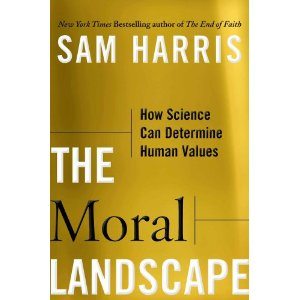
Several recent books have looked at morality from a scientific viewpoint. Animals have been shown to exercise altruism and to appreciate fairness. Human cooperation has been shown to offer a survival advantage to individuals and groups. Game theory has demonstrated the success of the tit-for-tat strategy. In The Science of Good and Evil, Michael Shermer argues that evolution has produced in us a moral sense that is not a reflection of some “absolute” morality but that constitutes a worthy human project that transcends individuals. He posits a pyramid of morality that becomes more advanced as it is applied to larger in-groups, from self to family to community to all living creatures. He amends the Golden Rule to specify that we should treat others not as we want to be treated but as others want to be treated.
Harris goes much further. With a background in both philosophy and neuroscience, he is qualified to do so. He points out that questions about values — about meaning, morality, and life’s larger purpose — are really questions about the well-being of conscious creatures. He says we know enough about the human brain and its relationship to events in the world to say that there are right and wrong answers to the most pressing questions of human life. He shows that it’s as senseless to claim morality is relative as to claim it is absolute. Morality cannot be understood as some Platonic ideal; it cannot be understood as whatever the preferred deity of one’s society has commanded; it cannot be dismissed as meaningless and varying with culture. Cultural relativism is stupid: we should never accept slavery or female genital mutilation as moral even in the societies that practice them believing they are moral. It is immoral and irrational to accept such practices out of political correctness and unwillingness to offend.
Harris has honed in on what we all believe, no matter what we might say we believe. He defines an action as moral if it increases the well-being of humans and other conscious beings, and immoral if it decreases well-being. We all accept that a good life is preferable to a life of suffering and that things like kindness to children are desirable. We all accept the Golden Rule: it’s not that we accept it because religion so dictates, it’s that religions have adopted it because we all know that it is valid.
Religion has long claimed that morality is its province, but this is clearly untenable. Different religions have different standards, religious commandments have encouraged immoral behaviors, non-religious societies are as moral as religious ones. Guidelines are inconsistent: the Catholic church excommunicates women who try to become priests, but fails to excommunicate priests who rape little boys. Religious morality also values human well-being, but with a difference. Most religions give priority to well-being in some imagined life after death. This often leads to unnecessary suffering in this, the only life we can be sure of.
Just as people are often wrong about science (i.e. rejecting evolution) people are often wrong about what is moral, but Harris sees signs of progress. Slavery is now universally condemned. Racism has diminished. But some societies mistreat women and deny them education, and our fear of offending the beliefs of others has prevented us from improving the lot of humanity by fighting certain clearly immoral practices. If morality can be established as a science, it will facilitate rational progress.
Science can have a great deal to say about morals. It can examine whether making women wear a burqa improves the well-being of a society. It can test whether corporal punishment has the beneficial results envisioned by those who prefer not to “spare the rod.” It can test whether abstinence-only education achieves its stated goal of reducing pre-marital sex. It can try to measure well-being. Well-being will be difficult to quantify, but not impossible. The environment and the individual’s response to it can be objectively studied. The important thing is to be willing to look at these issues and to try to evaluate moral questions through rational inquiry. It is no longer acceptable to claim that slavery would become moral if a society chose to practice it or to claim that homosexuality is an absolute evil.
It would be easy to reject Harris’ ideas as simplistic and impractical or to mistake hedonistic “happiness” for true well-being. If you think he is wrong, I would urge you to read the book to appreciate the subtleties and nuances of what he is actually saying.
Harris sees the moral landscape as one with valleys of suffering and peaks of well-being. He accepts that there can be different peaks with similar magnitudes, so there need not be one single prescription for all societies.
He sets us three ambitious projects:
- To explain why people tend to follow certain patterns of thought and behavior (many of them demonstrably silly and harmful) in the name of “morality.”
- To think more clearly about the nature of moral truth and determine which patterns of thought and behavior we should follow in the name of “morality.”
- To convince people who are committed to silly and harmful patterns of thought and behavior in the name of “morality” to break these commitments and to live better lives.
These may be phenomenally difficult, especially the third, but they are indisputably worthy goals to aim for. There must be something to know about meaning, morality and values in principle, if not always in practice. And Harris believes that merely admitting this will transform the way we think about happiness and the public good.
This is one of those books that can stretch the reader’s mind to new dimensions. Even the eminent Richard Dawkins was altered by reading it. He says,
I was one of those who had unthinkingly bought into the hectoring myth that science can say nothing about morals. The Moral Landscape has changed all that for me. Moral philosophers, too, will find their world exhilaratingly turned upside down, as they discover a need to learn some neuroscience. As for religion, and the preposterous idea that we need God to be good, nobody wields a sharper bayonet than Sam Harris.
Posted in: Book & movie reviews, General
Leave a Comment (241) ↓
Dr Benway – I’m not sure I understand what you mean when you say “values are motives” – can you explain a bit more in depth please?
And the very obvious and much discussed issue (but apparently more or less ignored in this discussion) that arises is “whose well being”? Are we talking about our collective well being as a species over the longterm or short term? Or are we talking about individual well being? How do we balance out individual vs collective needs? Considering that research seems to be showing that growing up in different cultures – communal vs individualist – influences neurobiology and literally influences how we see the world (specifically people), making assumptions about what is innately “moral” and what is “immoral” may be a lot less universal than people like to believe based upon their own subjective experience of “feeling” moral (isn’t that what a “moral sense” really is, a feeling of being virtuous/accepted/rewarded when we behave a certain way and feeling of being bad/rejected/punished when we behave another way…which comes from how our parents treated us more than any innate internal “sense of morality”).
I would note that I see a lot of philosophical arguments (rational inquiry) regarding the strength or weakness of Harris’ premise.
I don’t think I’ve seen any evidence or data showing the strength or weakness of Harris’ premise (unless I missed it in moderation delays).
Perhaps it’s all in his book.
But I’m still humming that Alanis Morissette tune*.
Fifi,
I’d say there’s a moral sense but that it becomes more and more unreliable the more complex our communities become. If it were reliable we wouldn’t need behaviour to be codified and taught.
We have a moral sense that someone who walks over to us and grabs our stuff is being an @$$hole. We judge both them and their act, and we might yell at them much more than is actually justified by the value of the grape (or whatever). Babies and animals can be demonstrated to behave this way.
We have a moral sense that someone who cheats on us behind our backs is being despicable. We might even feel that they deserve to be publicly killed to be made an example of.
Some of us have a moral sense that respecting authority and cooperating with a leader is a good and community-minded thing to do.
What might need to be taught is the bit about not taking other people’s stuff, or not cheating on someone else behind their back. (People who feel good about cooperating with a leader/ respect for authority might learn these things more easily than people who do not.)
Also, existing “moral” feelings of righteousness, disgust and outrage can be amplified, overcome or redirected through social learning.
My pet (speculative, unsubstantiated) theory of outraged homophobia and the persistence of some people in calling it “moral” is that it’s rooted in a moral requirement to protect one’s honour/ fearsome reputation. If I happen to be both a heterosexual man and a sexist pig, I know how I think about women. If I then meet a gay man I assume he is thinking about me the same way. This is morally outrageous to me and my honour/ fearsome reputation and I beat the $hit out of him the way I would if he took my stuff or flirted with my woman.
So yeah, I’m pretty sure there is evidence for an inborn moral sense. I just wouldn’t want to found a complex society on it.
michele – Can you define what a “moral sense” is though? Do you mean a feeling that something is right or wrong? I’m not sure believing someone is an asshole because they do something we don’t like is actually “moral” – or the fact that we judge someone makes us “moral”.
Are you trying to equate “moral” with a sense of fairness? And are you referring to the grape and cucumber experiments done with monkeys around fairness? While, from my subjective perspective, I’d agree that ideas of “fairness” can play into what we believe to be moral or immoral but that’s undoubtedly at least partly due to my own biases because I’m very much wired for fairness (to a much greater degree than some other people apparently, for both better and worse in our culture). Not everyone is to the same degree, and obviously what seems “fair” can be very subjective (and is dependent upon what value each individual puts on something, which can very much be a result of cultural learning). For instance, if we go by “fairness” then America is a highly immoral country because of the great imbalance of wealth (just as Saudi Arabia is too on this basis) – some people have all the grapes and won’t share.
Some cultures emphasize sharing and communal ownership, our beliefs and values associated with ownership are very much a part of our cultural values and not universal values. We really don’t know how much of this is nature and how much is nurture at this point. (As an aside, most European colonialist cultures, have some ideas about ownership that involve owning other human being, both as slaves and wives/children that are still a part of our culture, despite the very non-science based battles for both equality of women and non-whites. Slavery is still very common and obviously not everyone agrees it’s wrong – sex slavery isn’t morally condoned anywhere but it still exists all over the world, including in the US (as does agricultural slavery). In fact, if we include wage slavery into the mix then the world is still full of slavery and we condone it – all of us because we consume the fruits of slave labour. See, my sense of fairness leads me to believe that it’s unethical to do that to others but clearly many people don’t agree. Fairness is a very subjective measure.
As for homophobia, studies seem to indicate that it’s most prevalent/virulent amongst those who are repressing their own homosexual urges.
We often forget that it’s not just women who have to conform to rigid rules of behavior in rigid societies, men also have to conform to being an idealized version of a male. Hierarchal systems are about where you are on the power structure – it’s why Pakistan has had a female PM even though it’s also a home to Islamic fundamentalism. Even in countries (or times in our own history) rife with sexism or gender inequality a rich woman has more power than a poor man. (Even if she is treated as an object and possession in the eyes of the law, something that’s not very far back in our own legal and social history.)
“So yeah, I’m pretty sure there is evidence for an inborn moral sense. I just wouldn’t want to found a complex society on it.”
I have read about human/primate tendencies to prefer “fairness” and dislike “freeloaders”. I believe that Pinker covers this in “The Blank Slate”. Chimpanzees and some monkey have been shown to have a sense of fairness based on the quality of a relationship. http://www.sciencedaily.com/releases/2005/02/050212191635.htm
If one considers fairness a moral sense, I believe that we can show scientifically that humans (as well as animals) typically have what we might label an instinctive* moral sense. How extensive it is, I don’t think is known.
I won’t comment on whether that inborn sense is overall better or worse than science.
I wonder what Sam Harris would say if science showed that a belief in a factitious supernatural being was better for human’s over all well being?
http://www.npr.org/templates/story/story.php?storyId=129528196
“Is believing in God Advantageous?”
micheleinmichigan asks “I wonder what Sam Harris would say if science showed that a belief in a factitious supernatural being was better for human’s over all well being?”
I think he would accept it, but would go on to ask if such a belief was better for the well being of every individual. There is a big difference between “the opium of the people” and the individual intellectual’s search for the truth. Anyway, you can’t believe on purpose or make someone believe.
Fifi, that was me, not micheleinmichigan.
All I’m trying to do really is define the word. “Morality” is an emotionally-charged word, so if you’re talking about morality you are talking about emotions. I have selected the emotions of righteousness, disgust and outrage to correspond to “morality.” My proposal is that we have inborn feelings about what what we are entitled to and also that these feelings are pretty crude. The society we are born into will dress them up for us, put names on them, refine them, redirect them, amplify them and attenuate them. Our society will also teach us how to behave so that we don’t get in the way of someone else’s moral outrage. But I would say we do come into the world with something; we aren’t complete tablulae rasae (rasa?).
Ethics is a more thoughtful system of what you think about how you yourself should behave. There aren’t a lot of people who sit down and decide that the most ethical thing they could do for their wife is to kick her to death for talking to the guy next door. But there are a whole bunch of people who feel morally entitled to do so… though most of them don’t, because they have thought it through and know that it’s a really dumb idea.
Affiliation is sometimes grouped in with morality. The happy glow that a lot of people get from holding a baby is held to be morally good. Friendliness may be felt to be morally good. I wouldn’t object to that really, but I see that as more the naturalistic fallacy (it feels good therefore it is inherently good) and “morality” as being more tied to feelings of “ought” as in “you ought to behave this way towards me and I ought to be able to punish you if you don’t.”
Just to place this in context, Fifi, I don’t have much use for what I have defined as “morality” here.
Equivocation.
Let me reword the sentence so that we can avoid that.
Can the moral skeptic ask why the brain states that relate to prosperity, happiness, welfare, contentment, etc. should be thought of as worthwhile or desirable?
“I think he would accept it, but would go on to ask if such a belief was better for the well being of every individual. ”
Firstly, Is there a way for a moral to be better for the well being of every individual.
Regardless, he would come up against the very first comment posted here by Mark P having to do with the question of how one values the rights and responsibilities of the group vs the individual.
Also, my premise was that science proved that religion was better for the over all well being of human’s. You said “He defines an action as moral if it increases the well-being of humans and other conscious beings”
So now Harris is more interested in the well being of the individual? It sounds like you are suggesting that if Harris didn’t like the answer he would change the question.
Gee, I’ve never seen that happen before in science.
The point of whether you can convince yourself to believe in God or not is irrelevant. Morals often have little to do with what you can do they have to do with what you should do.
Dr Hall – Interesting that you find it “self evident” but offer no actual evidence.
And incredibly interesting that you’re making claims about “inborn moral sense” that’s definitely due to nature not nurture. No competent neuroscientist would divide nature from nurture in the way you have here and all you’re revealing is your lack of understanding of the science around the effect of culture on neurobiology. Mentioning one study you’ve cherry picked means nothing, there are just as many (if not more) studies that can be held up that contradict your claims. You’re claiming a remarkable amount of certainty about things that scientists who are experts in these fields don’t claim themselves – the very fact that you won’t even question or apply doubt to your beliefs tend to indicate they’re ideological and not based in science. Which, of course, goes to show that many people who consider themselves “science first” are much less so when it comes to their own deeply held beliefs.
FiFi – since my post on morality appeared after yours, I’ll assume you were referring to Alison’s.
But in case of some weird tech glitch. I’ll answer. I usually define moral as the distinction between right and wrong. To me this encompasses those senses we seem to be born with such as fairness (to an some extent) as well as those that we are taught and have….(damn, what is that word)? made a part of ourselves so that it feels “natural”.
To me this is distinct from ethics, that have been constructed through logic and reasoned discussion and may not “feel natural.”
As with other words, my definitions may be strange.
*can I just say how much peri-menopause or thyroid disease or just my brain function completely sucks sometimes.
Dr Hall – Even the fact that some of your fellow SBM bloggers and scientists who work in the relevant domains that study these issues question Harris’ belief that setting up science as a moral authority doesn’t give you pause. Or the fact that he bases his ideas on incorrect science doesn’t give you pause. The fact that you don’t pause at all in the face of scientists or science is what makes it appear that your beliefs are ideological even though you’re proposing that they’re scientific. C’mon, you’re now not only uncritically promoting a book on SBM that misrepresents science for ideological reasons but refusing to acknowledge or investigate that there may be a misuse of science for ideological reasons on the book. And this is exactly why scientists – who would be the ones interpreting the scientific data – are dangerous when they believe their ideological beliefs are science and try to implement them as social policy.
Also, Dr Hall, you may want to deepen your understanding of neurobiology and humans if you think certain things are “self evident” – intuition and the “self evident” have been proven, by science, to be wrong quite often.
Alison – Sorry about the mis-attribution and thanks for the explanation. I think we tend to agree with each other here (particularly about how the term “moral” is loaded and differs from “ethical”). Which, of course, not only means we’re right but also righteous and waaaaay more moral than anyone else here, particularly those evil people who disagree with us. We must kill them because we are righteous and they are not, etc
Fifi,
Of course we are morally entitled to do so, but lucky for them we are so ethical that we won’t!
Which reminds me of a nice irony. I once said something to my sister about our family’s values: “One of the ways we know we are better than other people is that we aren’t snobs.” Which elicited a sick giggle of recognition.
habituated – jeesh
I usually feel more virtuous when I feel morally inferior.
Alison – “One of the ways we know we are better than other people is that we aren’t snobs.” Which elicited a sick giggle of recognition.”
Of course! That’s hilarious.
Michele – You martyr!
I like to consider myself pretty ethical but amoral – my ethics have often meant that I’ve had to protest against morality-based laws or social policies that are highly unethical from my perspective. The reality of history is that it’s not science that was the first to question racial segregation, gender inequality or homophobia (it wasn’t religion either, even if civil rights protests were at least partially organized around church structures and black churches played an important role). The great ethical advances in the treatment of people in our own culture haven’t been driven directly by advances in scientific knowledge and often the science only really gets there once society has started to move in a certain direction.
Fifi,
Harris is not “setting up science as a moral authority.”
You have not shown that he “bases his ideas on incorrect science.”
You have not shown that the book “misrepresents science for ideological reasons.”
You have not convinced me that I am deficient in understanding neurobiology and humans.
You haven’t specified what “deeply held beliefs” you think I hold that are interfering with my judgment.
You criticize me for not providing evidence for something that is self-evident. What do you think self-evident means? Do you criticize Thomas Jefferson for “holding these truths to be self-evident” in the Declaration of Independence without providing evidence?
It seems Fifi is more interested in discrediting me than in trying to understand the subtleties of Harris’ arguments. For the nth time, I implore all our commenters to read the book before they attack what they imagine it must say.
bluskool:
I have no idea what a “moral skeptic” is.
Dr. Hall,
Imagine a book subtitled, “How to build a generator that will meet all our energy needs without consuming any fuel.” No reading of the book would be necessary to reject such a foolish claim.
Sam’s book is subtitled, “How science can determine human values.” Likewise, no reading of his book is required to reject such an idea.
That word “determine” is the problem. Had he said, “inform,” or “clarify,” no problemo.
Sam fell in love with “objective” morality as a short cut to world peace or something. But the concept is deeply problematic –maybe even oxymoronic. For what does “objective” mean if not, “Your opinion is unnecessary.”
Before inviting me over for dinner you should:
1. Consult the scientific literature.
2. Review a PET scan of my brain.
3. Ask me what I might enjoy eating.
Fifi, I met Dr. Hall at TAM. She’s soft spoken, friendly, reasonable, and not at all stuck up or annoying. If she found Harris convincing, I think it’s likely that Harris says much that is interesting and illuminating.
If I can’t convince Dr. Hall of my point, that the is/ought problem is significant and enduring and nothing to be dismissed short of a truly mind-blowing, Earth-rocking, Nobel prize winning argument, I take that to mean that I suck at expressing myself. Or that I’m wrong.
Dr. Benway,
One of the definitions of “determine” is “to find out or ascertain something, usually after investigation. In other words, what science does. If you had read the book, you might have understood that that is the sense in which Harris used the word.
Surely you don’t deny that science can find out what humans say they value and can study their behavior in relation to those values to find out whether they are actually achieving what they say they want to achieve. Harris is not looking for a shortcut to world peace nor does he underestimate the difficulties of investigating morality with science.
For the nth plus one time, I implore all our commenters to read the book before they attack what they imagine it must say.
Actually Dr Hall, I linked to the discussion on Edge ages ago (which Harris is part of) where people more knowledgeable and expert than either your or I challenge Harris on his science and discuss just this topic with him. You seem very unfamiliar with the discussions going on within science or any of the studies done regarding actual terrorism, despite being very sure Harris is basing his views on science not ideology.
The discussion…and a rather good analysis of why the whole “memes” hypothesis is probably incorrect (as an added bonus) even if we may intuitively feel it isn’t.
http://www.edge.org/discourse/bb.html#atran2
And some science and practical, rather than ideological, discussion of terrorism…
http://www.edge.org/archive.html#atran
I’m interested in understanding the subtleties of the whole argument, apparently Dr Hall you’re just interested in promoting Harris’ perspective (irrelevant of the science or discussion within the scientific community by experts much more knowledgeable than you or I) because it confirms your own. I’ll read the book at some point but this is hardly new conceptual territory for me and it’s hardly a new argument or discussion Harris is advancing – I don’t know when you started pondering or discussing these issues but they have been discussed in my family since the 70s (and within science in general for a pretty long time). As was overpopulation, climate change, the energy crisis and all the topics that ethical scientists and doctors were discussing at the time. We had a pretty good chance of actually enacting a more science-based culture but then came Reagan and Thatcher and the birth of the NeoCons (and then the NeoLiberals) and so started the attack on science and attempt to corrupt public science.
I have no need to convince you that you don’t understand neurobiology – I highly doubt you’re capable of changing your mind in this regard or otherwise because you seem to have an ideological attachment to certain beliefs and it’s also a matter of ego and your self image. Likewise, being human, I have the same tendencies towards confirmation bias I’m just not silly enough to think I don’t have them (you seem to believe you never do suffer from a confirmation bias). You seem more interested in feeling “right” than actually understanding the discourse going on around Harris’ claims. You make it quite obvious that you are impervious to both scientific fact and even considering alternate opinions when you hold an ideologically based belief you want to claim is science based. (And since you simply believe that others must object because it somehow offends their deeply held beliefs but that could never be the case with you, you’ve hardly been using science to support your assertions either. All in all, this was a puff piece affirming your previously held beliefs and in no way a critical or skeptical reading of the book.
As an interesting tidbit for other readers who may want to ponder whether supposedly secular US really are always more pro-science, Iran actually allows stem cell research while it was banned by the government in the US for religious/moral reasons.
http://www.washingtontimes.com/news/2009/apr/15/iran-at-forefront-of-stem-cell-research/
I don’t consider that in any way an argument for the current Iranian regime, it’s just a fact to ponder when thinking about science under Islamic rule and under the supposedly secular US government.
OK quick then I really gotta stop procrastinating mah jobs.
I was responding to this: “Is it really a “fact” that we have a “moral sense” though?”
I think we can determine what people value by looking at their actions.
The existence of values can be taken as evidence of a “moral sense,” particularly when there is great similarity for certain values across many people from a variety of backgrounds.
“this was a puff piece affirming your previously held beliefs”
Really? A piece that started out by retracting my previously stated beliefs and saying that “I stand corrected.” ??
Fifi, I would respect you much more if you stuck to critiquing the content of what I actually wrote instead of reinterpreting my words, bringing in new issues like terrorism, and personally disparaging me, telling me what I believe, how my mind works, how ignorant I am, and what is wrong with me. You may be right: I may be a biased idiot who is impervious to scientific facts and who doesn’t even know my own mind. If so, I can console myself that I’m in good company: Richard Dawkins also said Harris’ book persuaded him to change his mind. I’m sure you won’t hesitate to attack Dawkins too; but I have the greatest respect for his intellectual capacity and I’m proud to have come to the same conclusion he did.
I’m going to try to restrain myself and bow out of this discussion now. I’ve said what I had to say and I stand by it. At least it has served to get people thinking about an important issue.
“And one can easily argue that it’s actually a “moral sense” that leads highly educated, young (often Persian, not Arabic) men from wealthy nations such as Saudi Arabia or the UK to commit suicide bombings. A sense of both being virtuously heroic in the eyes of your peers and doing something for the greater good of your people is just as promoted by the US military as it is by Al Quaeda. Young people here are doing the same thing when they join the army (if it’s not out of necessity) or join a militant protest group. Revenge and fighting the enemy are often seen and felt to be very morally virtuous – though it’s generally important to view the other as being somehow less human or “moral” to justify doing to them something that would be unacceptable to do to their in-group. In wars, both sides consider themselves as being “moral” and the other side “immoral’. There are many people who would counter that perpetuating tribalism and xenophobia under the guise of promoting science is actually highly immoral because it’s harmful to the common good – not to mention harmful to the practice of honest science.”
Timothy McVeigh was an atheist and even said that “science is my religion.” He believed his attack was a virtuous and heroic action against evil and oppression. He referred to the children he killed as “collateral” damage. But his outrage over the events in Waco was what finally pushed him over the edge. Revenge went into choosing the date which marked the anniversary of that event. He also had served in the military, another characteristic attributed to a personal belief system that views killing as a moral duty. He even viewed his actions as martyrdom. However, religion played no role in his ideology.
On the other hand, there seems to be an assumption in these discussions on moral values that people who believe in a supreme being will want or try to obey and please their god. The amount of people in Western society who believe in God, but aren’t religious, out numbers the atheists. Yet, we share the same Judeo-Christian principles when it comes to the way we treat each other for the most part. Whether you believe the rules are made by God, culture or human science, there are people who are defiant.
Dr Hall – If you consider me a pot then you are the kettle, whether you want to see it or not. You’re hardly above the same kinds of ad hominem attacks when it comes to ideas you hold that are more informed by ideology or some personal involvement. You[‘re human, you’re stubborn – I get it, so am I obviously.
None of us truly “know our own mind” in many ways, such is the nature of our neurobiology – certainly not if we’re deluding ourselves due to a confirmation bias. We can know our conscious beliefs, of course, but we often hide other beliefs below the threshold of awareness.
This is why I find it rather disappointing that on an SBM blog you’re always so unwilling to even consider that you may be prone to a confirmation bias in some cases. It’s disappointing that instead of actually following the link to the discussion and science that you dismiss terrorism when Harris’ most unscientific claims revolve around his distaste for Islam and his erroneous beliefs about terrorists. Harris himself brings terrorism into the discussion about science and “morality” again and again, it’s not me just randomly throwing something into the mix and it’s highly relevant to the issue of ideology dressing itself up as science (which, I’m sure we both agree, is pseudoscience even when people we like or admire do it). I never trust someone who claims to be a scientist but is convinced that they could never ever fall prey to the very common, and human, foible of the confirmation bias. It is why double blind studies were created, as I’m sure you know.
And while you may not have thought about this issue before with any depth, as mentioned already it’s actually a very longstanding conversation amongst people who are interested in science, ethics and practical ways that science can serve humanity. And, as already mentioned, there’s no need for a “science of morality” to replace religion (or more accurately it seems, replace it with a version of Westernized/modernized and idealized Buddhism that’s been slowly insinuating itself into science). I may meditate but I’m also aware that high level Buddhists monks commit murder for political gain, that Buddhism is historically sexist and monks commit rape, and all those human things. Hey, for a while there I thought that a secular form of Buddhism may be workable too but, really, it’s still just religion pretending not to be religion. Sure as someone who grew up atheist with scientific principles with an emphasis on kindness and social responsibility as guiding principles it’s the religion most conducive to my core beliefs – that’s why Buddhism is so attractive to scientists and atheists – but, ultimately, it’s still religion and it’s got some pretty extreme elements too.
What can I say, I find it hard to take someone who’s an apologist for reincarnation and continually uses religious terminology in regards to science very seriously when they talk about science and religion and propose a “science based morality” – it’s the kind of thing that usually sends the woo meter through the roof here on SBM.
“Yet, we share the same Judeo-Christian principles when it comes to the way we treat each other for the most part. Whether you believe the rules are made by God, culture or human science, there are people who are defiant.”
Well said Laurasaurus. Growing up an atheist I eventually became aware of how Judeo-Christian values (and Islam is part of the same tradition) permeate all aspects of culture and even an atheist is shaped by the culture they grow up in. I could, for lack of a better term, see the shadows of religion in my family and how societal prejudices often get embedded as “self evident” truths that are actually incorrect and of religious origin.
In general, the biggest threat to science and reason in North America isn’t Islam, it’s our own governments. In Canada the NeoCon government has gotten rid of the detailed census so that policy decisions CAN’T be evidence based anymore, appointed a chiropractor as Minster of Science and Technology, put a still employer Pfizer CEO on a funding body for medical research, has a Minister who simply makes up stories that he claims are facts about crime rising but being magically “unreported” (which contradict the actual statistics) and pushing to privatize prisons so we can become a lucrative (for corporations, expensive for tax payers) prison-industrial-complex like in the US, gagged environmental scientists, and on and on the attacks on science and basic reality go. The same people who froth at the mouth about how we have to give up our hard won social freedoms for “Homeland Security” and how terrorists are out to get us are the ones most at war with reality based thinking and honest science. We’re so distracted and emotionally worked up about Islam is anti-science and anti-reason that we entirely ignore the fact that our own governments are doing us far more harm and have been much more successfully destroying both science and reality-based policy making.
“Ideas are bullet proof. Ego is cancer.”
–whyweprotest.net
The more we talk about ideas rather than personalities, the better our chances of finding a cure for cancer within our lifetimes.
BTW, whyweprotest is a lot like sciencebasedmedicine.org, just with more hilarious Photoshopped images, wittier insults, and far more disturbing pr0n.
Dr Benway – Point cleverly made and point taken.
Scientology, another religion that’s more dangerous to the practice of real science than many seem to realize – I’d advocate xenuphobia over xenophobia any day.
I for one welcome Lord Xenu and the entire Marcabian phamaceutical fleet to our fair Teegeeack.
http://en.wikipedia.org/wiki/Moral_skepticism
These quotes show a great deal of unfamiliarity with modern philosophy. The majority of philosophers have rejected the idea that most moral claims fall into an “ought” category, and many have even rejected the idea that “ought” is a real category at all. The “mind-blowing, Earth-rocking” arguments are already available if you are open to having your world-view challenged. You can start here: http://en.wikipedia.org/wiki/Moral_realism. You have the option of either exposing yourself to the counter arguments (from scholars, not just laymen on the internet), or plugging your ears and piously shouting “is/ought, is/ought, is/ought.” Judging by the above quotes, it seems you have chosen the latter.
bluskool – you might want to re-read your pullquote from Dr Benway.
you know the part… “I take that to mean that I suck at expressing myself. Or that I’m wrong.”
It hardly comes across as her (him?, sorry) plugging (the appropriate pronoun) ears and shouting in an attempt to prove they are right.
Gosh, folks it’s only morals. Take it down a notch.*
*She said from her glass abode.
Harriet (as well as a number of other commentators) said,
“You can’t get “ought” from “is” but we already all have “oughts.””
TI wouldn’t be so quick to affirm such statements. Bridging this gap may have some answers:
http://www.philosophyetc.net/2004/04/bridging-isought-gap.html
I am glad I didn’t use the word “dogmatic” then.
But really, I was referring to the part about being able to reject an idea without even hearing the argument for it and the overstating of the is/ought problem.
Now I have read some of the book, so I can comment on parts of the book as opposed to youtube video of his TED talk, or the issues raised in this bog’s article.
I would use this quote from the book to support my opinion that I originally expressed.
From my perspective, this is a book on philosophy, and enthusiasm of the author that scientific methods will contribute to moral realism. I suppose from the perspective of an academic philosopher, this would be a book on neuroscience.
Time to move on.
Thanks for the homework assignment, bluskool.
I am, however, a little sad that you didn’t simply clear up the whole is/ought thing right here for all to see. Shouldn’t be too difficult for you, given your careful reading of several modern philosophers who have whipped that sucker soundly.
HH: “Harris has honed in on what we all believe, no matter what we might say we believe. He defines an action as moral if it increases the well-being of humans and other conscious beings, and immoral if it decreases well-being.”
http://www.gallup.com/poll/144080/Religious-Americans-Enjoy-Higher-Wellbeing.aspx
“A new analysis of more than 550,000 Gallup-Healthways Well-Being Index interviews conducted over the last year and a half finds that Americans who are the most religious also have the highest levels of wellbeing. The statistically significant relationship between religiousness and wellbeing holds up after controlling for numerous demographic variables. Higher levels of healthy behaviors, life evaluation, work environment perceptions, and emotional health affect religious Americans’ high wellbeing.”
Is Harris sincere about his moral philosophy? According to his own definition, his fight to eliminate religion in modern society is unethical. The poll determined that religion, in fact, plays a statistically significant role in determining wellbeing.
Then again, it was obvious Harris had reached his conclusion long before he wrote this book to try to support it. The trick was to convince his audience that science could replace the important role of religious doctrine, such as the Golden Rule or the Ten Commandments. Atheists in Western society have the benefit of Judeo-Christian influence, and take morality for granted. Secular organizations have not successfully replaced faith communities but not for lack of trying.