
May 12 2008

The early detection of cancer and improved survival: More complicated than most people think

“Early detection of cancer saves lives.”

How many times have you heard this statement or something resembling it? It’s a common assumption (indeed, a seemingly common sense assumption) that detecting cancer early is always a good thing. Why wouldn’t it always be a good thing, after all? For many cancers, such as breast cancer and colon cancer, there’s little doubt tha early detection at the very least makes the job of treating the cancer easier. Also, the cancer is detected at an earlier stage almost by definition. But does earlier detection save lives? This question, as you might expect, depends upon the tumor, its biology, and the quality and cost of the screening modality used to detect the cancer. Indeed, it turns out that the question of whether early detection saves lives is a much more complicated question to answer than you probably think, a question that even many doctors have trouble with. It’s also a question that can be argued too far in the other direction. In other words, in the same way that boosters of early detection of various cancers may sometimes oversell the benefits of early detection, there is a contingent that takes a somewhat nihilistic view of the value of screening and argues that it doesn’t save lives.

A corrollary of the latter point is that some boosters of so-called “alternative” medicine take the complexity of evaluating the effect of early screening on cancer mortality and the known trend towards diagnosing earlier and earlier stage tumors as saying that our treatments for cancer are mostly worthless and that the only reason we are apparently doing better against cancer is because of early diagnosis of lesions that would never progress. Here is a typical such comment from a frequent commenter whose hyperbolic style will likely be immediately recognizable to regular readers here:

Most cancer goes away, or never progresses, even with NO medical treatment. Most people who get cancer never know it. At least in the past, before early diagnosis they never knew it.

Now many people are diagnosed and treated, and they never get sick or die from cancer. But this would have also been the case if they were never diagnosed or treated.

Maybe early diagnosis and treatment do save the lives of a small percentage of all who are treated. Maybe not. We don’t know.

As is so often the case with such simplistic black and white statements, there is a grain of truth buried under the absolutist statement but it’s buried so deep that it’s well-nigh unrecognizable. Because we see this sort of statement frequently, I thought it would be worthwhile to discuss some of the issues that make the reduction of mortality from cancer so difficult to achieve through screening. I will do this in two parts, although the next part may not necessarily appear next week

Shortly after I learned that Elizabeth Edwards’ breast cancer had recurred in her bones last spring, meaning that her cancer is now stage IV and incurable, I read for our journal club a rather old article. However, this old article still has a lot of resonance today; indeed it was eerily prescient given the technological leaps that have driven the development of ever more sensitive imaging instruments and other diagnostic tests that have occurred over the last 15 years. The article, written by William C. Black and H. Gilbert Welch and entitled Advances in Diagnostic Imaging and Overestimations of Disease Prevalence and the Benefits of Therapy, appeared in the New England Journal of Medicine in 1993, but could easily have been written today. All you’d have to do is to substitute some of the imaging modalities mentioned in the article, and it would be just as valid now, if not more so. Until someone writes a better one, this article should be required reading for all physicians and medical students.

The article begins by setting the stage with the essential conflict, which is that increasing sensitivity leads to our detecting abnormalities that may never progress to disease:

Over the past two decades a vast new armamentarium of diagnostic techniques has revolutionized the practice of medicine. The entire human body can now be imaged in exquisite anatomical detail. Computed tomography (CT), magnetic resonance imaging (MRI), and ultrasonography routinely “section” patients into slices less than a centimeter thick. Abnormalities can be detected well before they produce any clinical signs or symptoms. Undoubtedly, these technological advances have enhanced the physician’s potential for understanding disease and treating patients.

Unfortunately, these technological advances also create confusion that may ultimately be harmful to patients. Consider the case of prostate cancer. Although the prevalence of clinically apparent prostate cancer in men 60 to 70 years of age is only about 1 percent, over 40 percent of men in their 60s with normal rectal examinations have been found to have histologic evidence of the disease. Consequently, because the prostate is studied increasingly by transrectal ultrasonography and MRI, which can detect tumors too small to palpate, the reported prevalence of prostate cancer increases. In addition, the increased detection afforded by imaging can confuse the evaluation of therapeutic effectiveness. As the spectrum of detected prostate cancer becomes broader with the addition of tumors too small to palpate, the reported survival from the time of diagnosis improves regardless of the actual effect of the new tests and treatments.

In this article, we explain how advances in diagnostic imaging create confusion in two crucial areas of medical decision making: establishing how much disease there is and defining how well treatment works. Although others have described these effects in the narrow context of mass screening6,7 and in a few clinical situations, such as the staging of lung cancer, these consequences of modern imaging increasingly pervade everyday medicine. Besides describing the misperceptions of disease prevalence and therapeutic effectiveness, we explain how the increasing use of sophisticated diagnostic imaging promotes a cycle of increasing intervention that often confers little or no benefit. Finally, we offer suggestions that may minimize these problems.

Since 1993, CT and MRI scans have now become so powerful that they now routinely “section” people into “slices” much thinner than 1 cm, making currently achievable imaging sensitivity considerably higher than it was 14 years ago. What the essential conflict is, at least in the case of cancer, is that far more people have malignant changes in various organs as they get older than the number of people who actually ever develop clinically apparent cancer. The example of prostate cancer is perhaps the best example of this phenomenon. If you look at autopsy series of men who died at an age greater than 80, the vast majority (60-80%) of them will have detectable microscopic areas of prostate cancer if their prostates are examined closely enough. Yet, obviously prostate cancer didn’t kill them. After all, they all lived to a ripe old age and died either of old age or a cause other than prostate cancer. In other words, they died with early stage cancer but not of cancer.

Now, imagine if you will, that a test was invented that was 100% sensitive and specific for detecting prostate cancer cells and that, moreover, it could detect microscopic foci of prostate cancer less than 1 mm in diameter. Now imagine applying this test to every 60 year old man. Somewhere around 40% of them will register a positive result, even though only around only 1/40 of those apparent positives would actually have disease that needs any treatment. Yet, they would all get biopsies. Many of them would get radiation and/or surgery simply because we can’t take the chance, or because, in our medical legal climate, watchful waiting and observation to see if it is going to grow at a rate that would make it clinically apparent in the case of potential cancer are a very hard sell, even when they’re the correct approach. After all, we don’t know which of them has disease that actually will threaten their lives. It may well be that eventually using expression profiling (a.k.a. gene chip) testing, something that did not exist in 1993, will eventually allow us to sort this question out, but in the meantime we have no way of doing so. Even so, I note that there is nonetheless an increasing trend towards “watchful waiting” rather than aggressive surgery or radiation therapy in many cases of prostate cancer with less aggressive histology.

Of the most common diseases, the various forms of cancer are probably the diseases that are most likely to be overdiagnosed as our detection abilities, either through increasingly detailed imaging test or through blood tests, both of which are becoming ever more sensitive. Breast cancer is the other big example other than prostate, but I plan on holding off on that one until Part 2 of this series. So instead I’ll look at another example from the article, namely thyroid cancer. Thyroid cancer is fairly uncommon (although certainly not rare) among cancers, with a prevalence of around 0.1% for clinically apparent cancer in adults between ages 50 and 70. Finnish investigators performed an autopsy study in which they sliced the thyroids at 2.5 mm intervals and found at least one papillary thyroid cancer in 36% of Finnish adults. Doing some calculations, they estimated that, if they were to decrease the width of the “slices,” at a certain point they could “find” papillary cancer in nearly 100% of people between 50-70. This is not such an issue in thyroid cancer, which is uncommon enough that mass screening other than routine physical examination to detect masses is impractical, but for more common tumors it becomes a big consideration, which is why I will turn to breast cancer in the next post.

The bottom line is that the ever-earlier detection of many diseases, particularly cancer, is not necessarily an unalloyed good. As the detection threshold moves ever earlier in the course of a disease or abnormality (in the case of cancer, to ever smaller tumors all the way down to the level of clusters of cells), the apparent prevalence of the disease being screened for increases, and abnormalities that may never turn into the disease start to be detected at an increasing frequency.In other words, the signal-to-noise ratio falls precipitously. This has consequences. It leads, at the very minimum, to more testing and may lead us to treating abnormalities that may never result in disease that affects the patient, which at the very minimum leads to patient anxiety and at the very worst leads to treatments that put the patient at risk of complications and do the patient no good.

This earlier detection can also lead to an overestimation of the efficacy of treatment. That’s the grain of truth in the comment above. The reasons for this are two types of bias in treatment studies known as lead time bias and length bias. In the case of cancer, survival is measured from the time of diagnosis. Consequently, if the tumor is diagnosed at an earlier time in its course through the use of a new advanced screening detection test, the patient’s survival will appear to be longer, even if earlier detection has no real effect on the overall length of survival, as illustrated below:
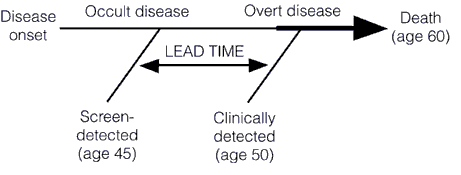
Lead time bias

Unless the rate of progression from the point of a screen-detected abnormality to a clinically detected abnormality is known, it is very difficult to figure out whether a treatment of the screen-detected tumor is actually improving survival when compared to tumors detected later. To do so, the lead time needs to be known and subtracted from the group with the test-based diagnoses. The problem is that the use of the more sensitive detection tests usually precede such knowledge of the true lead time by several years. The adjustment for lead time assumes that the screening test-detected tumors will progress at the same rate as those detected later clinically. However, the lead time is usually stochastic. It will be different for different patients, with some progressing rapidly and some progressing slowly. This variability is responsible for a second type of bias, known as length bias.

Length bias refers to comparisons that are not adjusted for rate of progression of the disease. The probability of detecting a cancer before it becomes clinically detectable is directly proportional to the length of its preclinical phase, which is inversely proportional to its rate of progression. In other words, slower-progressing tumors have a longer preclinical phase and a better chance of being detected by a screening test before reaching clinical detectability, leading to the disproportionate identification of slowly progressing tumors by screening with newer, more sensitive tests. This concept is illustrated below:
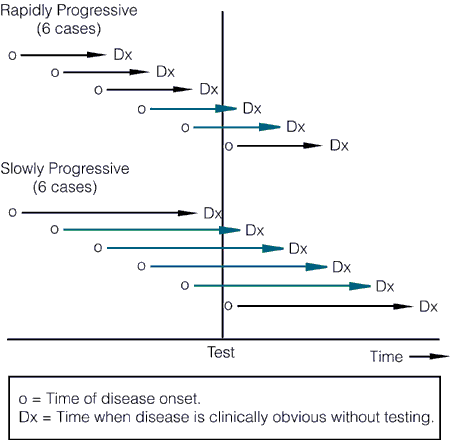
Length bias

The length of the arrows above represents the length of the detectable preclinical phase, from the time of detectability by the test to clinical detectability. Of six cases of rapidly progressive disease, testing at any single point in time in this hypothetical example would only detect 2/6 tumors, whereas in the case of the slowly progressive tumors 4/6 would be detected. Worse, the effect of length bias increases as the detection threshold of the test is lowered and disease spectrum is broadened to include the cases that are progressing the most slowly, as shown below:
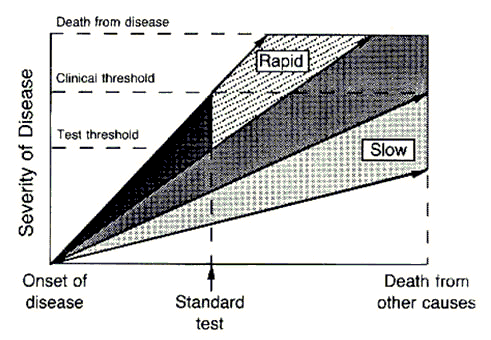
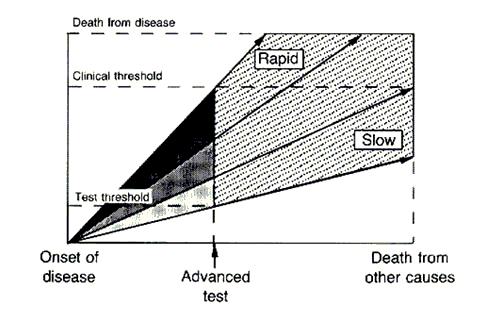
Cancer Diagnosis
06f4b.jpg

The top image represents an idealized example of disease developing in a cohort of patients by two different hypothetical tests, the first one being the less sensitive standard test and the next one being the “advanced” test, which has a lower threshold of detection. The cases detected by the more sensitive advanced test are represented in the stippled area. The standard test detects only the cases that are rapidly progressive. However, the new test detects all cases, including the ones that are slowly progressive and, if left alone, would not have killed the patient, who would have died from other causes before the tumor became clinically detectable by the “standard” test. These latter two patients would be at risk for medical or surgical interventions that would not prolong their lives and carry the risk of morbidity or even mortality if subjected to the more sensitive test. This is one reason why “screening CT scans” are usually not a good idea.

As the authors state:

Unless one can follow a cohort over time, there is no way of accurately estimating the probability that a subclinically detected abnormality will naturally progress to an adverse outcome. The probability of such an outcome is mathematically constrained, however, by the prevalence of the detected abnormality. The upper limit of this probability can be derived from reasoning that dates to the 17th century, when vital statistics were first collected. If the number of persons dying from a specific disease is fixed, then the probability that a person with the disease will eventually die from it is inversely related to the prevalence of the disease. Therefore, given fixed mortality rates, an increase in the detection of a potentially fatal disease decreases the likelihood that the disease detected in any one person will be fatal.

In other words, early detection makes it appear that fewer people die of the disease, even if treatment has no effect on the progression of the disease. It will also make new treatments introduced after the lower detection threshold takes hold appear more effective:

Lead-time and length biases pertain not only to changes that lower the threshold for detecting disease, but also to new treatments that are applied at the same time. Whether or not new therapy is more effective than old therapy, patients given diagnoses with the use of lower detection thresholds will appear to have better outcomes than their historical controls because of these biases. Consequently, new therapies often appear promising and could even replace older therapies that are more effective or have fewer side effects. Because the decision to treat or to investigate the need for treatment further is increasingly influenced by the results of diagnostic imaging, lead-time and length biases increasingly pervade medical practice.

This month there was a study out of Norway that shows just how variable the growth rate of a tumor can be, a variability that suggests just how difficult it is to optimize a screening strategy that applies to a wide population. Indeed, this study shows that not only are cancers of different organs different diseases, but arguably different cancers in the same organ behave almost like different diseases. In brief, imaging and cancer incidence data were modeled from 395 women and the rates of breast cancer growth thereby estimated. What was found was an enormous variability in tumor doubling times. The mean time for a tumor to double from 1 cm to 2 cm in diameter was 1.7 years. However, 5% of the subjects with breast cancer had tumors whose doubling time was less than 1.2 months. Of course, the doubling of the diameter of a tumor is in actuality an eight-fold increase in tumor volume, which makes this result even more impressive. Not surprisingly, women with such rapidly growing tumors tended to be younger. On the other end of the spectrum, 5% of the women had tumors whose doubling time was greater than 6.3 years. the study also suggested that most breast cancers become detectable on imaging when they reach a diameter of between 0.5 and 1.0 cm. It’s not hard to see how, taken together, this data suggests that no screening regimen is likely to detect a cancer before it reaches 2 cm in diameter except maybe 10% of the time. The converse of this is that women with slow-growing tumors could do just as well with screening every three years. Of course, the problem is that we have no way of knowing who will fall into which category. Such are the complications that have made it difficult to demonstrate a decrease in cancer-specific mortality from mammographic screening. The evidence that it does so in women over 50 is fairly strong; less srong–equivocal, even–is the evidence supporting a decrease in mortality attributable to mammographic screening in women between 40-50.

There is another complication that these more powerful imaging modalities can lead to that wasn’t discussed in the paper, stage migration. This is a phenomenon that occurs when more sophisticated imaging studies or more aggressive surgery leads to the detection of tumor spread that wouldn’t have been noted in an identical patient using previously used tests. This phenomenon is colloquially known in the cancer biz as the Will Rogers effect. The name is based on Will Rogers’ famous joke: “When the Okies left Oklahoma and moved to California, they raised the average intelligence level in both states.” This little joke describes very well what can happen in cancer. What in essence happens is that technology results in a migration of patients from one stage to another that does the same thing for cancer prognosis that Will Rogers’ famous quip did for intelligence. Consider this example. Patients who would formerly have been classified as, for example, stage II cancer (any cancer), thanks to better imaging or more aggressive surgery, have additional disease or metastases detected that wouldn’t have been detected in the past. They are now, under the new conditions and using the new test, classified as stage III, even though in the past they would have been classified as stage II. This leads to the paradoxical statistical effect of making the survival of both groups (stage II and III) appear better, without any actual change in the overall survival of the group as a whole. This paradox comes about because the patients who “migrate” to stage III tend to have a lower volume of disease or less aggressive disease compared to the average stage III patient and thus a better prognosis. Adding them to the stage III patients from before thus improves the apparent survival of stage III patients as a group. The converse is that patients with more disease that was previously undetected, tended to be the stage II patients who would have recurred and done more poorly compared to the average patient with stage II disease; i.e., the worst prognosis stage II patients. But now, they have “migrated” to stage III, leaving behind stage II patients who truly do not have as advanced disease and thus in general have a better prognosis. Thus, the prognosis of the stage II group also ends up appearing to be better with no real change in the overall survival from this cancer.

Does all of this mean that we’re fooling ourselves that we’re doing better in treating cancer? That, after all, is the charge being made. Not at all. It simply means that the question of sorting out “real” effects on cancer survival attributable to new treatments being tested from spurious effects due to these biases is more complicated than it at first seems. For one thing, it points to the importance of carefully matching any experimental groups in clinical trials according to stage as closely as possible using similar tests and imaging modalities to diagnose and measure the disease. These factors are yet another reason why well-controlled clinical trials, with carefully matched groups and clear-cut diagnostic criteria are critical to practicing science-based medicine. It also means that sorting out lead time bias, length bias, and the Will Rogers effect from whether there is actually a better effect from new treatments can be a complex and messy business. If we as clinicians aren’t careful, it can lead to a cycle of increasing intervention for decreasing disease. At some point, if common sense doesn’t prevail (and in the present medical-legal situation, it’s pretty hard to argue against treating any detectable cancerous change), it can reach a point of ever diminishing returns, or even a point where the interventions cause more harm than good to patients. The authors have similarly good advice for dealing with this:

Meanwhile, clinicians can heed the following advice. First, expect the incidence and prevalence of diseases detectable by imaging to increase in the future. Some increases may be predictable on the basis of autopsy studies or other intensive cross-sectional prevalence studies in sample populations. Others may not be so predictable. All types of increases should be expected. The temptation to act aggressively must be tempered by the knowledge that the natural history of a newly detectable disease is unknown. For many diseases, the overall mortality rate has not changed, and the increased prevalence means that the prognosis for any given patient with the diagnosis has actually improved.

Second, expect that advances in imaging will be accompanied by apparent improvements in therapeutic outcomes. The effect of lead-time and length biases may be potent, and clinicians should be skeptical of reported improvements that are based on historical and other comparisons not controlled for the anatomical extent of disease and the rate of progression. Clinicians may even consider that the opposite may be true — i.e., real outcomes may have worsened because of more aggressive interventions.

Finally, consider maintaining conventional clinical thresholds for treating disease until well-controlled trials prove the benefit of doing otherwise. This will require patience. A well-designed randomized clinical trial takes time. So does accumulating enough experience on outcomes from nonexperimental methods that can be used to control for the extent of disease and the rate of progression. From the point of view of both patients and policy, it is time well spent.

These words are just as relevant to day as they were 15 years ago. On the surface, they would appear to support the words of our cranky commenter from the beginning of this post, but they do not. The reason, of course, is that it is quite possible to control for lead time and length bias, the Will Rogers effect, and stage migration, and it’s what clinical investigators do. It’s just difficult, and careful trial design is necessary. Indeed, in carefully controlled studies for a number of cancers the efficacy of our various inteventions against cancer have been demonstrated. In addition, in science-based medicine, unlike the blandishments of “alternative” medicine, we know that there is a cost for every new intervention. The detection of ever-smaller cancers the percentage of which that will endanger the patient’s life we do not know and can only roughtly estimate, leads to increasing numbers of biopsies and treatments that subject the patient to the risk of complications and overtreatment while doing some patients no good even as they may lead to the saving the lives of others. Finding the “sweet spot,” where increased detection reaches a point that maximizes the diagnosis of treatable tumors at an early stage but minimizes the number of “unnecessary” biopsies and therapeutic interventions is a complex business that doesn’t always give the clear-cut answers that our commenter clearly wants.

Compounding the difficulty is that it is very difficult to convince patients and even most physicians that, if we can detect disease at ever lower thresholds that we shouldn’t and that if we can treat cancer at ever earlier time points or ever smaller sizes that we shouldn’t. Moreover, the answer will also not be the same for all tumors. Remember, cancer is not a single disease, but rather a collection dozens, if not hundreds, of diseases. For some tumors (pancreatic cancer, for instance), clearly we need to do better at early detection, but for others (perhaps prostate cancer and breast cancer) spending ever more money and effort to find disease at an earlier time point will yield ever decreasing returns and may even lead to patient harm. It is likely that each individual tumor will have a different “sweet spot,” where the benefits of detection most outweigh the risks of excessive intervention. Similarly, different tumors require different clinical trial designs to rule out the effects of the various biases discussed in this post. Contrary to what our commenter says, it is not only possible to find each sweet spot in terms of early detection versus overtreatment and sorting out the effects of confounding biases, it is imperative that we do so. It’s just that doing so is far more difficult than the frequently simplistic slogans urging more early detection or attacks on “conventional” oncology as not curing anyone because “most cancers don’t progress” would suggest.

To be continued…

[Slashdot] [Digg] [Reddit] [del.icio.us] [Facebook] [Technorati] [Google] [StumbleUpon]

228 responses so far

228 Responses to “The early detection of cancer and improved survival: More complicated than most people think”

  1. [...] The early detection of cancer and improved survival: More … By David Gorski It?sa common assumption (indeed, a seemingly common sense assumption) that detecting cancer early is always a good thing. Why wouldn?t it always be a good thing, after all? For many cancers, such as breast cancer and colon cancer, … Science-Based Medicine – http://www.sciencebasedmedicine.org/ [...]

  2. pecon 12 May 2008 at 6:47 pm

    pec: “Maybe early diagnosis and treatment do save the lives of a small percentage of all who are treated. Maybe not. We don’t know.”

    Gorski: “As is so often the case with such simplistic black and white statements, …”

    I said “maybe” and “we don’t know.” How is that simplistic or black and white? It’s an accurate acknowledgment of the fact that we don’t know.

    And I certainly am NOT looking for clear-cut answers. I am just trying to encourage you “skeptics” to be as skeptical of mainstream medicine as you are of alternatives.

    The public and most medical professionals have been convinced that great progress has been made in treating and curing cancer — when it’s diagnosed early. But the reality is that we don’t know how much, if any, progress has been made, and it’s extremely difficult to find out. And you have admitted all of that in this post.

    It’s ironic that you accuse me of being simplistic when I have been exactly the opposite. I have been noticing and explaining the complexity of this problem. It’s the medical profession and the drug companies who have been simplistic.

  3. David Gorskion 12 May 2008 at 8:51 pm

    It’s ironic that you accuse me of being simplistic when I have been exactly the opposite. I have been noticing and explaining the complexity of this problem. It’s the medical profession and the drug companies who have been simplistic.

    No, you’ve been repeatedly very simplistic and just plain wrong. You’ve ranted on and on about how supposedly chemotherapy does no good, doctors want only to poison cancer patients with it, and how most cancer never progresses. You take the uncertainty about how much value early diagnosis has and leap to the unjustified conclusion that “conventional” medicine doesn’t cure any cancers and that any increase in survival is due to earlier diagnosis of tumors that never would have progressed anyway. Controlling for stage shows that you’re wrong.

    You have demonstrated time and time again that you have no idea what you’re talking about in this area, and patient attempts by others to correct you and educate you by myself and others have been to no avail–alas.

  4. Harriet Hallon 12 May 2008 at 9:20 pm

    As I read Dr. Gorski’s post, I knew pec would be saying “I told you so.” But pec has failed to understand the complexities involved. We DO know that cancer treatment saves lives. We DO know that progress has been made. We DO know that early detection improves outcome for some cancers but not for others. Dr. Gorski has tried to explain how to decide just how much we do know, and why early detection is sometimes helpful and sometimes not.

    “I am just trying to encourage you “skeptics” to be as skeptical of mainstream medicine as you are of alternatives.”
    You just don’t get it. It’s not a matter of being skeptical of alternatives or of mainstream; it’s a matter of questioning anything that is not supported by good evidence, whether it’s mainstream or alternative. Dr. Gorski’s excellent post is a great example of questioning things in his own specialty and demanding a high standard of evidence and a rigorous application of the scientific method.

    There is plenty of evidence that modern scientific medicine improves cancer outcome; I know of no evidence that any alternative treatment improves cancer outcome.

  5. wertyson 12 May 2008 at 11:43 pm

    At least when you’re sceptical about ‘mainstream’ medicine the people you criticise don’t roll up into a ball and cry about it, then ignore the criticism and persist in their infantile delusions….

  6. pecon 13 May 2008 at 6:37 am

    I was NOT wrong or simplistic about this. I did NOT say chemotherapy never works. I said we don’t know if, or how often, it works. You say you know it works — well how exactly do you know?

    It’s true that most early cancer will never progress. There is no debate about that, according to the article you are citing. Are you now disagreeing with the article.

    I NEVER said MDs want to poison their patients with toxic chemicals. But the chemicals ARE toxic, and because of the forms of bias you are talking about here in your post, we DO NOT KNOW their effectiveness or safety.

    Most statements about cancer mortality rates refer to mortality per diagnosis. When diagnoses increase, because of better screening technology, this type of mortality must decrease. But it tells us nothing about the real effectiveness of the treatments.

    You would have to calculate cancer mortality rates relative to the population rather than relative to cancer diagnoses.

    Where exactly is your data that shows mortality relative to population decreasing as a result of a particular treatment?

    You keep saying there are treatments that work, but you do not provide any evidence. How is that science-based medicine? It’s nothing but angry defensive support for the status quo.

  7. pecon 13 May 2008 at 6:39 am

    “There is plenty of evidence that modern scientific medicine improves cancer outcome”

    Yes Harriet, and most of it is biased and misleading — that is what this post is all about. I would like to see some unbiased evidence.

  8. David Gorskion 13 May 2008 at 8:12 am

    Yes Harriet, and most of it is biased and misleading — that is what this post is all about. I would like to see some unbiased evidence.

    Tell you what, pec. Show me a study with some “biased and misleading” evidence showing that modern scientific medicine improves cancer survival. A specific example. Explain exactly how it was biased. Then show me some evidence to demonstrate that “most” studies showing a survival benefit from a treatment based on scientific medicine are “biased and misleading.” Show me how you come to that conclusion using science and appropriate citations from the peer-reviewed literature.

    You talk a good game, but you never deliver.

  9. weingon 13 May 2008 at 9:15 am

    pec,

    Please back up your assertion that ‘most’ early cancers will never progress, otherwise change it to ’some’ and I’ll agree with you.
    You do realize that life carries a 100% mortality. Are you looking at treatments for cancers as failures because the patients still die?

  10. pecon 13 May 2008 at 9:28 am

    weing,

    It is well-known that most early cancer will never progress. Read the article linked by this post, for example.

    Cancer treatments are failures when they do nothing to help the patient. Treating someone for cancer that would never have progressed or caused disease is a failure, because it wastes time and money and exposes the person to harmful, unnatural, substances.

    All of that is explained in the article linked by Dr. Gorski. If you don’t believe him, then you certainly won’t believe me.

    How often does it happen that cancer is caught early and treated and the treatment saves the patient’s life? We don’t know. You can’t deprive diagnosed patients of treatments so you can’t do the experiment.

    In areas with good access to modern medicine, there are high rates of diagnosis and high rates of “cures.” In areas with poor access, there are low rates of diagnoses and low cure rates. You can’t draw a conclusion about the treatments from that. So how can you know?

    I am genuinely interested in this subject, partly because of my interest in statistics. Where is evidence that is not confounded by the bias discussed in the article? I have read several similar articles and none of them propose solutions, or give examples of unbiased research.

  11. David Gorskion 13 May 2008 at 10:54 am

    In other words, pec cannot provide a single peer-reviewed study that is “biased and misleading” and demonstrate why it is “biased and misleading,” much less provide a whit of evidence that “most” studies that show a treatment benefit from a science-based treatment are “biased and misleading.”

    The rest of his post is one massive exercise in the logical fallacy known as the appeal to ignorance, not to mention his ability to ignore the fact that it is possible to match for cancer stage and generate a true treatment effect and that this is done all the time. That it is difficult does not make it impossible.

  12. pecon 13 May 2008 at 11:12 am

    Everything I have read so far about cancer research is biased, in the ways we are discussing here. You have not provided a single unbiased study to back up your claim that cancer treatments work. I do not have access to subscriber-only medical journals, so please give us something the public is allowed to see.

  13. Harriet Hallon 13 May 2008 at 11:28 am

    pec,

    “In areas with good access to modern medicine, there are high rates of diagnosis and high rates of “cures.” In areas with poor access, there are low rates of diagnoses and low cure rates. You can’t draw a conclusion about the treatments from that. So how can you know?”

    Well, duh! By doing high-quality controlled studies, of course!

    You are looking for answers, and there are no easy black and white answers. The best we can do is to look at each individual cancer and evaluate all the available evidence with a critical eye. Dr. Gorski is teaching us how to do that.

    We don’t have the kind of evidence that we would ideally like to have, but we do have good enough evidence to give patients some rough numbers. Something like “There is an x percent chance this screening test will prolong your life but a y percent chance you will have a false positive result and a z percent chance you will be treated unnecessarily.” We can share the uncertainty with the patient and involve him in the decision.

    Mammograms do save lives, but they also cause harm. The answer is not to stop using mammography; it’s to learn how to use mammography more judiciously. For one thing, we must consider the risk factors of the individual patient. Mammography might be life-saving for a high risk patient but worthless for a low risk patient. The article I posted today on the art of clinical decision-making addresses some of these issues.

  14. pecon 13 May 2008 at 11:52 am

    Harriet,

    Please explain how you know that mammograms save lives. Please give a scientific answer, not a “common sense” answer. There is no way to know whether or not an early cancer found on a mammagram would have progressed and become dangerous if untreated.

    I am not getting any straight answers to my question. How do you know?

  15. David Gorskion 13 May 2008 at 12:04 pm

    Patience.

  16. weingon 13 May 2008 at 12:06 pm

    pec,

    I still haven’t found proof of your claim that most cancers will never progress, sorry.

    That is the reason for staging and stratifying lesions based on size in controlled studies. This helps to eliminate lead-time and length bias. Then you can see if and how your treatments are working compared to others. I am not an oncologist but I am sure they are well aware of what good and lousy studies are.

    You can volunteer to be in the control group if you are ever found to have cancer on a screening test.

  17. DBonezon 13 May 2008 at 12:33 pm

    Pec said:

    “In areas with good access to modern medicine, there are high rates of diagnosis and high rates of “cures.” In areas with poor access, there are low rates of diagnoses and low cure rates. You can’t draw a conclusion about the treatments from that. So how can you know?”

    How about life expectancy figures? Why is it that “indigenous people” without modern medicine and without accurate diagnostic procedures who “live simplistically and are one-with-nature” (one-with-nature = herbs, medicine men, and all natural living) have such short life spans? Why do all modern, industrialized nations have significantly longer life expectancies? Sure there are a ton of variables blended in, but so is cancer and I think this list pretty well sums up most peoples’ views on this website.

    http://geography.about.com/library/weekly/aa042000b.htm

    This is also my argument about “traditional Chinese medicine” (TCM) and any other forms of non-science-based medicine that are hundreds or thousands of years old. Sure, TCM is thousands of years old, but their life expectancy was 35 years. Modernized countries utilizing science-based medicine has life expectancies pushing 80 years with excellent quality of life.

    Sorry, but I can draw a conclusion from this evidence and I am living a great, long, happy life with modern medicine, and statistically will continue to do so for another 40 + years.

  18. pecon 13 May 2008 at 1:02 pm

    DBonez,

    What a ton of nonsense. Yes, lifespan is often included in the pro-cancer drug propaganda.

    We know very little about prehistoric longevity, and average lifespan is utterly misleading. All species in nature produce more offspring than can be expected to survive — this is nature’s “cruel” way of keeping species healthy, since the less fit are weeded out.

    Modern humans have disabled the mechanism, since we (understandably enough) have focused on preventing infants from dying.

    Pre-modern humans had high infant mortality rates, which resulted in a low average lifespan.

    Pre-modern humans also lived under a wide variety of conditions. In the middle ages, for example, many lived in filthy cities, which led to early deaths from infectious disease.

    Pre-moderns of all times and places died from infections and injuries that we now survive easily thanks to antibiotics and advanced surgical technology.

    If you factor out deaths from infection and injury, and infant mortality, and you consider whether or not the environment was clean or not, then you might wind up with a reasonable estimate of pre-modern typical lifespan. It would certainly not be 35 — people living in clean natural conditions with plenty of food and exercise did not drop dead of old age at 35. That is a complete misconception. It’s exactly what the drug companies hope you will believe, but it is BS.

    And pre-moderns did not get cancer. Cancer is a modern western disease. This may be partly because we survive many other causes of death. But more likely, I think, it’s because of our horrendously unnatural and unhealthy lifestyle.

    This is a hard thing to prove, but it is wrong wrong wrong to assume current cancer treatments are effective just because we are more likely than pre-moderns to reach old age.

    There have been studies of contemporary traditional societies where old people are MUCH healthier than old people here. We have no reason to assume contemporary traditional societies are all that different from prehistoric traditional societies.

    Yes we have the advantage of being able to survive certain kinds of infections, diseases and injuries. But in almost every other respect, we are less healthy now.

  19. Harriet Hallon 13 May 2008 at 1:09 pm

    “There is no way to know whether or not an early cancer found on a mammagram would have progressed and become dangerous if untreated.”

    You’re right. There is no way to know whether an individual early cancer would have progressed. Science doesn’t have crystal balls to predict the outcome for an individual.

    What science CAN do is show statistically that a group of women who get mammograms will have a better survival rate than a group of women who don’t. Lives are saved; we just don’t know which ones.

    As Dr. Gorski says, Patience! He has more to say in part 2. Meanwhile, here are just two of the many recent studies that support my claim that mammography saves lives:

    http://www.ncbi.nlm.nih.gov/pubmed/18351455?ordinalpos=12&itool=EntrezSystem2.PEntrez.Pubmed.Pubmed_ResultsPanel.Pubmed_RVDocSum

    http://www.ncbi.nlm.nih.gov/pubmed/16434585?ordinalpos=22&itool=EntrezSystem2.PEntrez.Pubmed.Pubmed_ResultsPanel.Pubmed_RVDocSum

    These studies were of unselected patients. The benefit of mammography is even greater for women at higher risk.

  20. Harriet Hallon 13 May 2008 at 1:11 pm

    “And pre-moderns did not get cancer.”

    Wrong.

  21. Harriet Hallon 13 May 2008 at 1:13 pm

    “There have been studies of contemporary traditional societies where old people are MUCH healthier than old people here.”

    Sure. In those societies only the healthy people live to old age. Modern medicine keeps some of the unhealthy ones alive longer.

  22. weingon 13 May 2008 at 1:51 pm

    “pre-moderns did not get cancer.”
    OMG, I nearly wet myself when I read that.

  23. David Gorskion 13 May 2008 at 1:58 pm

    And pre-moderns did not get cancer.

    Bullshit.

    I’m sorry; I know Steve likes to maintain more decorum than that here, but that statement is such a big, stinky, dripping turd that there is no other response to it. (Sometimes bullshit just has to be called for what it is, even here.) I just finished reading a very good chapter on the history of breast cancer going back to before ancient Egypt; there were lots of descriptions of how, for example, ancient Egyptians thought about and treated breast cancer. Ever hear of Nabby Adams? (Watch HBO?) Pre-moderns most definitely did get cancer.

    It is true that life expectancy in the preindustrial age was such that many fewer people as a percentage of the population lived to a sufficiently old age to reach the years when humans are most susceptible to the most common cancers that people get today, most of which are diseases of the elderly. It is not true that pre-moderns did not get cancer.

  24. weingon 13 May 2008 at 2:16 pm

    I think it was Hippocrates that came up with the name ‘cancer’ as it had the appearance of a crab on a woman’s breast.

  25. daedalus2uon 13 May 2008 at 2:37 pm

    Those pre-moderns had quite sensitive stomachs too. Quite a few of them died of acute indigestion. Good thing modern medicine has virtually eliminated deaths from acute indigestion, what with antacids and the like.

  26. pecon 13 May 2008 at 3:08 pm

    “that statement is such a big, stinky, dripping turd that there is no other response to it”

    Ok Gorski, don’t have a stroke. The rate of cancer now is MUCH MUCH MUCH higher than in pre-modern times.

    As I said, this could be partly because we are more likely to reach old age. But anyone who denies the possible importance of lifestyle and exposure to pollution is a big stinky dumb turd.

  27. pecon 13 May 2008 at 3:09 pm

    Sorry, I meant to say “big stinky dripping dumb turd.”

  28. apteryxon 13 May 2008 at 3:34 pm

    In little over a century, life expectancy has increased by about 25 years. I have read an estimate that over 21 years of this should be attributed to better public health (clean water, ventilation, improved food) and only a couple of years apiece to active medical treatment and prophylactic medical treatment. In prehistoric times, most people died of accident (eaten by cave lions…) or infectious disease. Western treatments for diseases such as typhoid and cholera are more potent than traditional treatments, until resistance evolves, but the primary reason why few American children die of those diseases is not that we have pharmaceuticals instead of traditional (or worse, horrors, Chinese!!) medicine; it’s that we have sewer systems and chlorination. Or just soap and water. It’s possible to avoid most disease cheaply in the field if you know what to do and why, but if you have no idea that germs exist, you won’t wash your hands very often or care if flies land on your food.

    Daedalus quips that “premoderns” died of “acute indigestion” – well, it’s probably true that the later-era European diet was not good for people, but you folks don’t accept any other “premodern” opinion as fact; they might have diagnosed heart attacks as indigestion. Was the point here to mock them for not having had fully equipped labs with which to make modern diagnoses?

    As for the cancer rates, good grief, can’t people talk about cancer without calling each other names? Given that rates of some cancers are far lower in modern non-Western peoples who eat traditional diets and are less sedentary, it’s reasonable to assume that our ancestors also had lower cancer rates than we do. The stated health concerns of people at the time also seem to support that. But of course some people got cancer; there is such a thing as genetic bad luck.

  29. Joeon 13 May 2008 at 3:40 pm

    Spec wrote “The rate of cancer now is MUCH MUCH MUCH higher than in pre-modern times.

    As I said, this could be partly because we are more likely to reach old age.”

    You did not say that, you wrote “Yes, lifespan is often included in the pro-cancer drug propaganda.” You are trying to horn in on the bread and butter of priests and politicians (words), and you are inept at it. What is “pro-cancer drug propaganda”?

    So we know you are wrong about the antiquity of cancer. However, you wrote a long dissertation with many more assertions. Are any of them supported by reliable publications?

    I have experience that allows me to infallibly spot an anonymous chiropractor; in this case, I suspect you are a naturopath, or an acolyte. How am I doing?

    @Weing, your ability to deal with spec’s posts Depends on proper preparation. Also, Wikipedia supports your claim about Hippocrates; nonetheless, I think you are correct.

  30. pecon 13 May 2008 at 3:48 pm

    Thank you apteryx. At least I’m not the only person here who has ever read a book outside their immediate field.

    Joe you can’t read; this is what I said:

    “Cancer is a modern western disease. This may be partly because we survive many other causes of death”

  31. pecon 13 May 2008 at 3:55 pm

    I almost never call anyone names and I admit it’s stupid. But Gorski is such a filthy-mouthed you-know-what, sometimes you just have to fight back.

    Saying pre-modern people didn’t get cancer is a tiny bit inaccurate, since they probably did get it, very rarely. Notice how insane he went over that tiny inaccuracy. It doesn’t matter than almost everything I say is qualified and careful and seldom inaccurate or exaggerated. He’s ready to pounce on small errors so you don’t notice how wrong he is about so many important things.

    But of course, he makes a living “curing” people with toxic unnatural substances, so he must never question the wisdom and compasssion of his beloved drug companies.

  32. Harriet Hallon 13 May 2008 at 4:11 pm

    pec, You’re contradicting yourself. First you said “pre-moderns did not get cancer.” Then you said, “The rate of cancer now is MUCH MUCH MUCH higher than in pre-modern times.”

    Those two statements are not logically compatible.

    We know the rate of cancer is higher today, but I don’t know if we have enough comparison data to say it is MUCH MUCH MUCH MUCH higher. And how much of the increase is due to better diagnosis and to people surviving to older ages? And didn’t pre-modern people have exposure to other factors that might contribute to cancer, like close contact with open fires? Their world wasn’t so pristine.

    “But anyone who denies the possible importance of lifestyle and exposure to pollution is a big stinky dumb turd.”

    Yes, I agree with you completely. I wouldn’t even qualify it with “possible.” We KNOW lifestyle and pollution contribute to cancer, especially lung pollution from smoking. But why are you bothering to say something so obvious? I doubt if a single person reading this blog denies that. The references I gave you about cancer prevention all agreed. Do you know of ANYONE who ever denied the possible importance of lifestyle and exposure to pollution, or are you just indulging in indiscriminate fantasy?
    .

  33. David Gorskion 13 May 2008 at 4:13 pm

    I almost never call anyone names and I admit it’s stupid. But Gorski is such a filthy-mouthed you-know-what, sometimes you just have to fight back.

    Ah, yes, the old “skeptics are mean” trope.

    I didn’t insult you. I simply said that what you said was a load of B.S., so much so that there was no reason to sugarcoat it or show more respect to your claim that “pre-moderns did not get cancer,” which you neither qualified nor equivocated on, than the claim deserved. There’s a difference. Trust me, I’ve had far worse “insults” in far more colorful language directed at things I’ve argued or said in medicine or science. I didn’t take it personally (well, most of the time, anyway); I knew it was what I said that was being ridiculed, not me personally. Scientists (and surgeons even more so) tend to have little patience for repeated bad arguments and to be fairly ruthless when it comes to deconstructing each other’s hypotheses and contentions; it’s the intellectual war of ideas, with the person who can best support his or her arguments with data the winner. The best way to deal with it is to come up with the evidence to show why one’s argument is not “bullshit,” as I had politely asked you to do several times before I gave up and lost my patience. As Thomas Jefferson famously said (and was quoted by fellow SBM blogger Mark Crislip):

    “Ridicule is the only weapon which can be used against unintelligible propositions. Ideas must be distinct before reason can act on them…”

    Moreover, it was appropriate in your case. You were clearly making an unsupported statement, and now that you’ve been called to task for it by more commenters than just me, you’re retreating to one of the lamest defenses in the book by claiming you didn’t really mean what you said. In any case, attacking something you said vigorously is not the same thing as attacking you. Confusing the two, however, is a frequent sign of someone who has a hard time separating ideas from people.

    Saying pre-modern people didn’t get cancer is a tiny bit inaccurate, since they probably did get it, very rarely. Notice how insane he went over that tiny inaccuracy. It doesn’t matter than almost everything I say is qualified and careful and seldom inaccurate or exaggerated. He’s ready to pounce on small errors so you don’t notice how wrong he is about so many important things.

    Pot. Kettle. Black. Of course, you could provide evidence other than your say-so that your argument is correct. You could provide scientific evidence from the peer-reviewed literature to support your contention that most trials supporting the efficacy of science-based medicine against cancer are “biased and misleading.” But you don’t.

    Why is that?

    But of course, he makes a living “curing” people with toxic unnatural substances, so he must never question the wisdom and compasssion of his beloved drug companies.

    Actually, I make my living cutting cancers out of the body with cold steel and electrocautery. Big pharma means little to me, because the vast majority of drugs that I prescribe are either narcotics for the relief of postoperative pain or the the occasional odd antibiotic for wound infections. I don’t prescribe chemotherapy. Oh, and I also do research looking for better ways to treat cancer. As for “unnatural substances,” did you know that one of the mainstays of breast cancer treatment is taxol? Do you know how Taxol was discovered? It was isolated from the bark of the Pacific Yew tree, that’s how.

  34. Harriet Hallon 13 May 2008 at 4:14 pm

    pec said, ” he makes a living “curing” people with toxic unnatural substances, so he must never question the wisdom and compasssion of his beloved drug companies.”

    Do you know of anyone who makes a living curing people with nontoxic natural substances?

    Did you even notice that he is questioning the wisdom of drug treatment for some cancers?

  35. David Gorskion 13 May 2008 at 4:15 pm

    “But anyone who denies the possible importance of lifestyle and exposure to pollution is a big stinky dumb turd.”

    I’m curious: Who denied the importance of lifestyle or environmental pollution to the development of cancer? I assure you, it wasn’t me.

  36. David Gorskion 13 May 2008 at 4:19 pm

    Did you even notice that he is questioning the wisdom of drug treatment for some cancers?

    pec can’t make up his mind. First, my article is cited as validation of his whole “early stage cancers rarely progress” and “scientific medicine cures almost no one of cancer” thesis, but then when it is pointed out to him that it is not and that all it says is that science can sort these confounding factors out but that it’s difficult and requires rigorous controlled clinical trials, he starts attacking.

  37. pmoranon 13 May 2008 at 4:43 pm

    Pec, it is not “extremely difficult” to show that current medical approaches are having an impact. What do you make of these statistics for breast cancer? There is a similar trend with colorectal cancer, although some of the decline in deaths from that is due to declining incidence.

    http://www.statistics.gov.uk/cci/nugget.asp?id=575

  38. apteryxon 13 May 2008 at 5:01 pm

    I think the comment about “people who deny the possible effects of lifestyle and pollution” derives from the apparent belief held by some people – not Dr. Gorski – that if our ancestors were less likely to get cancer, that was just because they almost all died too young to get it. If you tell yourself that age-corrected cancer rates would have been unchanging throughout history, then you will not be able to acknowledge intercultural differences in current age-corrected cancer rates, or discuss what environmental factors may cause them. That can be a touchy subject. Dr. Hall was quick to point out that smoking has greatly increased age-adjusted lung cancer rates. Nobody, these days, will be annoyed with a doctor who criticizes smoking, and the entrenched interests encouraging smoking are relatively small and on the defensive. If you started seriously scrutinizing the beef-and-HFCS-based diet, say, or diesel exhaust, or bisphenol A, then that would be a whole different can of worms.

    Suppose you (the MDs among us) treated cancer like infectious disease? You all support mandatory vaccination, even for diseases that are generally harmless, like chickenpox. If someone comes to you severely sick with chickenpox or measles, you will treat them, but you would rather prevent as many such cases as possible even if that takes costly, society-wide efforts. Some people will always get cancer, diabetes, etc., and you will treat them as best you know how – but why not try first to minimize their number by investing intensively in prevention and healthy lifestyles?

  39. Joeon 13 May 2008 at 5:02 pm

    pec wrote “Joe you can’t read; this is what I said:

    “Cancer is a modern western disease. This may be partly because we survive many other causes of death”

    Mea culpa. You wrote so much unsubstantiated nonsense that I lost track. I guess you are not going to support any of your statements, or deny that you are a naturopath.

  40. rjstan@together.neton 13 May 2008 at 6:01 pm

    Thank you Peter. You for providing the evidence about the effectiveness of the treatment of breast cancer.
    http://www.statistics.gov.uk/cci/nugget.asp?id=575

    Pec, do you have evidence showing that the statistics reported there are incorrect or that the reporting is biased?

    I haven’t looked further at the site but would expect that they have similar statistics showing the number of deaths for each specific type of cancer over a period of many years. I also suspect that the cancer specialists here could give references showing that many cancers which 20, 30 or 40 years ago were almost always fatal are rarely so today and I suspect that many of the childhood cancers would be among them.

    Pec, you stated, “I am genuinely interested in this subject, partly because of my interest in statistics.” The fact that you are genuinely interested in the subject is very obvious. What is not obvious is the reasons or where your ideas on the subject come from. I asked you before where you got your ideas from and whether or not they are from personal experience that you or a loved one had or from reading stories about people with cancer. Unless I have missed it, I have not seen your response.

    You sound like cancer terrifies you, but you don’t provide a way of knowing what your fears are based on. Without knowing that, I think it is impossible to have a rational discussion with you because i don’t know if you really had or observed a terrible experience yourself, have imagined something that never happened, believed horror stories quacks tell to scare people into buying their “therapies” or are a quack trying to scare people into buying yours.

    Now please don’t tell me how horrible cancer is or that everyone should know how dreadful it is because as I’ve already told you, I have had cancer myself and it doesn’t frighten me anywhere near the way it appears to frighten you. I have also known others who have been successfully treated for cancer and I’ve helped care for others who have died from it.

  41. David Gorskion 13 May 2008 at 6:28 pm

    I have also known others who have been successfully treated for cancer and I’ve helped care for others who have died from it.

    Recent cancer victims in my family include an aunt and an uncle (within less than three years of each other), both of whom died, and my mother-in-law, who is doing well so far, although her tumor was not early stage–not to mention cancer scares recently with my mother and father. Add that to seeing some pretty young patients recur with stage IV disease, and I know just how horrible cancer can be. That’s why I always get annoyed when told that I just don’t care or understand.

  42. pecon 13 May 2008 at 6:37 pm

    “You sound like cancer terrifies you”

    That is such an absurd statement. There was nothing in anything I said that expressed emotions about cancer, or any other disease.

    No one likes diseases, but why waste effort saying something so obvious? I am interested in how people come to believe things that are just not supported by any clear scientific evidence.

    We are always being told that people now live longer healthier lives thanks to recent medical advances. Well it’s true that more of us are getting old, but not because of the new drugs. That is a complete misconception. And we’re getting sicker as we get older.

    The drug companies are happy to take credit for our longer average lifespan, but they probably don’t deserve much of it. And the people whose lives are extended by the new drugs suffer greatly. That is because these drugs, in general, work against the system, not with it.

    We need a more holistic and prevention-oriented approach to health. We can’t possibly avoid all the carcinogenic substances in the air, water and food, but there is still a lot we can do.

    And it was actually very helpful and open-minded of Dr. Gorski to post about this article. Most people have never thought about overdiagnosis, lead-time bias, etc., and it is very important that the public becomes aware. Too many Americans are careless about their lifestyle, assuming that there are, or will soon be, drugs that cure cancer and the other lifestyle diseases that plague our society.

  43. rjstan@together.neton 13 May 2008 at 7:16 pm

    I said, “You sound like cancer terrifies you”

    Pec, responded, “That is such an absurd statement. There was nothing in anything I said that expressed emotions about cancer, or any other disease.”

    I know that I may have been incorrect about you actually being terrified of cancer, but all your statements have certainly given me the impression that you are. The question is do most people reading what you have written here have the same impression as I have or not? If not, then my statement is absurd. If they do, then you haven’t got the slightest idea of how you sound to others.

    Getting objective evidence to determine if my impression is that of the majority of readers would be rather simple. We could take a poll to see how many readers think you sound as if cancer terrifies you and how many think that nothing you have ever written here about cancer is emotional.

    Actually, I don’t expect the forum to go to the trouble of conducting such a poll. My point is that your response that my statement about how I believe you sound is absurd tells me a great deal about you. It tells me that you haven’t bothered to sit back and say to yourself, Well look how I sound to this person and what makes her think such a thing? Could I really sound to others the way I sound to her, and if so, could they possibly be right?

    I also note that you have once more refused to answer the questions I asked you about how you have arrived at the ideas you continually express here and you have once more preached to us about the horrors of scientific medicine and the marvelous of the alternative unscientific kind. From that i conclude, and will continue to conclude until presented with evidence to the contrary, that you either are not facing your irrational fears or that you sell unscientific medicine.

  44. Harriet Hallon 13 May 2008 at 7:21 pm

    “I am interested in how people come to believe things that are just not supported by any clear scientific evidence.”

    We are interested in how you come to disbelieve things that are supported by clear scientific evidence.

    “Well it’s true that more of us are getting old, but not because of the new drugs. That is a complete misconception”

    No one here has the misconception that drugs are “the” reason. There are many reasons more of us are getting old. Hygiene and vaccines are major reasons; drugs may be of lesser importance than those, but there is clear evidence that some drugs save lives. Other drugs don’t save lives but do improve symptoms and quality of life.

    “we’re getting sicker as we get older” It is a truism that the longer we live, the more chance we have of developing illnesses. Do you think there is some way to prevent that beyond the preventive measures recommended by scientific medicine?

    “people whose lives are extended by the new drugs suffer greatly” That’s just silly, pec. It’s like saying people who drive cars are injured in terrible automobile accidents. Maybe SOME people suffer; maybe a few ever suffer greatly; the majority don’t. And many of those who suffer side effects are quite willing to accept those side effects to get the benefit of extended life.

    We are all in favor of more prevention. What makes you think we aren’t? We are talking about what to do when prevention fails.

    You are constantly criticizing drug treatments but you haven’t offered any safe and effective alternatives. Do you think there are any? What would be your approach if you were diagnosed with, say, breast cancer?

  45. HCNon 13 May 2008 at 7:28 pm

    pec said “And pre-moderns did not get cancer. Cancer is a modern western disease”

    So Ada, Countess of Lovelace did NOT die of uterine cancer at the age of 36? (and her hypochondriac mother out lived her! — sorry, recently read a biography)

    pec said “We need a more holistic and prevention-oriented approach to health. ”

    Prevention is also why vaccines are important. Even for chicken pox, which does kill… and makes a person eligible for shingles later in life. Some of the vaccines even help prevent cancer, not just HepB and HPV:
    http://www.sciencedaily.com/releases/2008/04/080425082125.htm …. “In another paper, Israeli researchers suggest that measles virus may also be a factor in some lung cancers. Their study included 65 patients with non-small-cell lung cancer, of whom more than half had evidence of measles virus in tissue samples taken from their cancer.”

    Wait… um, i got a bit lost here: who said prevention was not important?

  46. Harriet Hallon 13 May 2008 at 7:30 pm

    rjstan,

    My impression is not that cancer scares pec, but that she is terrified by chemotherapy. She seems to be under the misconception that it always causes great suffering, which it clearly does not. It also seems to me that she is averse to the idea of taking medications and would prefer some unspecified “natural” approach.

    My impression is that she subscribes to some nonscientific world view and is letting her preconceptions interfere with understanding our arguments and accepting the facts.

  47. rjstan@together.neton 13 May 2008 at 8:20 pm

    Pec, is Harriet’s impression that you are terrified of chemo correct or is it also absurd? If it is correct, where have you gotten the idea that it is always horrible?

    You specifially stated, “I did NOT say chemotherapy never works,” but in your anti-scientific rants you sound as if you don’t think it works often. Could you please clarify that.

  48. qetzalon 13 May 2008 at 11:24 pm

    pec said:

    It doesn’t matter than almost everything I say is qualified and careful and seldom inaccurate or exaggerated.

    I’ve no doubt you think so, but what does the evidence say? Let’s ignore all the counter-examples from past threads, and look only at this one.

    At 6:37 am, pec wrote:

    I NEVER said MDs want to poison their patients with toxic chemicals. But the chemicals ARE toxic, and because of the forms of bias you are talking about here in your post, we DO NOT KNOW their effectiveness or safety.

    Really? Not even the ones that have been tested in double blind, placebo-controlled studies? Or did you neglect to qualify that statement?

    At at 6:39 am, pec wrote:

    “There is plenty of evidence that modern scientific medicine improves cancer outcome”

    Yes Harriet, and most of it is biased and misleading — that is what this post is all about. I would like to see some unbiased evidence.

    I note that you did NOT qualify this careful statement by saying “most of it may be biased….” I also note the careful way you ignored requests to support this claim with actual evidence.

    At 3:08 pm, pec wrote:

    The rate of cancer now is MUCH MUCH MUCH higher than in pre-modern times.

    This is my personal favorite (on this thread). You insist we can’t know if cancer death rates are getting better today, even though we’re aware of various biases and try to account for them. Then you turn around and claim that cancer rates are MUCH MUCH MUCH higher today!

    How did you adjust for longevity biases in arriving at that careful, qualified, accurate conclusion?

    At 6:37 pm, pec wrote:

    I am interested in how people come to believe things that are just not supported by any clear scientific evidence.

    Irony, thy name is pec.

    In all sincerity, pec, if you would apply the same skepticism and rigor to your own beliefs that you demand from conventional medicine, I’m certain you could make meaningful contributions to these discussions. Sadly, the evidence to date suggests you’re unable or unwilling to do so. I hope that changes some day.

  49. pecon 14 May 2008 at 6:01 am

    Harriet: It also seems to me that she is averse to the idea of taking medications and would prefer some unspecified “natural” approach.

    I have said, very explicitly, that the American lifestyle is the cause of many of the supposedly age-related diseases. The longer you practice this lifestyle, the more likely you will get these diseases. Therefore, many or most older Americans get sick and are put on unnatural, often toxic, drugs.

    The drug companies have convinced many or most medical professionals, and the general public, that taking pills is as good, or better, than improving your lifestyle.

    The public has also been convinced that there are excellent treatments for cancer. Rather than change their deadly lifestyle, they count on these treatments to save them.

    Yes, increasing numbers of Americans are starting to think about lifestyle. But as long as MDs believe, and convince their patients, that unnatural medical treatments are as good or better than living more naturally (exercising, eating natural food, sleeping enough), this change will be slow.

    Another medical blogger, PalMD, recently said that osteoporosis drugs are better than exercise. So that’s what he must be telling his trusting patients — these drugs will help you more than natural lifestyle changes. And I’m sure he isn’t the only one.

    So I definitely have alternatives to drugs, for the diseases that are caused by our unnatural lifestyle. A healthy lifestyle will not prevent all disease, but it will make a tremendous difference. And there is plenty of scientific research to confirm my opinion.

  50. PalMDon 14 May 2008 at 8:18 am

    Another medical blogger, PalMD, recently said that osteoporosis drugs are better than exercise. So that’s what he must be telling his trusting patients — these drugs will help you more than natural lifestyle changes. And I’m sure he isn’t the only one.

    That is quite similar to what I said, if not an exact quote. The exact quote is:

    the data from randomized controlled trials are actually quite clear. The effect of bisphosphanates is significantly better in increasing bone density and decreasing significant fractures than non-medical interventions. That doesn’t mean exercise etc isn’t important—it is, but it is only one tool, and unfortunately not the most powerful one.

    Once someone has significant osteopenia or osteoporosis, bisphosphonates are currently the best intervention to prevent fractures. Of course, exercise is a great thing, and we all encourage it.

    Oh, and pec, you’re still an idiot. You have never backed a single claim of yours with any actual data, and when you are asked you always change the subject. Perhaps you need a new hobby.

  51. weingon 14 May 2008 at 8:20 am

    I really think these SCAM practitioners should be held to the same standard as we are. Imagine telling a post-menopausal woman with a T score < -2.5 that she doesn’t need the osteoporosis medication and that life style changes are enough. Ridiculous. The life style changes had to have been made when she was younger, not now. And who says MDs don’t advise lifestyle changes? Half my time is spent drumming that need into my patients heads.

  52. pecon 14 May 2008 at 9:33 am

    Lifestyle changes are to prevent disease, not cure it. Although some conditions can be greatly improved even if you start late.

    I don’t think PalMD is an idiot, but I do think he is dogmatic, narrow-minded and unscientific. And he is also an insecure, immature name-caller.

    The osteoporosis drug ads target older women in general, not just the ones who are already sick. PalMD is intensely pro-drug (does he own a lot of shares of Merck or Vioxx, by any chance?) I suspect his patients are told more about the glories of synthetic drugs than about simple, boring, lifestyle changes.

    I know a woman whose MD got her on anti-depressants (she doesn’t have enough will power to exercise) and now she can’t stop, since the withdrawal from these drugs is so intensely unpleasant. But, amazingly, she is letting him put her young daughter (who smokes and won’t exercise either) on the same drugs. She trusts MDs more than she trusts here own direct experience and common sense.

    That is just one example, but there are millions of Americans going on addictive and harmful drugs, mostly for problems caused by an unnatural lifestyle. It can’t all be blamed on MDs. The TV ads — about one every 5 minutes — are also to blame.

  53. PalMDon 14 May 2008 at 9:47 am

    Once again, you descend into idiocy. You make many unfounded assertions with no data.

    If you have a point, bring the data, otherwise, get a life.

  54. David Gorskion 14 May 2008 at 10:06 am

    pec is nothing, if not consistent. I’ve been asking for hard evidence and data to support her contention that the clinical trials showing efficacy of various science-based treatments for cancer are “biased and misleading.”

    I’m still waiting.

  55. apteryxon 14 May 2008 at 10:13 am

    Look on the bright side, Requip has just been approved as a generic. This means no more TV ads about the horror of RLS and a lot fewer patients coming in to get their brain chemistry scrambled.

    You guys who keep piling on pec — for those of you who are actually experts, is your purpose in writing to take pleasure in bashing opponents, or is it to educate the public? Pec does strike me as being too broadly negative towards conventional medicine while being too credulous towards some other practices, and she’s not always accurately informed. However, it’s clear from her writing that she’s not a moron. In short, she is representative of millions of American consumers. I’m sure you find it frustrating when people less educated than you don’t seem to respond to what you see as well-reasoned arguments. However, when you start saying not just that they are wrong about one subject but that they are idiots, irrational, liars, or quacks, you make it impossible for them to consider moving closer toward your viewpoint; to do so would imply also accepting your negative views of themselves. Maybe pec has irritated you enough that you don’t care, but this blog may have dozens or hundreds of readers who hold some similar beliefs. They will take those insults as directed at them too, and the message they will take away is that MDs are hostile to and contemptuous of patients who have unconventional opinions. Is that really what you want? I have adopted new opinions in response to Web discussions before, and the writers I found convincing were not people who treated me with disrespect because I did not already agree with them.

  56. rjstan@together.neton 14 May 2008 at 10:35 am

    Pec said, “I have said, very explicitly, that the American lifestyle is the cause of many of the supposedly age-related diseases. The longer you practice this lifestyle, the more likely you will get these diseases. Therefore, many or most older Americans get sick and are put on unnatural, often toxic, drugs.”

    First, where did you get that from? Second, I don’t have statistics but I sure have a lot of anecdotes. Of course i know anecdotes don’t prove anything, but I will throw out a few on the off chance they may make you realize how silly you sound.

    I live in an area where a lot of people are “locavoirs” (sp?). They produce their own food both animal and plant. They exercise and only eat “organic, whole foods”. Several are seriously overweight. One is quite thin but had breast cancer in her early thirties and none stands out as being healthier than others with bad lifestyles. The lady with breast CA didn’t expect to live. The MDs gave her horribly toxic drugs and she survived quite well both the cancer and the toxins. They told her not to get pregnant again so she quickly proceeded to do just that. Her sister thought it was her way of “defying the disease”. She had a recurrence, got more toxins and got better again. That was over 10 years ago. She is still doing fine.

    Pec said, “The drug companies have convinced many or most medical professionals, and the general public, that taking pills is as good, or better, than improving your lifestyle.”

    Once more where did you get that from? Haven’t you seen any of the brochures medical professionals leave out in waiting rooms telling people how to live healthy lifestyles? Haven’t you seen the programs many medical institutions offer to help people do just that? Haven’t you heard anyone say that his doctor told him to loose weight, exercise, stop smoking or eat more fruit and vegetables. How about cutting down on cholesterol? No one has ever told you his doctor told him to do that? Ever had to drive over the middle line in the road to avoid hitting a very skinny MD jogging by, one who jogs habitually? What do you think he tells couch potatoes?

    Pec said, “The public has also been convinced that there are excellent treatments for cancer. Rather than change their deadly lifestyle, they count on these treatments to save them.”

    You’ve apparently have never tried to convince anyone with a “vice” to try to change his ways. If you had, you’d know that a lot of people either won’t or can’t change. I’ve known several people who decided to continue smoking because they enjoyed it and prefered to live short enjoyable lives rather than long unpleasant ones. They assumed sometimes erroneously that those where the two choicses life had given them.

    I don’t think the public is anywhere near as dumb or as impressed with authority as you seem to believe. I still think that you are terrified of cancer and perhaps all disease and are trying desperately to convince yourself that there is a magic wand you can wave to live a happy, healthy life until you are 90 when you can die peacefully in your sleep and I think that is the delusion that makes unscientific medicine so appealing to true believing alts.

    I can just imagine the pain listening to such nonsense as you preach causes caring doctors who practice scientific medicine and caring scientists do everything rationally within their power to find cures that actually work. It is painful to me to listen to knowing that if you preach such nonsense to others, especially if they are strangers on the Internet, that some may actually become as terrified as you are of drugs and therapies that can improve and save their lives.

  57. pecon 14 May 2008 at 10:52 am

    apteryx,

    Hey why did you suddenly decide I’m less educated than these guys, and that I represent a typical consumer? Is it by any chance because you got the idea that I am female???

    I am not less educated, just not an MD. I have a Ph.D. and pretty good undertanding of statistics.

    “Pec does strike me as being too broadly negative towards conventional medicine while being too credulous towards some other practices, and she’s not always accurately informed.”

    Anyone who has read any of my comments should know that I REPEATEDLY state that mainstream medicine is great if you need emergency surgery or antibiotics, or painkillers. And you would also know that I REPEATEDLY state that I have no opinion on alternative treatments I have not tried or seen scientific evidence for. I am not very interested in alternative treatments and I assume most of them are rip-offs.

    In short, you have mistaken me for some other stereotype.

  58. Early cancer detection « Random Johnon 14 May 2008 at 10:55 am

    [...] here it is: his description on the difficulties of disentangling the effectiveness of early detection in cancer in t… is well written and worth a read. The comments, however, seem to degenerate into a [...]

  59. rjstan@together.neton 14 May 2008 at 10:57 am

    Apteryx, without good studies showing the contrary, I will continue to believe that one of the reasons that snake oil and quacks are now a multibillion $ industry which has even “integrated” itself into scientific institutions is that doctors and scientists have for too long been intimidated by your “be nice bad bigoted white men” argument and been silent when confronted with nonsense and false claims that can cause injury and death. They have been trained to be rational and unemotional which in most situations is a very good thing, but not when they have marketing professionals feeding lies to the public to get them to waste money on useless remedies and therapies as well as outright dangerous ones and when the marketers are trying to replace science with nonsense and delusions. It isn’t about arguments. It is about life and death. It is emotional. Quacks know that only to well and use it to sell product. It is about time that MDs and scientists learned it too.

  60. Harriet Hallon 14 May 2008 at 11:35 am

    OK, I think I’m beginning to understand where pec is coming from. She’s comparing medical treatment to prevention. She’s against taking pills because she thinks the disease should have been prevented in the first place.

    All of scientific medicine AGREES with her that prevention is much more effective than treatment. Treatment is for when prevention has failed.

    So yes, let’s continue to do as much as possible to prevent disease. But when a healthy lifestyle doesn’t work (and even pec has admitted that it doesn’t prevent all disease), or when a patient has been given good preventive advice and for whatever reason has failed to follow it, then what? The drugs that pec keeps calling “unnatural” and “toxic” DO help people. I hope she’s not suggesting that we tell these people “You’re screwed. You didn’t live right, and now you have to suffer the consequences and you shouldn’t take pills.”

    “as long as MDs believe, and convince their patients, that unnatural medical treatments are as good or better than living more naturally (exercising, eating natural food, sleeping enough), this change will be slow.”

    pec, this is a ridiculous straw man argument. MDs don’t believe any such thing. I bet you can’t find a single example anywhere of a doctor telling a patient that pills are as good as or better than prevention.

    And you keep using the word “natural.” A scientist doesn’t ask whether any individual diet or lifestyle measure is “natural” – he asks whether there is evidence that it improves outcome.

  61. David Gorskion 14 May 2008 at 11:46 am

    However, when you start saying not just that they are wrong about one subject but that they are idiots, irrational, liars, or quacks, you make it impossible for them to consider moving closer toward your viewpoint; to do so would imply also accepting your negative views of themselves.

    Ineducability is the problem. pec has been corrected many, many times and shown where to look at the evidence for herself by not just SBM bloggers but by several other regular commenters. It has been water off a duck’s back, and she keeps repeating the same misinformation again and again and again. She has also been repeatedly asked by me and others to back up her assertions with more than just her own assertions and posturing. So far, she has steadfastly ignored such requests.

    We here at SBM have in fact been very, very patient with pec until recently, far more so than her behavior and comments have warranted. We do this because of our dedication to free and open debate, even though no amount of evidence or anything we write seems likely ever to persuade her and trying to do so, I have reluctantly concluded, is almost certainly a waste of time. Countering her misinformation, however, is not, although the sheer volume of misinformation that must be countered is daunting. Remember, too: On a number of other blogs, pec would have been banned long ago as a disruptive troll, but not here; we have as yet banned no one, and I would be opposed to banning her.

    Even so, given her extreme persistence and apparent ineducability, however, I have concluded that there is no longer any compelling reason to be gentle or patient with pec when she goes off the rails. How many times do I have to read the same old canards and fallacious broadsides against science- and evidence-based medicine again and again and still remain “nice”? In terms of debating, it’s the proverbial bringing a knife to a gunfight. There comes a limit, and sometimes, as I pointed out before, you just have to take the gloves off and call an assertion bullshit, when it is, in fact, bullshit. No, it’s not necessarily “nice,” but it is accurate, and it’s not as though I, at least, haven’t waited a long time before doing it.

    Maybe pec has irritated you enough that you don’t care, but this blog may have dozens or hundreds of readers who hold some similar beliefs. They will take those insults as directed at them too, and the message they will take away is that MDs are hostile to and contemptuous of patients who have unconventional opinions.

    Have you ever heard of the term “concern troll”? Please look it up, because it describes your statement to a T, although it’s usually used in politics, usually in liberal politics. Its use, however, has become more generalized recently. I understand where you’re coming from, but it’s gotten to the point where I disagree, at least in this case.

    In any case, respect is earned, at least after the initial default of showing courtesy to a new commenter. Indeed, I try to treat new commenters with courtesy, even when they say something that is obviously incorrect, on the default assumption that they just don’t know better and can be shown why what they said was wrong. This blog has been in existence for four and a half months, and pec showed up pretty early on. I think that’s enough time to have figured out whether or not there is any hope of getting through to her. In any case, rjstan put it very well, having to be “nice” and “rational” all the time is good to a point, but in some cases it just isn’t enough.

  62. apteryxon 14 May 2008 at 12:16 pm

    My apologies if I offended you, Pec – I was trying to discourage others from insulting you, not to insult you myself. When I referred to “people less educated than [the MDs on this site]” I meant specifically education in medical science. Sorry that that was not clear; it certainly was not meant to be sexist! I too have a PhD and am more educated in my own field (and on botanicals research, I think) than the MDs here. But I will happily concede that they are more educated than I when it comes to anatomy and pharmacology. I think that does make us reasonably typical CAM consumers, who tend to be more educated (in a general sense) and well-read than average, but usually not medical experts. As for your opinions, though I do not follow rjstan’s lead in trying to imagine irrational motivations for them, I do think they are too extreme. You tend to paint with a broad brush. Most MDs are basically well-meaning, and they will not take any more kindly to being told their treatments are worthless and toxic than you or I take to being told all CAM/TM is similarly evil.

    David, maybe instead of seeing Pec as “that person who keeps arguing with me,” you can try to envision her argument in each thread as coming from a different random health care consumer. (I really don’t like that word….) Don’t argue to a single writer; argue to the multiple consumers who read the blog and share that writer’s opinions. If you have facts on your side and you argue politely, I’m sure that you will make an impression on some of them. I have not heard the term “concern troll,” but will go look it up in the Font of All Knowledge (i.e. Wikipedia ;) )

  63. pecon 14 May 2008 at 1:03 pm

    “I bet you can’t find a single example anywhere of a doctor telling a patient that pills are as good as or better than prevention.”

    I already gave the example of PalMD. And I personally know of examples.

    “And you keep using the word “natural.”"

    By “natural” I mean substances in a state that our bodies evolved over millions of years to deal with.

    And Harriet I have never said or implied that patients should be left to die if they became sick in spite of a healthy lifestyle, or if they became sick because they failed to practice a healthy lifestyle.

    I am saying that we have no good treatments for the chronic diseases associated with aging, such as type 2 diabetes, cancer, heart disease, etc. And these diseases can largely be prevented by avoiding the typical American lifestyle. This is well known because people from non-Western cultures do not get type 2 diabetes, for example, until they start eating processed food and stop getting exercise.

    When Americans are led to believe that there is, or will soon be, a pill for these diseases they are less likely to worry about lifestyle. For example, if they knew that the “cure” rate for cancer is so much lower than it seems, they would be less complacent. Everyone knows someone who was “cured” of cancer — but all of those patients were diagnosed early and only a tiny percent would have become sick without the treatment.

    This is terribly misleading, and it’s dangerous because it gives people much more faith in mainstream medicine than is warranted.

    As I keep saying, if you fall off the roof and land on your head your life may be saved by mainstream surgery. In the past, you would have died. Mainstream medicine is also great at diagnosing certain diseases with blood tests.

    I have very little use for mainstream medicine, or alternative medicine, outside of certain limited areas. Everyone keeps saying how wonderful most MDs are but people I know have been given very bad advice and have become addicted to these wonderful drugs.

    Another example is a guy I knew who had RLS. I advised him to try stretching or yoga, because I could see that he had bad posture and I suspected his RLS was related to subluxations. He tried that and it worked, but he decided to consult a specialist anyway. Now he is completely addicted to one of the RLS drugs — if he misses one does his RLS becomes unbearable, much worse than it ever was before the drug.

    I could go on and describe more and more examples. I know people whose lives were saved by emergency surgery, and others whose lives have been seriously damaged by unnecessary drugs.

  64. PalMDon 14 May 2008 at 1:36 pm

    “I bet you can’t find a single example anywhere of a doctor telling a patient that pills are as good as or better than prevention.”

    I already gave the example of PalMD. And I personally know of examples.

    That is a fairly crappy mischaracterization. Pevention is extremely important, but when an 80 year old woman comes to me with a T-score of -3.0 and vertebral compression fractures, offering exercise rather than fosamax would be pretty close to malpractice.

  65. Fifion 14 May 2008 at 1:43 pm

    People shouldn’t have faith in medicine of any kind, it’s not a religion and treating it as such will only lead to disappointment. Just like treating doctors like shaman will ultimately be disappointing when it’s discovered they’re just humans with some training and access to specialized knowledge. Rather than relying on faith, people should ask their doctor to explain to them the things they don’t understand so that faith isn’t required. Naturally if one has built up trust in a doctor then one can trust them as one would anyone else who’s earned your trust.

    Having actually faced the challenge of helping chronic pain patients make lifestyle changes, I can tell you that some people are resistant to changing their diet or exercising even when their current lifestyle is clearly hurting them. I have seen many yoga teachers do things that are patently dangerous and likely to create damage in the long term. There are great ones’ too but putting faith and unwarranted trust in yoga – particularly if someone has a physical problem that may contraindicate practicing certain asanas – is not only foolish but potentially dangerous. Which, of course, is not to say that yoga can’t be practiced safely or be beneficial, just that it’s actually a rather dangerous thing to proscribe in some cases.

    Pec, since you’re diagnosing subluxations are you a chiropath?

  66. apteryxon 14 May 2008 at 1:52 pm

    “This is well known because people from non-Western cultures do not get type 2 diabetes, for example, until they start eating processed food and stop getting exercise.”

    That’s not always true. Studies have found that diabetic indigenous people who return to traditional wild-food diets and lifeways have their blood sugar and lipids normalize rapidly. However, many traditional ethnic diets have enough carbs that it is possible for susceptible people to have type 2 diabetes. Among agricultural peoples, diabetes has been common enough that many traditional pharmacopoeias have at least semi-effective herbal treatments for diabetes; I believe these are not likely to work well for people with type 1 diabetes, so they were probably developed by observation of their benefits in people with type 2 diabetes. (No, I am NOT saying that people should give up their metformin in favor of the plant from which metformin was derived. I’m saying the plant was significantly better than nothing.)

  67. HCNon 14 May 2008 at 1:54 pm

    No, from:
    http://www.sciencebasedmedicine.org/?p=87#comment-2869

    She says “I am a woman in computer science and we are very very scarce. I never had any natural love of machines, so I’m not sure how I got into this field. I think it was my typically female love of language and logic.”

  68. PalMDon 14 May 2008 at 2:01 pm

    As has been written here recently, EBM is hard—it requires applying data to actual people. I have a wonderful patient (actually he’s a wonderful guy, not a great patient) who just won’t quit smoking. He has several severe complications of smoking.

    It would seem that the pecs of this world would rather I didn’t offer evidence-based therapy to this guy, despite that fact that I can help him a lot. It’s a terribly punative viewpoint, and full of wishful thinking.

  69. pecon 14 May 2008 at 2:07 pm

    PalMD,

    The drug ads do not show 80-year-old women with severe osteoporosis. They show attractive actesses or models who obviously do exercise. But they take the bone drug anyway and the implication is the drug is healthy and wholesome and good for you. It is not. Maybe it’s ok for someone whose life is endangered by severe disease. I am not even convinced it’s good for that, since dense bones are not necessarily healthy.

    And when you first made that statement no one was talking about 80-year-olds with fractures. The commenter was a not-very-old woman who said she would rather exercise than take pills, and was scolded, by “oldfart” I think, for not following her doctor’s advice. Your comment followed that. I know I should go look it up and quote it exactly but I don’t have time right now.

  70. pecon 14 May 2008 at 2:10 pm

    And by the way, in that same conversation you said your patients don’t always follow lifestyle advice so you have to give them drugs. I do not believe a patient would ignore lifestyle advice if they thought there were no easier alternatives.

    When you tell patients to change their lifestyle, and then say “but don’t worry I’ll give you a pill if that doesn’t work,” you know very well they would rather have the pill.

    People who have never tried a healthy lifestyle do not know that it feels good to be healthy. They assume exercise is boring and painful and therefore drugs are the more attractive choice. So they will take the pill every time, if you offer it and they trust you.

  71. PalMDon 14 May 2008 at 2:10 pm

    The drug ads do not show 80-year-old women with severe osteoporosis.

    Pec, this particular logical fallacy is called “moving the goalposts”. When you get trapped, you change your objectives to continue the argument.

    You haven’t fooled anyone—your objections aren’t based on science, they are based on your own prejudices. That’s it.

  72. pecon 14 May 2008 at 2:12 pm

    Oh and we were talking about drugs for PREVENTING osteoporosis, not curing it. Jane was advised to take it for prevention.

  73. PalMDon 14 May 2008 at 2:29 pm

    Um, I’m not sure of Jane’s exact story, but bisphosponates are only indicated for prevention in certain situations (like chronic steroid use). That’s the science. If I were to offer fosamax to a woman with normal bone density and not on chronic steroids, I would be ignoring the medical evidence.

    Pec, you don’t actually have some rare insight that medicine has missed. We really do think about these things.

  74. weingon 14 May 2008 at 2:30 pm

    pe,
    There are so many errors and ridiculous blanket statements in your post that one doesn’t know where to begin to correct them. Diabetes mellitus was known in ancient Rome and was recognized by the sweet urine of the patients. Hence its name.
    I think we can do quite a lot to help patients despite themselves. It would be ideal if they adhered to lifestyle modifications. “Natural” is a bogus term. Everything is natural. Try eating a “natural” amanita phalloides, drink some “natural” hemlock. Eat some unripe seeds of the “natural” akee fruit. Spend enough time outside in “natural” sunshine in non-western countries and see if you don’t develop natural skin cancers. The trouble with your statements is that there is a tiny grain of truth that is twisted to come up with bizarre conclusions.

  75. Joeon 14 May 2008 at 2:54 pm

    Pec wrote “And by the way, in that same conversation you said your patients don’t always follow lifestyle advice so you have to give them drugs. I do not believe a patient would ignore lifestyle advice if they thought there were no easier alternatives.”

    What you ‘do not believe’ is worth less than the electrons that convey your message (updating “the paper it is printed on” trope).

    Pec wrote “When you tell patients to change their lifestyle, and then say “but don’t worry I’ll give you a pill if that doesn’t work,” you know very well they would rather have the pill.”

    Haven’t you worked out what “straw man” means?

    Pec wrote “People who have never tried a healthy lifestyle do not know that it feels good to be healthy. They assume exercise is boring and painful and therefore drugs are the more attractive choice. So they will take the pill every time, if you offer it and they trust you.”

    More, worthless, rumination.

  76. pecon 14 May 2008 at 3:17 pm

    weing,

    You’re the ignoramus. Diabetes mellitus can result from lack of insulin (type 1) or insulin resistance (type 20). You don’t know which type occured in ancient Rome. Probably type 1, since almost everyone had to walk then.

    And I KNOW that natural substances can be toxic. I defined “natural,” in this context, as substances we evolved to deal with. And I KNOW that not everything natural is good for us. But substances cooked up in a laboratory are very unlikely to be something we ought to take into our bodies every day.

    If you think evolution has done a lousy job — and many materialists do believe that — then maybe you don’t think natural is generally better.

  77. pecon 14 May 2008 at 3:17 pm

    “type 20″ should be “type 2.”

  78. PalMDon 14 May 2008 at 3:19 pm

    You’re the ignoramus. Diabetes mellitus can result from lack of insulin (type 1) or insulin resistance (type 20). You don’t know which type occured in ancient Rome. Probably type 1, since almost everyone had to walk then.

    ZOMG! The unsupported assertions continue!

  79. weingon 14 May 2008 at 3:42 pm

    pec,
    Based on that statement, it’s obvious you haven’t studied history and don’t really know what people are like. You are romanticizing the non-western lifestyles and demonizing science based approaches. As I said, there is a tiny grain of truth in what you say that you manage to totally twist to suit your fantasy. I guess a little knowledge is a dangerous thing.

  80. Harriet Hallon 14 May 2008 at 4:50 pm

    Pec, you are hard to pin down, and people are responding to you in a scattershot pattern. I’m going to offer you a chance to redeem yourself and carry on a sustained focused discussion. I’m responding to your last comment responding to my comments. Please respond to each numbered point.

    (1) I said, “I bet you can’t find a single example anywhere of a doctor telling a patient that pills are as good as or better than prevention.” pec said “I already gave the example of PalMD.”

    No, pec; PalMD is not at all an example of that. He was talking about treating a woman who already had a problem. He never suggested that primary prevention wouldn’t have been a better idea when this woman was younger. If he had seen her in her youth, I’m sure he would have suggested preventive measures like exercise and adequate calcium in the diet.

    (2) “By “natural” I mean substances in a state that our bodies evolved over millions of years to deal with.”

    Our bodies evolved to deal with a lot of different things in their environment. In our present state of evolution our bodies are quite capable of dealing with things that were not present in prehistoric times. Biochemical mechanisms that evolved for one purpose may also work quite well for another purpose. It is not logical to reject something just because it wasn’t present 1000 years ago.

    (3) “I have never said or implied that patients should be left to die if they became sick in spite of a healthy lifestyle, or if they became sick because they failed to practice a healthy lifestyle.”

    I never said you said that. I said I hoped that wasn’t what you meant. I wanted to know what you did mean. You did say that telling people that treatments exist interferes with their motivation to follow a healthy lifestyle. What would you do? Censor information? Keep all treatment options secret until the patient is sick?

    (4)”we have no good treatments for the chronic diseases associated with aging, such as type 2 diabetes, cancer, heart disease, etc.”

    FALSE. The only way you can try to justify that statement is by making up your own idiosyncratic definition of “good.”

    (5) “people from non-Western cultures do not get type 2 diabetes, for example, until they start eating processed food and stop getting exercise.”

    FALSE. Where did you get your information?

    (6) “Everyone knows someone who was “cured” of cancer — but all of those patients were diagnosed early and only a tiny percent would have become sick without the treatment.”

    FALSE. A lot of those patients were diagnosed when their cancer was advanced and had already metastasized and they were already sick. And still treatment was able to prolong their lives and in some cases actually cure the cancer.

    (7) “people I know have been given very bad advice and have become addicted to these wonderful drugs ”

    Individual experiences are not enough to counteract the general reality. The majority of scientific doctors do not give bad advice and very few patients become addicted to drugs. It is not scientific to let personal experiences influence your opinions.

    (8) “I suspected his RLS was related to subluxations.”

    Why on earth would you suspect that? Do you have any evidence that indicates the cause of restless legs? Do you have any evidence that the “subluxations” chiropractors talk about really exist?

    (9) “others whose lives have been seriously damaged by unnecessary drugs.”

    We all know of people like that. That’s why it’s so important to only prescribe drugs when they are clearly indicated and when there is scientific evidence to support their use. That’s what good doctors try to do, and that’s what this list is all about. Don’t you know of anyone who was ever helped by necessary drugs?

  81. David Gorskion 14 May 2008 at 5:02 pm

    A lot of those patients were diagnosed when their cancer was advanced and had already metastasized and they were already sick. And still treatment was able to prolong their lives and in some cases actually cure the cancer.

    A good example that Harriet is correct is a famous one: Lance Armstrong. In 1996, he was diagnosed with testicular cancer that had metastasized to his brain and lungs, described as over forty tumors in his lungs and two in his brain. He underwent brain surgery and chemotherapy for them and survived. It’s hard to argue that he isn’t thriving, and there’s no way it can be argued that he had “early stage” cancer. Indeed, if I staged him correctly, nowadays he’d be staged as IIIC, and brain metastases are generally among the poorest of prognostic factors for most solid tumors. Lance Armstrong, and many patients like him, are strong evidence that scientific medicine can cure more than just early stage cancers. Moreover, his primary treatment was chemotherapy. And he wasn’t elderly, either. He’s only 36 now. Of course, testicular cancer is a disease primarily of younger men, usually in their 20’s and 30’s.

    Not unexpectedly, scientific medicine doesn’t do as well with advanced cancers as with early stage cancers, and there are cancers that are incurable once they’ve metastasized distantly (pancreatic cancer and breast cancer, for instance). There are also others that are potentially curable after they’ve metastasized (testicular cancer, sarcomas, and colon cancer metastatic to the liver, for example). In other words, pec is being simplistic to the point of being just plain wrong when she says that scientific medicine can’t successfully treat anything other than early stage cancers. She’s also wrong when she implies that “natural” cures could do any better or even equal what scientific medicine can accomplish.

  82. Fifion 14 May 2008 at 5:07 pm

    pec – “The drug ads do not show 80-year-old women with severe osteoporosis. They show attractive actesses or models who obviously do exercise.”

    Ads for drugs are made by pharmaceutical companies not doctors – like all ads they’re made to get people to buy things they don’t need. For a long time it was illegal to advertise drugs to the public, you’re a prime example of why it’s essentially an unethical thing to do since advertising isn’t about distributing information but about creating a demand to sell more product. I’ve yet to meet a doctor who thinks advertising prescription drugs to the general public is a good idea.

    pec – “People who have never tried a healthy lifestyle do not know that it feels good to be healthy. They assume exercise is boring and painful and therefore drugs are the more attractive choice. So they will take the pill every time, if you offer it and they trust you.”

    You could insert “magic CAM cures” in place of “drugs” as the attractive choice. Some people just don’t want to give up their unhealthy habits or create healthy ones – they want to be magically “cured” of all that ails them while continuing to do what hurt them in the first place (including the minor aches and pains that are just a part of life). There are a wide variety of reasons for this, but ultimately it’s people selling things (Big Vita/Sup and Big Pharma) try to sell the public magic cures, not doctors. Eat less and exercise more is obviously less attractive than magic, no matter who’s conjuring up fantasies that involve getting what we want with no effort.

  83. pecon 14 May 2008 at 6:35 pm

    (1) >“I bet you can’t find a single example anywhere of a doctor telling >a patient that pills are as good as or better than prevention.” pec >said “I already gave the example of PalMD.”

    >No, pec; PalMD is not at all an example of that. He was talking >about treating a woman who already had a problem.

    Harriet,

    The conversation at PalMD’s blog was about preventing osteoporosis. He changed it at this blog so you would think it was about 80-year-olds in bad shape, but it wasn’t.

    http://scienceblogs.com/denialism/2008/05/about_that_crank.php#comments

    (2) “Our bodies evolved to deal with a lot of different things in their environment. … It is not logical to reject something just because it wasn’t present 1000 years ago.”

    A lot of these drugs weren’t even present 5 years ago. It IS logical to see a difference between substances our species has been eating for tens of thousands of years, and newly concocted concocted.

    Even natural substances, such as vitamins, often can’t be used by our bodies when they have been separated from their natural context in food(. Evolution does matter.

    (3) “You did say that telling people that treatments exist interferes with their motivation to follow a healthy lifestyle.”

    I would not hide information. But I would tell them the drugs should be avoided if at all possible, because they do not restore health. For example, I know people who were told that the new anti-depressants restore brain chemicals to their correct balance. This kind of statement is very misleading, and gives patients false confidence in the drugs. Notice that I don’t call them “medicine,” since medicine is supposed to help the body heal itself. Many of these drugs throw complex systems further out of balance — exactly the opposite of what you want.

    (4) ”we have no good treatments for the chronic diseases”

    No, we don’t. A “good” treatment helps the body heal itself. I would define emergency surgery as a good treatment, since it allows the patient to survive an recover. Antibiotics are sometimes good, although of course they have been over-used and misused. I don’t think the drugs used for heart disease and cancer are very good.

    Yes there are exceptional cases where they do allow patients to survive and recover. But citing exceptional examples, like Armstrong, is not scientific. If I cite a particular example — even if it is representative and typical — you all shout “unscientific!” Well an atypical example is even worse.

    (5) “people from non-Western cultures do not get type 2 diabetes”

    “FALSE. Where did you get your information?”

    I have read it many times in many places, would have to search. Native Americans are one example — they had no refined sugar or alcohol before the Europeans came, so they were extremely vulnerable to alcoholism and diabetes. Just look at pictures of people in traditional cultures — they are not obese. And obesity is the main cause of type 2 diabetes.

    (6) “FALSE. A lot of those patients were diagnosed when their cancer was advanced and had already metastasized and they were already sick. And still treatment was able to prolong their lives and in some cases actually cure the cancer.”

    You always want citations — where is the evidence for that statement? What is implied by “in some cases actually cure the cancer?” One in a billion cases were cured? It could mean anything. And when a treatment very rarely results in a cure, you have to wonder if factors other than the treatment were involved. Sometimes cancer just goes away, with or without treatment, and no one knows why.

    (7) “The majority of scientific doctors do not give bad advice and very few patients become addicted to drugs.”

    From what I have read the new psychiatric drugs can have severe withdrawal symptoms. Therefore, they are addictive.

    (8) “I suspected his RLS was related to subluxations.”

    “Why on earth would you suspect that?”

    I have decades of experience with subluxations. No, I have not run clinical trials, I am talking about direct personal experience. It won’t convince you. But the guy I was talking about saw for himself that I was right — it was just easier to take the pills and he trusted the MD. When he complained to the doctor about being much worse off than before, the doctor said “You asked me for medicine, so I gave it. It’s not my fault.”

    “Don’t you know of anyone who was ever helped by necessary drugs?”

    Yes, especially antibiotics. Before antibiotics minor injuries could be fatal. I also am grateful that we have better painkillers now, in case anyone needs them temporarily. And sometimes I need allergy medicine, even though I hate it. There is always a week in the fall when I can’t stop sneezing.

    I can’t think of any other drugs right now that are worthwhile. But to have a thriving drug industry you have to constantly invent new products, and you have to invent needs for those products.

  84. PalMDon 14 May 2008 at 7:19 pm

    Based on this bizarre response, I’d say it’s time to stop feeding the troll.

  85. Harriet Hallon 14 May 2008 at 8:00 pm

    (1) Thanks for the link, pec. It says, “Jane, the data from randomized controlled trials are actually quite clear. The effect of bisphosphanates is significantly better in increasing bone density and decreasing significant fractures than non-medical interventions. That doesn’t mean exercise etc isn’t important—it is, but it is only one tool, and unfortunately not the most powerful one.”

    You misinterpreted what he wrote. Any discussion that mentions biophosphanates is clearly about SECONDARY prevention, i.e. preventing fractures in patients who already have decreased bone density. He is not talking about PRIMARY prevention, which is what you are talking about, preventing osteoporosis in the first place. He says exercise has not been shown as effective as the drugs once the condition has developed. He absolutely does not say what you think he said. You still have not given me a valid example of a doctor who thinks drugs are equal or better than lifestyle measures for preventing disease in the first place.

    (2) “It IS logical to see a difference between substances our species has been eating for tens of thousands of years, and newly concocted concocted.”

    The ONLY difference is that they are newly concocted. They are all chemical substances. There is no reason to assume that a new chemical is any worse for the body than a previously existing chemical. Some of the things that our species has been eating might be bad for us, and some new things might be good for us. The only way to find out is to test them.

    (2a) “Even natural substances, such as vitamins, often can’t be used by our bodies when they have been separated from their natural context in food.”

    I can’t think of an example. What are you talking about?

    (3) “I would tell them the drugs should be avoided if at all possible, because they do not restore health.”

    I agree that drugs should be avoided if at all possible, but you’re wrong that they do not restore health. Sometimes they DO restore health. Sometimes nothing can really restore health but the drugs can help the patient function and live with suboptimum health.

    (4) “Yes there are exceptional cases where they do allow patients to survive and recover. But citing exceptional examples, like Armstrong, is not scientific.”

    In some cancers, survival and recovery are not exceptional, but routine. Armstrong’s case was not so exceptional. You can look up the survival rates for various cancers with and without treatment. One case like Armstrong proves nothing, and Dr. Gorski did not intend to “prove” anything by citing him; he was just trying to get you to question your convictions by providing a well-known example that strikingly refuted them. The statistics DO prove the benefits of cancer treatments. Do some research.

    (5) “I have read it many times in many places.”

    Well, I’ve read many times in many places that the Tooth Fairy brings money to children. That’s not good enough.

    (5a) “Just look at pictures of people in traditional cultures — they are not obese. And obesity is the main cause of type 2 diabetes.”

    I’ve seen lots of pictures of people in traditional cultures who were obese. Type 2 diabetes is complex, and it is simplistic and inaccurate to say it is “caused” by refined sugar and/or obesity. In fact, Type 2 diabetes can itself CAUSE obesity and can make it extremely difficult to control weight, and thin people can develop diabetes too. For a discussion of causal and risk factors, see http://www.umm.edu/ency/article/000313.htm

    (6) “One in a billion cases were cured?”

    Your estimate is truly laughable. At least half of invasive cancers can be cured today.

    See:
    http://rex.nci.nih.gov/NCI_Pub_Interface/raterisk/rates28.html
    http://www.users.on.net/~pmoran/cancer/cancercure.htm
    and many other sources of accurate statistics.

    Even those that can’t be cured can be treated to prolong life and improve symptoms.

    (7) “From what I have read the new psychiatric drugs can have severe withdrawal symptoms. Therefore, they are addictive.”

    Some psychiatric drugs do cause withdrawal symptoms; some more than others. Most do not. This is not “addiction” in the common sense of the word, and patients can easily be tapered off these medications. Once they are off the drug, their body chemistry returns to normal and they do not have any craving for the drug or any need for it. Addictions to drugs used in scientific medical treatment are rare.

    (8) “I have decades of experience with subluxations.”

    You have decades of experience with what you thought were subluxations. Since chiropractic has been trying to demonstrate subluxations to the scientific community for a century and has never been able to do so, can you admit at least a tiny possibility that your experience might have misled you? Do you realize many chiropractors have admitted their training misled them and have given up the subluxation myth? Do you understand why? If you trust your personal experience more than scientific evidence, I wonder what attracts you to science blogs.

    You didn’t answer this question: “Do you have any evidence that indicates the cause of restless legs?”

    (8a) “I can’t think of any other drugs right now that are worthwhile.”

    I can. Insulin, anti-convulsants, corticosteroids, anti-hypertensives, gout medications, low molecular weight heparins, anti-HIV agents, diuretics, disease-modifying agents for rheumatoid arthritis…. the list goes on and on. How can you not know about any of these or think they’re not worthwhile?

  86. PalMDon 14 May 2008 at 8:07 pm

    Well, I’ve read many times in many places that the Tooth Fairy brings money to children.

    What are you trying to say? That she isn’t real? Because that would really suck.

  87. Harriet Hallon 14 May 2008 at 8:22 pm

    PalMD,
    Don’t let me disillusion you. I was just kidding. The Tooth Fairy is real but her vibrations exist on a quantum energetic plane which does not lend itself to scientific testing. Prejudiced and closed-minded scientists reject her, but science is only another belief system. There are other ways of knowing. There is more than just the material world that we see and touch.
    I have personal experience with the Tooth Fairy – she brought me money many times in my childhood. So many other people believe: there must be something to it. I know what I know, so don’t try to talk me out of it. :-)

  88. qetzalon 14 May 2008 at 9:23 pm

    Also, the Tooth Fairy cured my subluxations. Great gal!

  89. HCNon 14 May 2008 at 11:49 pm

    Fifi said “You could insert “magic CAM cures” in place of “drugs” as the attractive choice. Some people just don’t want to give up their unhealthy habits or create healthy ones – they want to be magically “cured” of all that ails them while continuing to do what hurt them in the first place (including the minor aches and pains that are just a part of life). There are a wide variety of reasons for this, but ultimately it’s people selling things (Big Vita/Sup and Big Pharma) try to sell the public magic cures, not doctors. Eat less and exercise more is obviously less attractive than magic, no matter who’s conjuring up fantasies that involve getting what we want with no effort.”

    You have essentially described a member of our extended family. She has several health issues. She has been told over and over and over again by regular doctors to leave her house and walk, to eat a balanced diet. But no, she does not like those answers. Especially since the only vegetable she will eat is corn.

    So she goes to a naturopath and gets several expensive compounded nostrums to help her. But she refuses to exercise, refuses to eat a balanced diet and then complains that she cannot lose weight and she is constipated.

    At a family gathering years and years ago she was complaining about her constipation. I piped in that I found walking very helpful, along with eating whole wheat bread, salads and whole fruit instead of juice for fiber. All I got was a deadly glare.

    Later I was informed that those were activities she was trying to avoid.

    Oh, by the way… after three years of trying to control my cholesterol through exercise and diet (up to swimming 2000 yards, and lost over 20 pounds) my genetics have fought back. While I initially brought my levels down, my liver has decided that I need more LDL to accompany my very high HDL (it was over 70 at one point!)… and I need to schedule an appointment to talk about my options. While my half-Dutch hubby gets to eat all the cheese, butter and sausage he wants and his levels are very low (his grandparents cooked everything in butter, I actually had a steak in their little house in a town outside Amsterdam that was cooked in a half-inch of butter!).

    Anyway, I have read:
    http://www.amazon.com/Survival-Sickest-Medical-Maverick-Discovers/dp/0060889659/ … which says that some genetic characteristics that are fatal at a certain age (like over 50) had advantages for survival in an era where the life expectancy was much lower. Like the author’s own genetic blood iron disorder, and sickle cell anemia.

    All I can conclude is that somewhere in my very Northern European heritage their is an advantage to making so much blood cholesterol (British Isles and Scandinavia). Something like getting most of their protein from fish instead of pigs or other meats with fats. Along with the fair skin for better getting more Vitamin D from sunlight.

    It sucks, but I might have to go on medication to keep my liver from trying to do its evolutionary job.

    Much like my oldest son who is on medication to keep the blood pressure across his mitral valve from causing any more damage. He has a genetic heart condition that has been known to cause “sudden death”: hypertrophic cardiomyopathy with obstruction.

    I did the whole exercise and diet bit… which I will continue to do (on the bright side, my back no longer goes out, something that started with child #3… now I have no problem filling a wheelbarrow with a pea gravel and pushing it up an incline to fill in under a porch). I don’t like it, but at least I was given a few years to attempt to bring the levels down with changes to lifestyle. What am I supposed to do? Increase my swimming to 4000 yards? Become a reluctant vegan?

    My son was exercising and eating a balanced diet when his heart murmur was found when he was fourteen. Now he has to limit his exercise, or his abnormal heart muscle will block his mitral valve and kill him. What miracle natural cure do you have for http://4hcm.org/WCMS/index.php?overview ?

  90. HCNon 15 May 2008 at 12:12 am

    Let me bring this back to early detection of cancer and genetics:
    What miracle natural treatment do you suggest for those born with either the BRCA1 or BRCA2 gene?

    The reason I ask is because I went to this lecture:
    http://www.gs.washington.edu/wednesdays/speakers/king.html

    Since I come from a family that put “fun” into dysfunctional, which includes familial non-communication and a possible adoption (or two, I just found out that the grandmother who may have carried the hypertrophic cardiomyopathy gene was adopted… something out of an Old West “the mom died, gotta give the babe to a young family to care for her ‘coz the dad had a hard job on the range” story… I am not joking). I am the one in the video (which I have not watched, well, because I was there) that asked about cloudy family history.

    After the talk I was cornered by a pair of young ladies. They were identical twins who had been adopted out as infants, fortunately together. It turns out that when they were both in their early 30s they were diagnosed with breast cancer. They hired a detective to find their birth mother (the adoption papers out here in the far west are usually very murky, and some are under the table… I actually met someone in college who was part of an illegal adoption in the late 1950s, even stranger family dynamics than mine!). The detective was able to find the records, and both the birth mom and her sister were already dead: from breast cancer. The twins both tested positive for one of the BRCA genes.

    And no, I am not sure this experience contributes much to this discussion, but I thought it was interesting. This genetics stuff is very interesting. I started to study my genealogy just for fun, but I have only found it to be very murky and my ancestry is not what I thought (found out some secrets, and created more… turns out my great-grandfather left my great-grandmother because she decided to live openly as a lesbian with her girlfriend in the 1930s, now I know why he moved diagonally across the country to Georgia! — my dad was actually laughing when he told me about “the part of the family we don’t talk about”). I am actually tempted to pay for one of those tests that take a guess at where a person’s ancestors come from, but they are expensive (but could be worth a sciencebasedmedicine article?).

  91. pecon 15 May 2008 at 5:50 am

    http://rex.nci.nih.gov/NCI_Pub_Interface/raterisk/rates28.html

    You must be kidding Harriet. Or you missed the entire point of Gorski’s post. Those data are for 5-year survival, and do not correct for lead-time bias.

  92. pecon 15 May 2008 at 6:00 am

    “If you trust your personal experience more than scientific evidence,”

    Many things have never been studied by science. And for heaven’s sake why should I doubt my own experiences anyway? And most of what you call “science” is really based on a materialist ideology and has nothing to do with objective observations.

    Yes I trust my own experiences more than the dictates of a materialist pseudo-scientific establishment.

    On the other hand I love science and I do care about evidence. There is NOTHING in your brand of pseudosience, however, to demonstrate the non-existence of subluxations.

    “Some chiropractors” have decided subluxations aren’t real? So I should go along with that group of ex-chiropractors because they agree with you?

    Most things are unknown to science (I mean real science, not materialist ideological pseudoscience). Some things have been demonstrated by careful observation and data collection — evolution for example. But many of the things we need to know haven’t been studied, and of those that have been studied no clear answers have yet been found. As our knowledge grows, our ignorance remains infinite.

    I know a lot about subluxations, and about yoga. Harriet you are wrong but I don’t have millions of dollars to prove it with research.

    I am very grateful for what I have learned during my life and I wish everyone could benefit. But closed-minded MDs like yourself want to prevent your suffering patients from ever knowing.

  93. pecon 15 May 2008 at 6:01 am

    Correction:

    “But many of the things we need to know haven’t been studied, and of those that have been studied no clear answers have yet been found.”

    But many of the things we need to know haven’t been studied, and of those that have been studied no clear answers have yet been found, in many cases.

  94. Michelle Bon 15 May 2008 at 6:17 am

    I am quite late to this v interesting thread, but here’s my two cents: Pec is insulated from terror by cocooning herself (and I will now refer to Pec by that gender since she has identified herself) in a nature-knows-best chrysalis. We have certainly evolved within nature, and we continue to have a very close relationship with it (How can we not?). Evidence-based medicine does not usurp nature–it does not violate any true natural laws.

    But, recognizing and trying to understand the natural world does not mean we suspend reality or attribute to it characteristics it does not have–like it knowing what is best for us, cares about us, fills us with a force of ‘life energy’, etc. For Pec, I think, nature is intuitive while drug-based medicine is not, and she, despite her intelligence, skills, and above-average knowledge base, remains mired in her ‘intuitive’ distrust of ‘un-natural’ drugs. Within this blinkered perspective, she then gloms onto valid criticisms of how some doctors adversely practice medicine and makes it the centerpiece of why one must defer to/trust Mother Nature.

    Just like a drunk or a druggie or a believer in irrational religious superstitions comes up for air from time to time, so does Pec. It would be great if she did it more though and not just flounder temporarily–taking nice, big drafts of reality–on the surface of her murky, ‘intuitive’ pond.

    Some education experts focus on what students are already familiar with and also with what they do right. So, I am guessing that since intuition plays a prominent role in Pec’s decision making, perhaps a post on that angle, how some true concepts can appear counter-intuitive would make a nice addition to this blog.

  95. David Gorskion 15 May 2008 at 7:01 am

    Yes I trust my own experiences more than the dictates of a materialist pseudo-scientific establishment.

    As I had been beginning to suspect, Pec’s inability to deal with science appears to have a religious or “spiritual” basis more than anything else, which is perhaps why she is so resistant to data that conflicts with her world view. Whenever I hear anyone refer to science as “materialist” in such a tone, I can be pretty sure I’m right in concluding that they are not coming from a scientific viewpoint.

  96. Fifion 15 May 2008 at 7:52 am

    It occurs to me (and please excuse me for stating the obvious but it is a bit like trying to ignore the elephant in the room) that anyone who truly defers to mother nature and think nature knows best would just let people die. Disease is natural. Death is natural. Whether one’s using CAM or pills, both are intervene with the natural progression of disease and a natural death (using tools and systems created by humans).

    I’m curious as to whether pec’s resistance to science and fear/fear mongering comes from a professional involvement with CAM or is purely personal. I doubt we’ll get a straight answer, since I suspect she doesn’t want to reveal her motivation since she keeps dodging these kinds of questions. People who have spent their whole life playing CAM “doctor” – who took people’s money and told them not to get tested or treated for cancer, high blood pressure, diabetes, etc – would start to realize how much blood they have on their hands if they admitted that science had shown their beliefs (and consequently actions) to be wrong. As most CAM philosophies blame the patient for their disease/illness – it’s a spiritual imbalance, an evil act in a past life, etc – CAM practitioners tend to blame the patient (via karma, bad vibes or whatever) when treatments don’t work. I can see how some people would deny the evidence in this kind of situation – particularly if they had a religious need to see themselves as “good” or some sort of superiorly evolved spirit being and they realize on some level that their actions and advice actually caused more harm than good. I can certainly see how someone could irrationally cling to their beliefs in this kind of situation.

    That pec claims to know about yoga but doesn’t even seem to understand that certain asanas are very ill advised with certain injuries or conditions, and that some yoga teachers are actively dangerous in their ignorance of the body and basic exercise safety. Any yoga teacher with experience and adequate training recognizes and understand this – yoga teachers who specifically work with people with injuries most of all.

  97. daedalus2uon 15 May 2008 at 9:08 am

    The only way we can think about things is to use the cognitive structures we have in our brains. If those cognitive structures are “tuned” to work best at understanding human relationships, they may be ill suited for use in thinking about reality.

    In other words, if the only tool you have is a hammer, every problem looks like a nail. If the only cognitive structures you have relate to human interactions, everything you try to think about will appear anthropomorphic. I think this is why people attribute human motivations to non-human objects. It lets them use their very well developed brain structures for interacting with other humans to think about physical reality involving those non-human objects (even if that thinking is muddled). To understand other humans and interact with them successfully, you need to attribute motivations to them and model them as autonomous actors with human motivations that you can understand. There is no reason to suppose that any non-human aspect of reality corresponds to any matching human behaviors.

    It is very easy for humans to get sucked into that mindset. I am reminded of an incident I once read about where a mother found a wild bear cub, and smeared peanut butter on her child’s face so the bear cub would lick it off so the mother could get “cute pictures” of the bear cub licking her child’s face. Bears of all ages are wild animals, not “child-like” organisms that our anthropomorphic oriented senses “see”, because infants of all mammalian species are “cute” because they invoke parenting behaviors.

  98. pecon 15 May 2008 at 9:43 am

    “she is so resistant to data that conflicts with her world view. ”

    What data am I resisting? I believe objective scientific data, and i believe my own direct experiences. I have not seen any conflict between them.
    I DO see conflicts between my experiences and materialist dogma, which has nothing to do with scientific evidence.

    “Whenever I hear anyone refer to science as “materialist” in such a tone, I can be pretty sure I’m right in concluding that they are not coming from a scientific viewpoint.”

    I am a real scientist, because I look at the evidence, whether from my own experiences, or scientific research, or the experiences of others.

  99. pecon 15 May 2008 at 9:43 am

    Materialism DOES NOT EQUAL science.

  100. weingon 15 May 2008 at 9:49 am

    “I am a real scientist, because I look at the evidence, whether from my own experiences, or scientific research, or the experiences of others.”
    That is your definition of scientist? Someone who just looks at evidence?

  101. David Gorskion 15 May 2008 at 10:18 am

    Materialism DOES NOT EQUAL science.

    Yet another straw man from you. I didn’t say it does, although a good argument can be made that science can’t really study anything that is not of a material nature that can be measured.

    Leaving that aside, in my long experience debating these issues, I’ve noticed that it is rare for a scientist to disparage a scientific result or the process of science by bandying about the term “materialism” with a sneer, as you did. That sort of characterization almost always comes from people of either a religious or spiritual bent, whose beliefs do not allow them to accept the results of well-established science. Indeed, the “materialism” charge most frequently comes from creationists who do not accept evolution because of their religious beliefs. Not uncommonly, it also often comes from “alt-med” aficionados who believe in some sort of extra-material or supernatural “life energy” or other force in healing.

  102. HCNon 15 May 2008 at 10:29 am

    I still want to know what the natural treatment or prevention is for those born with the BRCA1 and BRCA2 gene.

  103. apteryxon 15 May 2008 at 10:42 am

    HCN, it sounds like you are demanding that natural products and evolutionarily appropriate lifestyles be the salvation of even the most unfortunate. Those things will not cause an established tumor to evaporate; while they can reduce the risk of developing an established tumor, they can’t reduce it to zero, most especially not if someone has a high-penetrance genetic defect. That doesn’t make them worthless for the vast majority of people who do not carry such a defect. One might as well demand to know what the allopathic treatment or prevention is for people who carry the Huntington’s gene.

  104. Fifion 15 May 2008 at 10:44 am

    pec – The question is really whether you’re capable of adjust your thinking and beliefs when the objective scientific data contradicts your idiosyncratic/religious explanation of what you’ve subjectively experienced. For instance, if you experience sleep paralysis and believe the traditional/religious “explanation” which is that you have a demon sitting on your chest and you see/hallucinate what your believe system proscribes, can you let go of your belief in demons sitting on your chest when it’s objectively shown that sleep paralysis has an entirely natural explanation that doesn’t need supernatural explanations? It seems you can’t from the evidence so far.

  105. weingon 15 May 2008 at 10:47 am

    HCN,

    They could try primrose oil, daily exercise, and a healthy attitude. If they develop cancer, it’ll be because they missed a few exercises, didn’t have the right attitudes or didn’t use enough primrose oil.

  106. weingon 15 May 2008 at 10:56 am

    apteryx,
    There is none. Treatment is of symptoms and unsatisfactory. Research is being done on the mechanisms involved and eventually a treatment/prevention will be found to interfere with the ‘natural’ progression of the disease.

  107. David Gorskion 15 May 2008 at 11:05 am

    I am a real scientist, because I look at the evidence, whether from my own experiences, or scientific research, or the experiences of others.

    How do you weigh the types of evidence relative to each other? After all, as has been discussed here, personal experience and anecdotes are among the very weakest forms of evidence for the efficacy of a treatment. That is because human beings have so many cognitive quirks that make memory unreliable and lead us to remember occurrences and information that confirm our prior beliefs and world view and forget those that conflict with them or even remember versions of incidents with huge differences from what actually happened. Scientists learned this hard lesson over time, which is why the scientific method was, in fits and starts, developed: Because it does as well as any human method can controlling for the biases of researchers and the cognitive quirks that all humans have in observing the natural world and drawing conclusions from it. Indeed, it is these quirks that lead humans to believe that homeopathy or reiki works, despite extreme implausibility and lack of evidence.

    You appear to place far more weight on “personal experience” and the experiences of others than you do on science. That appears to be why you come to such fallacious conclusions.

  108. Harriet Hallon 15 May 2008 at 11:32 am

    pec,

    You only responded to 2 of my 8 numbered points. Shall I assume you have conceded that you were wrong on the other 6? I won’t answer the ones you responded to until you comment on the other 6.

  109. HCNon 15 May 2008 at 11:40 am

    apteryx said “HCN, it sounds like you are demanding that natural products and evolutionarily appropriate lifestyles be the salvation of even the most unfortunate. ”

    I’m not demanding anything. I want those who claim cancer and disease is a consequence of lifestyle choices to give me good answers on the ones that are shown to be genetic. I get so tired of the “you need to change your lifestyle” arguments, when the cause of the illness is genetic.

    But at least you revealed where you are coming from.

    Personally, I prefer looking at the whole picture. I’m just an engineer, I would never ever claim to be a scientist. But I’ll wager I have a better handle of what is better evidence than others.

    weing said “They could try primrose oil, daily exercise, and a healthy attitude. If they develop cancer, it’ll be because they missed a few exercises, didn’t have the right attitudes or didn’t use enough primrose oil.”

    Yeah, I thought so… of course there are also those lovely natural products that come from castor beans and apricot pits.

    ;-)

  110. Dackson 15 May 2008 at 11:51 am

    “When Americans are led to believe that there is, or will soon be, a pill for these diseases they are less likely to worry about lifestyle. For example, if they knew that the “cure” rate for cancer is so much lower than it seems, they would be less complacent.”

    I think this statement illustrates the widespread inclination to find a scapegoat for death and disease. We know smoking is a high risk factor for lung cancer, so when a person develops lung cancer we say, ‘Well, he smoked for 20 years,’ or ‘Wow, he never smoked in his life.’ In other words, we need something to blame disease on. And there is a moralistic aspect in pointing to a failing that someone else has (not me, of course) that caused his or her problems.

    This is not to say that lifestyle elements are not crucial to good health, but that disease and death are somewhat mysterious (uh-oh, I’m sounding a little woo) in when and whom they strike. I can’t agree that complacency leads to cancer.

  111. apteryxon 15 May 2008 at 12:59 pm

    HCN writes:

    “I want those who claim cancer and disease is a consequence of lifestyle choices to give me good answers on the ones that are shown to be genetic. I get so tired of the “you need to change your lifestyle” arguments, when the cause of the illness is genetic. But at least you revealed where you are coming from.”

    I did? Where is that, pray tell?

    Is this a straw man? I doubt anyone would claim that all disease is due to lifestyle, with none due to genetic defects or pathogens to which all people may be equally exposed. Given the enormous evidence that environmental factors affect the incidence of cancer, I’m sure you likewise would not try to claim that the sole cause of cancer is “bad genes,” whether one really bad gene or a thousand simply imperfect and human genes. Most of us could and would get some type and degree of cancer if we lived long enough. Rather than saying we are all genetic defectives and there’s nothing any of us can do but wait for the MDs to save us, it makes sense to try to control known environmental risk factors.

  112. pecon 15 May 2008 at 1:22 pm

    “How do you weigh the types of evidence relative to each other?”

    Dr. Gorski,

    Pure, objective, scientific evidence wins every time. Of course, that does not mean do an experiment and be satisfied. Definitive conclusions are not easy to reach — but that is the goal.

    However most of our questions have not been answered; even more have never been asked.

    I do not believe in ANYTHING that high quality scientific evidence has shown to be false.

    When I experience something directly, such as the effect of correcting subluxations, I trust my experience, especially if it occursrepeatedly over many years. There is NO scientific evidence that contradicts my belief in subluxations. There are ideological, materialist reasons to disbelieve subluxations, but no scientific reasons.

    There are many other examples of things science has no evidence for or against, but which are nevertheless important to me and to many others. If we have directly experienced something which does not fit the materialist paradigm — so what? I don’t believe in “materialism,” whatever that word means.

    If you say things are “material” only if they can be measured, and you only believe in those “material” things, you are really saying you only believe in things ALREADY discovered and measured by scientists. You fail to see that we humans are a miniscule spec in the overall scheme of things. If we have not discovered or measured something, that does NOT mean it doesn’t exist.

    As our knowledge increases, our ignorance remains infinite.

  113. pecon 15 May 2008 at 1:24 pm

    Harriet,

    I responded to all 8, and I numbered them. Please check my previous comments on this post.

  114. Fifion 15 May 2008 at 1:56 pm

    pec – “When I experience something directly, such as the effect of correcting subluxations, I trust my experience, especially if it occursrepeatedly over many years.”

    Where does all this experience with “subluxations” come from? Are you a chiropractor?

  115. David Gorskion 15 May 2008 at 2:37 pm

    There is NO scientific evidence that contradicts my belief in subluxations. There are ideological, materialist reasons to disbelieve subluxations, but no scientific reasons.

    Actually, there are plenty of scientific reasons to believe that there is no such thing as subluxations, as Harriet wrote about a couple of months ago. Nor is such disbelief “ideological,” although your belief in subluxations certainly strikes me as such.

  116. Harriet Hallon 15 May 2008 at 3:01 pm

    pec,

    “I responded to all 8, and I numbered them. Please check my previous comments on this post.”

    Nice try at deflection, but I won’t let you get away with it. You did not respond to the 8 numbered items in my comments of 14 May 2008 at 8:00 pm. Your answer on 15 May 2008 at 6:00 am only addressed 2 of them, and it did not even answer 3 of the specific questions I asked you in item 8. Please go back and answer those questions. And if you concede you were wrong on the other 6, just say so. If not, please explain.

  117. pecon 15 May 2008 at 7:58 pm

    “Where does all this experience with “subluxations” come from?”

    I have practiced hatha yoga all my life. Subtle adjustments can make dramatic differences in how you feel. Nerves, skin, muscles, joints, internal organs — all can be adversely influenced by overly-tense muscles and even slightly misaligned vertebrae.

    Subluxation is not a simple concept and it would be unfair to dismiss it just because it has not been acknowledged or investigated by mainstream medicine.

    I find it hard to understand why you would not expect nerves to be influenced by the joints they pass through. And why do you think posture can have such a dramatic effect on the way we feel? If you hunch over your desk all day you are going to feel aches and tiredness. If you deny the possible existence of subluxations, I don’t see how you can explain this fact, something that almost all of us have probably experienced at least occasionally.

    Aches and pains are considered an inevitable result of age in our society, but very often they are the result of subluxations and the modern lifestyle. I have LESS of that kind of pain, not more, than I had 25 years ago.

    We spend long hours sitting in chairs, slouching in front of computers, driving in stressful traffic. We wear shoes that squeeze our toes and force our spines out of balance (well actually I never wear those shoes, but lots of women do).

    All of that can damage the precarious balance of our spines. It’s bad enough that we have to balance on two legs without a tail (maybe nature isn’t always so smart!). But it’s made so much worse by weak muscles, tense muscles, inactivity, bad posture, etc.

    I think yoga, or other similar exercises, is better than chiropractic because chiropractic adjustments are temporary. To make lasting changes we have to train the muscles, and that is a long and difficult process.

    Well I am not selling anything. I don’t even teach yoga. I just want people to be healthy, or as healthy as they can be given our less than ideal lifestyle.

    The voluntary muscles, the breathing process and the alignment of the spine are all central concepts in the “science” of yoga. It’s sad that mainstream medicine continues to ignore it.

    And yes, yoga is a science to me. I try things and notice the results. It isn’t clinical trials, but it’s still empirical and rational. I would not continue doing something that does not work and makes no difference.

    And of course I am not the only person who has benefited from yoga.

    Can you explain yoga in terms of mainstream medical concepts? I’m sure someone here will try to claim it’s all simple relaxation. Well maybe, but why is relaxation so good for our health? For one thing, it allows joints to return to their natural positions, removing pressure from nerves and allowing them to function normally.

    Words alone can’t convince anyone of something that has to be experienced directly. So that’s enough, good night.

  118. PalMDon 15 May 2008 at 8:56 pm

    I find it hard to understand

    Yes, we noticed.

  119. pecon 16 May 2008 at 5:04 am

    http://en.wikipedia.org/wiki/Vertebral_subluxation

    “Chiropractic also asserts that spinal health and function are directly related to general health and well-being. Preliminary research concerning the intricate functioning of the nervous system suggests that this speculation may have some support.”

    http://www.ncbi.nlm.nih.gov/pubmed/10714536?dopt=Abstract

    “Researchers at the RMIT University-Japan, Tokyo studied reflex effects of vertebral subluxation with regards to the autonomic nervous system. They found that “recent neuroscience research supports a neurophysiologic rationale for the concept that aberrant stimulation of spinal or paraspinal structures may lead to segmentally organized reflex responses of the autonomic nervous system, which in turn may alter visceral function.”

    “Researchers at the Department of Physiology, University College London studied the effects of compression upon conduction in myelinated axons. Using pneumatic pressure of varying degrees on the sciatic nerves of frog specimens, the studied supported the idea of nerve conduction failure as a result of compression.”

  120. pecon 16 May 2008 at 5:17 am

    PalMD,

    There is more to this universe than what they happened to teach you in medical school. We can study all our lives and still only know a fraction of what has been learned. And what has been learned is an infinitesimal fraction of what exists.

    You are very typical of someone who is in love with the idea of being an expert and having the answers. Anyone who has not been indoctrinated into your world view must be inferior in some way.

    Some of us have more curiosity and have continued reading outside the little areas we studied in school. The result is that we are baffled and amazed by the confusing complexity we were born into. We lost our childish faith in authorities and experts, and replaced it with a passion for learning. We question every established myth and think for ourselves.

    The materialist ideology is reassuring; it says there are no real mysteries, since everything not yet explained will be explained in terms of substances we already know about. What would happen to your sense of superiority if you had to acknowledge there might be questions science has not yet begun to answer, or even to ask?

  121. Fifion 16 May 2008 at 7:53 am

    pec – You seem to want to go off in a whole other direction rather than share where you gained all the experience with diagnosing and treating “subluxations” that you claim you’re basing your claims on. Or are you claiming that all the experience you’re talking about is from doing yoga yourself?

    I’ve never heard the term “subluxation” used by a yoga teacher or even a yoga therapist but perhaps your teachers have also been interested in chiropractice or you’re just transposing the beliefs you’ve taken on from chiro onto another system. (Or you’re trying to pretend you’re not a chiro while promoting chiro by pretending it’s a part of yoga.) Yogic systems – and there are a wide variety of schools of yoga – obviously are more aligned with ayurveda. Just because something is a system or a practice doesn’t make it a science. I could make the claim “art is a science” or “gymnastics is a science” or “weight training is a science” just as validly as you claim “yoga is a science”. Yoga doesn’t even need to involve practicing asanas (postures, the physical arm of yoga) – there are purely devotional schools of yoga.

    I’d certainly hope that you’d be in okay shape if you’ve been practicing yoga your whole life – though if it’s your whole life then it’s a bit strange that you present a before/after scenario as your anecdotal evidence. Since you’re proposing a before/after scenario over 25 years you’re either very young or exaggerating just a wee bit here.

    I think we can both heartily agree that exercise (including yoga) is generally far superior for getting back into or keeping in shape, and improving posture, than going to a chiropractor. Of course, like all exercise, when one has a chronic injury it’s important to be aware of what one is doing and refrain from contraindicated movements that would make it worse. There are a wide variety of asanas that need to be modified or shouldn’t be done if a person has certain injuries (a good teacher will offer the modification because it’s easy to see when it’s needed if one’s observant and knows what to look for). A well trained teacher will know this and ask any new student if they have any injuries and work within the person’s limitations. Of course, there are those teachers who think yoga is a panacea and injure their students by getting them to repeat damaging movements and posture, to “push past pain/resistance” or who adjust peoples bodies into ill advised postures (there’s a reason why all yoga studios get students to sign wavers absolving the studio and teacher of responsibility for injuries that occur during class). Not surprisingly as yoga increases in popularity more injuries are being seen, and it’s not uncommon for people to be injured by teachers “making adjustments” (which can translate to forcing someone’s body into a position that’s damaging).

    Yoga teachers with a firm understanding of anatomy, exercise safety and physical limitations are much less likely to injure students. There are great yoga teachers out there, it can be a fantastic form of exercise and more than that if one also meditates, and there are a very wide variety of schools of yoga – from purely devotional to a more contemporary secular physical practice.

    It’s so interesting that you claim authority via your personal experience of yoga but deny the validity of the personal experiences of others. I’m not sure what physical aspect of yoga that you don’t think can be studied scientifically. There are already studies going on about meditation (yoga is traditionally a preparation for meditation) and some on yoga.

  122. pecon 16 May 2008 at 8:56 am

    Fifi,

    What personal experiences of others have I denied? I don’t know what you’re talking about. If someone has an experience I don’t necessarily take their word for it, that would be crazy. Anyway, i think you’re just trying to argue.

    I specifically said I practice HATHA yoga, which involves breathing and physical exercise, as well as meditation. If yoga teachers don’t talk about subluxations, well that could be because most people stay inside their little boxes. I look for parallels and analogies. As soon I as read a book on chiropractic, years ago, I saw that the basic concepts were ancient, not new.

    Yes I have before and after experience with hatha yoga. I was in a car accident many years ago, and I live the modern lifestyle (desk, computer, car), except for the woman’s shoes — even if I had a dress-up job I would keep my $2 chinese slippers. So my spine needs adjustments, and I find that yoga works. Maybe a great chiropractor (and as in any profession competence varies widely) would be helpful in addition to yoga. But I am not trusting and prefer doing things myself if I can.

    Yoga (meaning hatha yoga) is great, but of course it can’t cure everything and of course it has risks. I have always been very careful, and I have never been injured by yoga.

  123. Fifion 16 May 2008 at 10:08 am

    pec – Actually I’m trying to discuss yoga, “subluxations” and what experience with “subluxations” you’re offering up as evidence – you keep avoiding giving a straight answer about what evidence you’re basing you claims upon.

    What I see you doing is trying to give “subluxations” all kinds of auras of authority by associating it with practices and traditions other than chiro.

    I’ve related my experience and observations regarding the dangers of yoga teachers that believe yoga can do no harm and that are poorly trained. You’ve just glossed over and avoided discussing this. You say it would be crazy for you to accept other people’s personal experience and observations yet you expect everyone else to accept the assertions you make from your personal experience. Considering you’re not a chiropractor (or at least won’t own up to being one), you’re not a yoga teacher or a medical professional, are you speaking only about self diagnosis and treatment?

    That’s great that yoga is helping you with the natural consequences of the unhealthy “modern” lifestyle you’ve chosen. Any kind of physical activity will but if you enjoy yoga then it’s a great choice for you. Of course, one could just choose to live in a healthier way in the first place – prevention really is the best medicine. It’s also great that you’ve been careful and never been injured practicing yoga – that doesn’t mean that all students or teachers are careful, educated or caring enough to avoid preventable injuries. And, of course, it’s not “yoga” that injures people but poor teachers who don’t understand anatomy or sports safety, or poorly designed asanas, since there are so few standards for training or what is or isn’t yoga it’s really a buyer beware kind of thing. Which, if you’re as wary and “untrusting” as you say, should certainly give you pause in promoting yoga (hatha or other schools) as a panacea for injuries.

  124. pecon 16 May 2008 at 10:54 am

    “Of course, one could just choose to live in a healthier way in the first place ”

    This is getting to be a really weird conversation. I live in the healthiest way I can, and spend at least 2 hours every day on various kinds of exercise. What more can a human being possibly do? I have to work and I prefer to use my brain at work than load trucks or something more active.

    And if there are bad yoga teachers, well there are bad members of any profession.

    I don’t expect anyone to accept the reality of subluxations because of my personal experiences. I accept them because of MY experiences, because it’s OK to trust your experiences. And I recommended that others try it and find out for themselves.

    Subluxations can be recognized once to learn how to feel that a vertabra is not correctly aligned. Very often the whole spine is just “off.” This is not unusual — probably everyone is “off” to some degree, especially if they’re older and not active enough. We each have our own ways of being not quite right, and we can learn to recognize and correct problems.

    I am not going to write a dissertation on yoga here. Try it, learn about it, be amazed.

    I do not provide any kind of health treatments for anyone. I write software. I try to help myself and people I know by recommending various kinds of exercise. I think walking is one of the best, aside from yoga. Other kinds are good also, depending on what you like.

  125. Harriet Hallon 16 May 2008 at 11:04 am

    pec has deflected the discussion to other issues. She has not responded to my last message, so I will repeat it:

    pec,

    “I responded to all 8, and I numbered them. Please check my previous comments on this post.”

    Nice try at deflection, but I won’t let you get away with it. You did not respond to the 8 numbered items in my comments of 14 May 2008 at 8:00 pm. Your answer on 15 May 2008 at 6:00 am only addressed 2 of them, and it did not even answer 3 of the specific questions I asked you in item 8. Please go back and answer those questions. And if you concede you were wrong on the other 6, just say so. If not, please explain.

  126. pecon 16 May 2008 at 11:31 am

    Ok Harriet, I found it. No problem but it will have to be later. I wasn’t deflecting it, just got side-tracked. And then I thought you were refering to the first 8, not the second 8.

  127. Joeon 16 May 2008 at 12:26 pm

    Pec on 14 May 2008 at 6:35 pm “A lot of these drugs weren’t even present 5 years ago. It IS logical to see a difference between substances our species has been eating for tens of thousands of years, and newly concocted concocted.”

    Logic is not at your service when your premise is incorrect. Fully modern humans left Africa ca. 50k years ago, moved to Australia ca. 40kya, and the Americas 10kya. In each case, they encountered and (abruptly) began using, natural products which they they had evolved to use. Natural products from the Americas were introduced in Europe (e.g., quinine) only a few hundred years ago.

    Pec on 15 May 2008 at 6:00 am “Many things have never been studied by science. And for heaven’s sake why should I doubt my own experiences anyway?”

    You should doubt your experience because it can, and does, fool you. Someone I know says ‘we only began making progress when we realized how easily we fool ourselves.’ You are no exception.

    Pec on 15 May 2008 at 6:00 am “On the other hand I love science and I do care about evidence.”

    Sorry; but there is scant evidence that you know what science is.

    Pec on 15 May 2008 at 6:00 am “There is NOTHING in your brand of pseudosience, however, to demonstrate the non-existence of subluxations.”

    Now we are pseudoscientists? We cannot prove non-existence, you must prove your claim of existence. That’s the rule, I don’t make the rules, I just follow them. In addition, as for “correcting subluxations” Crelin proved that, even if they existed, it was impossible http://www.chirobase.org/02Research/crelin.html

    Pec on 15 May 2008 at 9:43 am “I believe objective scientific data, and i believe my own direct experiences.”

    You clearly don’t understand the difference between “objective” and your (‘direct’) “subjective” experiences.

    Pec on 16 May 2008 at 5:04 am …

    Wikipedia is not an authoritative source for anything. Neither is JMPT, your second link; it is written by and for quacks.

  128. Joeon 16 May 2008 at 12:29 pm

    In my last post, “In each case, they encountered and (abruptly) began using, natural products which they they had evolved to use.” Should be “In each case, they encountered and (abruptly) began using, natural products which they had NOT evolved to use.”

  129. pecon 16 May 2008 at 8:39 pm

    (1) “Any discussion that mentions biophosphanates is clearly about SECONDARY prevention, i.e. preventing fractures in patients who already have decreased bone density.”

    Well maybe that is what PalMD was talking about, but in the context of that conversation it seemed like we were discussing the pros and cons of giving these drugs to all older women.

    This is what Jane said: “We are all beaten over the head with the message that MOST adult women are at risk and face that fate if they don’t get medicated”

    Anyway, it was a long conversation. I hope you are right and that PalMD would never give these drugs to a healthy woman, whatever her age.

    “You still have not given me a valid example of a doctor who thinks drugs are equal or better than lifestyle measures for preventing disease in the first place.”

    Yes doctors have been gradually seeing the importance of lifestyle. But I know people who have been harmed. I described the guy who was treated for RLS and is now much worse off than before. His doctor never suggested trying exercise, even though this is a person who smokes and never does any form of aerobics or stretching. Wouldn’t you expect that kind of person to come down with RLS, or some other annoying illness? There is also another guy at work who smokes and is overweight and is taking Ambien for sleep apnea. If I were his doctor I would say “I will not let you have any more Ambien until you make some kind of effort to be healthy.”

    We can all think of many examples of people whose doctors give them drugs when their lifestyle is obviously out of whack.

    (2) “There is no reason to assume that a new chemical is any worse for the body than a previously existing chemical. Some of the things that our species has been eating might be bad for us, and some new things might be good for us. The only way to find out is to test them.”

    Well I just don’t agree. We are products of evolution, we evolved within a biological context. I am not an environmentalist, but anyone can see that much of what we are eating, drinking and breathing now is not very good for us. Why are so many other species dying if unnatural chemicals aren’t harmful?

    When you create a substance in the lab you really don’t know how it affects all the complex systems of the body over a period of years or decades. Yes our bodies are great at surviving and adapting, but there are limits. And people who are on a lot of drugs probably don’t feel nearly as well as they would without the drugs. How we feel does matter. One of my friends is on statins, etc., for heart disease and he almost never feels really good. Yes it’s important to survive, but it’s better if you can survive AND feel well.

    (2a) Vitamins: I have heard over and over — and I’m sure you have also — that it’s better to get your nutrition from natural food, rather than from pills. Vitamins in food are not isolated, and this can be important. I am no expert on vitamins. Just thought this was common knowledge.

    (3) “you’re wrong that they do not restore health. Sometimes they DO restore health.”

    Ok well there may be certain drugs that restore health. I don’t think the ones that are being pushed on TV and that are the biggest sellers are likely to restore health. Most of them are meant to be taken for life, so obviously no one expects them to cure anything.

    (4) “In some cancers, survival and recovery are not exceptional, but routine.”

    I think you have to think more carefully about lead-time bias and over-diagnosis.

    (5) Type 2 diabetes in traditional cultures.

    We know that type 2 diabetes caused by obesity is becoming an epidemic in America, and even some children are getting it. This was not the case a couple of generations ago. It’s obvious that our lifestyle makes this disease much more likely than it has been in other cultures. Maybe people in non-modern cultures did get it occasionally, but it certainly has never been as common as it is here and now.

    (5a) “I’ve seen lots of pictures of people in traditional cultures who were obese.’

    Well I haven’t. Maybe the pictures you saw were taken after they opened a MacDonalds.

    “Type 2 diabetes can itself CAUSE obesity and can make it extremely difficult to control weight”

    That is the opposite of what typically happens. Yes type 2 diabetes makes it hard to lose weight, but refine carbohydrates and inactivity are known to be the most common causes of the disease. If we want to be scientific we should focus on what is typical, not the odd exceptions.

    (6) “At least half of invasive cancers can be cured today.”

    http://rex.nci.nih.gov/NCI_Pub_Interface/raterisk/rates28.html
    http://www.users.on.net/~pmoran/cancer/cancercure.htm

    Some, possibly most, of this is related to lead-time bias and over-diagnosis. This type of account has been so misleading, to the public and to MDs.

    (7) “Some psychiatric drugs do cause withdrawal symptoms; some more than others. Most do not.”

    That’s not what I have read. But you like drugs, we see it differently. It does not seem possible that soaking the brain in these unnatural chemicals can do any good in the long run. I have known people whose lives were saved by them, but those people were severely mentally ill before the drugs, and drugged (not sane) afterwards. I believe in avoiding them if at all possible. I know a woman who put her teenage son on drugs when his father (her husband) died. It’s NORMAL to be sad when a parent dies, for heaven’s sake! It was so hard to keep my mouth shut when she told me this.

    (8) “Since chiropractic has been trying to demonstrate subluxations to the scientific community for a century and has never been able to do so, can you admit at least a tiny possibility that your experience might have misled you?’

    Your “scientific” materialist community is never going to believe any non-materialist theory, no matter what.

    (8) “If you trust your personal experience more than scientific evidence,”

    I trust both. When a medical question has not been settled one way or the other — and most have not — my experience counts.

    People should trust their experience more than they trust the “experts” and authorities. We can read and think. When there is evidence that seems conclusive we believe it, until something else comes along and contradicts it. When there is no clear evidence we should trust our own experiences and intelligence, and the opinions of others we trust and respect. That does not include the drug industry or anyone profiting heavily from drug sales.

  130. pecon 16 May 2008 at 8:40 pm

    That last post was for Harriet, and the numbers refer to her questions from 5/14 at 8 pm.

  131. David Gorskion 16 May 2008 at 11:23 pm

    Some, possibly most, of this is related to lead-time bias and over-diagnosis. This type of account has been so misleading, to the public and to MDs.

    Neither of the links, especially not Dr. Moran’s, that you reference supports the contention that most of the improvement in cancer survival is related to lead time bias and overdiagnosis. Some almost certainly is, but not most.

    Nice job twisting what the references say, though.

  132. Harriet Hallon 16 May 2008 at 11:50 pm

    pec,
    1. You said doctors “think drugs are equal or better than lifestyle measure for preventing disease in the first place.” The examples you gave do not support your claim. Both of your examples were of patients who were already ill.

    “We can all think of many examples of people whose doctors give them drugs when their lifestyle is obviously out of whack.”

    Yes, but that doesn’t mean they think drugs are equal or better than lifestyle measures for preventing disease in the first place, which is what you claimed.

    Incidentally, Ambien is not a treatment for sleep apnea; in fact, sleeping pills can CAUSE sleep apnea and are contraindicated for this potentially life-threatening condition. Are you sure you got the story straight?

    As for RLS, I would not “expect” someone who smokes and doesn’t exercise to come down with it. Smoking cessation and exercise might improve his symptoms, and I can’t be sure that his doctor never suggested those things. Patients have been known to say, “My doctor never told me that” when the doctor did tell them that and they refused to hear it or promptly forgot it. The responsibility works both ways, and patients often let doctors know that they have no intention of changing their lifestyle and that all they want from them is a pill or a quick fix.

    2. You don’t agree that we shouldn’t assume a new chemical is worse for the body than an old chemical without first testing it? You are free not to agree, but you can’t expect to convince others on opinion alone. Scientists test things; they don’t just assume that something is good or bad for us. The “natural vs unnatural” origin of a substance is meaningless. Some “unnatural” chemicals are harmful; some aren’t. Some natural chemicals are good for us; some are lethally toxic.

    Why are so many other species dying? I don’t know, but I suspect there are a lot of different reasons and I don’t think we can lay all the blame on unnatural chemicals.

    “And people who are on a lot of drugs probably don’t feel nearly as well as they would without the drugs” Probably not, because all effective drugs can have side effects. We are all in agreement that it is better to prevent illness than to take pills once you are sick.

    2a. First you said, “Even natural substances, such as vitamins, often can’t be used by our bodies when they have been separated from their natural context in food.” That is wrong. All vitamins can be used by our bodies when they have been separated from food.

    Now you say, “it’s better to get your nutrition from natural food, rather than from pills.” That is right. But it’s not at all what you said.

    3. First you said “Drugs don’t restore health.”
    Now you say, “Ok well there may be certain drugs that restore health.” You admit you were wrong. Good.

    “…the ones that are being pushed on TV …are meant to be taken for life, so obviously no one expects them to cure anything.” Some people might think that pills that don’t “cure” them can still maintain them in a state of health. I guess it depends on how you want to define health.

    4. I said, “In some cancers, survival and recovery are not exceptional.” You said, “I think you have to think more carefully about lead-time bias and over-diagnosis.”

    I think I have thought carefully, and I read Dr. Gorski’s article, and I am talking about cancers that were discovered when they became symptomatic, not just cancers that were diagnosed early or overdiagnosed.

    5. First you said “people from non-Western cultures do not get type 2 diabetes.” That is false. Now you say, ”It’s obvious that our lifestyle makes this disease much more likely than it has been in other cultures.” OK, I can agree with that.

    5a. There were obese people in primitive cultures long before McDonald’s, and I suspect more of them would have been obese if they could have obtained all the food they wanted. Obesity was a sign of prosperity and health for some cultures. I found a website that said the prevalence of overweight in adult females in traditional Western Samoans was 46%. I have heard of a tribe in Africa where the men have periodic eating contests and put on massive amounts of weight to make themselves attractive.

    You said, “refined carbohydrates and obesity are known to be the most common causes of the disease.” I don’t think that’s accurate. Only about 55 percent of type 2 diabetics are obese. The etiology is multifactorial, partly genetic, and poorly understood. One hypothesis is that obesity and sedentary lifestyle trigger the genetic elements that cause the disease.

    I completely agree with you that we would be healthier if we exercised, avoided obesity, and ate a healthy diet, but making rash generalizations about diabetes without checking the facts only impairs your credibility.

    6. You questioned whether “one in a billion” cancers were cured. I said half of invasive cancers are cured. You said, “Some, possibly most, of this is related to lead-time bias and over-diagnosis.”

    I don’t think most of it is. Invasive cancers are ones that have already started to spread. There are statistics that compare the survival rates for cancers at various stages. Dr. Gorski is far more knowledgeable about the numbers than I am, but I think he would agree that even after allowing for lead-time bias and over-diagnosis, the real cure rate is much closer to 50% than to one in a billion.

    7. I said, “Some psychiatric drugs do cause withdrawal symptoms; some more than others. Most do not.” You said, “That’s not what I have read. But you like drugs, we see it differently.” If you want to share with us what you have read, we can discuss the evidence. It’s not a matter of “liking” or disliking, and it’s not a matter of seeing differently. It’s a matter of whether the evidence supports your claim.

    You said, “It does not seem possible that soaking the brain in these unnatural chemicals can do any good in the long run.” And then you contradicted yourself by saying “I have known people whose lives were saved by them.”

    I agree with you that psychiatric drugs often have significant side effects and should not be over-prescribed, but you could make that point without exaggerating the dangers.

    8. You said you had experience with subluxations. I asked you if you could admit at least a tiny possibility that your experience might have misled you? You didn’t answer.

    I asked if you understood why some chiropractors have given up the subluxation myth. You didn’t answer.

    You suggested subluxation might cause RLS. I asked if you have any evidence that indicates the cause of restless legs?” You didn’t answer.

    You said “I can’t think of any other drugs right now that are worthwhile.” I provided a list of other drugs and asked “How can you not know about any of these or think they’re not worthwhile?” You didn’t answer.

    You said,“People should trust their experience more than they trust the “experts” and authorities.” I don’t think they should trust the experts and authorities, but I don’t think they should trust their own experience either. I think they should trust scientific evidence above experience. If their experience suggests something is true, they should withhold judgment until it can be tested. If you think something works for you, it’s reasonable to keep doing it, but it’s not reasonable to advance a general truth claim based on that experience.

    People’s experience throughout many centuries convinced them that bloodletting balanced the humours, relieved symptoms, cured illnesses, and saved lives. When their beliefs were tested, we discovered they were wrong. How can you possibly know your beliefs are not wrong until they have been tested?

    .

  133. pecon 17 May 2008 at 7:05 am

    http://www.dlife.com/dLife/do/ShowContent/type2_information/causes_and_risk_factors/causes_and_risk_factors.html

    “According to the National Institutes of Health, an estimated 80% of people with type 2 diabetes are overweight or obese”

    The other 20% are probably elderly and extremely inactive. It’s wrong to suggest that 45% of the time type 2 diabetes occurs for genetic reasons, or for reasons unrelated to lifestyle.

    “the real cure rate is much closer to 50% than to one in a billion.”

    You are probably defining “cure” as 5-year survival. I will try to find more information about this. I am very skeptical about the claim that chemotherapy cures half the time, for non-early stage cancer.

    “then you contradicted yourself by saying “I have known people whose lives were saved by them.””

    It is not a contradiction. There are mainstream treatments that keep people alive, but do not restore their health. Is it better to be insane or drugged? Well both are very bad.

    “You said you had experience with subluxations. I asked you if you could admit at least a tiny possibility that your experience might have misled you?”

    No there is absolutely no possibility of that. My experiences with this are 100% real. But I can’t convince anyone unless they try it and have similar experiences. There are uncontrolled variables that could make my experiences different from someone else’s. Sometimes we know things with absolute certainty even though we can’t prove it to someone else. That does not make our knowledge unscientific. It’s just the way life is.

    “I think they should trust scientific evidence above experience.”

    I have said this several times already but you missed it: If there is conclusive scientific evidence about something we should trust the evidence. I keep saying it, you don’t read it.

    I said:
    “When there is evidence that seems conclusive we believe it, until something else comes along and contradicts it. When there is no clear evidence we should trust our own experiences and intelligence, and the opinions of others we trust and respect.”

    “If you think something works for you, it’s reasonable to keep doing it, but it’s not reasonable to advance a general truth claim based on that experience.”

    I never did. I said I can know something because of my own experiences, but I would not make a general claim based on that. If I were the only person in the world who believes in subluxations and has experience with them, I would probably never talk about it until I found some convincing evidence. Then I would become famous for being the first to discover it. But subluxations are a well known concept that is widely accepted and believed. If as you say there is no scientific evidence, well that’s just another reason we need more CAM research.

    “How can you possibly know your beliefs are not wrong until they have been tested?”

    You can’t. And I don’t believe in any weird therapies that have not been tested. Most medical treatments throughout history have been at least partly wrong. That’s because human beings just don’t know enough to cure most diseases. MDs are human, and every often they can’t cure their patients.

    I do not believe you are curing half of patients with invasive cancer.

  134. rjstan@together.neton 17 May 2008 at 7:32 am

    Pec, based on your personal experience you have some great theories about the benefits of things like good posture and yoga, but in my personal experience they haven’t worked for me nor for a few of my friends and relatives.

    I was trained in classical dance as a child, a discipline which emphasizes the importance of good posture teaching how the spine should be used to support body weight. However, I discovered through personal experience over 50 years ago that sitting straight exhausts me. That probably has to do with the fact that I am natuarlly exceedingly flexible and it requires a great deal of muscle strenght for me to hold my body upright while sitting. I’ve knowingly slouched for those fifty years and feel just fine.

    I also studied yoga many years ago but I avoided any of the exercises that moved a hinge joint in a direction nature hadn’t intended it to go, another lesson learned studying classical dance.

    In the late 1970s I returned home to have a visiting friend tell me he had just dislocated his shoulder doing yoga. He said he had dislocated it several times in the past and I assume it wasn’t always when he was practicing yoga. He had seen a sign for a chiroprator nearby and told me to take him there which I did.

    Since he didn’t speak English, I had to translate. The chiro fixed his shoulder then said that he could give him treatments so that it wouldn’t pop out again. I didn’t know anything about the topic but it sounded very strange. All my dance training had taught that you can stretch and tighten muscles through exercise but not tendons or ligaments which were what I assumed kept the shoulder in place. When I questioned the chiro about that, he assured me that he could treat Fernando so that his shoulder would stay in place. It would take 14 treatments. I translated that. Fernando said he was leaving in a week. When I told that to the chiro, he said, “Then I can fix it in two treatments.”

    I translated that. Fernando and I managed to get out of the office without laughing. He didn’t return.

    My point is that I and a few others I know personally have had very different experineces than you have with things like good posture and yoga although I expect you will blame Fernando’s experience on bad teachers.

    Actually, I think it would be wonderful if there was some kind of expert, a medical anthropologist perhaps ?, who could write a blog on what is suspected about the influence of lifestyle on health and longevity. I say suspected because I don’t think it is an area where it is possible to get hard evidence since you can’t lock people up for years to do studies in which you control the food they eat and the exercise they get or all the other variables that come into play. But it would be interesting to hear what someone who had actually studied different cultures in depth had to say. Based on my experiences, and I have lived in several different cultures, I used to speak 3 languages in addition to English, I would suspect that lifestyle really isn’t as important as many healthy people obsessed with good health assume.

  135. Fifion 17 May 2008 at 10:10 am

    Harriet – “You said you had experience with subluxations. I asked you if you could admit at least a tiny possibility that your experience might have misled you?”

    Pec’s response – “No there is absolutely no possibility of that. My experiences with this are 100% real. But I can’t convince anyone unless they try it and have similar experiences. There are uncontrolled variables that could make my experiences different from someone else’s. Sometimes we know things with absolute certainty even though we can’t prove it to someone else. That does not make our knowledge unscientific. It’s just the way life is.”

    No doubt you had your experiences, no one’s questioning that you had an experience (or experiences). It’s your interpretation and theories about your experiences that are being questioned (meaning the story you tell yourself to explain your experience to yourself – and us).

    Actually, yes, claiming absolute certainty in a situation where the evidence contradicts your interpretation of your experience is unscientific. Even if there wasn’t evidence that sheds doubt upon your subjective interpretation of your experience, being 100% sure of something is “real” simply because you experienced it shows a great lack of understanding of how the brain and mind work.

    Refusing to even consider contradictory evidence that may disprove your theory is a prime example of a full blown confirmation bias. All in all you’ve shown your attitude to be pretty much the definition of an unscientific perspective and attitude towards knowledge.

    Also, were you really advocating that doctors should blackmail patients into making lifestyle changes by withholding needed medicine? That doctors should be able to punish people for being unhealthy and impose lifestyles you approve of upon them? You seem to be promoting an extremely paternalistic model of medicine that totally negates patient freedom and responsibility regarding their own life and the style they live it in.

  136. David Gorskion 17 May 2008 at 10:33 am

    Actually, yes, claiming absolute certainty in a situation where the evidence contradicts your interpretation of your experience is unscientific.

    Actually, claiming absolute certainty about any data is unscientific. That’s why scientists always use phrases like “the evidence strongly supports the contention that” rather than “there is no doubt about the contention that.” ;-)

  137. Fifion 17 May 2008 at 10:47 am

    Thanks for the clarification David, it seems I was missing the forest while focusing on the tree :-)

  138. Harriet Hallon 17 May 2008 at 12:29 pm

    pec,

    OK, let’s see if I understand correctly. You have conceded that you were wrong about almost everything you wrote about the 8 numbered points except for two items:

    1. You are questioning the actual cure rate of invasive cancer. But apparently you have recognized that it is clearly much greater than the 1 in a billion you originally suggested as a possibility.

    2. You are questioning the relative causal contributions of genetics and other factors for type II diabetes. You questioned my numbers for the percentage of obese diabetics, but you countered with numbers for overweight AND obesity, which are not the same thing. For a breakdown of the actual numbers for obesity and/or overweight broken down by age and sex, see http://www.cdc.gov/mmwR/preview/mmwrhtml/mm5345a2.htm#tab2. These numbers don’t match the 45% figure I found elsewhere, but they are in the same ballpark. All the references I found say that the cause of type II diabetes is multifactorial and that there is a significant genetic component. It is simplistic and inaccurate to say “obesity causes diabetes.” And it is clear that at least some of the overweight diabetics are overweight “because” they are diabetic.

    As for psychiatric drugs, you say you didn’t contradict yourself. But you did clearly say you thought they didn’t do any good, and then you said they saved lives. The only way you could justify this as not being a contradiction is if you believed that saving lives is not good. Do you think it’s better to be dead than to take medication with side effects? A relative of mine was schizophrenic. He was diagnosed when he nearly succeeded in killing himself under the influence of a delusion. He spent the rest of his life, several decades, on psychiatric medications. He was “drugged” and not normal, but he was able to marry, raise a family, enjoy his grandchildren and live a life that was limited but that included much joy. I think the medications saved his life; do you think they “did no good”?

    You still haven’t answered some of the specific questions I asked:
    1. Do you understand why some chiropractors have given up the subluxation myth?
    2. Do you have any evidence that indicates the cause of restless legs?”
    3. “How can you not know about any of these [other drugs that are worthwhile] or think they’re not worthwhile?”

  139. Harriet Hallon 17 May 2008 at 12:58 pm

    pec,

    I asked you if you could admit at least a tiny possibility that your experience might have misled you?”

    You answered, “No there is absolutely no possibility of that. My experiences with this are 100% real.”

    I never suggested your experiences weren’t real. I suggested that those real experiences might have misled you. The experiences of bloodletters and their patients were very real, but they led the experiencers to conclusions that were not correct. They were misled by the post hoc ergo propter hoc fallacy, the natural course of disease, the placebo effect and other sources of error.

    When you see a magician “disappear” a rabbit, your experience of the disappearance is very real, but if you concluded that the rabbit had really vanished into thin air you would be letting your experience mislead you into making a false conclusion.

    You said, “Sometimes we know things with absolute certainty even though we can’t prove it to someone else.” I’m sure the bloodletters “knew” with absolutely certain that bloodletting worked. The world has always been full of “true believers” who were absolutely certain about things that were wrong.

    In my review of Burton’s book “On Certainty” (http://www.sciencebasedmedicine.org/?p=103) I explained why the feeling of certainty can be deceptive. When you say you “know” something with absolute certainty, what you are really saying is that you have a strong feeling of absolute certainty. It has been demonstrated over and over that such feelings are not always consistent with the truth.

  140. pecon 17 May 2008 at 2:05 pm

    “I and a few others I know personally have had very different experineces than you have with things like good posture and yoga”

    rjstan,

    My experience with yoga has not been simple either. I have learned some of it from various books and classes over the years, but a lot of it has been trial and error. I have found that no one can really explain correct posture — you just have to learn how to recognize it. It’s hard, takes patience and a real determination to improve your health.

    You said you aren’t able to sit “straight” — well good posture isn’t straight; the spine’s correct shape is an “S.” And it’s awfully difficult to get everything lined up to minimalize subluxations. As I said, for me it’s partly trail and error. And I once read a short book on Alexander technique that was tremendously helpful. I have tried to combine that with what I learned about yoga and chiropractic. If I had more time to devote to health I probably would have made faster progress. But the progress has been really great anyway.

    Since I learned so much from one little book on Alexander technique I imagine I could have learned a lot more from actually getting the training. And there are many different body therapies. Maybe different ones work for different people.

    The point is I just know that posture makes a difference. And I am hardly saying anything revolutionary — even our grade school teachers told us that.

  141. pecon 17 May 2008 at 2:20 pm

    Harriet,

    I did not concede I was wrong about almost everything. I am trying not to be dogmatic and argumentative. I don’t pretend to know everything.

    When I express any uncertainty you say I conceded I was wrong. When I express certainty you and others say anyone who feels certain about something must be wrong.

    This is all silly quibbling that intentionally misses the important points.

    Communication can never be exact. In order to understand each other, people must give each other some benefit of doubt. Adversaries seldom learn anything from each other because they focus on picking apart every little thing. That’s easy to do, because the nature of language is imprecise. The nature of knowing and understanding, and living, is imprecise.

    People who agree with each other on a topic communicate well on that topic. That’s because they aren’t zooming in looking for tiny inaccuracies so they can “win” points.

    So people who agree with each other talk to each other, and their preconceptions are continually reinforced. You talk to like-minded people all day, and your sense of being right has strengthened over your life time.

    I like to question things and I don’t mind finding out I was wrong about something. I would like to see the evidence showing a 50% cure rate for invasive cancer. That goes against everything I have heard and it would be an interesting surprise.

    I would like to see evidence that type 2 diabetes is not primarily a disease of modern Western society. That would certainly be an interesting surprise.

    For most of what we are talking about here there is no clear evidence and nothing that would be easy to interpret. As I keep saying, most things just are not known. I am always making the kind of comments that good skeptics should approve of. But you don’t, because I am not a materialist. When I eventually claimed to be certain about something, that was jumped on immediately — oh look, she is not a skeptic after all, she claims to be sure about something.

  142. Harriet Hallon 17 May 2008 at 4:24 pm

    pec,

    You said, “I am trying not to be dogmatic and argumentative.” Maybe you are “trying” but you’re not succeeding. You have repeatedly made statements that could only be interpreted as dogmatic and argumentative.

    You have clearly contradicted yourself and then denied that you did so. You have admitted you were wrong by backing down from your original statements to quite different ones. For examples, see my comments from 16 May 2008 at 11:50 pm You have given ridiculous examples like a doctor giving Ambien for sleep apnea, and you don’t comment when these examples are challenged. You have repeatedly failed to answer specific questions. You have mis-read or misinterpreted our words repeatedly.

    We are not just talking about semantics and quibbling. Precision of language is essential when you are discussing scientific evidence, or anything for that matter. You can’t say A is B, then learn that A isn’t B and then make the excuse that you what you really meant was that A is C. It’s not fair to move the goalposts in mid-game.

    You said, “When I express any uncertainty you say I conceded I was wrong. When I express certainty you and others say anyone who feels certain about something must be wrong.”

    That’s not true. I didn’t say you were wrong because you expressed uncertainty; I said you were wrong because you made false claims that you couldn’t support and it was only after you were shown that you were wrong that you backed down and expressed uncertainty. If you had expressed uncertainty from the beginning, our discussion would have been very different. And if you will read carefully, you will see that I never said people who feel certain MUST be wrong; I said that they are often wrong and that the feeling of certainty is not a reliable guide to truth.

    You didn’t respond to my arguments about the certainty of bloodletters. I hope you can recognize that their certainty was misguided, and I hope you don’t think you are of some superior species that is immune from such errors.

    The whole edifice of science is built on the recognition that humans are very prone to all kinds of errors and that the only way to approach the truth is to test human beliefs objectively against reality. If you are welded to beliefs formed by personal experiences and are unwilling to even admit a minuscule possibility that you could be wrong about, for example, subluxations, then you are essentially rejecting the whole concept of science and retreating to a world where we can’t have any meaningful dialog.

    You said, “I am always making the kind of comments that good skeptics should approve of. ” I’ll grant you that you do make such comments – but you keep interspersing your legitimately skeptical comments with dogmatic nonsense. What are we to think?

    It has become clear that you are not arguing on the level that the rest of us have come to expect from scientists and critical thinkers. And when you can’t hold up your end of the argument, you play the “poor me” card and fall back on excuses like saying that you don’t pretend to be an expert or suggesting that we’re being mean to you just because we don’t share your views.

    I’m going to make a suggestion even though I don’t think you’ll follow it. I would suggest that for a time you refrain from commenting except for comments that you can frame as legitimate questions on the subjects covered in this blog.

    Go back and look at your earliest comments on this thread, and think how differently our discussion might have evolved if you had simply asked Dr. Gorski what he thinks the true rate of cancer cures is after correction for the errors he discusses in his article.

  143. rjstan@together.neton 17 May 2008 at 4:43 pm

    Pec, now you are treading on my biases. :-) You said that “…good posture isn’t straight; the spine’s correct shape is an ‘S.’” I am defining proper posture as “straight” the way that I remember it being defined by ballet teachers eons ago. Where did you get the idea that correct posture means that the spine is shaped like an ‘S’, something that sounds ambiguous to me since it doesn’t address the sharpness of the curves? Is that a concept from yoga or chiropratic? Do you know many professional ballerinas? Since you said that you have a PhD in statistics, I would think your would reserve judgment on which type of posture is best for health until you have seen studies with statistically significant differences comparing groups who have what I referred to as straight posture to those who have what you refer to as ‘S’ posture.

    You also said, “The point is I just know that posture makes a difference. And I am hardly saying anything revolutionary — even our grade school teachers told us that.”

    Yes, and they told us to drink 8 glasses of water a day, to eat plenty of red meat and have a good old American breakfast like bacon, eggs and sugar coated cereal.

  144. pecon 17 May 2008 at 5:26 pm

    The spine should be straight when seen from the back or front — not curved to one side or the other. When seen from the side, the spine is shaped like an “S.” This is well-known, obvious, and you can see it on any illustration or x-ray. Sorry I have to say I am certain about this, but I have to because it is a perfectly obvious fact. If you have never seen a picture of a normal spine, that is quite amazing. Just look.

  145. pecon 17 May 2008 at 5:28 pm

    http://encarta.msn.com/media_461516367_761555694_-1_1/human_spine.html

    Here is one. It took me half a second to find. I can’t believe I’m getting involved in this level of lunacy

  146. rjstan@together.neton 17 May 2008 at 5:54 pm

    “Level of lunacy”? Pec you are not talking to a nice MD, scientist or Skeptic trained to me unemotional. You are insulting me, Rosemary Jacobs, a person who was seriously injured by an MD who was almost as foolish as you are but a lot nicer.

    You may not be dangerous in person because you may be wearing a fur coat when it is 90 degrees out so that people who see you realize that they can’t rely on what you tell them, but on the Internet the kind of nonsense you utter does hurt people who become victims of unsciedntific medicine and the utter nonsense you preach.

    I have seen x-rays. I have seen skeletons, but you obviously have never seen a ballerina. What’s more you have no desire to. You have no desire to see anything that contradicts the rosy little world you’ve created for yourself.

    The only question I have is whether or not you are terrified of sickness and death or just another alt trying to make a buck not caring who you hurt trying to convince the public that scientific medicine is evil and the alt kind is good or that a “good lifestyle” can protect them from everything bad when that is only true in your own deluded world.

  147. pecon 17 May 2008 at 11:54 pm

    It’s a fact that the spine is not “straight.” Ballet does not teach you correct posture anyway — we are not meant to walk on our toes with knees pointing outwards.

    I always say here that I do not use alternative treatments and that I have not opinion on most of them. I don’t promote any kind of treatments.

    I also always say that mainstream medicine is great for certain things. And I always say that lifestyle can’t prevent all diseases — but it can prevent many of the modern chronic diseases associated with aging.

    I think the alignment of the spine is extremely important for health — and of course MDs get enraged when I say that.

    The spine is not straight and no one who has seen an x-ray or a skeleton would deny that and angry about it. Unless they were nuts.

  148. dcardanion 18 May 2008 at 1:40 am

    pec,

    you say:

    “I always say here that I do not use alternative treatments and that I have not opinion on most of them.”

    You keep saying that, and people here keep not believing you. Why do you think that is?

  149. pecon 18 May 2008 at 8:07 am

    “You keep saying that, and people here keep not believing you. Why do you think that is?”

    It’s because I am not a materialist, and I have a more “holistic” philosophy. They don’t like that. They want to feel confident that “materialism” is correct.

    I think some mainstream treatments are useful and some alternative treatments probably are also. Mainstream medicine has more money for research, and I’m glad if funding for CAM is increasing.

    So I am accused of believing in any crazy alternative therapy that’s advertised. They’re good at using logical fallacies to seem to win arguments.

    Mainstream materialists want to believe they have effective treatments for cancer, and that progress is continually being made. If you question that they feel threatened. Harriet believes that invasive cancer is cured half the time, but won’t explain why she believes it.

    This post was about how hard it is to determine cancer cure rates, but no one explained how it can be done. They say “yes we know it’s very hard, you aren’t telling us anything we didn’t know.” Ok great, I didn’t tell them something they didn’t know. But they still haven’t provided answers.

  150. David Gorskion 18 May 2008 at 8:52 am

    It’s because I am not a materialist, and I have a more “holistic” philosophy. They don’t like that. They want to feel confident that “materialism” is correct.

    No, it’s because you so often spout utter nonsense (such as “pre-moderns didn’t get cancer”) that you are unable back up with any evidence other than your “personal experience” or “experiences of others,” that’s why so many commenters around here take issue with you, including Harriet and myself. When shown evidence that clearly demonstrates you to be incorrect, you just keep spouting the same nonsense again.

  151. Fifion 18 May 2008 at 9:19 am

    pec – How is your philosophy more “holistic” than that of others here? If you mean “holistic” in the new age sense then certainly the beliefs and philosophy you’ve expressed here seem to be. If you mean “holistic” as in “recognizing the functional relationship between the parts and the whole”, you certainly don’t seem to be expressing a more holistic philosophy.

    You’re not accused of anything, you expressed a 100% unshakable belief in “subluxations” (an idea you obviously learned from someone) based on subjective experience and interpretation while totally ignoring the evidence that was presented. This doesn’t make you “loony” but it does make you appear naive enough to believe in all kinds of wacky things that don’t exist.

    You keep calling people “mainstream materialists” – first of all CAM is extremely mainstream and much of it is corporate, despite promoting itself as grassroots and alternative. The majority of people in America are theists and have faith based life philosophies (though American theists sure do like to gobble up more than their share of material resources, so they’re theist materialists I guess, who also believe that science and technology should perform magic for them! Another side effect of magical thinking, no doubt!).

    Pec, you’re part of the majority because theists ARE the mainstream and this is why religion is so influential in the US (along with the admitted governmental bias against “reality based thinking”). CAM/new age and Christian Fundamentalists are really part of the same assault on “reality based thinking” – not surprisingly they actually often end up in bed together politically since they have the same agenda. A recent example is the Rove/McCain/RevMoon connection. It’s hardly surprising that CAM/Big Vita, Christian Fundamentalists and neo-Conservative politicians all have it out for reality-based and critical thinking – it makes the sheeple much harder to herd and fleece. So, at the end of the day, while there are certainly individuals of all kinds within CAM (and I know some lovely acupuncturists and CAM healers) the overall philosophy and commercial interests actually support the most rigid, unprogressive and repressive elements of our society.

  152. Harriet Hallon 18 May 2008 at 1:03 pm

    pec said, “Mainstream materialists want to believe they have effective treatments for cancer, and that progress is continually being made. If you question that they feel threatened.”

    I don’t feel threatened. I just think anyone who denies that there are effective treatments for cancer is out of contact with reality. It annoys me a bit, just as I am annoyed by those who deny the germ theory or evolution.

    I don’t appreciate being labelled as a materialist. That’s a philosophy, and as such it has no bearing on a discussion of science. Science is a method to study those things that can be objectively investigated with various ways of observing and testing that make up the scientific method. Science does not presume to say whether the immaterial can or can’t exist. It doesn’t even presume to say whether what it studies really exists in a metaphysical sense.

    “Harriet believes that invasive cancer is cured half the time, but won’t explain why she believes it.”

    I wish you wouldn’t presume to tell me what I “believe.” I try not to “believe” anything but to hold provisional conclusions based on the best available evidence. I provided evidence like this:
    http://rex.nci.nih.gov/NCI_Pub_Interface/raterisk/rates28.html

    I read Dr. Gorski’s article, and I know these statistics don’t reflect the considerations he raised. They represent a starting point, and the “real” cure rates can be approached by adjusting for things like lead-time bias. And these “cure” rates are really 5-year survival rates; 5 years of survival is a rough indication that the cancer is probably cured but a minority of patients may still have recurrences after 5 years. Anyone with a shred of common sense recognizes that the actual corrected cure rates would be lower than 50% but also realizes that speculations like pec’s “one in a billion” are ludicrous.

    “This post was about how hard it is to determine cancer cure rates, but no one explained how it can be done.”

    I thought it was obvious that it can be done by correcting for sources of error like lead-time bias. The process is not simple, and each cancer is different. The best answer will still be only an approximation. It seems you are looking for precise answers, and there aren’t any, but we can be 99.999…% confident that the true overall cancer cure rate is less than 50% and MUCH MUCH more than one in a billion.

  153. rjstan@together.neton 18 May 2008 at 2:10 pm

    Pec said, “Ballet does not teach you correct posture anyway — we are not meant to walk on our toes with knees pointing outwards.”

    Your ignorance and illogical thought processes are overwhelmingly apparent again. It is not true that ballerinas walk on their toes with their knees pointing out and if you are certain that their posture is bad, then you had better do some investigating to see if they have a statistically significant amount of disease over and above that of people like yourself, assuming there actually are others like yourself, who have whatever it is you define as good posture because if they do not it clearly demonstrates that your insane beliefs about the benefits of whatever it is you call “good posture” are inaccurate.

    All I ever hear you say is, “I am right because I know I’m right. I’ve experienced this or that and that is how I know that I am right. Everyone who doesn’t believe me or has the audacity to ask for objective evidence is evil or a fool or an evil fool.” That is crazy.

  154. pecon 18 May 2008 at 2:16 pm

    “we can be 99.999…% confident that the true overall cancer cure rate is less than 50% and MUCH MUCH more than one in a billion.”

    Ok, “one in a billion” was an exaggeration. But we are now left wondering how much lower than 50% the real cure rate might be. You say we can’t know precisely — all right, but how do we correct for bias and approach some kind of realistic estimate?

    This is important because when you say there is a 50% cure rate, as you did say, people will generally take your word for it. If you say there is a 50% cure (or 5-year survival) rate, but we have to correct for various sources of bias, people will assume those corrections will be relatively minor.

    But is that a warranted assumption?

    We are left not knowing if the real cure rate is closer to 50%, or 30%, or 10%, or what. We don’t know, until we have some reasonable way of correcting for bias. How is that generally done?

    I think I am asking a perfectly legitimate question.

  155. Joeon 18 May 2008 at 4:15 pm

    pec on 18 May 2008 at 2:16 pm “We are left not knowing if the real cure rate is closer to 50%, or 30%, or 10%, or what. …?”

    You should have some idea about the answer to questions you ask, so why not tell us? I know- you don’t know the answer, you don’t even have an estimate; but you think posing it, as if none of us has thought of it, validates your shaky notions.

    A 10% cure rate is 100 hundred million times better than 1 in a billion. I doubt you realize the difference. Yours was not a ’slight’ discrepancy in numbers. It is like claiming you can pick up a stone in your driveway, and you can also lift a battleship.

    The reason I thought you were a naturopath is that you are not, merely, uninformed about health (and science); you are thoroughly misinformed. One is reminded of a character, invented by Lewis Carrol (I believe), whose words mean just what the character intends- no more, no less. Your personal notions of facts have no currency.

  156. weingon 18 May 2008 at 4:24 pm

    pec,
    “We are left not knowing if the real cure rate is closer to 50%, or 30%, or 10%, or what. We don’t know, until we have some reasonable way of correcting for bias. How is that generally done?”

    I am repeating what I posted earlier regarding this.

    “That is the reason for staging and stratifying lesions based on size in controlled studies. This helps to eliminate lead-time and length bias. Then you can see if and how your treatments are working compared to others.”

    Are you really saying that only about 7 people in the world have been cured of cancer?

  157. pmoranon 18 May 2008 at 4:51 pm

    Pec “We are left not knowing if the real cure rate is closer to 50%, or 30%, or 10%, or what. We don’t know, until we have some reasonable way of correcting for bias. How is that generally done? ”

    We do know roughly what the ultimate cure rate for cancer is because we have masses of long term statistics such as those at ttp://www.users.on.net/~pmoran/cancer/cancercure.htm
    . If you think there are biases that might materially affect the conclusions drawn there, it is up to you to say what they are.

  158. Harriet Hallon 18 May 2008 at 6:32 pm

    pmoran,

    You left an “h” off the beginning of the link.

    I gave that same link to pec on14 May 2008 at 8:00 pm. Either she didn’t read it, or she didn’t believe it (for reasons that she has not shared with us), or she is incapable of understanding it. Based on the quality of her comments, I suspect the last of the three.

    I think she wants something simplistic like total cure rate minus effect of lead time bias length time bias minus cancers that were overdiagnosed, misdiagnosed, or would never have progressed. And even if you could give her that, I suspect she would remain unsatisfied.

    The link mentions that carcinoma in situ and skin cancers are excluded from the figures. Omitting carcinoma in situ effectively removes most of those cancers that might never have progressed enough to harm the patient. And since skin cancers are eminently curable, if you were to add them to the mix, the overall cancer cure rate would only rise.

    Pec,

    you say “people will assume those corrections will be relatively minor.” That will be a correct assumption, pec. Read Dr. Gorski’s article again. Look at the data.

    Remember that these data represent an average. The cure rate of cancers varies from 100% to 0% depending on type of cancer and stage.

  159. pecon 18 May 2008 at 8:16 pm

    “The overall permanent cure rate of cancer lies in the vicinity of 50%, and is improving. ”

    That web page is just another example of the kind of misleading claims we were supposedly talking about. If 50% of patients diagnosed with cancer are alive 5 years later, that tells you nothing about how many would have survived without the treatment.

    The first graphs shows that cancer incidence has increased in America since 1972 while mortality remained fairly constant. The author makes the usual conclusion, that mortality rates would have increased with incidence rates, if not for the treatments. But that fails to consider that better diagnostic technology is finding more cases that would never have progressed.

  160. pecon 18 May 2008 at 8:41 pm

    http://www.slate.com/id/2103428/

    “Not only do some abnormalities grow very slowly, some actually regress without treatment, as a result of complex interaction between precancerous cells and the body’s immune system. This can be true, for example, of LSILs and HSILs, low-grade and high-grade squamous intraepithelial lesions, detected by Pap smears and linked to cervical cancer. As it turns out, through processes that are not well-understood, many—and some say most—LSILs and HSILs will simply improve on their own.”

    “subtle, cellular alterations may fall into a gray area between cancer and not-cancer, particularly for early stage cases—the very realm in which screening is routinely used.”

  161. Harriet Hallon 18 May 2008 at 10:16 pm

    pec,

    You have failed to understand the data on that web page. It DOES tell you something about how many would have survived without treatment, albeit indirectly. You do the author a disservice; he is fully aware of the kind of biases Dr. Gorski covered and all the known sources of error. We can’t do a controlled study on humans where we diagnose cancer and only treat half of the patients, but we can reach reasonable conclusions indirectly, based on the kind of data on that page and based on known survival rates for untreated cancer, for instance see table 6 at http://www.mcn.org/c/irapilgrim/toc20.html.

    Your examples of LSIL and HSIL show your ignorance. They are not cancer. They have nothing to do with the statistics about invasive cancer.

    You are obviously way out of your depth here.

  162. pmoranon 19 May 2008 at 1:38 am

    “>The overall permanent cure rate of cancer lies in the vicinity of 50%, and is improving. ”

    >That web page is just another example of the kind of misleading claims we were supposedly talking about. If 50% of patients diagnosed with cancer are alive 5 years later, that tells you nothing about how many would have survived without the treatment.

    >The first graphs shows that cancer incidence has increased in America since 1972 while mortality remained fairly constant. The author makes the usual conclusion, that mortality rates would have increased with incidence rates, if not for the treatments. But that fails to consider that better diagnostic technology is finding more cases that would never have progressed.”

    Pec, the claim on that page is not merely that 50% of cancer patients are alive (and cancer-free) 5 years later, but that in excess of 50% of cancer patients are now cured *permanently*. The overall five year cancer-free survival rate in the latest figures is well in excess of sixty per cent. But because deaths continue to occur from some cancers after five years the ultimate cure rate would probably now be closer to 55-60% range.

    It is true that some of the increasing overall incidence will be due to the discovery of tiny asymptomatic breast, prostate cancers via screening, and possibly a small number of other cancers that might not be progressive. But even thirty-five years ago, before such technology, overall cancer cure rates were running at 40-50 per cent. We have always been able to cure a lot of breast cancers, bowel cancers, cervical cancers etc. Also, breast cancer screening seems proven to be able to reduce absolute death rates, suggesting that at least some of the screen-discovered ones are lethal.

    So yes, I suppose somewhere in the figures there will be a few cancers that will not progress, but these are extremely rare with *symptomatic cancer*, as most of these cases still are. If we surgeons leave even a little bit of these cancers behind the patient can be in deep trouble.

  163. pecon 19 May 2008 at 5:25 am

    I did not see anything on that web page to help estimate how many people would die of cancer without treatment. The incidence went up in 30 years, but that could be because of earlier diagnosis. The mortality rate didn’t change much. Are you saying your treatments are effective, but have not improved much in 30 years? If the new drugs were effective we would expect the mortality rate to have decreased greatly in 30 years. The only way you could claim your treatments have been improving would be if the increasing incidence could not be accounted for by earlier diagnosis. And you didn’t mention anything about that.

    There are many articles on overdiagnosis saying that it’s very possible that most cancer never causes disease. Are you taking that into account? I don’t see any hint of that idea on that web page.

    The article I linked — and there are many like it — explains why we really don’t know the cure rate for cancer, in general. And therefore we don’t know how effective the treatments are, or if the treatments are improving.

    And I would say that if the treatments have not improved much in 30 years research must not have made much progress in understanding cancer.

  164. pecon 19 May 2008 at 5:27 am

    “You do the author a disservice; he is fully aware of the kind of biases Dr. Gorski covered and all the known sources of error.”

    Then how come he never mentioned overdiagnosis? Some people do not think overdiagnosis is a big problem, because they think cancer usually progresses. But as the article I linked, and others I have read, explains, that may not be true.

  165. [...] I had originally planned on posting Part II of a series on cancer screening. However, something came up on Friday that, in my estimation, requires a timely response. I should [...]

  166. Harriet Hallon 19 May 2008 at 1:06 pm

    pec,

    “Are you saying your treatments are effective, but have not improved much in 30 years?” No, he’s not saying that. He’s saying that cancer treatment was effective 35 years ago before widespread screening and before lead-time bias and overdiagnosis became an issue.

    The treatment for some cancers has improved more than others; overall it has improved significantly. The charts on the website demonstrate continuing improvement over time.

    The historical comparisons show that overdiagnosis and lead-time bias can be corrected for, and the corrections are SMALL.

    I gave you a reference showing the survival rate for untreated cancers. Did you read it? If you would take the time to look at the untreated numbers and compare them to the treated numbers, you could see for yourself how effective cancer treatment is.

    When you talk about cancers that don’t progress, you are mainly talking about carcinoma in situ. The studies we showed you are for invasive cancer, cancer that has ALREADY progressed. Can’t you understand the difference? You are mixing apples and oranges. Carcinoma in situ may never develop into invasive cancer, but once a cancer is invasive, it is very rare for it to regress spontaneously.

    I repeat: it is obvious that you are out of your depth. It seems to me that you have made up your mind that modern cancer treatment does more harm than good, and you are stubbornly resistiing all evidence to the contrary.

  167. pmoranon 19 May 2008 at 5:17 pm

    Pec, you have not grasped the significance of the fact that even today most of the cancers that we treat are already producing symptoms. There is no basis in medical experience for believing that cancer can progress to the stage of causing an enlarging lump, an ulcerating crater, pain, visceral obstruction or rectal bleeeding and then progress no further. (It can happen, but mostly as spontaneous remission — extremely rare with most kinds of cancer.)

    Prostate cancer screening is by far the major potential source of non-progessive non-symptomatic cancers, and you can actually get an impression of its impact on the figures from the graphs on my web page. Look at them again and read the fine print. You will observe that even that very large source of possibly non-lethal cancers would have negligible effect on the deliberately conservative estimate that about 50% of all invasive cancers are now cured.

  168. pecon 19 May 2008 at 7:22 pm

    http://findarticles.com/p/articles/mi_m0815/is_n6_v22/ai_19501725

    “In a special report entitled Cancer Undefeated, the authors compared the most recent cancer mortality rates with those of 1970, just before the National Cancer Act began releasing billions of dollars for cancer research. Overall, the odds of dying of cancer are 6% higher today then they were in 1970.”

    “Breast cancer mortality, for example, has dropped 25% in younger women. However, the majority of those diagnosed with breast cancer are over age 55; and the death rate has actually increased among these women by 10% since 1970.”

    “Changes in lung cancer mortality are due to changing patterns of smoking rather than treatment advances. ”

    “There are treatment successes, but they are largely confined to the rarer types of cancers, such as Hodgkins disease and childhood cancers.”

    “The public regularly receives inflated news reports about cancer treatment progress from organizations like the American Cancer Society and the National Cancer Institute (NCI), which have a vested interest in making things appear rosier than they are. Admitting defeat in the war on cancer tends to put a damper on donations and research grants.”

  169. Harriet Hallon 19 May 2008 at 7:58 pm

    Rather than going by secondary sources, here is the abstract of the article: BACKGROUND: Despite decades of basic and clinical research and trials of promising new therapies, cancer remains a major cause of morbidity and mortality. We assessed overall progress against cancer in the United States from 1970 through 1994 by analyzing changes in age-adjusted mortality rates. METHODS: We obtained from the National Center for Health Statistics data on all deaths from cancer and from cancer at specific sites, as well as on deaths due to cancer according to age, race, and sex, for the years 1970 through 1994. We computed age-specific mortality rates and adjusted them to the age distribution of the U.S. population in 1990. RESULTS: Age-adjusted mortality due to cancer in 1994 (200.9 per 100,000 population) was 6.0 percent higher than the rate in 1970 (189.6 per 100,000). After decades of steady increases, the age-adjusted mortality due to all malignant neoplasms plateaued, then decreased by 1.0 percent from 1991 to 1994. The decline in mortality due to cancer was greatest among black males and among persons under 55 years of age. Mortality among white males 55 or older has also declined recently. These trends reflect a combination of changes in death rates from specific types of cancer, with important declines due to reduced cigarette smoking and improved screening and a mixture of increases and decreases in the incidence of types of cancer not closely related to tobacco use. CONCLUSIONS: The war against cancer is far from over. Observed changes in mortality due to cancer primarily reflect changing incidence or early detection. The effect of new treatments for cancer on mortality has been largely disappointing. The most promising approach to the control of cancer is a national commitment to prevention, with a concomitant rebalancing of the focus and funding of research.

    This seems at odds with the statistics we’ve seen elsewhere. I noticed that there were several letters to the editor about this article, but I don’t have access to them. I suspect the letters challenged the authors’ conclusions. And it is addressing overall rates and only covers up to 1994. We know treatment has improved for some individual cancers since 1970.

    pec,

    Let me ask you this: even if you could prove that cancer treatment had not improved since 1970 (which I don’t accept), wouldn’t it still be true that modern scientific medical treatment is effective in curing close to 50% of cancers? It appears to me that you are looking for a certain kind of tree and entirely missing the forest.

  170. pecon 19 May 2008 at 8:18 pm

    “The effect of new treatments for cancer on mortality has been largely disappointing.”

    If the conventional approach to treating cancer were promising, we would have seen a lot more improvement over the past 30 years.

    And I still disagree with you about overdiagnosis. I think it might be a much bigger factor than you realize, and might account for a large percentage of the 50% of patients who survive at least 5 years. Even invasive cancer might be defeated by the immune system in many cases. I don’t think we really know right now. How can you be sure that 100%, rather than 50%, would have died before 5 years if they had not been treated?

    At this point, I am not at all convinced that standard cancer treatments are effective in general. Maybe surgery is sometimes effective, maybe certain treatments that suppress certain hormones, etc. But standard chemotherapy does not look good, from what I have read so far.

  171. daedalus2uon 19 May 2008 at 8:19 pm

    You can’t just look at cancer mortality, you have to look at other types of mortality too. Someone could make cancer mortality go to zero by killing everyone with herbal poisoning. Does that make lethal herbal treatments great for cancer? No it doesn’t.

    Everyone is eventually going to die of something. Moving the age of death from 35 to 55 (as seems to have been done to some extent with breast cancer), saves 20 years of life. That is progress.

    If fewer people die from heart attacks, eventually they are going to die from something else. I think that is why the idea of “cure” is too simplistic and misleading.

  172. pmoranon 19 May 2008 at 8:21 pm

    Pec, are you shifting the debate onto cancer treatment progress, or lack of it?

    If you look around you can find plenty of mean-spirited opinion concerning the slow progress that medicine has made with this very difficult foe. At least this concedes that the overall cure rates of cancer are improving, which is all that anyone here has claimed. None of us would claim that our results are spectacular, although the fact that some previously incurable cancers can now be regularly cured is definitely not to be sneezed at.

    I am not interested in arguing whether the glass is half full or half empty. I have been disappointed with medical progress, too, there being a time in my career when it looked as though the “magic bullet” might be just around the the corner.

    And it is not that we don’t now have many powerrful weapons against cancer, ones that can virtually obliterate many types. Eliminating every last cancer cell has proved to be the problem, once cancer has spread beyond the scope of surgery or radiotherapy. There is no reason to assume that any “alternaitve” method would not share the same problem.

  173. pecon 19 May 2008 at 9:14 pm

    I have never promoted any alternative method. I am just saying that I think you started down the less promising path decades ago and don’t want to start over. Obviously I don’t have the answers, but I do think certain ideas from alternative science make a lot more sense than the standard approach. I think that cancer, and some other diseases, are often caused by an imbalance of the system as a whole. You assume the disease is caused by cancer cells, while I think that at least sometimes the cancer cells are merely a symptom.

  174. Harriet Hallon 19 May 2008 at 9:36 pm

    “If the conventional approach to treating cancer were promising, we would have seen a lot more improvement over the past 30 years.”

    If the conventional approach works, it works – whether we have seen a little improvement or a lot. There is certainly no more promising form of treatment. There is promise in prevention, which we all advocate, and in basic research, which continues to investigate how cancers start and progress and may eventually result in totally different kinds of treatment.

    “Even invasive cancer might be defeated by the immune system in many cases.”

    You have been told repeatedly that this almost never happens. Why are you so resistant to accepting the facts?

    “How can you be sure that 100%, rather than 50%, would have died before 5 years if they had not been treated?”

    We have statistics for untreated cancer. I gave you a link to the data. Didn’t you read it? Here’s the link again. http://www.mcn.org/c/irapilgrim/toc20.html See figure 6.

    It depends on the cancer: on this graph, for cervical cancer, essentially everyone was dead at 5 years without treatment; for leukemia about 90% were dead at 5 years. The rates for specific types of cancer and different stages will vary.

    “I am not at all convinced that standard cancer treatments are effective in general. Maybe surgery is sometimes effective, maybe certain treatments that suppress certain hormones, etc. But standard chemotherapy does not look good, from what I have read so far.”

    This really sounds ignorant. “maybe” surgery is “sometimes” effective? Oh, come on! Face reality!

    Chemotherapy doesn’t look good? I don’t know where you’re looking. For acute lymphoblastic leukemia, chemotherapy is the initial treatment of choice, and 85% of children are cured. Six months of anthracycline based chemotherapy reduced the annual death rate from breast cancer by about 38%. Numbers like those look pretty good to me.

  175. Harriet Hallon 19 May 2008 at 9:39 pm

    “less promising path” Less promising than what?

    “I do think certain ideas from alternative science make a lot more sense” There is no such thing as alternative science.

    “I think that cancer, and some other diseases, are often caused by an imbalance of the system as a whole.” This is meaningless mumbo jumbo.

    “at least sometimes the cancer cells are merely a symptom.” A symptom of what, pray tell!

  176. David Gorskion 19 May 2008 at 10:50 pm

    “at least sometimes the cancer cells are merely a symptom.” A symptom of what, pray tell!

    Oh, no. Pec appears to believe in something akin to German New Medicine:

    THE GERMAN NEW MEDICINE provides us with illuminating explanations about the origin, development and healing of both physical and mental disorders. In 1981, Dr. Hamer discovered that every DISEASE is caused by a shock experience that catches us completely off guard. He found that this shock not only occurs in the psyche but simultaneously in the brain and on the organ level. At the moment the unexpected trauma takes place the shock impacts a specific area in the brain causing a lesion that is clearly visible on a brain scan as a set of sharp concentric rings. With the impact the affected brain cells communicate the disturbance to the corresponding organ. Whether the organ responds with a tumor growth (cancer), with tissue degeneration, or with functional loss, is determined by the exact type of conflict shock. Based on the analysis of over 40,000 case studies Dr. Hamer is the first to provide scientific proof that cancer is not caused by a malfunctioning organism producing deadly cancer cells but is rather the result of an innate meaningful survival program that has been successfully practiced for millions of years. Since HEALING can only occur after the conflict has been resolved, the GNM-therapy focuses on identifying and resolving the original conflict. By understanding healing symptoms such as painful swelling, infections, fever, or inflammation in their psychological, biological and evolutionary context, we are able to liberate ourselves from the fear and panic that often come with the onset of an illness. Dr. Hamer’s findings offer a completely new understanding of so-called diseases. His scientific discoveries revolutionize entirely our view of medical conditions and their causes.

    There are also a number of other “alt-med” beliefs that postulate that the cause of cancer isn’t the tumor cells, but rather some sort of “imbalance” or that the tumor is the result of some emotional trauma. In reality, such ideas are at their core no different than ancient concepts of imbalances in the four humors or the miasma theory of disease. the things these all have in common, along with German New Medicine, is that they view the cancer cells as a symptom rather than the cause of the disease.

  177. pecon 20 May 2008 at 5:32 am

    Of course you searched for something ridiculous and pretended that’s what I meant.

    The problem is that you have no concept of how a system can be out of balance. That’s why you can’t imagine anything other than your reductionist approach.

    Type 2 diabetes is an easier example to explain. According to complementary medicine, it starts gradually as the metabolism gets increasingly out of balance. The cause is usually diet and lifestyle, and it is sometimes called “metabolic syndrome” or “syndrome x.” The eventual result can be insulin resistance. Lifestyle changes can help restore balance, but drugs and insulin only try to slow the progression of certain side effects. Insulin is actually harmful for type 2 diabetics, in the long run.

    I hope that helped you understand a little about the concept of balance. Maybe there is a better word, or a better way to explain it.

    So much of what I think is wrong in mainstream medicine results from a refusal to think in terms of complex systems.

  178. pecon 20 May 2008 at 5:36 am

    “There is no such thing as alternative science.”

    There are alternatives that challenge mainstream views. You know nothing about any of the alternatives, because in the past they had not been taught in medical school.

  179. David Gorskion 20 May 2008 at 8:14 am

    Of course you searched for something ridiculous and pretended that’s what I meant.

    What you appear to believe is very much akin to the German New Medicine. After all, you yourself said that sometimes cancer cells are a “symptom,” not the disease itself.

    That’s exactly what German New Medicine says as well, the only difference being that it says that it’s not just “sometimes” and that you haven’t told us what the “real” problem is that causes the “symptom” of cancer.

  180. weingon 20 May 2008 at 8:14 am

    There is an alternative to medical science and its proper name is quackery.

  181. David Gorskion 20 May 2008 at 8:14 am

    So much of what I think is wrong in mainstream medicine results from a refusal to think in terms of complex systems.

    Indeed. I agree with you. You do seem to refuse to think in terms of complex systems.

  182. pecon 20 May 2008 at 10:00 am

    “What you appear to believe is very much akin to the German New Medicine. After all, you yourself said that sometimes cancer cells are a “symptom,” not the disease itself.”

    You’re having a problem with logic. If I agree with one thing the German New Medicine says, that does not mean I agree with them on other things.

    Yes I do believe that there may be times when cells become cancerous for a reason, not just by accident. In those cases, the reason, the cause, should be considered as much as the result.

    I used type 2 diabetes as an example of how the system can gradually get out of balance, resulting in a complex disease with many symptoms. Maybe some forms of cancer could be understood in this way. If you were looking for this kind of understanding, but you are not. You are still mainly focused on finding ways to destroy cancer cells.

  183. weingon 20 May 2008 at 10:15 am

    pec,

    If it quacks like the German New Medicine. Is it a cow?

  184. Harriet Hallon 20 May 2008 at 11:22 am

    “you have no concept of how a system can be out of balance.”

    Yes we do. We understand how diabetes develops. We understand lots of other physiologic and hormonal feedback mechanisms. We understand how specific things can be out of balance and we can measure them. What we don’t understand is your vague idea of “the system out of balance as a whole” because it means absolutely nothing and can’t be measured.

    “The cause is usually diet and lifestyle”

    I tried to explain to you before that this is a simplistic idea. The causes of diabetes are multifactorial and there is a stong genetic component.

    “but drugs and insulin only try to slow the progression of certain side effects.”

    No, drugs and insulin try to (and succeed in) maintaining normal blood sugar levels. In one sense, they “restore the balance.” The purpose of treating diabetes is twofold: to slow the progression of side effects and to prevent the symptoms of high blood sugar.

    “Insulin is actually harmful for type 2 diabetics, in the long run.” Where on earth did you get that idea? Multiple studies have shown that type II diabetics have better outcomes with insulin than with no treatment.

  185. Harriet Hallon 20 May 2008 at 11:26 am

    pec said, “There are alternatives that challenge mainstream views. You know nothing about any of the alternatives”

    There are alternatives within science that challenge mainstream views. There are alternatives outside science that are too silly for scientists to take seriously. There is no such thing as alternative science.

    You know nothing about how much I know. I happen to know a great deal about the kind of alternatives you are talking about: I’ve been studying them for many years now. I’m not impressed.

  186. Harriet Hallon 20 May 2008 at 11:34 am

    pec said,
    “Yes I do believe that there may be times when cells become cancerous for a reason, not just by accident….You are still mainly focused on finding ways to destroy cancer cells.”

    Gee, I thought cells always became cancerous for a reason. I thought we had learned quite a bit about some of those reasons. I thought medical science was very interested in finding out more about why cancer develops and how to prevent it.

    Is there anything wrong with clinical research focusing on ways to destroy cancer cells and save some lives while we wait for basic science to figure out how to prevent cancer in the first place? Maybe you’d rather we put a stop to all clinical cancer research and let more people die now so we could possibly learn faster how to prevent all deaths at some remote point of the future?

  187. pecon 20 May 2008 at 11:39 am

    “Multiple studies have shown that type II diabetics have better outcomes with insulin than with no treatment.”

    That is not relevant to what I said. They would be better off without injecting insulin, if they are still producing their own. High insulin is responsible for much of the blood vessel damage associated with type 2 diabetes. Low insulin is not the problem in type 2, except sometimes in advanced cases. It is MUCH better to avoid insulin injections if at all possible, except when blood sugar levels are out of control. Insulin does not help to restore a healthy balance, since the problem is that the cells have become insulin-resistant. And this happens mostly because of refined carbohydrates in the diet and an inactive lifestyle.

    So many things get out of balance in this syndrome, long before insulin resistance becomes obvious. It can be reversed if caught in early stages, and it can be improved by lifestyle changes at most stages.

    Please consider the possibility that some forms of cancer are like type 2 diabetes in this respect. We know that obesity can increase the likelihood of cancer, so maybe we should consider that something about the typical unhealthy lifestyle can lead to either cancer or type 2 diabetes.

    Who knows? But it certainly seems worth thinking about.

  188. weingon 20 May 2008 at 11:53 am

    What a load of crap. I don’t have the time to correct all your misconceptions about diabetes and insulin but you are way off base and don’t know what you are talking about.

  189. Harriet Hallon 20 May 2008 at 12:53 pm

    pec,

    I’m tired of telling you over and over: WE ALL AGREE that it would be better to prevent disease than to treat it once it’s established. It seems you are under the misconception that scientific medicine only wants to treat disease rather than prevent it. That is absolutely untrue. We encourage prevention in every way we can, but we also have to deal with people who either rejected prevention or developed disease in spite of preventive measures.

    Your comments about diabetes are based on a partial understanding of a complex subject and a misunderstanding of many aspects. I suggest you consult this website. Among other things, it has a whole section on prevention of diabetes where it recommends changes in diet and exercise. http://www.diabetes.org/home.jsp

    Scientists are well aware that lifestyle factors DO contribute to diseases like diabetes and cancer, and these things ARE being actively pursued by researchers around the world. If you weren’t so blinded by your prejudices, you might be able to see that.

  190. pecon 20 May 2008 at 12:59 pm

    You missed my whole point. I am using the analogy of type 2 diabetes to suggest that cancer might also be a complex syndrome, in which cancerous cells are not the actual cause. Just as high blood sugar is a result, not a cause, of diabetes.

  191. pecon 20 May 2008 at 1:02 pm

    weing,

    I know exactly what I’m talking about. Low insulin is not the cause of type 2 diabetes and if you don’t know that you are not an MD. Injecting insulin does nothing to correct the syndrome and may cause additional harm. Type 2 diabetes is caused by insulin resistance and if you didn’t know that I am not wasting time trying to teach you.

  192. Harriet Hallon 20 May 2008 at 1:50 pm

    pec,

    Your idea of causation is curious. Obviously cancerous cells are not the cause of cancer. They are the cancer. The question is what caused the cells to become cancerous.

    And it’s more complex than that, because abnormal cells are being produced all the time through copying errors and mutations. The body has mechanisms that eliminate most abnormal cells. We need to find out how cancers escape our self-protective mechanisms.

    And as for low insulin, there is a RELATIVE deficiency of insulin in type II diabetes. Injecting insulin doesn’t correct the underlying problem of insulin resistance, but it compensates for the relative insulin deficiency and “balances” the system. It’s not an ideal solution, but it’s the best we’ve got.

    As for insulin causing harm, it can cause hypoglycemia if too much is used. It may cause minor and usually temporary side effects such as rash, irritation or redness at the injection site. Any “harm” it does is far outweighed by the good.

  193. weingon 20 May 2008 at 2:17 pm

    pec,
    Why don’t you take a look at the website about diabetes that Harriet gave you. Learn a little about it before spouting anymore nonsense.

  194. pecon 20 May 2008 at 3:06 pm

    “abnormal cells are being produced all the time through copying errors and mutations. The body has mechanisms that eliminate most abnormal cells. We need to find out how cancers escape our self-protective mechanisms.”

    Precisely my point.

  195. pecon 20 May 2008 at 3:12 pm

    “As for insulin causing harm,”

    From what I have read, the high insulin levels of type 2 diabetes may be related to the blood vessel damage that leads to heart disease, a common result of type 2 diabetes. When the cells are insulin-resistant, insulin levels can become very high, and this is not something the body is prepared to deal with. Of course the same is also true of high sugar levels.

    i think, from what I have read (lots of things over many years, do not have links ready), that injecting insulin should only be a last resort. It does nothing to correct the syndrome, and might make it worse.

  196. PalMDon 20 May 2008 at 3:23 pm

    pec, hyperinsulinemia is probably not a good thing, however, hyperglycemia is worse. If a patient comes to me with an A1C of 14 and fasing sugars of 350, it would be dangerous for me to say, “insulin is bad for you, so change your eating and exercise habits”. They will go into a hyperosmitic state and die while we wait.

  197. weingon 20 May 2008 at 3:31 pm

    There is also a difference between endogenous and exogenous insulin. In my practice, I have been starting my patients earlier in the disease than I did 5-10 years ago.

  198. pmoranon 20 May 2008 at 4:32 pm

    The common “alternative” belief that curing cancer might be simply a matter of eliminating causes is not born out by experience. Not in the slightest. In most cases of cancer the cause is long gone, as in those due to radiation of various types. Thus shiielding from the sun does not cure skin cancers. Stopping smoking does not cause lung cancer to regress in the slightest. Cancers due to occupational exposure to carcinogens can also occur long after exposure ceases. Many are determined mainly by inherited factors.

    What’s more, while some precancerous states can be reversed by the treatment of whatever is causing the cells to misbehave, it is difficult to find any instance in either clinical experience or in vast animal experimentation with carcinogens where the cells of an invasive cancer have reverted to normal as the result of removal of causative agents. Once triggered, the cancer goes on its own merry way.

    And this experience fits in with what we know about the nature of cancer, that it is due to mutations that will always be passed down from cell to daughter cell. We may learn how to switch important cancer genes on and off, and influence cancer behaviour that way, but we do not yet have any way of replacing the bad genes. We probabaly will one day, but medical progress very often has to wait upon technological advances.

    This is the reason why just about all treatments that have any effect upon cancer do so by either directly killing the cancer cell, inducing the cell to kill itself (apoptosis), or by inducing the immune system to attack the cancer cell. We cannot return them to normal.

  199. Harriet Hallon 20 May 2008 at 4:39 pm

    I said, “abnormal cells are being produced all the time through copying errors and mutations. The body has mechanisms that eliminate most abnormal cells. We need to find out how cancers escape our self-protective mechanisms.”

    pec said, “Precisely my point.”

    WHAAAT?! No, pec, YOU DID NOT MAKE THAT POINT. You “suggested that cancer might also be a complex syndrome, in which cancerous cells are not the actual cause.”

    It is idiotic to suggest that cancerous cells might NOT be the actual cause, because no one ever thought they WERE. That would be like saying the disease was the cause of the disease.

    And you did NOT mention anything about copying errors, mutations, or the body’s mechanisms for eliminating abnormal cells. You suggested cancer “might also be a complex syndrome” (which is so vague that it is meaningless) and “might” have something to do with lifestyle (which we all know IS true for some cancers, smoking and lung cancer being a stand-out case).

    And for your information, insulin is not usually the first line of treatment for type II diabetes unless the case is a severe one like the one PalMD described. For most patients, diet, exercise, weight loss and oral medications are tried first. And when insulin is required, it doesn’t make the situation worse, it makes it better.

  200. pecon 20 May 2008 at 7:14 pm

    I think that cancer might some times be the result of a complex syndrome, and not always the result of mutations or exposure to carcinogens. If the immune system failed to kill the cancer cells we might wonder if something is wrong with the immune system. We might think about what could go wrong with the immune system that would prevent it from destroying cancer cells.

  201. daedalus2uon 20 May 2008 at 8:13 pm

    pec, all cancer is always due to mutations.

    I am sure that David Gorski and the others will correct me if I am wrong, but all cancer results from disruptions to the DNA of cells, such that those cells divide not according to the normal control paradigm, proliferate out of control and cause dysfunction in the organism. That proliferation derangement is heritable, that is the DNA of the cell (and all the daughter cells) is not behaving normally.

    That is the one thing (perhaps the only thing?) that all cancers share.

  202. PalMDon 20 May 2008 at 8:16 pm

    WTF is a “complex syndrome”???

  203. Harriet Hallon 20 May 2008 at 8:50 pm

    There is a good overview of the causes of cancer at http://www.britannica.com/EBchecked/topic/92230/cancer

    It explains how copying errors (translocations, etc.) as well as mutations, can set the stage for cancer. There are mechanisms within the cell that identify, repair, or destroy defective DNA. This happens within the cell, and does not have anything to do with the immune system.

    The immune system gets involved later, when a cancer cell has escaped the intracellular repair processes. The immune system can detect surface antigens on some cancers, identify them as “foreign” and try to destroy them. People with immune deficiencies like AIDS or genetic immune disorders are more likely to develop some cancers like lymphoma.

    BUT, an increase in the most common forms of cancer like breast, lung and colon cancer, is not observed in immune deficient patients.

    The idea from alternative medicine that you can “support the immune system” to prevent cancer is vague, simplistic, and ineffective.

    Read the whole article: it’s very enlightening.

  204. Steve Keeleyon 20 May 2008 at 9:16 pm

    Childhood acute lymphocytic leukemia – pre chemotherapy almost universally fatal, current long term disease free survival over 90%.

  205. pecon 21 May 2008 at 6:04 am

    I used the analogy of type 2 diabetes as an example of what I mean by a “complex system.”

    We all get cancer cells but our immune system destroys them most of the time and we stay healthy. What I am suggesting is that, when a person gets sick from cancer maybe their immune system is not functioning well, for some reason. If we all get cancer cells but we don’t get sick from it, then the cancer cells are a necessary cause, but not a sufficient cause, of the disease of cancer.

    Is anyone getting that yet? A causal factor can be necessary without being sufficient.

    We also know that obesity increases the risk of cancer, and it also increases the risk of type 2 diabetes. Is it possible that obesity, or some of the causes of obesity (some aspects of lifestyle, for example) might somehow contribute to cancer in some of the ways they contribute to type 2 diabetes?

    I am trying to explain what I mean by “complex.” You are all saying that mutations that cause cancer cell are the cause of the diseases we call cancer. Period. You are thinking in terms of simple causality only. You are not considering that once you have discovered one necessary cause, there might be other causes you don’t know about. You have not wondered why obesity increases the risk of cancer, as well as of type 2 diabetes and heart disease.

  206. daedalus2uon 21 May 2008 at 6:51 am

    In this context I think “complex syndrome” is simply a label attached to something not understood with the feeling that once something is given a name, that it is then understood. It is an “explanation” that has no connection to anything else, no connection to reality or to the gigantic amounts of data that has been accumulated in the scientific literature.

    In engineering, it is axiomatic that the every structure needs to be able to support its own weight, and that weight must be supported by something else which must also be supported. The top floor of a building is supported by the lower floors and must sit on a foundation and that foundation must be large enough to support everything given the load bearing strength of the ground. If not, the building will collapse.

    Sometimes a novice will suggest a structure that cannot be supported and when that becomes apparent there will be the suggestion that a “sky hook” be used to support it. A “sky hook” is a fictitious device that comes down from the sky and which can support an infinite load (if necessary) with no support. Everyone knows that there is no such thing as a sky hook, and that it is meant as humor.

    The uses of imaginary devices to explain reality are the equivalent of sky hooks. The ultimate sky hook is “God did it”. An “explanation” that “explains” everything, but not in terms of anything that can be connected to reality or what is actually known. When an argument doesn’t follow from its premises, the conclusion is a sky hook. Pec’s use of the term “complex syndrome” is a sky hook. She has no way to define or explain what she means by “complex syndrome” in terms of things that are known in physiology. A term that cannot be defined using other terms has no useful meaning. She is trying to carve out a subset of “cancer” that is not explained by medicine, that is not due to mutations in the cancerous cell’s DNA. There is no such subset of “cancer”. She has made up a fictitious cancer subset to be “explained” by her fictitious cause, which then can be cured by her fictitious treatment.

    I suspect that many readers here may think of my nitric oxide explanations as sky hooks also. That is an inappropriate characterization because my ideas are grounded in data from the literature and are completely consistent with the literature. The only time it is legitimate to use a device floating in air to support a structure is when you can actually build such a device. Under such circumstances such a device may appear to be magic but it isn’t, it is simply technology sufficiently advanced so as to be indistinguishable from magic.

  207. weingon 21 May 2008 at 7:52 am

    daedalus2u,
    Your posts remind me of the game “six degrees of Kevin Bacon”.

  208. pecon 21 May 2008 at 8:52 am

    “She is trying to carve out a subset of “cancer” that is not explained by medicine, that is not due to mutations in the cancerous cell’s DNA.”

    Because you know nothing about the concept of complex systems, you are not capable of understanding what I meant by necessary vs. sufficient causes. I SAID that even if all cancer cells are caused by mutations in the DNA, that might not be a sufficient cause, since our bodies manage to destroy most of these cancerous cells.

    If you know absolutely nothing about the study of complex systems — and obviously you don’t — you are not going to get my point. So go back to killing cancer cells without ever wondering if there might be better ways to approach the problem.

  209. weingon 21 May 2008 at 9:10 am

    Just chant to the cancer cells “Can’t we all get along?” and they will stop multiplying.

  210. BrianTanion 21 May 2008 at 9:25 am

    First off, I’m not a doctor, and I don’t know much about cancer. I’m learning a lot from the debates here so I thank you all.

    However, what I think pec is trying to articulate and failing to do so in a way that is divorced from the “woo factor”, has to do with what she considers the underlying cause of cancer.

    I think you people have already thought of that, and from daedalus2u last post we can see that this is the case.

    What I think pec is trying to say is that something – not specified, but connected to lifestyle – can cause such mutations, or exacerbate their probability of occurring. The cancerous cells are still the disease itself, but something else before it contributed to it. To which Harriet Hall conceded that some cases are as such, but pec is trying to say that all cancers are as such – completely ignoring random mutations and/or genetic predispositions and ignoring that scientists, as others said, are also studying other causes of cancer. Also ignoring that Harriet Hall said that prevention is always better than treatment.

    The other point she tried to make, and that carry over from the previous point, is that the immune system usually kills off cancer cells. But Harriet Hall said that only some cancerous cells that expresses antigen on the surface are susceptible to the immune-system clean up. Other types of cancers don’t have such characteristic and are therefore ignored by the immune system. To my knowledge some lines of cancer research are actually pursuing such ways to activate early immune-system reaction – the Cancer Vaccine idea.

    Those points however are all addressed by Harriet Hall as I see it, and at no point pec made a good argument to suggest scientists aren’t exploring all sides of the issue.

    Perhaps pec> is suggesting to stop other avenues of research in favor of this blame the patient idea of cancer. Otherwise, she would need to show that scientists aren’t exploring all sides of the issue. Isn’t it?

  211. daedalus2uon 21 May 2008 at 10:09 am

    I will take that as a compliment. I think it does reflect how I think in general and also the specifics of what I am trying to convey in most of my posts (connect everything to nitric oxide).

    The documentary series Connections by James Burke reflects the way I try to understand things, by trying to see the connections between different facts.

    http://en.wikipedia.org/wiki/Connections_(TV_series)

    If we think of facts as nodes in a network and as ideas being the linkages between those nodes, one could characterize the network by the size (number of nodes), and by the average number of connections between nodes, and the number of connections to go from any particular node to any other particular node. The goal of science is to make the network very large, and also to minimize the number of steps to go from any node to any other node. The goal is to make science a completely connected “small world network”, that is a network where everything is connected and it takes relatively few steps to go from one node to any other.

    http://en.wikipedia.org/wiki/Small_world_network

    In small world networks, the high connectivity is due to relatively few nodes being very highly connected. In science (as a small world network) those highly connected nodes would be fundamental disciplines, such as mathematics, physics, chemistry, biology, evolution, physiology and genetics. Once something becomes highly connected into the rest of science, its reliability becomes very high. When something is not connected to anything else, it is extremely difficult to evaluate (and may simply be wrong). Those of us who can see the highly connected nature of the network of science appreciate this.

    Once something becomes highly connected, it can still be wrong, but then all of the connecting ideas are wrong too and need to be changed to correct the network. This does happen, but rarely. That is what happens when paradigms shift in science. When the heliocentric model of the solar system was developed, the earlier astronomical observations (data) were not wrong, but the ideas connecting them were.

    Something like homeopathy isn’t connected to anything else that is known to be real and reliable science. It is sitting off there alone with no connections to anything else despite 200 years of trying. That is the case for virtually all CAM stuff.

    Finding a new set of nodes is like finding undiscovered territory. Humans are territorial, and feel “ownership” of the new nodes they have discovered. Those new nodes only become useful to science when they are connected to the mainland by bridges. Islands that cannot be connected remain useless diversions. Something like a non-material mind would be an extremely important discovery were it to actually exist, much the same way that finding a new continent known as Atlantis would be an extremely important geographical discovery. As important as finding Atlantis would be, it would be a waste to spend even a few pennies looking for it because the likelihood a continent in the Atlantic ocean has been missed is vanishingly small. Similarly the likelihood that there is a non-material mind that all science to date has missed the evidence for is also vanishingly small.

    I think the insistence of proponents of CAM is based more on their feelings of territoriality. It seems that much of the value to pec of her ideas derives from them not being mainstream ideas but being her ideas.

  212. David Gorskion 21 May 2008 at 10:44 am

    You are all saying that mutations that cause cancer cell are the cause of the diseases we call cancer. Period.

    No, that’s a straw man argument. The real argument is more complex than that. Think Warburg effect. Think mitochondrial contributions to cancer development. Think chromosomal aneuploidy. All of these are highly active areas of cancer research; I’ve seen a number of presentations at ASCO and AACR, and the literature is increasingly full of articles describing research into these areas. Moreover, research into the immune causes of cancer is a long and winding story that spans over many decades. In any case, hardly anyone anymore says that mutations alone “are the cause of the diseases we call cancer. Period.”

    However, the existence of these new lines of research other than mutations does not rescue your claim because your claim seems to be that some other “thing” (which you don’t specify very well) is The One True Cause of some cancers.

  213. Robon 21 May 2008 at 1:21 pm

    Oh no. I usually only read Neurologica, but thought I’d see what was going on over here, and I didn’t know pec was HERE, too!

    NOOOOOOOooooooooo….

  214. David Gorskion 21 May 2008 at 1:29 pm

    I’m not sure if pec found us first and then metastasized over to NeurologicaBlog or if she was a fixture there and metastasized here, but I’ve seen her at both.

  215. Harriet Hallon 21 May 2008 at 2:54 pm

    pec said

    “We all get cancer cells but our immune system destroys them most of the time and we stay healthy.”

    Most of the time our immune system doesn’t destroy them. I explained that. Didn’t you read the link I gave you to the Britannica article about the causes of cancer?

    “If we all get cancer cells but we don’t get sick from it, then the cancer cells are a necessary cause, but not a sufficient cause, of the disease of cancer.”

    No, the cancer cells are not a cause. The mutations and copying errors are the cause. The cancer cells are a result. They are the disease. Sometimes the body is able to reverse the disease in an early stage, but more often not. Didn’t you read the link?

    “Is anyone getting that yet? A causal factor can be necessary without being sufficient.”

    Yes, we all get that. But you don’t seem to be getting the reality of how cancer develops. Didn’t you read the link?

    “Is it possible that obesity, or some of the causes of obesity (some aspects of lifestyle, for example) might somehow contribute to cancer in some of the ways they contribute to type 2 diabetes?”

    It’s not only possible, it’s almost certain. Didn’t you read the link?

    “You are all saying that mutations that cause cancer cell are the cause of the diseases we call cancer. ”

    No we are not saying that at all. Cancer can get started in many ways, including viruses, mutations, and copying errors. The “cause” is complex: it includes the process that led to the abnormality, the process that failed to repair the defective DNA, the process that allowed the cell to survive and reproduce, the new blood vessel development that allowed the mass of cells to grow, and in the cases of those cancers that can be recognized by surface antigens, the failure of the immune system to eliminate them. Didn’t you read the link?

    “You are not considering that once you have discovered one necessary cause, there might be other causes you don’t know about.”

    Yes we are! Didn’t you read the link?

    “You have not wondered why obesity increases the risk of cancer.”

    Yes we have. Didn’t you read the link?

  216. Harriet Hallon 21 May 2008 at 3:02 pm

    pec said,
    “Because you know nothing about the concept of complex systems, you are not capable of understanding what I meant by necessary vs. sufficient causes.”

    Not true. And this kind of undeserved insult is inappropriate. We all know about complex systems and understand the difference between necessary and sufficient causes. If you had read the Britannica article I recommended, you would see that medical science is way ahead of you in understanding the reality of these concepts whereas you only have vague suppositions.

    “If you know absolutely nothing about the study of complex systems — and obviously you don’t — you are not going to get my point.”

    Again, not true, inappropriate, and insulting. How would you like it if we told you you know nothing about cancer so you are not going to get our points?

    “So go back to killing cancer cells without ever wondering if there might be better ways to approach the problem.”

    I’m getting tired of saying the same thing, but we have repeatedly shown you that we do wonder and that we would far rather prevent cancer than kill cancer cells. Why are you not able to hear us?

  217. Joeon 21 May 2008 at 5:49 pm

    I think Lewis Carrol wrote a character based on pec. Words mean exactly what ske intends them to mean, no more, no less.

    According to the American Cancer Society (www.cancer.org), about 1/3 of cancers re due to smoking, about half the rest can be prevented by lifestyle considerations. Note, these conclusions come from scientific research, not your imagination.

  218. pecon 21 May 2008 at 6:00 pm

    “how would you like it if we told you you know nothing about cancer so you are not going to get our points?”

    I don’t like it. And you’re always telling me things like that.

  219. pecon 21 May 2008 at 6:14 pm

    “your claim seems to be that some other “thing” (which you don’t specify very well) is The One True Cause of some cancers.”

    I never said or implied anything like that.

  220. Harriet Hallon 21 May 2008 at 6:55 pm

    “how would you like it if we told you you know nothing about cancer so you are not going to get our points?”

    pec said, “I don’t like it. And you’re always telling me things like that.”

    People have responded to you with anger and frustration because it seems to us that we are telling you 2+2=4 and either you are arguing back that we shouldn’t have said 2+2=5 or you’re claiming that 2+2=applesauce. I think if you will look back, most of the time you have been told you don’t understand an issue, or that you don’t know enough, or that you don’t know what you’re talking about, not that you “know nothing.” Sometimes you know just enough to get you in trouble. “A little knowledge is a dangerous thing.”

    Although you are resisting valiantly, I think you ARE perfectly capable of getting our points.

  221. PalMDon 21 May 2008 at 7:20 pm

    Actually, looking back, most of the time folks have offered pec’s references to read, and there seems to be no evidence that she has read/understood them.

    Failure to at least try to remediate ignorance is kinda sad.

  222. Joeon 22 May 2008 at 12:44 am

    pec. approximately 2/3 of cancers are preventable
    http://caonline.amcancersoc.org/cgi/content/full/56/5/254 That leaves a lot of disease in need of treatment.

  223. HCNon 23 May 2008 at 11:14 pm

    Not to beat a dead horse, but I thought of this thread when I read this interesting little bit this evening…
    From page 12 of http://www.fnlm.org/magazinePDFS/MLP_Spring%2008.pdf
    “Nigeria—High fatality rates and ineffectiveness
    of treatment of African women with breast cancer,
    compared with Caucasian women in the United
    States, was linked to three genes.” …

    “In addition to several other factors such as poor access
    to care, genes play a key role in the poor prognosis of
    breast cancer and the lower success rates of treatment
    of the disease in African American women. Knowledge
    of genetic markers can facilitate personalization of
    treatment for African Americans.”

  224. daedalus2uon 24 May 2008 at 10:53 am

    There is some thought that some of the difference in prognosis of breast cancer in African American women does relate to differences in NO physiology.

    http://www.ncbi.nlm.nih.gov/pubmed/12824961

    My own thought is that some of the excess incidence of some diseases associated with people whose ancestors were long time residents of tropical regions (i.e. people of color) relates to their NO physiology. That would include hypertension, diabetes, heart disease and kidney failure.

    People with light skin had ancestors who lived in temperate regions sufficiently long for light skin to evolve. Presumably light skin is sufficiently adaptive for some aspects of living in temperate regions for it to evolve. Another aspect of living in temperate regions is the lack of sufficiently high temperatures year round for sweating to occur year round. In the “wild”, the normal presence of a biofilm of ammonia oxidizing bacteria, causes sweating to be one of the normal process for regulating basal NO/NOx levels. Presumably people whose ancestors survived without sweating during the winter evolved other compensatory pathways to cope with the loss of the NO/NOx that sweating would provide.

    There are numerous photochemical reactions in the skin that involve NO/NOx physiology, providing a rationale for skin color to be coupled to NO/NOx physiology (and to diseases associated with NO/NOx).

  225. [...] If you haven’t already, you should read PART 1 of this two-part series. It defines several terms that I will be using in this post, and I [...]

  226. [...] We have no idea where Holford obtained the numbers relating to premature death, diabetes and cancer, but it is sufficient to say that he has been spectacularly wrong about similar numbers on previous occasions. Plus, it is rather a truism, but more men die with prostate cancer than from prostate cancer, so, the relevance of the incidence of prostate cancer rather depends on whether it is progressive or not. Dr Dave Gorski points out that The early detection of cancer and improved survival: [Is more] complicated than most people think. [...]

  227. [...] mammography. What that means is that, if such a study could be done today, it is very likely that lead time bias would significantly increase the apparent median survival, because increasingly tiny tumors are [...]

  228. [...] before symptoms appear, should result in a better outcome. I’ve discussed the phenomenon of lead time bias in depth before; it’s a phenomenon in which earlier diagnosis only makes it seem that survival is [...]