
Apr 29 2008
Chiropractic and Stroke
I wonder how many people have heard that chiropractic neck adjustments can cause strokes. It isn’t exactly common knowledge. One organization is trying to raise public awareness through signs on the side of city buses (Injured by a Chiropractor? Call this number) and through TV commercials. I had never heard about this phenomenon myself until a few years ago, when I heard it mentioned on an episode of Alan Alda’s Scientific American Frontiers. I questioned his accuracy, but I quickly found confirmation in the medical literature.
A typical case was that of 24 year old Kristi Bedenbaugh who saw her chiropractor for sinus headaches. During a neck manipulation she suffered a brain stem stroke and she died three days later. Autopsy revealed that the manipulation had split the inside walls of both of her vertebral arteries, causing the walls to balloon and block the blood supply to the lower part of her brain. Additional studies concluded that blood clots had formed on the days the manipulation took place. The chiropractor later paid a $1000 fine.
The two vertebral arteries run straight up the back of the neck passing through holes in the sides of each neck vertebra. When the head
turns, the “tethered” artery is drastically kinked: 
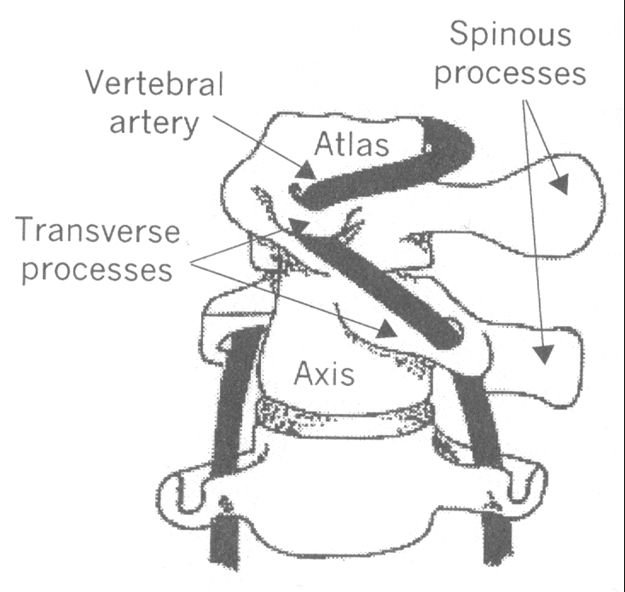
Because of this kinking, it is particularly susceptible to injury. Even a simple thing like extending the neck back over the basin for hair washing at the beauty salon has been known to cause a stroke. The artery is elastic, but with hardening of the arteries, with cholesterol plaques, with trauma (like automobile accidents) or simply with rapid stretching, the delicate lining of the artery can tear. It is easy to imagine how a rapid, forceful thrust by a chiropractor could cause damage.
Sometimes the damage is immediate and the patient collapses on the chiropractor’s table. Sometimes mild symptoms start immediately and progress after the patient leaves the chiropractor’s office. Sometimes the tear is a small one and it clots over; then days later the clot breaks loose, travels to the brain and causes a delayed stroke. By this time, the patient may not connect his sudden collapse to the previous visit to the chiropractor.
Chiropractors are well aware of the risk. They discuss it in their journals and online forums. They have tried to find ways to screen patients for high risk, but there is no reliable way to do so. Strokes are a major reason for chiropractic malpractice insurance payouts – 9% of claims paid by the major chiropractic insurer in 2002, the only year for which I was able to find statistics. Some chiropractors are now asking patients to sign an informed consent form before manipulations. If asked, most chiropractors downplay the risk, saying it occurs in less than one in a million manipulations. Many (perhaps most) chiropractors do not mention the risk at all.
Most alarming: some chiropractors perform these neck adjustments with no warning and without permission. I met a woman who still walks with a limp and has other residual impairments from a chiropractic stroke. She went to her chiropractor for a shoulder problem and thought he was going to massage her shoulder muscles. She did not want him to manipulate her neck, did not give him permission, and didn’t realize what he was doing until he suddenly twisted her neck. She collapsed on the table and nearly died.
How often can a stroke be attributed to neck manipulation? We really don’t know. Estimates have varied from one in ten million manipulations to one in 40,000. I should clarify that only one specific type of stroke, basilar stroke, has been linked to chiropractic. It has been estimated that about 20% of all basilar strokes are due to spinal manipulations. This would work out to about 1300 a year in the U.S. But we just don’t know, because it has not been properly studied. Carotid artery strokes have also been reported after chiropractic treatments. Chiropractors do not follow up on every patient. Patients who have delayed strokes may never see their chiropractor again, so chiropractors would naturally tend to underestimate the risk. Many of these diagnoses are missed because the vertebral arteries are not typically examined on autopsy.
One study of patients under the age of 45 who had this kind of stroke showed that they were 5 times more likely to have visited a chiropractor in the preceding week than control patients. In the past, neurologists treating stroke patients simply did not ask patients about chiropractic; and when they started asking, they started finding. There have been deaths. There have been court cases. In 2002, a group of Canadian neurologists issued a statement of concern to the public, recommending vigilance, education, informed consent, and other measures to protect the public. Awareness is rising, and injured patients have formed organizations in the US, Canada, and the UK both for support and for litigation.
Defensive chiropractors have tried to counteract the growing body of evidence with studies like this one, which concluded that “SMT [Spinal Manipulation Therapy] resulted in strains to the VA [Vertebral Artery] that were almost an order of magnitude lower than the strains required to mechanically disrupt it. We conclude that under normal circumstances, a single typical (high-velocity/low amplitude) SMT thrust is very unlikely to mechanically disrupt the VA.” That’s certainly true. It is unlikely. Under normal circumstances. But it does happen.
They tell us that the stroke would have happened anyway. Maybe. We don’t have any way of knowing. But when the patient collapses immediately after the neck is twisted, I think we can say the stroke wouldn’t have happened at that time without the manipulation. Given a choice of sooner or later, later is good.
They tell us that other treatments for neck pain, like NSAIDs, also carry dangers. Patients have developed bleeding ulcers and died from taking aspirin. That’s very true, but they are invoking the logical fallacy known as tu quoque: just because something else is dangerous too, that doesn’t make neck manipulation any less dangerous. And comparing the dangers of two treatments doesn’t mean there aren’t other options that are safer than either of them.
Until really good studies are done, we simply don’t know the magnitude of the risk; but we are reasonably confident there is a risk. Now, let’s measure that risk against the benefits. Some chiropractors are doing neck adjustments on 90% of their patients for everything from ear infections to low back pain. There are lots of testimonials, but no POEMS (patient-oriented evidence that matters) and no evidence of any long-term benefit or any advantage over other treatments. The only thing neck manipulations have been shown to help with is mechanical neck pain, and a recent Cochrane review did not find that manipulation was any better than simple mobilization treatments. If there is no benefit, isn’t any degree of risk too much?
There are plenty of other options for treating mechanical neck pain for those who prefer not to take pain pills. The cervical spine can be gently mobilized with physical therapy methods that have not been linked to stroke. Heat, massage, tincture of time, exercises and other measures may offer symptomatic relief with no associated risks.
“Don’t ever let a chiropractor touch your neck “is the safest advice; but we can’t expect everyone to accept it. Some patients have had good experiences with neck manipulations and will continue to ask for them. We can’t presume to dictate to others. If someone judges that there is a one in a million risk of a stroke and is willing to take that risk, he has every right to do so. I think people have the right to engage in risky behaviors like skydiving and smoking cigarettes. I just think they deserve to know there is a risk, and to have some idea how much of a risk it is. I suspect the general public doesn’t know the facts about neck manipulation.
I wonder if Laurie Jean Mathiason knew neck manipulations could cause strokes. This 20 year old girl had a tailbone injury and sought out a chiropractor who manipulated her neck. Yes, her neck – to fix her tailbone! She fell into a coma and died three days later. Her visit to the chiropractor might qualify her for a Darwin Award. In my opinion, it qualifies as a tragedy and a crime.
For more information and links see: http://www.quackwatch.org/01QuackeryRelatedTopics/chirostroke.html
I like the blog but, as someone who spent many happy minutes skydiving, I think putting it next to smoking is a little unfair.
Yes, it’s risky but the risks are immediate and obvious and most if not all taking part are aware of them – there are always exceptions. Smokers as I understand it, don’t feel the risk because it’s potentially years away and I wonder how many appreciate the many ways smoking can kill them?
The skydiving industry, at least here in the UK, is pretty good at preparing people for their first jump. I don’t think the tobacco industry has a similar approach – who reads wrappers?
Other than that, keep up the good work :*)
I’ve never been to a chiropractor, but I’m always cracking my neck. Is there a consensus in the medical community about whether I’m in danger of doing this to myself?
I don’t think there’s any consensus because I don’t think the issue has been addressed. I don’t think cracking your own neck is comparable to the high-velocity/low amplitude chiropractic techniques that have been most associated with damage. But on the other hand, since simple things like tipping the head back for a shampoo, painting ceilings, or turning the neck to look behind the car have been known to precipitate a stroke, maybe there is a slight risk. Especially if you have susceptible arteries, which is something you would have no way of knowing.
One commenter on Wiki-Answers said, “All depends on how you crack them. Cracking your back by stretching it or your neck by rolling it around shouldn’t cause any damage. But, if you use your hands to twist your neck around to get it to pop, you risk possibly damaging the vertebrae in your neck (either slipping,cracking, or even possibly rupturing a disk in extreme cases).”
In short, the more like chiropractic thrusts, the worse; the more like gentle mobilization, the better.
The latest issue of Dynamic Chiro http://www.chiroweb.com/columnist/edwards/index.html says the customer presents in the chiro office with VBA dissection in progress, and the chiro just gets the blame!? I thought they had a growing recognition of their culpability, while they played it down as a normal risk accompanying any therapy. As Harriet said- there is no need for the neck-snap in the first place. That is, risk/benefit results in division by zero, an unacceptably large number.
Thank you, Dr Hall, for such a straightforward and impartial article on this topic.
It’s particularly interesting that you say that “chiropractors are well aware of the risk”, because that doesn’t appear to be universally true. For example, as recently as December 2006, Peter Dixon, Chairman of the General Chiropractic Council (the UK regulatory body), claimed that “there’s no available evidence to show that manipulation of the neck by chiropractors has ever caused a stroke”:
http://www.gcc-uk.org/files/link_file/DAILY%20MAIL%2012%20December%202006.pdf
Perhaps that statement would have been less misleading if Mr Dixon had cared to mention that there has never been a formal reporting system in place in the UK to which patients can report any complications they may experience during, or following, their chiropractic treatment. In addition to that, he also failed to mention that despite the fact that (chiropractic) spinal manipulation is widely used on children, paediatric safety data are virtually non-existent:
http://www.ncahf.org/digest07/07-14.html
With regard to your comments that everyone deserves to know about the potentially life-threatening risks associated with chiropractic neck manipulation, it’s disappointing to learn that chiropractors themselves are, in many cases, not telling their patients of the risks when carrying out their legal obligation to obtain informed consent:
Consent: its practices and implications in United Kingdom and United States chiropractic practice: Results from this survey suggest a patient’s autonomy and right to self-determination may be compromised when seeking chiropractic care. Difficulties and omissions in the implementation of valid consent processes appear common, particularly in relation to risk.
http://www.ncbi.nlm.nih.gov/sites/entrez?Db=pubmed&Cmd=ShowDetailView&TermToSearch=17693332&ordinalpos=6&itool=EntrezSystem2.PEntrez.Pubmed.Pubmed_ResultsPanel.Pubmed_RVDocSum
Consent or submission? The practice of consent within UK chiropractic: Results suggest that valid consent procedures are either poorly understood or selectively implemented by UK chiropractors.
http://www.ncbi.nlm.nih.gov/sites/entrez?cmd=Retrieve&db=pubmed&dopt=AbstractPlus&list_uids=15726031
Perhaps the reason for this is that chiropractors don’t want to deter patients from proceeding with their treatment. For the UK, that would be entirely understandable since most chiropractors work in private practice.
For those who haven’t read it, in their new book ‘Trick or Treatment? Alternative Medicine on Trial’, Professor Edzard Ernst and Simon Singh propose that all chiropractors be compelled by law to disclose the following to their patients about chiropractic therapy:
“WARNING: This treatment carries the risk of stroke or death if spinal manipulation is applied to the neck. Elsewhere on the spine, chiropractic therapy is relatively safe. It has shown some evidence of benefit in the treatment of back pain, but conventional treatments are usually equally effective and much cheaper. In the treatment of all other conditions, chiropractic therapy is ineffective except that it might act as a placebo.”
And perhaps the following information which is provided by The Chiropractic Stroke Awareness Group could be added to that:
“Did you know that a cervical adjustment can tear or crush an artery to your brain causing a stroke?
Did you know that it can take days or weeks after the artery is torn before you actually have a stroke following a chiropractic adjustment?
Symptoms
Nausea, vomiting, dizziness, weakness, slurred speech, sudden numbness on one side of the body, vision problems, severe headache”
http://www.chiropracticstroke.com/
For anyone wishing to learn more about chiropractic, the Kinsinger Report on Chiropractic 2008 (approx. 42 mins) is well worth viewing:
http://ph-ms.ouhsc.edu/ah/rehab/kinsinger.wmv
I think that if you looked at the documented benefits of neck manipulation (marginal, but probably positive in acute neck pain, probably absent in chronic neck pain) vs the documented potential for catastrophic complications, you would conclude that it wasn’t worth the risk. In the case of epidural anaesthesia, the rate of complications which can be catastrophic is balanced by the well-documented reductions in general anaesthetic complications and postoperative respiratory complications. The search for better and safer ways of doing the same thing is ongoing, and in a few years epidurals may well be obselete. Again, if the risk is known about and efforts have been made to identify at-risk patients which are not reliable, the treatment should be dropped from the ‘therapeutic’ armamentarium of manipulative therapists.
What’s so hard about that ?
(closes eyes and waits for roof to fall in…)
I agree with most of the article except comparing the risk of cervical manipulation to Cig smoking. When you show the risk in 1-millions or even 1-40,000 the risk of cig smoking is much more. Also, the risk of over the counter medication has been listed as 1-10,000. So is there risk, yes, most everything has risk, just listen to Persciption med adds on the TV, the side effects are worse than what you are taking the meds for in the first place.
I was also surprised from the reply on if “self adjusting was bad”. The reply, as long as its not done by a Chiropractor it maybe safer is absurd. The article itself talked about the mechanism of the manipulation as being the culprit. Rotation, extension are the two evils. Self manipulation does both, rotating the neck in circles to “stretch the neck” is also very dangerous and risky yet they still teach this in some exercise classes.
If the neck is manipulated by a Board Licensed Doctor of Chiropractic who understands the risks, uses techniques that use NO rotation and No extension than the risk is very, very low. Just as if you get medications from a Board licensed Medical Doctor vs ordering meds on line. Doctors of Chiropractic are just that, they are Doctors and most know the right from the wrong, yet you see Therapists, karate instructors, Medical Doctors with no training, yoga instuctors and friends “popping necks”. This is very dangerous. Done by the rightly trained person, who understands the proper anatomy, proper biomechanical and neurological function, and proper low risk techniques, the results can be fantastic.
You can talk about people dying on a a Chiropractic table, but then you can also talk about the millions who die on the surgical table or in the hospital. Those who went in for routine problems and never walked out, I bet those numbers are higher.
When properly trained, properly educated and doing what they do best the results can be amazing. All health care providers have a place in the health care field and all do amazing things. To say never let a Chiropractor touch a neck is ignorant. I would say, never let an untrained person manipulate your neck. That includes self manipulation, a medical doctor or therapist with no training, your trainer or yoga instructor or the guy down the street. That is a risk I would not want to take.
Thank you for your good articles.
Tweyman,
Either you didn’t read carefully or I didn’t write as clearly as I thought.
“comparing the risk of cervical manipulation to Cig smoking” – I wasn’t comparing them. Smoking is the leading preventable cause of death; neck manipulation is far less dangerous. I mentioned them together only to show that we allow people the right to take risks, and that I support that right as long as they know they are taking a risk.
“the risk of over the counter medication has been listed as 1-10,000″ Where did you get that number? Surely not deaths: perhaps side effects? As a matter of fact, my article mentioned the risks of medication. We need to look at the risk/benefit ratio for any treatment, and if the benefit of neck manipulation is no greater than the benefit of gentle mobilization, I don’t see how any degree of risk can be justified.
“as long as its not done by a Chiropractor it maybe safer is absurd” That’s not what I said. Please read again. Simple rotation and extension can rarely cause stroke in susceptible patients, but high-velocity chiropractic thrusts have been linked to stroke in young healthy people because of traumatic tears in the artery. I think most reasonable people would agree that the more like a rapid, forceful chiropractic thrust, the greater the danger.
“If the neck is manipulated by a Board Licensed Doctor of Chiropractic who understands the risks, uses techniques that use NO rotation and No extension than the risk is very, very low”
If there is no rotation or extension, then that is not chiropractic manipulation.
” the results can be fantastic.” This is not supported by the literature.
“You can talk about people dying on a a Chiropractic table, but then you can also talk about the millions who die on the surgical table or in the hospital.” Apparently you didn’t understand what I said about the “tu quoque” fallacy. Please read my article again.
“I would say, never let an untrained person manipulate your neck.” I agree with you there; but even trained people can do damage. I would say, let a trained person do gentle mobilization but never let anyone do high-velocity chiropractic-type thrusts.
“If there is no rotation or extension, then that is not chiropractic manipulation”
Where did you get your information, there are many techniques performed by Licensed Chiropractors that do not use Rotation or Extension. The use of a high-velocity LOW AMPLITUDE thrust can be done with the neck not in extension and no rotation and the results are fantastic. There are only a few techniques still taught but rarely used that put the neck in extension and rotation and most Licensed Chiropractors do not use these techniques anymore.
Just as surgeons have changed their techniques in time due to advances in knowledge, literature and risks, Chiropractic Techniques have also advanced, changed and evolved.
Instead of saying “never let anyone do high-velocity chiropractic-type thrusts” take out the word Chiropractic and just add, “never let anyone do high-velocity untrained thrusts into ones neck”. I have seen Osteopaths manipulate cervical spines with “osteopathic manipulation” that made my toes curl. Using crude rotational moves that would should be banned. I have seen Neurologist manipulate cervical spines with High Velocity High Amplitude thrusts that should be rendered malpractice.
You missed one word in your letter, low amplitude, that makes a lot of difference. Calling cervical manipulation, Chiropractic-type manipulation is like calling Fascial tissue- kleenex. Its a brand and you are using it too broad based. The changes can be subtle and a good licensed Chiropractor knows when to use what technique for what condition and there are hundreds of techniques out there.
I agree with you on a high velocity move with extension and rotation should be outlawed and never used. Make sure you target osteopaths, neurologist, Physical therapists and other practioners. Knowledge is power and I am glad that you are calling attention to moves that can cause damage, just don’t single out the profession who has evolved and is doing its best to do it correctly. When comparing risks, manipulation done by Chiropractors is very, very low. Manipulation of cervical spine done by others can be higher.
Tweyman’s comments point out one of the difficulties in determining the risk of neck manipulation: the wide variation in techniques. Chiropractors use over 200 different techniques. The Cochrane review I referred to only distinguished generally between “manipulation” and “mobilization.”
According to Samuel Homola, DC, “Manipulation is a hands-on procedure used to restore normal movement by loosening joints and stretching tight muscles. In some cases, manipulation will restore normal movement by unlocking a joint or by breaking down adhesions. A popping sound often occurs when a spinal joint is stretched a little beyond its normal range of motion. Mobilization simply stretches soft tissues by moving joints through a full range of movement.”
The classic manipulation technique that most people associate with chiropractors “cracking the neck” is the high velocity/low amplitude SMT thrust. The article I mentioned from the chiropractic literature specified this particular technique in an unconvincing attempt to show that neck manipulation by chiropractors was safe.
If there is a technique that counts as “manipulation” that is safer than “mobilization,” the Cochrane review did not consider it, and I don’t think there is anything in the literature that substantiates it.
I don’t accept that chiropractic “has evolved and is doing its best to do it correctly.” A minority of chiropractors may fall into that category, but there are still a lot of chiropractors out there who are doing the most dangerous type of manipulation and who are doing it for the wrong indications.
I’m “targeting” anyone who uses these risky techniques inappropriately. They are indeed used by osteopaths and others, but the majority of manipulations are performed by chiropractors, and chiropractors are the ones who have been implicated in the published studies of stroke risk.
You say manipulation done by non-chiropractors carries a higher risk. Do you have any evidence to support that claim? I would think what matters is whether the practitioner was properly trained in SMT and has good judgment rather than what title he holds. I would rather have a properly trained PT work on my neck than a chiropractor who believes in mythical subluxations.
Tweyman, watch the video linked, above, by Blue Wode. In fact, you can just listen to it while you are doing something else. Dr. Kinsinger has scores of case reports of stroke following manipulation by chiros, and none by PTs. He draws the reasonable conclusion that the difference is because PTs are better educated to recognize the indications for manipulation, and better trained in administration of it. It helps that they do not study fairy-tale subluxations, and they do see people who need therapy in their clinics (as opposed to young, healthy friends who are recruited to pose as customers in chiro clinics).
As for your claim “we don’t do that any more” is nonsense. Look at the dates in the cases Harriet cited.
Moreover, nobody really knows what chiros do in practice; there are more than 100 unproven methods in use. They range from NUCCA nuttiness (see the report of the woman whose neck was manipulated for pain in the tailbone!?) to the Logan technique which focuses on the other end.
The chiropractic license is conferred by other chiros, who believe in such nonsense as subluxations. It cannot be taken seriously. Can you cite anything that is treatable on the basis of a subluxation? Manipulation, after all, is not chiropracty.
Wow there is some bias out there. I don’t argue that better research needs to be done.I also think that the Chiropractic Profession needs to continue to work on improving the literature out there, the information to the public and getting the word out on all the differences out there. For example, are you aware that there are fellowships and specialalities in the profession? Such as pediatric, orthopedic, sports specific, radialogy and neurology? These are 4 more years of education with longer residencies yet most people do not know about that. Its said that the information is slow to get to peoples ears and minds.
The other problem, most techniques are done with hands, so the results are hard to put into Pub med papers since hands vary. I have seen the same ACL surgery performed by two different surgeons with a very similar person yet two different results. Why one of the surgeons was more skilled and used newer techniques. To put down the profession of the unskilled would be unfair. There are good and bad in all professions.
No offense Harriet, but to say “I don’t accept that chiropractic “has evolved and is doing its best to do it correctly.” is ignorant. That is like saying that medicine has not evolved in 50 years, look back at what was legal to do 30 years ago. The problem is only the bad seem to make the news and the good Docs who are evolving do not. Techniques are always changing and the Good Docs are always evolving and learning. 10% always make the most news in any profession.
The other comment that PTs and Osteopaths have not causes strokes is untrue as well. There are many osteopaths who use manipulation as their main source of healing and some of their techniques involve a lot of rotation in the cervical spine. Yet, they do a lot of good as well, so do the PTs who manipulate.
The education in Chiropractic School is very good. There are those that have strong feelings of the “subluxation therory” and those that don’t. The license that is given is by other licensed Chiropractors, true, but so is the PT credential and Medical Doctors is given by their peers. Is that wrong, no.
There are many Professional and College teams that use Good Chiropractors, Pts, MDs in harmony to give the patient what is needed. Its easy to find the 10% who give every profession and bad name and cause most of the risk, to put down a profession is wrong, to go after to individual practioner who is doing wrong is right. With health care the way it is we need to focus on getting rid of the practioners (ie Medical Doctors, Chiropractors, Therapists) who are using old techniques, are not staying up on the education and who are causing the damage that has been reported in this blog.
Tweyman, anybody who has properly studied anatomy and physiology, and chiro, is bound to be biased. I take it you are not going to provide references to treatments of subluxations.
Of course PTs and MDs are credentialed by their peers; but their peers don’t believe in fairy tales such as chiropractic subluxations and Innate Intelligence. And those are the reasons chiro is a cult, not a profession. When Palmer’s ideas are shown to be ridiculous, they cannot be abandoned. Many chiros still believe that DD cured deafness, despite the anatomical implausibility and the lack of any subsequent replications.
“Chiropractic specialties” yes, we know about them. There is a tarot-card reader near me who specializes in round (rather than rectangular) cards. It doesn’t make her any better informed.
As for “… PTs and Osteopaths have not cause[d] strokes …” it may be untrue; but I did not say that. Listen to the Kinsinger video, cited by Blue Wode. He does not say that either.
You wrote “The education in Chiropractic School is very good.” I must ask, “compared to what.” How would you know?
You wrote “There are those that have strong feelings of the “subluxation theory” and those that don’t.” According to the McDonald study approximately 90% subscribe to that fairy tale, and the Association of Chiropractic Colleges says it remains the focus of chiro. If you take that away, chiro is just massage (with the possibility of killing people).
You wrote “There are many Professional and College teams that use Good Chiropractors …” Many of them pray a lot, too; that doesn’t help, either. Tiger Woods wears (wore?) a red shirt on the final day of every tournament for luck. I will concede that a chiro can be a competent masseur; but I would just go for a massage from someone without delusions about health care (subluxations, Innate).
On the Healthfraud discussion list on the Quackwatch website, we had a long discussion over many months with Stephen Perle, a DC and a professor of chiropractic at Bridgeport University who is valiantly trying to reform chiropractic from within. He tried his best, but was unable to convince us that the scientifically oriented chiropractors make up more than a small fraction of those in practice. There are no good published studies of how many chiropractors reject irrational methods, but I know of 2 unpublished, informal studies showing that the majority of chiropractors accept the subluxation myth and use nonsensical methods like applied kinesiology. Their own published studies show that half of chiropractors endanger our public health by failing to support immunization, and about a third of them actively discourage it.
I’m well aware that chiropractors can become specialized in areas like chiropractic neurology. Here’s an example of the quality of the information students learn: http://www.chirobase.org/06DD/blindspot.html
If one of the major teachers of chiropractic neurology is this clueless about science and logic, I don’t have high hopes for his students.
As for chiropractic evolving, evolution is more than just developing and refining techniques; it must also involve testing techniques and discarding those that don’t work or that don’t work as well. Medicine has tested and given up countless treatments and diagnostic procedures over the last century. I have repeatedly challeged chiropractors to tell me one thing that chiropractic as a whole has given up: the only thing I have been able to find that no chiropractor is still doing is the bogus nerve tracing technique that BJ Palmer invented.
I’ll believe chiropractic is evolving when the major chiropractic organizations and schools reject the subluxation myth and things like applied kinesiology and when they firmly endorse vaccination.
I don’t claim that osteopaths and PTs have never caused strokes. I only claim that the evidence we have suggests that the majority of manipulation-induced strokes are caused by chiropractors, many of whom are using manipulation for the wrong indications.
I have no problem with chiropractors who limit their practice to evidence-based short term treatment of musculoskeletal problems. Unfortunately, they represent only a small fraction of practicing chiropractors, and when they speak out, they are often reviled and attacked by their less scientific colleagues.
Harriet et al.,
I must admit there is a huge struggle within our profession (and Joe, it’s a profession, not a cult) to weed out the unscientific rhetoric and evangelistic sales pitches and replace them with science based practice.
This was specifically why the chiropractic physicians in Florida raised $1 Million to support a research institute at Florida State University. Unfortunately for our profession and for our patients, this effort was thwarted by those “cult-ish” type chiropractors.
I, like Stephen Pearle (who is a friend and whom I consider a mentor) and many others don’t understand why these subluxation based (aka “straight”) chiropractors are so confidant with their positions that subluxation does everything they say; are afraid of having a world class research facility actually investigate their theories. Rather, they made a concerted effort to squash what would have and could have led to an evolution in chiropractic science. And, Stephen is right when he says those straight type chiropractors are in the minority. They are extremely vocal. We on the otherhand, continue to push on with our evidence based practice and the push for continued research. Hey, if the research proved their point, then I’d tout it as well. But not until such a time as credible works prove the theories.
Because our profession has been under the magnifying glass for such a long time, we have managed to get some credible peer reviewed research out there. But it is not enough, more definately needs to be done and there is much currently under way.
Regarding cervical spine adjustments and stroke, it’s on the mind of every chiropractic physician out there. Personally, I have a written informed consent that describes the risks as we know them. In my office, the patient must read and sign the inform consent, which not only covers the risks of verebral artery dissection type stroke(the paper simply says stroke), but also includes the risks of other therapies such as Ice and Heat, EMS, Exercise, Stretching etc. This often leads to a brief conversation and ends in a benign fashion with the patient givine their consent.
The important thing for us is to be aware that most people come to the chiropractic physician with the stroke already in progress. Signs of neck pain, headache, migraine type headaches are all reasons for patients to present, however they physician needs to stop and asses the patient and not just brush it off as just another headache.
does the patient present withsigns of diplopia, dizziness, drop attacks, dysphagia, dysarthria, ataxia of gait, nausea, numbness & nystagmus? Do they describe the “worst headache of their life”???
If so, the correct thing to do is call 911 and get them to the ER asap. Not, adjust them and see how they feel.
There is a huge separation between the subluxation based and the evidence based chiropractors in this country, and the gap is widening.
For the individual who suffers a vascular accident; as well as their family and friends, it must be horrible. But the numbers of these cases are much less than are pointed out in literature. 1 of these patients will visit 1, 2, 5 or more neurologists and it gets reported by each. That 1 case has now turned in to 2 or 4 or more and each is reported as a seperate incident.
Additionally, there are papers that show that so called “chiropractic manipulations” causing vascular accidents were never performed by a chiropractor. That they used the term chiropractic manipulation as a general term, even though a properly trained and licensed chiropractor wasn’t involved. There have even been letters published in the very same journals admitting to the errors in terminology. Here’s a link to one such summary:
http://www.chiro.org/ChiroZine/ABSTRACTS/Inappropriate_Use_of_the_title.shtml
Personally, I have a great relationship with the local medical community. I have a cardiologist, cardiothoracic surgeon, 1 general family practice physician, 1 pediatrician, 3 nurses & 2 physical therapists currently actice as patients. I actively get referrals from the pediatrician, 2 local internists (several have been specifically for headaches) and a local orthopedic surgeon; and I refer patients back to them.
The difference? Taking a good history, doing a good examination, keeping proper records and practicing evidence based chiropractic and develping a good relationship with my colleagues in the medical community. Over the years of practice, I’ve had 2 people walk into my office with an active stroke in progress, 3 people having mid-back pain and radiating arm pain in the early stages of a myocardial infarction. All were immediately sent to the local E.R., and all are alive and relatively well. Hopefully, most of them changed their eating and exercise habits.
I would ask that before further condemning my profession, you look into the works of:
1. Scott Haldeman, DC, MD, Ph.D (his medical specialty is neurology)
2. John Triano, DC, Ph.D
3. David Seaman, DC, DACAN
These are the people whom I seek out when attending continuing education seminars as well as others who speak int he area of sports medicine, nutrition and rehabilitation. Most of the chiropractors I know and all of the ones I consider colleagues do not practice subluxation theory chiropractic, but chiropractic based on evidence published, guided by some of the works of the 3 aforementioned. Studies on the effectiveness of spinal manipulation have been published in Spine, JMPT and others. There more out there and I don’t have the luxury of time to get all of the references.
Chiropractic physicians (specifically chiropractic sports physicians) have been on the medical team for the US Olympic Team since the 1980s. Additionally, all NFL teams, most MLB and NBA teams all have chiropractors for their athletes. If chiropractic were that dangerous, why we these organizations allow their elite athletes to be exposed to that great of a risk? Why is it that $1-Million in malpractice insurance cost only $3-5 thousand dollars a year? Because, the risks are minimal for causing harm. Weight the risks vs the benefits and the only conclusion is that for the conditions we treat, chiropractic is safe and effective.
I would like to leave you with the following, which pretty much sums up the neck adjustment-stroke issue and that my colleagues and myself view as credible. All referenced for Dr. Lauretti’s article are provided at the bottom of the article.
What are the Risk of Chiropractic Neck Treatments?
________________________________________
By William J. Lauretti, DC
Several recent news items have reported on the supposed risks of chiropractic manipulation to the neck. As a practicing chiropractor who uses neck manipulation everyday in my practice, I find these reports exaggerated and alarmist. In seven years of practice, I have personally performed, received and/or witnessed well over 7,000 neck manipulations, without a single significant complication. Clearly, the risks of neck manipulation are not as extreme as some of the more irresponsible reports imply. I believe the rash of sensationalist reporting has obscured the three key questions involved in this issue:
1. Just how risky is chiropractic neck treatment (cervical manipulation)?
2. How risky are the other common treatments for neck symptoms compared with chiropractic treatments?
3. How effective is chiropractic neck treatment compared to other common treatments?
This essay will discuss these points and attempt to clarify this issue for consumers, health care practitioners and policy makers.
How Risky is Cervical Manipulation?
Every published study which has estimated the incidence of stroke (CVA) from cervical manipulation has agreed that the risk is 1 to 3 incidents per million treatments. Dvorak, (1) in a survey of 203 practitioners of manual medicine in Switzerland, found a rate of one serious complication per 400,000 cervical manipulations, without any reported deaths, among an estimated 1.5 million cervical manipulations. Jaskoviak (2) reported approximately 5 million cervical manipulations from 1965 to 1980 at The National College of Chiropractic Clinic in Chicago, without a single case of vertebral artery stroke or serious injury.
Henderson and Cassidy (3) performed a survey at the Canadian Memorial Chiropractic College outpatient clinic where more than a half-million treatments were given over a nine-year period, again without serious incident. Eder (4) offered a report of 168,000 cervical manipulations over a 28 year period, again without a single significant complication. After an extensive literature review performed to formulate practice guidelines (5), the authors concurred that “the risk of serious neurological complications [from cervical manipulation] is extremely low, and is approximately one or two per million cervical manipulations.” The “one in a million” estimate was echoed in another extensive literature review performed by the RAND corporation (6).
In another survey, based on a computerized registration system in Holland, Patjin (7) found an overall rate of one complication in 518,886 manipulations. A survey done at Stanford University (8), asked every neurologist in California if they saw any neurological complications they thought resulted from chiropractic treatment in 1990-91. Their survey found 55 reported CVAs statewide over that two-year period. During that period there were about 110 million office visits to chiropractors in California, and between 33 and 50 million neck adjustments. Other experts on manipulation (9)have published opinions that the risk of stroke from cervical manipulation is two or three more-or-less serious incidents per million treatments.
In addition to these published studies, data from the National Chiropractic Mutual Insurance Company (NCMIC), which insures over 50 percent of US chiropractors, is also useful for estimating the risk of cervical manipulation. Since chiropractors deliver 80-90 percent of the spinal manipulation performed in the US, and this company insures about one-half of the profession in the US, this malpractice insurer is a good source of statistics on this subject. According to a member of NCMIC Board of Directors (personal communication with Louis Sportelli, DC, Dec. 21, 1994), in the three years of 1991-92-93, NCMIC closed a total of 96 claims for CVA; of this total 61 were closed with payment, and 35 were closed without payment. If one concludes that there was little or no merit to the 35 claims which were closed without payment, this would represent an average of 20 CVA claims per year.
If these NCMIC chiropractors are similar to the national average, they see approximately 120 patient visits per week (10). Curtis and Bove (11) report that rotary adjustments of the cervical spine comprise about 30% of the visits made to chiropractors. Therefore, chiropractors insured by NCMIC each performed some 1800 cervical manipulations in each of those three years. Considering these numbers, we calculate that NCMICs 24,000 DCs perform some 43,000,000 cervical manipulations per year. If this leads to 20 strokes, that’s a rate of less than one stroke per 2 million cervical manipulations.
Another study based on malpractice history was done in Canada (12). This study reported there were 13 documented CVAs related to chiropractic care in Canada (with no reported deaths) over a 5 year period. The author estimated there were at least 50,000,000 cervical manipulations performed by Canadian chiropractors during that time period. He concluded that a reasonable estimate of risk is 1 serious neurological complications per 3,000,000 neck manipulations.
Finally, in what might be the best documented study to date, Klougart et al (13). sought to identify the total number of cases of CVAs related to chiropractic manipulation that occurred in Denmark over a ten-year period. They surveyed all members of the Danish Chiropractors’ Association, and cross-referenced the members’ reports of CVA occurrences with published cases, official complaints and insurance data. Then they estimated the total number of neck manipulations performed by chiropractors over the same time period from the survey responses cross-referenced with insurance reimbursement data. They found five cases of “irreversible CVA after chiropractic treatment” occurred in Denmark between 1978 and 1988, in the course of 6,600,000 cervical spine treatment sessions. They estimated a risk of 1 CVA per 1,320,000 cervical spine treatments sessions, and 1 CVA per 414,000 cervical spine sessions using rotation techniques in the upper cervical spine.
Based upon these studies, the most reasonable estimate of the risk of stroke from cervical manipulation is one-half to two incidents per million manipulations performed. Only a minority of these cases are fatal. About one-third of the cases of stroke following cervical manipulation reported in Terrett’s review of 107 cases (14) resolved with mild or no residuals. In a later review, Terrett (15) found a total of 126 cases of vertebrobasilar accidents following manipulation reported in the international literature from 1934-1987, of which 29 cases resulted in death. This yields a mortality rate of 23% among the incidences reported in the literature. While it has been argued that the rate of strokes may be significantly under-reported in the literature, it is probable that the rate of deaths are proportionally over-reported, since it is likely the more serious and impressive cases would be described in the literature. Therefore, a conse! rvat ive estimate of the risk of death from stroke caused by neck manipulation is about one fatality per 4,000,000 neck manipulations.
Risks of Other Common Treatments for Neck Symptoms
For proper perspective, the risks of chiropractic neck treatment should be compared to the risks of other treatments for similar conditions. For example, even the most conservative “conventional” treatment for neck and back pain, prescription of Non-Steroidal Anti-Inflammatory Drugs (NSAIDs), may carry a significantly greater risk than manipulation. One study (16) found a 4/10,000 annual mortality rate for NSAID induced ulcers among patients treated for non-rheumatic conditions such as musculoskeletal pain and osteoarthritis; that extrapolates to 3,200 deaths in the US annually.
While it might be argued that the population covered in this study were only patients under long-term NSAID therapy, and that acute use carries far less risk, it is not true that these complications are limited only to chronic NSAID users. Gabriel et al, in a meta-analysis, found short-term NSAID use was actually associated with a much higher rate of GI complications than chronic use (17). They calculated that the odds ratio for adverse GI events associated with NSAID use was 1.92 for more than 3 months of NSAID exposure, but 8.00 for less than 1 month of NSAID exposure.
Less conservative treatments such as neck surgery are also commonly used for conditions very similar to the conditions chiropractors treat using spinal manipulation. There is a 3-4% rate of complication for cervical spine surgery, and 4,000-10,000 deaths per million neck surgeries (18).
Effectiveness of Chiropractic Neck Treatment
Numerous recent studies have found that spinal manipulation provides superior clinical outcomes compared to conventional care for neck and back complaints. Dozens of other studies have shown chiropractic care to be more cost-effective and more preferred by patients than medical care for several conditions.
A comprehensive literature review (6) concluded, “In summary, evidence from the literature supports the conclusion that cervical spine manipulation and/or mobilization may provide at least short-term pain relief and range of motion enhancement for persons with subacute or chronic neck pain.” They also concluded, “the literature is sparse but suggests that cervical spine manipulation and/or mobilization may provide short-term relief for some patients with muscle tension (and other nonmigraine) headaches. The evidence for long-term benefit is much less conclusive.”
The highest rated, large-scale, randomized trial comparing manipulative therapy to general practitioner management (including NSAIDs) in the treatment of back and neck pain was performed by Koes (19). He found manipulative treatment significantly superior, with the advantages for the group treated with manipulation persisting even at the 12-month follow-up.
More studies are currently underway comparing the effectiveness of cervical manipulation with other treatments for neck pain, headache and related conditions.
Ironically, despite their well-documented risks and widespread use, the evidence supporting the effectiveness of NSAIDs for neck pain is extremely limited. In a recent review of medications used for neck pain, the authors noted that the current standard of accepted practice “may rest on a quagmire of possibly valid, but unproven, treatments” (20). Even though NSAIDs are considered to be a well-established treatment for musculoskeletal pain, in a recent Medline search (1966 to 1996), we were unable to locate even a single randomized, controlled trial examining the use of NSAIDs specifically for neck pain.
________________________________________
SUMMARY:
**A reasonable estimate of the risks of stroke following cervical manipulation is 1/2 to 2 incidents per one million treatments.
**About one-third will resolve with mild or no residuals (probably more due to reporting bias).
**About one-fourth will prove fatal (probably less due to reporting bias).
**Therefore, there are about 40-50 manipulation-caused strokes in the US per year, and perhaps a dozen deaths.
To place this in perspective, if we agree that the risk of dying from a stroke after a neck adjustment is 1/4,000,000, there may be as much as a 100 times greater risk of dying from an ulcer due to taking a prescription NSAID like Motrin. If you drive about 8 miles each way to get to your chiropractic appointment, you have a statistically greater risk of being killed or seriously injured in a car accident getting to the office than of having a serious complication from your treatment.
The chiropractic profession has a well established record of safety and efficacy, and chiropractors’ malpractice insurance rates remain among the lowest in the health professions. The profession is leading the way in research to learn more about complications from treatments, and working to reduce them still further. Despite occasional sensationalistic reports in the media, the facts show that chiropractic treatments rank among the safest and most effective form of health care ever offered.
________________________________________
Bill Lauretti, DC
Bethesda, Maryland
Editorial Director, Chiropractic OnLine, the American Chiropractic Association’s Web Page.
This essay is based on an article which was published in the Journal of Manipulative and Physiological Therapeutics in October, 1995. The author will gladly send a reprint to any interested parties upon request. An expanded version will appear as a chapter in Contemporary Chiropractic (Daniel Redwood, DC, Editor), a text book to be published in 1997 by leading medical publisher Churchill Livingstone.
________________________________________
REFERENCES:
1. Dvorak J, Orelli F. How dangerous is manipulation to the cervical spine? Manual Medicine 1985; 2: 1-4.
2. Jaskoviak P. Complications arising from manipulation of the cervical spine. J Manip Physiol Ther 1980; 3: 213-19.
3. Henderson DJ, Cassidy JD. Vertebral Artery syndrome. In: Vernon H. Upper cervical syndrome: chiropractic diagnosis and treatment. Baltimore: Williams and Wilkins, 1988: 195-222.
4. Eder M, Tilscher H. Chiropractic therapy: diagnosis and treatment (English translation). Rockville, Md: Aspen Publishers, 1990: 61.
5. Haldeman S, Chapman-Smith D, Petersen DM. Guidelines for chiropractic quality assurance and practice parameters. Gaithersburg, Md: Aspen Publishers, 1993: 170-2.
6. Coulter ID, Hurwitz EL, Adams AH, et al. The appropriateness of manipulation and mobilization of the cervical spine. Santa Monica, CA: RAND Corporation 1996: xiv. (RAND Home page: http://www.rand.org).
7. Patijn J. Complications in Manual Medicine: A Review of the Literature. J Manual Medicine 1991; 6: 89-92.
8. Lee KP, Carlini WG, McCormick GF, Albers GW. Neurologic complications following chiropractic manipulation: A survey of California neurologists. Neurology 1995; 45: 1213-5.
9. Guttman G: Injuries to the vertebral artery caused by manual therapy (English abstract), Manuelle Medizin 1983; 21: 2-14.
10. Plamandon RL. Summary of 1992 ACA annual statistical survey. ACA J Chiropractic 1993; 30 (Feb): 36-42.
11. Curtis P, Bove G. Family physicians, chiropractors, and back pain. J Family Practice 1992; 35 (5): 551-5.
12. Carey PF. A report on the occurrence of cervical cerebral vascular accidents in chiropractic practice. J of Canadian Chiropractic Assoc 1993; 37 (2): 104-6.
13. Klougart N, Leboeuf-Yde C, Rasmussen LR. Safety in chiropractic practice. Part I: The occurrence of cerebrovascular accidents after manipulation to the neck in Denmark from 1978-1988. J Manipulative Physiol Ther 1996; 19: 371-7.
14. Terrett AG. Vascular accidents from cervical spine manipulation: Report of 107 cases. J Aust Chiro Assoc 1987; 17: 15-24.
15. Terrett AG, Kleynhans AM. Cerebrovascular complications of manipulation. In: Haldeman S., ed. Principals and Practice of Chiropractic. Norwalk, Ct.: Appleton & Lang, 1992: 579-98.
16. Fries, JF. Assessing and understanding patient risk. Scand J Rheumatol 1992; Suppl. 92: 21
17. Gabriel SE, Jaakkimainen L, Bombardier C. Risk for serious gastrointestinal complications related to use of nonsteroidal anti-inflammatory drugs; a meta-analysis. Ann Int Med 1991; 115: 787-96.
18. The cervical spine research society editorial committee. The Cervical Spine, Second edition. Philadelphia: J.B. Lippincott Company 1990: 834.
19. Koes BW, Bouter LM, et al. Randomized clinical trial of manipulative therapy and physical therapy for persistent back and neck complaints. BMJ 1992; 304: 601-5.
20. Dillin W, Uppal GS. Analysis of medications used in the treatment of cervical disc degeneration. Orthop Clin North Am 1992; 23(3): 421-33.
Suggested Additional Reading:
Terrett AGJ. Vertebrobasilar stroke following manipulation. West Des Moines, IA: National Chiropractic Mutual Insurance Company: 1996 (NCMIC Home page: http://www.ncmic.com).
Dabbs V, Lauretti WJ. A risk assessment of cervical manipulation vs. NSAIDs for the treatment of neck pain. J Manip Physiol Ther 1995; 18(8): 530.
Dock DP. A false claim: Stroke from manipulation. Duluth, MN: Dr. Daniel P. Dock 1994. To order call: (218) 525-2033.
Chiropracty is a cult. The proof is that cannot shed the originator’s notion of subluxations even though that idea is fully discredited. From the Association of Chiropractic Colleges (ACC), 2006:
http://www.chirocolleges.org/paradigm_scope.html
“Chiropractic is Concerned with the preservation and restoration of health, and focuses particular attention on the subluxation.”
There own survey (McDonald, 2003) shows 89% favor retaining subluxation in their practice. The ACC goes on to describe:
“A subluxation is a complex of functional and/or structural and/or pathological articular changes that compromise neural integrity and may influence organ system function and general health.” This sounds like “anything we can claim to fix and bill you for.”
Then there is the problem of Innate Intelligence
http://www.jcca-online.org/client/cca/JCCA.nsf/objects/Commentary+The+meanings+of+Innate/$file/3-Commentary%20Keating.pdf
“Since the notion was first introduced by D.D. Palmer circa 1904, “Innate Intelligence” has been a source of inspiration, confusion and derision for chiropractors. …”
They don’t deny Innate, they kinda sweep it under the carpet.
Chiros also continue to believe that, in 1895, DD Palmer cured deafness with a chiropractic adjustment of the thorax; despite the implausibility and the fact that feat has never been repeated. Slavish devotion to the originator of a notion is a pathognomonic feature of a cult.
As for being a “profession,” that word is used loosely these days to mean a member of an identifiable group. In that sense, chiro is a profession since it is characterized by opposition to criticism.
Beachdoc says, “Most of the chiropractors I know and all of the ones I consider colleagues do not practice subluxation theory chiropractic, but chiropractic based on evidence published.”
This is a testimonial, not evidence. I think Beachdoc is associating with members of a small minority rather than a random sample of chiropractic reality. His statement is contradicted by other data including the study Joe cites by chiropractors themselves.
As for chiropractic being a cult, at least one chiropractor has said it is. The full text of Samuel Homola’s book “Bonesetting, Chiropractic and Cultism” is available at http://www.chirobase.org/05RB/BCC/00c.html
Beachdoc says there is a greater risk of an auto accident on the way to the chiropractor’s office. Actually, that’s something I worry about. The risk of multiple trips to and from a chiropractor’s office must be added to the risk of the treatment itself. Other treatment options tend to require less travel.
He says “the facts show that chiropractic treatments rank among the safest and most effective form of health care ever offered.” I don’t think the facts show any such thing. Neither do Edzard Ernst or Simon Singh, who wrote an interesting article in the Guardian at http://www.guardian.co.uk/commentisfree/2008/apr/19/health that concludes “if spinal manipulation were a drug with such serious adverse effects and so little demonstrable benefit, then it would almost certainly have been taken off the market.”
I hope Beachdoc noted that I did not call for chiropractors to be taken off the market. I only asked that the risk/benefit ratio be considered and that patients be adequately informed.
That goes for any treatment for any condition, from neck manipulation to NSAIDs. The safest treatment of all is tincture of time. I think that option should be offered to every patient unless there is reason to think non-treatment would result in permanent damage.
Be very careful in reading this article. Dr. Hall does not have a clue what she is talking about. I have studied her posts on another forum. She clearly has no understanding of what chiropractic is. She is totally misguided. It is a shame because she is an intelligent person. Outside of the stroke issue she has made no tangible attempt to understand chiropractic. What I mean by this is that if she was sincere then she would take the time to spend a week in a top chiropractor’s office to experience on a clinical level what is done. You see you really cannot understand a field that involves art to a large degree by simply studying it in articles and slanted resources. If she were to take the time to see a few hundred patients with an experienced DC then she might get some insight. As far as the stroke issue. It has been even said in a major medical journal that this has been used as a weapon against chiropractors. It is extremely rare. A handful of cases are used by the anti chiropractic camp to discredit a procedure that is very safe. She does not mention that her own field is full of dangerous and unproven treatments that cause death in patients all of the time. She also fails to mention that even though there are very few strokes from manipulation the chiropractic profession is teaching and using methods to eliminate or reduce risk. She is obsessed with chiropractic but looks not at her own camp. Many people are killed by cosmetic surgeons every year and the precedures are not necessary. They play off the vanity of people and put them at risk. There are many other examples. But she is obsessed with a witch hunt on chiropractic. It is my experience from observing Dr Hall’s posts that she has an irrational fear of chiropractic. She is very selective about what she let’s into her head. You see you really cannot understand what another person knows or does without walking in their shoes. If she spent a week actually keeping her mouth shut and watching in a top DCs office she would learn something. If she ever bothered to come out to the National University of Health Sciences and spend a few days in classes and a week in the clinic she would learn something. I am sure they would have her. She would learn what chiropractic physicians know about MRI, CT, radiology and she does not. She would learn about how DCs actually manage patient using all forms of exams from eyes to gyn. She would experience the clinical reality of how chiropractic corrects imbalances in the NMS system. She would be shown the “subluxation” that she rejects as it can only be understood by experiencing hands on evaluation and reduction. If Dr Hall was open minded she would study the work of Joseph Janse and Fred Illi. But I know she will never do that. Not in a million years. So before listening to Dr Hall aske her these questions. 1. Have you ever spent a week in a chiropractors office to experience what they do? 2. Have you ever had a problem addressed by a DC or been under regular chiropractic care? 3. Can you Dr. Hall explain in some depth how the mechanics of the lower extremity, pelvis and spine relate in gaiting? 4. Have you ever observed the Derifield response as it relates to the cervical spine and the pelvis? And finally Dr. Hall what is a radiographic finding on a flat plate film in the soft tissues that is associated with Cordoma? Dr Hall in her day may have been a good surgeon but she does not no the first thing about modern chiropractic care as practiced by competent doctors. She is pathologically biased to an irrational degree. Instead of picking on problems in the profession she should look to the good. But she will never do that as with all religious zelots she is apparently trapped in a mindset. She cannot possibly know what she is talking about until she experiences chiropractic care on a high level for herself both as a patient and as an observer of a clinician. Lastly you will notice that she fails to mention that osteopathic physicians have caused a few strokes too but we never see their cases advertised. Her attack is on chiropractic by principle. It would seem that since DOs are part of the traditional medical system and in hospitals that she would be concerned with their practice. And she has no ground to say they do not believe what the DCs do. All you have to do is look at the position statements of the AOA. If Harriet would do as I say and experience reality she would actually learn something. But that is never going to happen. Because this attacking of chiropractic is obviously part of who she is. In the metabolism of the body there are two parts. One builds up the body and one tears it down. The same is true with humanity. To be focused on always tearing down something is in my opinion very imbalanced. So what about it Harriet. When are you going to tour National and spend a week there and in a top DCs office? Whe are you going to experience the care for your self? When you do that I will be more than willing to consider your position. But until then I view you as that guy that attacked windmills on horseback. If the child will open the closet they will find that there really is not a scary ghost in there. It is just a closet. No more and no less.
@ Beachdoc
You said: “I must admit there is a huge struggle within our profession (and Joe, it’s a profession, not a cult) to weed out the unscientific rhetoric and evangelistic sales pitches and replace them with science based practice.”
Well, here in the UK there doesn’t seem to be any ongoing struggle. Although UK chiropractors became regulated by statute in 2001, which created a new code of ethics requiring their provision of care to be evidence-based, it would seem that the members of all four UK chiropractic associations continue to buy into the subluxation myth:
The British Chiropractic Association’s website says “As you go through life, a loss of proper function (movement) in the vertebrae, which some chiropractors call a subluxation, may interfere with the healthy working of your spine and the nerves that run through it. This may affect your body’s natural ability to recover from injury and you may find yourself increasingly unwell, unable to shake off apparently minor aches, pains and even some illnesses.”
http://www.chiropractic-uk.co.uk/gfx/uploads/textbox/Servicing%20your%20spine.pdf
The UK McTimoney Chiropractic Association says “By correctly training hands as an instrument of innate intelligence, healing can be encouraged to take place by the detection and correction of bony subluxations (slight displacements)”:
http://www.mctimoney-chiropractic.org/mca_objectives.htm
The UK United Chiropractic Association says (on the subject of ‘vitalism’) “We ascribe to the idea that all living organisms are sustained by an innate intelligence, which is both different from and greater than physical and chemical forces. Further we believe innate intelligence is an expression of universal intelligence…We recognize that interference to innate intelligence (subluxation) diminishes healing capacity, with an alteration in the dynamic interrelationship between mental, physical and social aspects of the whole person”:
http://www.united-chiropractic.org/modules/content/index.php?id=4
And the Scottish Chiropractic Association says “Chiropractors are able to examine and evaluate a child’s spine to determine if they can help problems such as colic, asthma, bedwetting, eczema and sleeping difficulties. Chiropractors advise that a child’s spine be checked for subluxations and postural distortions before any symptoms are even present”:
http://www.sca-chiropractic.org/index2.htm
Indeed, if its (vague) definition of ‘subluxation’ is anything to go by, it would seem that the regulatory body, the General Chiropractic Council, makes a huge allowance for the UK’s unscientific chiropractic community:
“Q8. What is a subluxation and can it do me harm?
A8. A subluxation complex or ‘subluxation’ is the term used by chiropractors to describe a loss of function in the spine and nervous system due to a reduction in its normal motion or alignment and this can affect the quality of your life.”
http://www.gcc-uk.org/page.cfm?page_id=6
Beachdoc said: “Regarding cervical spine adjustments and stroke, it’s on the mind of every chiropractic physician out there.”
But is that because they’re genuinely concerned about patient safety, or because they’re more concerned that too much bad publicity might see their (often lucrative and whole-family dependant) patient bases starting to dwindle?
I would also add that whilst it is commendable that you obtain written informed consent from your patients, it doesn’t excuse the many chiropractors who apparently don’t do so (see the two links in my earlier post). Furthermore, if chiropractors are truly concerned about patient safety, then why aren’t all of them handing out fact sheets to their patients as a matter of routine – similar to the Patient Information Leaflets which accompany OTC medications – advising them of the benefits and risks of their treatment? FYI, here’s a sample fact sheet on chiropractic that’s currently available in the UK:
http://www.ukskeptics.com/factsheets/Chiropractic.pdf
Beachdoc said: “There is a huge separation between the subluxation based and the evidence based chiropractors in this country, and the gap is widening.”
I’m interested to know how you expect patients to be able to distinguish between those two types of chiropractors. And perhaps more to the point, why, in the 21st century, should they be faced with such a dilemma in the first place?
Beachdoc said: “I would like to leave you with the following, which pretty much sums up the neck adjustment-stroke issue and that my colleagues and myself view as credible.”
In the interests of balance, I’d like to leave you with the following which was written by a well respected British scientist who does not have a vested interest in chiropractic. It sums up the neck adjustment-stroke issue from a scientific perspective:
“In conclusion, spinal manipulation, particularly when performed on the upper spine, has repeatedly been associated with serious adverse events. Currently the incidence of such events is unknown. Adherence to informed consent, which currently seems less than rigorous, should therefore be mandatory to all therapists using this treatment. Considering that spinal manipulation is used mostly for self-limiting conditions and that its effectiveness is not well established, we should adopt a cautious attitude towards using it in routine health care.”
Adverse effects of spinal manipulation: a systematic review
Ernst E, J R Soc Med 2007;100:330-338
http://jrsm.rsmjournals.com/cgi/content/full/100/7/330
Quackdoctor’s ad hominem rant does not deserve an answer, but for the record I would like to say that most of what I know about chiropractic I have learned directly from chiropractors. There is nothing I say about chiropractic that some chiropractors don’t say themselves. A friend of mine is a chiropractor, and whenever he reads something I have written about chiropractic he writes to tell me he approves of what I wrote. I have had several other chiropractors e-mail me to thank me for exposing the abuses of their colleagues.
I’m not an enemy of chiropractic; I’m a proponent of science-based medicine. In fact, I have been criticized for my degree of tolerance by ex-chiropractors and medical colleagues who think chiropractic should be abolished. I don’t agree; I think there is a place for chiropractors who give up the subluxation myth and the other nonsense and who follow guidelines like those of the National Association for Chiropractic Medicine.
I’ve had many discussions with chiropractors over the years and I’ve noticed that when they run out of credible evidence and good arguments they almost always resort to ad hominem attacks. If Quackdoctor had anything of substance to contribute to this discussion he would have done so instead of trying to discredit me personally.
I think my post was not an attack and basically contained a lot of substance. My main point is that Harriet has done a lot of talking about chiropractic. Her chiropractic friends are people who see things in a similar way that she does. There are some problems in the profession. But trust me when I tell you. I am very skeptical and analytical. I come from a family of MDs. All I can say is that I wish Harriet could understand that she is not going to understand chiropractic until she spends time in a chiropractirs office. And by that I do not mean a chiropractor that does things her way. She believes for example that there is no reason to adjust the cervical spine when there is an imbalance in the pelvis or low back. (I am not even sure she knows what an imbalance is). But if she was to allow a top chiropractor to show her why she is wrong on a number of patients she would change her concepts I am sure. She cannot appreciate what a chiropractor is taught in school because she has never sat in classes. She assumes that her chiropractic friends are good chiropractors who have accurate information. But alas they may not. I really wish she would just spend some clinical time quietly observing a top chiropractor that deals with balance in the spine and can really analyse and adjust. Harriet actually is convinced for example that altered dynamics in the cervical spine cannot cause a functional short leg in a patient and imbalance them. To her full spine adjusting for a pain in the lower back does not make sense. Well it did not make sense to me either until I actually was taught and practiced for a while. Again I suggest she study Joseph Janse and Fred Illi. Come out to National College and spend some time seeing what the reality is. I wish she would break away from her chiropractic friends and quietly listen to what top full spine chiropractors have to say. And observe them. Because until she does she will not speak with any authority on the field. She does the sam thing other Skeptics of chiropractic like Steve Barrett do. They read about chiropractic. Maybe even pose as a patient for a free exam like Dr Barrett. But what they do not do is go to a chiropractor for a legit need and see how things are done. What they do not do is to spend time clinically studying with a top chiropractor. What I am saying is that Harriet perceives an acceptable chiropractor to be what she has constructed in her mind. But I am a very medical person and have had the advantage of seeing a lot of patients as a chiropractor for 25 years. All I can tell you Harriet is that there is truth to a lot of what these chiropractors are sayins. And it is a truth that you cannot understand until you study it on patients. Yes there are nutjobs in the field. I cannot change that. But there is something to this concept of “subluxation”. But subluxation is not what the chiropractors articulate it as. Instead of crying “prove it”. I wish Harriet would let a few people who were really good show her what they see and do. Then maybe she could as a very smart person come up with some ideas on how to document what she would see. Now I am actually a very medical person. But I also understand that spines become imbalanced. The only reason I know that is because I have practiced. I had no adgenda. I was not in it for the money. I have never quacked anyone. I never got rich on this stuff. I practiced ethically and quietly observed peoples spines. I arrived at some understanding over 25 years on how the spine works and responds to adjustments. What I see is people like Harriet on one side shaking their heads No No No on one side and some fanatical chiropractors on the other saying Yes Yes Yes. And I and a good many others are in the middle seeing the truth. So anyway Harriet you have my sincere apology if I projected myself as attacking you. I really did not mean to. But you are an intelligent person. You have been a surgeon and are an author among other things. I just wish you would be able to see clearly. There is much you know but there is much you do not about this field. When it comes to understanding truthful chiropractic and the spine either you get it or you don’t. Many of the people Harriet associates with will never get it. They just won’t. But I am hoping that Harriet will get it. And the only was to do that is to see it first hand. I am hoping that she will see that there is a baby in the bathwater and not to let the baby go down the drain.
I must be getting smarter. First “She clearly has no understanding of what chiropractic is.” and now “There is much you know but there is much you do not about this field.”
Quackdoctor’s thesis seems to be “if you see it you will believe it.” I don’t accept that as a valid method of learning the truth. We humans are too prone to errors of perception, fallacies of reasoning (particularly post hoc ergo propter hoc), seeing patterns where there are none, and jumping to false conclusions. The only thing that has any hope of avoiding those pitfalls is the scientific method.
“Either you get it or you don’t” doesn’t wash. Our criteria on the science-based medicine blog is “Either you have credible scientific evidence or you don’t.” Chiropractic doesn’t. Despite over 100 years of trying, chiropractors have never even been able to demonstrate the reality of the subluxation that is their whole raison d’etre.
Quackdoctor’s faith in chiropractic is based on personal belief and experience, not on evidence derived from the scientific method. He hasn’t given us a shred of evidence, just unsupported statements. He is the one who “doesn’t get it” about science.
He considers Joseph Janse an authority. Janse wrote “…in virtually all diseases a subluxated vertebra has something to do with their causation in one way or another.” That goes way beyond even D.D. Palmer’s original guesstimate of 95% and amounts to nothing but pure unadulterated bull spit.
Actually Harriet Joseph Janse said that many many years ago. In the early days. Also I think if you checked the quote is taken out of context. Times changed. Please check the date on your quote. Then give me some quotes by him in his later years. Everybody changes. I believe in the early days Dr Janse was against vaccines but he changed with the times. Often people who are anti chiropractic will quote fron antiquated sources. This is common on quackwatch for example. Ot they quote from Ralh Lee Smith or Holuma(spelling). Books about chiropractic written 40 years ago. Instead of quoting Joe Janse as you did why did you not find out what he contributed to biomechanics. Who do you think was key in the discovery that the SI joints move> Forgot to mention that. Did you not? Forgot to mention the fact that he essentially started the CCE and is refered to as the apostle of chiropration education. But you picking an old quote is reflective of exactly what I say. So Harriet what year was it that Dr Janse said that? 60 years ago, 70 years ago ? And what else did he say? Read the rest of the page. Now as far as science goes. I am more familar with it than you my friend. You are a clinician. I have a PhD and a DC. So I am well aware of science. That is why I recommended that you spend time with chiropractic doctors yourself. Surely a critical thinker like you would not be deceived. Measurements of subtle changes in spinal balance are easily observed by clinician who know what to look for but unfortunately they are not as easy to document. We have yet to find accurate methodologies to register postural and mechanical changes. Attempts have been mad with bilateral scales and other methodolgies. Radiographs are of no help. But experienced clinicians aare well aware of the changes. When you for example mesure a LMN deep tendon reflex with a Taylor Hammer you can appreciate the change and accept it and note it. Well the same goes for things like functional short legs and the spine. Certain judgements are made subjectively about reflexes by neurologists and other clinicians like “Trace” or “hyperreflexic”. Well the same is true for other phenomaena in terms of the NMS system. And science is a wonderful thing but sometimes it can be applied incorrectly. Like a study I was reading about how CPR is just as good as having a difibrillator for the public. Well no matter what the current science says if I am in trouble I hope the machine is around. So I will say again that you can keep throwing up the science stuff. But as a surgeon you know that art and experience comes into play. And personally I want my surgeon to be an artist and know science. I do not want a scientist who is a lousy artist as a surgeon. The almost entire field of psychiatry is not based in science from the diagnostic perspective. Sure the pharmacology is scientific but the diagnosis is totally subjective for the most part. How much science is there in surgery for AA? One vascular surgeon says one thing as far as cutting and another holds a different threshold. Where is the science in that? Harriet I trust that you are intelligent enough to not be fooled when observing a chiropractor treat a few hundred people. I trust that you are bright enough to sit in on classes at National and decide if science or woo woo is being taught. Many years ago my father who was a pioneering pulmonologist began using steroids in pulmonary patients. This was long before science caught up. Well I am sure he saved a lot of lives. And also my brother who is an internist one time said to me “You know Dad is not as scientific in his patient management in the ICU as we are today” “Today everything is science” He kind of insinuated that our father approached patients like a cook making a soup. Tasting the soup and altering it’s chemistry somewhat subjectively. And my brother could make a soup “scientifically”. He knew just what the patient(soup) needed. Well I will tell you if I was sick in the hospital I would want my Dad with 40 years in critical care keeping me alive over some young “science” doctor. Now I am not downplaying the kid and his science. But I want someone who knows what the drugs do verses someone who has read about it. I will take the fine cook over the technician. Well the same applies in many things. Science has just not caught up with measuring obvious changes in the NMS system that we see in manipulation and adjusting. lastly. When you have honestly spent a considerable amount of time in a number of chiropractors offices taking lessons I will be more than willing to consider your input. But until you do that I simply cannot listen to what I know not to be true. I personally do not critisize medicine on much because I have not walked in their shoes very much. I stand mute and listen. You would be very wise to do the same in a chiropractic doctors office. If I thought one thing about a heart murmur and a cardiologist said I was wrong I would welcome the chance to be shown by him what he heard. The guy just might know something I did not. If his explaination did not add up I would study further. But I would listen to what he had to say and show me. In any event Harriet I have read a lot of what you have written. You are a smart person. But I think you secretly want to be a chiropractor. And you may have some love/hate thing going on. And remember when your old and sick and have sore feet jsut ask and I’ll gently manipulate them and do some soothing ultrasound to make you feel better. No matter what the PT’s or the science protocols say.
Harriet & Joe,
In regards to the term subluxation, what was described in the past from the likes of D.D. & B.J. Palmer to what someone like Dr. David Seaman, a professor at Palmer College Florida describes are two totally different animals.
Personally, I will use terms like spinal joint dysfunction, biomechanical dysfunction or joint fixation because it better describes what is actually happening rather than the term subluxation. It’s a more functional descript term.
The problem isn’t the word subluxation, but rather how it is defined.
If you read the works of David Seaman, a chiropractic neurologist, you will better understand what I and many others in my profession feel is an accurate description of what takes place when a joint doesn’t function how it was designed; why it causes pain and how that can also manifest in problems other than just pain.
You have to admit, it’s much easier to explain to a patient a bone out of place pinching on a nerve causing their aches and pain rather than describing how Type 1, 2 & 3 mechanoreceptors being stimulated during normal joint function versus nociceptor stimulation during aberrant joint function, how the brain interprets this and how this could lead to the patient’s complaint(s).
I and many of my colleagues look forward to and welcome the forthcoming research in this area. It is those who would block this research from even happening so they can continue to practice their theories as if they are facts that I worry about.
As far as “a tincture of time” most patients have tried this themselves and that is why they present to my(our) office(s). Their tincture of time hasn’t worked.
For all those that say chiropractic doesn’t work and don’t want to believe the positive research that has been published, I always offer the following tid bit on how to get rid of the chiropractic profession…I tell this to every M.D. who things “medicine” is the “Be All-End All” of healthcare…
…Fix all your patients and there won’t be a need for chiropractors…
All I’m saying is that chiropractic does in fact have a place in the healthcare team. With the exception of a life threatening emergency, when medical methods fail, prior to surgery, chiropractic should be tried.
As far as what takes place in other countries Joe, I can’t comment. I know what the trends are here because I’m involved here. The subluxation theory teachings in all but a couple of the schools have changed quite a lot over the past couple decades and continue to evolve as new evidence is discovered. I think that’s what science is all about.
I still hold that our malpractice rates are so low because the practice is very safe. Patients continue to return and refer their family and friends because it’s effective.
I look forward to more stimulating discussion.
Healthfully yours…
Beachdoc
Quackdoctor says, “So I am well aware of science. That is why I recommended that you spend time with chiropractic doctors yourself.” If he thinks spending time observing chiropractors is valuable as scientific evidence, he clearly does not understand what science is all about. He goes on to essentially reject science in favor of art and experience. He needs to go to some other forum that accepts his world view. This blog is about science-based medicine.
Beachdoc,
Are “spinal joint dysfunction, biomechanical dysfunction” really better terms than subluxation? They seem pretty general and could be used as an excuse to refer to any kind of musculoskeletal pain. Restricted range of motion is something that can be objectively measured. Muscle spasm likewise. Pain with no objective findings is probably very common.
What’s wrong with simply saying “Patients with complaints like yours have frequently said they felt better after this treatment. We don’t really know why. We can try it for a few treatments but will stop if it doesn’t seem to be helping.”
I don’t see any problem with seeing a chiropractor before surgery, as long as safe, rational techniques are used. Even if it only has a placebo effect, it may reduce symptoms and give time a chance to work. Unfortunately, if a patient picks a chiropractor at random out of the phone book, he’s likely to get quacked.
Tincture of time may work better than you think. Many of the things people go to chiropractors for are self-limited. There are thousands of patients who ignore their symptoms or treat them with simple home remedies and never seek care. One man I know of had back pain that just wouldn’t go away, and he finally broke down and made an appointment with a chiropractor for a Monday. Over the weekend before the appointment, his pain disappeared and never came back. If he had seen the chiropractor on Friday, he would have been forever convinced that chiropractic had cured his back pain.
Quackdoctor, I love your screen name. About 60 years ago in the suburbs of NY, we had neighbors surnamed Quack, but as far as I know none of them were in the health care business.
You mentioned that you have a PhD. Did I miss something or did you tell us what it is in and where it is from? I’d be most interested in knowing.
You referred to “top DCs” several times. Can you tell us what criteria to use so that we can distinguish the top practitioners from the opposite kind?
You said you would like Dr. Hall to spend a week at a chiropractic school. Is that your personal wish or has a school extended her the invitation? If the invitation comes from a school, I hope that if Dr. Hall is unable to take them up on it that they permit another allopath, scientist and/or Skeptic of her choice to go. I think the report would be fascinating.
you like research, I am sure you are familar with this paper that was published in Spine, Feb 2008 that “We found no evidence of excess risk of VBA stroke associated chiropractic care compared to primary care.” I am sure Harriet won’t like this since retirement she makes a living with books and articles written about putting down alternative care.
Risk of Vertebrobasilar Stroke and Chiropractic Care: Results of a Population-Based Case-Control and Case-Crossover Study.
Supplementary Research Studies
Spine. 33(4S) Supplement:S176-S183, February 15, 2008.
Cassidy, J David DC, PhD, DrMedSc *+++; Boyle, Eleanor PhD *; Cote, Pierre DC, PhD *+++[S]; He, Yaohua MD, PhD *; Hogg-Johnson, Sheilah PhD +[S]; Silver, Frank L. MD, FRCPC [P][//]; Bondy, Susan J. PhD +
Abstract:
Study Design. Population-based, case-control and case-crossover study.
Objective. To investigate associations between chiropractic visits and vertebrobasilar artery (VBA) stroke and to contrast this with primary care physician (PCP) visits and VBA stroke.
Summary of Background Data. Chiropractic care is popular for neck pain and headache, but may increase the risk for VBA dissection and stroke. Neck pain and headache are common symptoms of VBA dissection, which commonly precedes VBA stroke.
Methods. Cases included eligible incident VBA strokes admitted to Ontario hospitals from April 1, 1993 to March 31, 2002. Four controls were age and gender matched to each case. Case and control exposures to chiropractors and PCPs were determined from health billing records in the year before the stroke date. In the case-crossover analysis, cases acted as their own controls.
Results. There were 818 VBA strokes hospitalized in a population of more than 100 million person-years. In those aged <45 years, cases were about three times more likely to see a chiropractor or a PCP before their stroke than controls. Results were similar in the case control and case crossover analyses. There was no increased association between chiropractic visits and VBA stroke in those older than 45 years. Positive associations were found between PCP visits and VBA stroke in all age groups. Practitioner visits billed for headache and neck complaints were highly associated with subsequent VBA stroke.
Conclusion. VBA stroke is a very rare event in the population. The increased risks of VBA stroke associated with chiropractic and PCP visits is likely due to patients with headache and neck pain from VBA dissection seeking care before their stroke. We found no evidence of excess risk of VBA stroke associated chiropractic care compared to primary care.
Re the Spine study: Gee, I would like to see more than the abstract, as there are a lot of questions.
There are a number of reasons why any association between actual cervical manipulation (CM) and stroke could be diluted in such a study. For one thing, some doctors might perform CM or refer to physiotherapists who do it. Also how many of those those attending chiropractors ALSO attended MDs? Probably the majority. There is an extremely high rate of all medical attendance in bulk-billing medical systems, which I assume applies here.
Also, why did they choose to look at billing “in the year before” the stroke date? Is that what they actually did, affording attandance to a doctor eleven months before the stroke equal significance to the experiencing of paralysis while still on the practitioner’s table? Surely if looking for a causal association the information of interest is the rate of actual cervical manipulation in the 3-4 days prior to the onset of neurological symptoms. Were they not able to extract that information?
@ Tweyman
Re the recent study in Spine: The integrity of its lead author, David Cassidy DC, was recently called into question by Sharon Mathiason, a mother whose daughter died following neck manipulation by a chiropractor for a tailbone injury (see the last paragraph of Dr Hall’s article):
“This new ‘study’ itself is a review of billing records. No patient charts or tests were examined. There was no new scientific data. The authors took 819 strokes and then used billing records to see who had seen a doctor in the past year and who had seen a chiropractor. Considering that billing payments were very limited for chiropractors in Ontario and now thank God have been completely eliminated, this is a very poor record of the actual number of visits to a chiropractor. Did the scientists not realize this simple statistical fact?
Of course, the strokes caused by the chiropractors happened in their offices while none happened in the office of the doctors. Where did they tell us that? According to the logic of this study, if my daughter Laurie or anyone else saw your medical doctor in January and then had a stroke in December after having a neck manipulation, it did not count against the chiropractor. Almost everyone has seen their doctor within a year. You would get the same result if she had stopped at McDonald’s to buy a hamburger and then went to the chiropractor.
The Globe and Mail [a newspaper in which the study was recently featured] is also negligent in not identifying the principal author, David Cassidy, as a chiropractor, one who has been sued in Saskatchewan, in 1999, by his research assistant for falsifying data, and one whose work is stated in the New England Journal of Medicine as “all of the study’s authors conclusions are completely invalidated by their methods”.
David Cassidy, before he was dismissed from the University of Saskatchewan, was called as an “expert” witness by the Chiropractic Association of Saskatchewan (CAS) at my daughter’s inquest.
In the Globe and Mail article co-author David Cassidy is quoted “Has it ever happened that a chiropractor has caused a stroke? I can’t say it’s never happened. But if it’s happening, it’s not happening at a greater risk than when it is at a GP office”. Well guess what, chiropractor David Cassidy admitted on the stand into the death of my daughter they he had manipulated the neck of a woman and caused a stroke, a very severe one called Wallenberg’s syndrome. Did he say it never happened because this poor woman also saw her doctor in the past year? I doubt if he has ever seen a patient coming out of a doctor’s office having a stroke after a neck manipulation.
There would be no greater gift in memory of my daughter and all the others for government to impose a scientific standard on highest neck manipulation just as standards exist for all medications. This would eliminate 99% of all chiropractic highest neck manipulations.”
More…
http://www.chirowatch.com/Chiro-strokes/gm080120stroke.html
@ Beachdoc
You said: “There is a huge separation between the subluxation based and the evidence based chiropractors in this country, and the gap is widening.”
As I asked in a previous post, I’m really interested to know how you expect patients to be able to distinguish between those two types of chiropractors. And perhaps more to the point, why, in the 21st century, should they be faced with such a dilemma in the first place?
I agree with pmoran. I have questions about this new study and I’m not sure what it adds to the mix. It certainly does not invalidate all the previous evidence. It says nothing about the patients who have collapsed on the table when being treated for symptoms not related to the head or neck. It says nothing about the relative benefits of neck manipulation compared to gentle mobilization and other treatments. I stand by what I said in my post: there is a small risk and we don’t really know its magnitude.
Tweyman said, “I am sure Harriet won’t like this since retirement she makes a living with books and articles written about putting down alternative care.”
That kind of comment is entirely uncalled for.
It’s not a matter of what I like or dislike, it’s a matter of trying to sort out the truth. If alternative medicine gets a lot of criticism on this blog it’s because this is a science-based medicine blog and the very definition of alternative medicine is that it is not supported by enough evidence to have earned itself a place within scientific medicine. I have nothing against people using alternative medicine as long as they are not misled into thinking there is more evidence for it than there really is.
And just for the record, I don’t make a living with books and articles. I haven’t earned one penny since retirement (except from jury duty).
Well, as far as finding a good chiropractic physician, here in Florida you can look up their educational background, post graduate history, license status on the Florida Department of Health’s MQA web site for starters. Patients should ask their friends for references, not just find a doctor in the phone book or from some cheesy ad. Next, I’d call the physician’s office and ask questions, find out more about their education and specifically about treatment methods and philosophy. Ask to see a C.V. Ask if it’s okay to stop by, meet the doctor and staff and ask the doctor a few questions.
There are several chiropractors in the city where I practice that are typical chiro-evangelists. Eventually, people with real musculo-skeletal problems make it in to my office and the difference is quite apparent.
It’s no different that in finding a good MD-internist or family practitioner.
Quality control in all physician disciplines varies. State boards, specialty boards can only go so far. It’s no different if its a DC, DO or MD. There are “Quacks” in all of our various disciplines.
You know how many times I’ve seen a patient with shoulder pain where the orthopedist didn’t even lay their hands on the patient? Just wrote an Rx for Meds or injected cortisone and off they went. These patients are so curious as to why I did a complete orthopedic exam of their shoulder when their orthopedist didn’t.
As far as pseudoscience, I guess it must make you cringe when an MD prescribes antibiotics for someone with the common cold huh? We all know the common cold is caused by a virus, (actually a variety of them), so what’s the rationale?
The point is that within each of our professions, you will find people who don’t practice up to acceptable standards. But, unfortunately, until a better system is developed, the patient must take responsibility to find out about their doctor prior to getting treatment.
Most people will do more research on a new car than on a potential new doctor.
Again, if you are going to continue to actively promote against my profession, I would suggest you have a sit down discussion with:
Scott Haldeman, DC, MD, Ph.D
John Triano, DC, Ph.D
David Seaman, DC, DACAN
Scott and John have done much investigation into the stroke issue. David has written extensively on the neurology behind joint dysfunctions or however you want to call it..the “lesion” chiropractors adjust.
These are the people in my profession whom I look to for information and leadership in these areas.
I look forward to more stimulating discussion
Beachdoc
Beachie wrote “Quality control in all physician disciplines varies. State boards, specialty boards can only go so far. It’s no different if its a DC, DO or MD.”
Quality control for chiros is different because chiros begin with quackery; quality control does not get any worse than that. DOs and MDs don’t spend time learning about chiro subluxations, Innate, and treating deafness with thoraxic “adjustment.” Moreover, real doctors spend many years, post-doctoral, practicing diagnosis and treatment of people with real illnesses. Chiros move immediately, after school, into recruiting healthy customers for unnecessary, regular “maintenance” adjustments.
Give us something to work with, here, do you realize there are no chiro subluxations (”spinal lesions” if you prefer), or Innate? Do you accept that the Palmers’ stories are just fairy tales? How many times do you crack someone before sending them on to medical care? Do you think healthy people should have regular spine checks and/or adjustments? Can you treat visceral diseases?
Beachdoc said, “I guess it must make you cringe when an MD prescribes antibiotics for someone with the common cold huh?”
Yes, of course it does. And I am just as quick to speak out against that practice as I am against irrational practices in chiropractic. The medical profession as a whole has condemned using antibiotics for colds. Chiropractic as a whole has never condemned much of anything.
Does it make you cringe when a chiropractor diagnoses allergies by applied kinesiology or treats asthma with neck manipulation?
“Again, if you are going to continue to actively promote against my profession,”
I am not “actively promoting against your profession.” I’m pointing out practices that are not science-based. I’m not campaigning to abolish chiropractic. I don’t advise people not to see a chiropractor; I only want to make sure they understand what they’re doing.
I recommend using guidelines like these to choose a chiropractor:
http://www.quackwatch.org/01QuackeryRelatedTopics/chirochoose.html
http://www.chirobase.org/13RD/chiroguidelines.html
“I would suggest you have a sit down discussion with:… the people in my profession whom I look to for information and leadership in these areas.”
That’s not how scientists do things. We try to evaluate published data rather than listening to advocates. It sounds like you look more to authority than to evidence.
@ Beachdoc
You said: “as far as finding a good chiropractic physician, here in Florida you can look up their educational background, post graduate history, license status on the Florida Department of Health’s MQA web site for starters.”
What is the point of looking up a chiropractor’s educational background, post graduate history and license status when, regardless of credentials, it’s so easy for them to dupe patients into unnecessary or inappropriate treatment? In other words, how could a patient *know for sure* that a chiropractor had abandoned subluxation-based/pseudoscientific practices? Unfortunately, if the sales tactics put forward by this fairly well known chiropractic marketing outfit are anything to go by, chiropractors can be taught, quite easily, to give a false impression about their intentions:
“Chiropractic Simplified—Chiropractic described in 100 words without using the terms adjustment or subluxation. Use it in your patient conversations and see more people “get” chiropractic.”
http://www.patientmedia.com/previewproducts/audio/seminar.htm
Interestingly, that quote also suggests that if adjusting a subluxation were a valid therapeutic approach, then chiropractors wouldn’t have to pretend that they’d dropped it.
You said: “Patients should ask their friends for references”
How can that be good advice? What if those friends have bought into the subluxation-based ‘Big Idea’ treatment-for-life ‘wellness hard sell’?
You said: “ask questions, find out more about their education and specifically about treatment methods and philosophy” and “ask to see a C.V. Ask if it’s okay to stop by, meet the doctor and staff and ask the doctor a few questions”.
But how would people know what relevant questions to ask? Where does the public start with the enormous amount of misinformation (much of which is contradictory and confusing) that seems to be deliberately foisted on it by chiropractors? For example, here in the UK the regulatory body, the General Chiropractic Council (GCC) requires that
“…all chiropractors must ensure that all the information they provide, or authorise others to provide on their behalf is factual and verifiable, is not to be misleading or inaccurate in any way, does not, in any way, abuse the trust of members of the public nor exploit their lack of experience or knowledge about either health or chiropractic matters, and does not put pressure on people to use chiropractic, for example by arousing ill-founded fear for their future health or suggesting that chiropractic can cure serious disease”. See page 5 here:
http://www.gcc-uk.org/files/link_file/F2P2005_6.pdf
Indeed, one of its regulations even states that “chiropractors’ provision of care *must* be evidence based”. See section A2.3 of the GCC’s Standard of Proficiency here:
http://www.gcc-uk.org/files/link_file/COPSOP_8Dec05.pdf
However, as outlined and referenced in a previous post, the reality of chiropractic practice in the UK appears to be very different when you consider that all four UK chiropractic associations buy into, and promote, the subluxation theory and/or the concept of ‘innate intelligence’.
It’s truly bewildering.
You said: “The point is that within each of our professions, you will find people who don’t practice up to acceptable standards. But, unfortunately, until a better system is developed…”
So are chiropractors taking an active role in developing a better system or would it not be in their interests to do so? Why not be proactive and start bettering the system right now by telling patients about the very slim scientific evidence base for chiropractic? Let’s have some honesty. What is there to stop every chiropractic licensing board/regulator/association (world-wide) issuing the simple statement about chiropractic which has been proposed by Professor Edzard Ernst and Simon Singh in their book ‘Trick or Treatment? Alternative Medicine on Trial’? For those who may have missed the statement, here it is again:
***This treatment carries the risk of stroke or death if spinal manipulation is applied to the neck. Elsewhere on the spine, chiropractic therapy is relatively safe. It has shown some evidence of benefit in the treatment of back pain, but conventional treatments are usually equally effective and much cheaper. In the treatment of all other conditions, chiropractic therapy is ineffective except that it might act as a placebo.***
You said: “…the patient must take responsibility to find out about their doctor prior to getting treatment.”
How can you seriously expect patients take on that responsibility i.e. make informed choices about their treatment – and the person who administers it – when there is no officially recognised source to which they can turn for *factual and accurate* information on chiropractic?
Tweyman quoted the following:
“In those aged <45 years, cases were about three times more likely to see a chiropractor or a PCP before their stroke than controls…. There was no increased association between chiropractic visits and VBA stroke in those older than 45 years. Positive associations were found between PCP visits and VBA stroke in all age groups. Practitioner visits billed for headache and neck complaints were highly associated with subsequent VBA stroke. Conclusion…. The increased risks of VBA stroke associated with chiropractic and PCP visits is [sic!] likely due to patients with headache and neck pain from VBA dissection seeking care before their stroke.”
Since there seems to be no guarantee of timing here, the first thing I wonder is whether people who go to a chiropractor complaining of headache or neck pain are much more likely to get their necks twisted than someone who goes in complaining of a backache.
The authors assumed that the increased risk rates associated with both PCP and chiropractic visits are artifacts. We don’t know of a mechanism whereby PCPs would cause VBA strokes; they might put you on medication that causes a stroke, but it probably wouldn’t be a VBA stroke. It seems obvious to me that people who go to a doctor regularly will be frailer, if elderly, or will (as a group) have more cardiovascular health problems or risk factors than people who don’t, and that those characteristics might make them more susceptible to rare vascular problems. But I’m not sure the same is true of people who go to chiropractors; people who suffer from backache or a sore neck following a car accident do not necessarily have more cardiovascular risk factors than those who don’t.
It is interesting that the increased risk from chiropracty only showed up in under-45 patients, but that isn’t proof that it’s coincidental. Alternate hypotheses: (a) you have to have some innate weakness to be vulnerable to VBA stroke, and while people with that vulnerability will rarely have spontaneous strokes while young, as they age they may start having spontaneous strokes in numbers that swamp the few caused by neck manipulation; or (b) chiropractors in practice do not wrench the necks of older patients around as far or as hard, perhaps recognizing that they are stiffer and frailer, and not wanting to do them an injury; younger people therefore are more often subjected to the extreme manipulations that carry meaningful risk.
Risk of vertebrobasilar stroke and chiropractic care: results of a population-based case-control and case-crossover study.
Cassidy JD, Boyle E, Côté P, He Y, Hogg-Johnson S, Silver FL, Bondy SJ.
Centre of Research Expertise for Improved Disability Outcomes, University Health Network Rehabilitation Solutions, Toronto Western Hospital, Toronto, ON, Canada. dcassidy@uhnresearch.ca
STUDY DESIGN: Population-based, case-control and case-crossover study. OBJECTIVE: To investigate associations between chiropractic visits and vertebrobasilar artery (VBA) stroke and to contrast this with primary care physician (PCP) visits and VBA stroke. SUMMARY OF BACKGROUND DATA: Chiropractic care is popular for neck pain and headache, but may increase the risk for VBA dissection and stroke. Neck pain and headache are common symptoms of VBA dissection, which commonly precedes VBA stroke. METHODS: Cases included eligible incident VBA strokes admitted to Ontario hospitals from April 1, 1993 to March 31, 2002. Four controls were age and gender matched to each case. Case and control exposures to chiropractors and PCPs were determined from health billing records in the year before the stroke date. In the case-crossover analysis, cases acted as their own controls. RESULTS: There were 818 VBA strokes hospitalized in a population of more than 100 million person-years. In those aged <45 years, cases were about three times more likely to see a chiropractor or a PCP before their stroke than controls. Results were similar in the case control and case crossover analyses. There was no increased association between chiropractic visits and VBA stroke in those older than 45 years. Positive associations were found between PCP visits and VBA stroke in all age groups. Practitioner visits billed for headache and neck complaints were highly associated with subsequent VBA stroke. CONCLUSION: VBA stroke is a very rare event in the population. The increased risks of VBA stroke associated with chiropractic and PCP visits is likely due to patients with headache and neck pain from VBA dissection seeking care before their stroke. We found no evidence of excess risk of VBA stroke associated chiropractic care compared to primary care.
PMID: 18204390 [PubMed - indexed for MEDLINE]
1: Spine. 2008 Feb 15;33(4 Suppl):S170-5. Links
Examining vertebrobasilar artery stroke in two Canadian provinces.Boyle E, Côté P, Grier AR, Cassidy JD.
Centre of Research Expertise for Improved Disability Outcomes, University Health Network Rehabilitation Solutions, Toronto Western Hospital, Toronto, Ontario, Canada. eboyle@uhnresearch.ca
STUDY DESIGN: Ecological study. OBJECTIVES: To determine the annual incidence of hospitalized vertebrobasilar artery (VBA) stroke and chiropractic utilization in Saskatchewan and Ontario between 1993 and 2004. To determine whether at an ecological level, the incidence of VBA stroke parallels the incidence of chiropractic utilization. SUMMARY OF BACKGROUND DATA: Little is known about the incidence and time trends of VBA stroke diagnoses in the population. Chiropractic manipulation to the neck is believed to be a risk factor for VBA stroke. No study has yet found an association between chiropractic utilization and VBA diagnoses at the population level. METHODS: All hospitalizations with discharge diagnoses of VBA stroke were extracted from administrative databases for Saskatchewan and Ontario. We included incident cases that were diagnosed between January 1993 and December 2004 for Saskatchewan and from April 1993 to March 2002 for Ontario. VBA cases that had previously been hospitalized for any stroke or transient ischemic attack (TIA) were excluded. Chiropractic utilization was measured using billing data from Saskatchewan Health and Ontario Health Insurance Plan. Denominators were derived from Statistics Canada’s annual population estimates. RESULTS: The incidence rate of VBA stroke was 0.855 per 100,000 person-years for Saskatchewan and 0.750 per 100,000 person-years for Ontario. The annual incidence rate spiked dramatically with a 360% increase for Saskatchewan in 2000. There was a 38% increase for the 2000 incidence rate in Ontario. The rate of chiropractic utilization did not increase significantly during the study period. CONCLUSION: In Saskatchewan, we observed a dramatic increase in the incidence rate in 2000 and there was a corresponding relatively small increase in chiropractic utilization. In Ontario, there was a small increase in the incidence rate; however, chiropractic utilization decreased. At the ecological level, the increase in VBA stroke does not seem to be associated with an increase in the rate of chiropractic utilization.
PMID: 18204389 [PubMed - indexed for MEDLINE]
Both of the above published in SPINE in 2008.
Interesting conclusions huh?
Imagine a well respected orthopedic journal like SPINE with an editorial and peer review panel made up of Ph.Ds and M.D.s publishing these 2 articles in the same year.
How about we continue this discussion and both agree that our references don’t go back further than 2006?
Beachdoc,
Apparently you haven’t been reading the comments. Tweyman already posted one of these studies, and we have already discussed its poor design and questionable conclusions. The other study is a related one and is even worse. To presume to learn something about stroke causation by comparing rates of stroke to rates of chiropractic utilization is to mistake correlation for causation. Please go back and read my May 4 comment.
Beachie, perhaps it was on another thread that someone observed one cannot draw any conclusions for the first paper from the abstract (and the article requires payment of a fee).
As for the second article, local spikes in the occurrence of rare conditions are statistically common. For every increased occurrence in one region, there are decreased occurrences elsewhere. Over time, they balance. One wonders why the authors saw fit to publish that trivial observation. If the increased cases were really significant, it could imply some (new or increased) cause other than chiro. The authors’ analysis is insignificant.
Does anyone know why this stuff was published in a “supplement” to spine? Was it peer-reviewed, or “proceeds” of a symposium?
Beachie wrote “How about we continue this discussion and both agree that our references don’t go back further than 2006?” No, research does not have a two-year expiration date. Only properly refuted, early articles are properly ignored. Think about it- do you want to ignore all of the claims of chiro from Palmer and going forward? I do; but because they are properly discredited, not because they are old.
These studies seem to equate chiropractic attendance with cervical manipulation, implying that just about any patient who attends a chiropractor for any condition will get their neck manipulated.
That is the guts of the problem for me. Chiropractic’s unique theoretical and commercial investment in cervical manipulation is creating a clear conflict of interest. The available evidence warrants a precautionary approach in which cervical manipulation should scarcely be considered the first line of treatment for ANY condition, let alone employed for the many dubious purposes within chiropractic.
If chiropractic wants to be seen as a responsible profession it cannot continue stalling. It has itself in the past regarded stroke as a potential complication of cervical manipulation, even devising tests supposedly able to select out those at risk. It seems to be only since the matter became more widely known publicly that influential elements of chiropractic have chosen to dispute that the risk exists at all.
Doctors May Be Third Leading Cause of Death
by Joseph Mercola, D.O. | Published 3/15/2000 | Pharmaceutical Industry News | Rating:
Joseph Mercola, D.O.
Dr. Mercola is a licensed Osteopathic physician and board-certified in family medicine. He served as the chairman of the family medicine department at St. Alexius Medical Center for five years and has been trained in both traditional and natural medicine. Dr. Mercola has been practicing natural medicine actively since 1990 and is the publisher of http://www.mercola.com, the most visited health site on the internet.
View all articles by Joseph Mercola, D.O…. Doctors Are The Third Leading Cause of Death in the US, Causing 250,000 Deaths Every Year
This week’s issue of the Journal of the American Medical Association (JAMA) is the best article I have ever seen written in the published literature documenting the tragedy of the traditional medical paradigm.
This information is a followup of the Institute of Medicine report which hit the papers in December of last year, but the data was hard to reference as it was not in peer-reviewed journal. Now it is published in JAMA which is the most widely circulated medical periodical in the world.
The author is Dr. Barbara Starfield of the Johns Hopkins School of Hygiene and Public Health and she describes how the US health care system may contribute to poor health.
ALL THESE ARE DEATHS PER YEAR:
12,000 — unnecessary surgery 8
7,000 — medication errors in hospitals 9
20,000 — other errors in hospitals 10
80,000 — infections in hospitals 10
106,000 — non-error, negative effects of drugs 2
These total to 250,000 deaths per year from iatrogenic causes!!
What does the word iatrogenic mean? This term is defined as induced in a patient by a physician’s activity, manner, or therapy. Used especially of a complication of treatment.
Dr. Starfield offers several warnings in interpreting these numbers:
First, most of the data are derived from studies in hospitalized patients.
Second, these estimates are for deaths only and do not include negative effects that are associated with disability or discomfort.
Third, the estimates of death due to error are lower than those in the IOM report.
If the higher estimates are used, the deaths due to iatrogenic causes would range from 230,000 to 284,000. In any case, 225,000 deaths per year constitutes the third leading cause of death in the United States, after deaths from heart disease and cancer. Even if these figures are overestimated, there is a wide margin between these numbers of deaths and the next leading cause of death (cerebrovascular disease).
Another analysis (11) concluded that between 4% and 18% of consecutive patients experience negative effects in outpatient settings, with:
116 million extra physician visits
77 million extra prescriptions
17 million emergency department visits
8 million hospitalizations
3 million long-term admissions
199,000 additional deaths
$77 billion in extra costs
The high cost of the health care system is considered to be a deficit, but seems to be tolerated under the assumption that better health results from more expensive care.
However, evidence from a few studies indicates that as many as 20% to 30% of patients receive inappropriate care.
An estimated 44,000 to 98,000 among them die each year as a result of medical errors.2
This might be tolerated if it resulted in better health, but does it? Of 13 countries in a recent comparison,3,4 the United States ranks an average of 12th (second from the bottom) for 16 available health indicators. More specifically, the ranking of the US on several indicators was:
13th (last) for low-birth-weight percentages
13th for neonatal mortality and infant mortality overall 14
11th for postneonatal mortality
13th for years of potential life lost (excluding external causes)
11th for life expectancy at 1 year for females, 12th for males
10th for life expectancy at 15 years for females, 12th for males
10th for life expectancy at 40 years for females, 9th for males
7th for life expectancy at 65 years for females, 7th for males
3rd for life expectancy at 80 years for females, 3rd for males
10th for age-adjusted mortality
The poor performance of the US was recently confirmed by a World Health Organization study, which used different data and ranked the United States as 15th among 25 industrialized countries.
There is a perception that the American public “behaves badly” by smoking, drinking, and perpetrating violence. However the data does not support this assertion.
The proportion of females who smoke ranges from 14% in Japan to 41% in Denmark; in the United States, it is 24% (fifth best). For males, the range s from 26% in Sweden to 61% in Japan; it is 28% in the United States (third best).
The US ranks fifth best for alcoholic beverage consumption.
The US has relatively low consumption of animal fats (fifth lowest in men aged 55-64 years in 20 industrialized countries) and the third lowest mean cholesterol concentrations among men aged 50 to 70 years among 13 industrialized countries.
These estimates of death due to error are lower than those in a recent Institutes of Medicine report, and if the higher estimates are used, the deaths due to iatrogenic causes would range from 230,000 to 284,000.
Even at the lower estimate of 225,000 deaths per year, this constitutes the third leading cause of death in the US, following heart disease and cancer.
Lack of technology is certainly not a contributing factor to the US’s low ranking.
Among 29 countries, the United States is second only to Japan in the availability of magnetic resonance imaging units and computed tomography scanners per million population. 17
Japan, however, ranks highest on health, whereas the US ranks among the lowest.
It is possible that the high use of technology in Japan is limited to diagnostic technology not matched by high rates of treatment, whereas in the US, high use of diagnostic technology may be linked to more treatment.
Supporting this possibility are data showing that the number of employees per bed (full-time equivalents) in the United States is highest among the countries ranked, whereas they are very low in Japan, far lower than can be accounted for by the common practice of having family members rather than hospital staff provide the amenities of hospital care.
Journal American Medical Association Vol 284 July 26, 2000
——————————————————————————–
COMMENT: Folks, this is what they call a “Landmark Article”. Only several ones like this are published every year.
One of the major reasons it is so huge as that it is published in JAMA which is the largest and one of the most respected medical journals in the entire world. I did find it most curious that the best wire service in the world, Reuter’s, did not pick up this article. I have no idea why they let it slip by.
I would encourage you to bookmark this article and review it several times so you can use the statistics to counter the arguments of your friends and relatives who are so enthralled with the traditional medical paradigm. These statistics prove very clearly that the system is just not working. It is broken and is in desperate need of repair.
I was previously fond of saying that drugs are the fourth leading cause of death in this country. However, this article makes it quite clear that the more powerful number is that doctors are the third leading cause of death in this country killing nearly a quarter million people a year. The only more common causes are cancer and heart disease. This statistic is likely to be seriously underestimated as much of the coding only describes the cause of organ failure and does not address iatrogenic causes at all.
Japan seems to have benefited from recognizing that technology is wonderful, but just because you diagnose something with it, one should not be committed to undergoing treatment in the traditional paradigm. Their health statistics reflect this aspect of their philosophy as much of their treatment is not treatment at all, but loving care rendered in the home.
Care, not treatment, is the answer. Drugs, surgery and hospitals are rarely the answer to chronic health problems. Facilitating the God-given healing capacity that all of us have is the key.
Improving the diet, exercise, and lifestyle are basic. Effective interventions for the underlying emotional and spiritual wounding behind most chronic illness are also important clues to maximizing health and reducing disease.
Related Articles:
Medical Mistakes Kill 100,000 per year
US Health Care System Most Expensive in the World
Author/Article Information:
Author Affiliation: Department of Health Policy and Management, Johns Hopkins School of Hygiene and Public Health, Baltimore, Md.
Corresponding Author and Reprints:
Barbara Starfield, MD, MPH, Department of Health Policy and Management, Johns Hopkins School of Hygiene and Public
Health, 624 N Broadway, Room 452, Baltimore, MD 21205-1996 (e-mail: bstarfie@jhsph.edu).
REFERENCES
1. Schuster M, McGlynn E, Brook R. How good is the quality of health care in the United States? Milbank Q. 1998;76:517-563.
2. Kohn L, ed, Corrigan J, ed, Donaldson M, ed. To Err Is Human: Building a Safer Health System. Washington, DC: National Academy Press; 1999.
3. Starfield B. Primary Care: Balancing Health Needs, Services, and Technology. New York, NY: Oxford University Press; 1998.
4. World Health Report 2000. Available at: http://www.who.int/whr/2000/en/report.htm. Accessed June 28, 2000.
5. Kunst A. Cross-national Comparisons of Socioeconomic Differences in Mortality. Rotterdam, the Netherlands: Erasmus University; 1997.
6. Law M, Wald N. Why heart disease mortality is low in France: the time lag explanation. BMJ. 1999;313:1471-1480.
7. Starfield B. Evaluating the State Children’s Health Insurance Program: critical considerations. Annu Rev Public Health. 2000;21:569-585.
8. Leape L.Unecessarsary surgery. Annu Rev Public Health. 1992;13:363-383.
9. Phillips D, Christenfeld N, Glynn L. Increase in US medication-error deaths between 1983 and 1993. Lancet. 1998;351:643-644.
10. Lazarou J, Pomeranz B, Corey P. Incidence of adverse drug reactions in hospitalized patients. JAMA. 1998;279:1200-1205.
11. Weingart SN, Wilson RM, Gibberd RW, Harrison B. Epidemiology and medical error. BMJ. 2000;320:774-777.
12. Wilkinson R. Unhealthy Societies: The Afflictions of Inequality. London, England: Routledge; 1996.
13. Evans R, Roos N. What is right about the Canadian health system? Milbank Q. 1999;77:393-399.
14. Guyer B, Hoyert D, Martin J, Ventura S, MacDorman M, Strobino D. Annual summary of vital statistics1998. Pediatrics. 1999;104:1229-1246.
15. Harrold LR, Field TS, Gurwitz JH. Knowledge, patterns of care, and outcomes of care for generalists and specialists. J Gen Intern Med. 1999;14:499-511.
16. Donahoe MT. Comparing generalist and specialty care: discrepancies, deficiencies, and excesses. Arch Intern Med. 1998;158:1596-1607.
17. Anderson G, Poullier J-P. Health Spending, Access, and Outcomes: Trends in Industrialized Countries. New York, NY: The Commonwealth Fund; 1999.
18. Mold J, Stein H. The cascade effect in the clinical care of patients. N Engl J Med. 1986;314:512-514.
19. Shi L, Starfield B. Income inequality, primary care, and health indicators. J Fam Pract. 1999;48:275-284.
Mr. beachie, I don’t know whether to s**t or go blind. Thanks for the amusing endorsement of Joe Mercola, D’oh.
On the other hand, don’t you know any equally profound chiroquacktors? Why do you have to stray afield?
Beachdoc is doing that “tu quoque” thing again.
We are well aware that modern scientific medicine is not perfect. That’s what this blog is all about – trying to make it better!
Errors happen, and medicine is trying hard to reduce the error rate. The numbers in those articles are very misleading for a number of reasons that have been discussed seriously and at length elsewhere. I’ll just say briefly that the biggest error is that they don’t put the risks of modern medicine in perspective with the benefits. And I’ll offer a parody I wrote of Mercola’s “Death by Medicine” at http://www.geocities.com/healthbase/death_by_medicine.html. I compared it to Death by Food.
Mercola is notoriously unscientific. You might want to read what Wikipedia says about him at http://en.wikipedia.org/wiki/Joseph_Mercola.
Any doctor in his right mind recognizes that prevention is better than “Smokey the Bear” medicine where you stamp out forest fires. Prevention based on science is likely to do more good than prevention based on unproven beliefs.
As for “the underlying emotional and spiritual wounding behind most chronic illness” (?!!) – what on earth are you talking about?
I think a better thing to measure regarding stroke and Chiropractic would be the number of stroke patients each individual Chiropractor has had in their career. If there is no association between Chiropractic actions and stroke, the distribution should be low and nearly uniform. If there is an association, then it is most likely due to relatively few bad actors.
play texas holdem online free…
No matter play texas holdem online free craps gambling game poker star play money holdem poker game play video poker online…
casino bonus…
Before gioca poker casino game online roulette craps free online play jeux de casino gratuitement online casino black jack…
poker holdem gratuites…
Get poker en ligne légal jouer poker online gratuites jeu video poker online poker rooms regles poker mains…
daedalus2u,
In respones to your question, based on the 1:1,000,000 statistic, 1 chiro in 5 will have a noticeable event relating to stroke in a 30 year career span. This is using the average number of weekly visits per an ACA survey. DCs having a lower average, would be less likely to have an event, whereas a high volume practitioner would have a greater likelihood.
I was at a research seminar a couple of years ago, and based on one studies conclusions and using the same career and visit numbers, a serious event will occur in 1 in 15 careers.
Mr.Ken,
Given a conservative estimate of 60,000 chiropractors in the USA; if 1 in 15 causes a stroke, that’s 4,000 strokes. And, they are unnecessary; the “benefits” (if any) from the chiro neck-snap can be achieved, more safely, otherwise. With benefit=0, the risk/benefit ratio is an unacceptably large number (division by zero).
On top of that, the risks are only beginning to be appreciated. For well-understood reasons, strokes caused by the neck-snap can take days to develop. The chiro may never know that the customer did not return because he disabled/killed her. The estimates of the number of, unnecessary, chiro-induced strokes is likely to rise.
http://www.ptjournal.org/cgi/content/full/79/1/50
“The literature does not demonstrate that the benefits of MCS [Manipulation of the cervical spine] outweigh the risks.”
joe,
The statistics I present were not only for stroke, but for a “noticeable event”, which may include such things as excessive dizzyness, nausea, or other symptoms, but not necessarily stroke. Also that would be a possible 4,000 events over a 30 year time frame, or 133/year for 60,000 DCs, and 374,400,000 manipulations.
I recall reading about a CA malpractice case involving informed consent as it relates to this subject. The court felt that the risk for stroke was so miniscule, that to require informed consent for such a procedure, would make informed consent disclosures in other health professions so long, as to make them too taxing on patients to read.
Also I find it odd, that if mobilization is as good as manipulation, why were physical therapists trying to get manipulation including cervical, added to their scope of practice here in WA state?
Mr,Ken,
Well, it would help if you cited your sources. What, exactly is your source for one in a million, I was being generous. Chiros keep pulling such stats out of who-knows-where in the hope of impressing the numerically challenged. Where is your data?
Nonetheless, one chiro-induced stroke is too many.
You have not presented anything that disputes the fact that “The literature does not demonstrate that the benefits of MCS [Manipulation of the cervical spine] outweigh the risks.” I cited my source.
Then there is ‘Journal of Pain and Symptom Management’ Volume 35, Issue 5, May 2008, Pages 544-562: “Manipulation is associated with frequent mild adverse effects and with serious complications of unknown incidence. Its cost-effectiveness has not been demonstrated beyond reasonable doubt. The concepts of chiropractic are not based on solid science and its therapeutic value has not been demonstrated beyond reasonable doubt.”
Ken wrote “I recall reading about a CA malpractice case involving informed consent as it relates to this subject. …” This may surprise you- sometimes legal cases are not settled on scientific considerations. Think of Wilk vs. AMA (1987?) the court found the AMA had good reason to object to chiro; but under the law of commerce it could not impede chiro. That is, laws do not validate chiro.
Ken wrote “Also, I find it odd …” I find it interesting that you can study (imaginary) subluxations, and then find anything “odd.”
Its interesting to note that after statements like “with my medical training i can tell you there is no basis for NUCCA upper cervical technique” a controlled study done at University of Chicago Hypertension Center documented sustained reduction in blood pressure ofter NUCCA treatment in a randomized study. I am as skeptical as anyone but the elitist attitude of many simply shows the weakness of the human ego. We have a lot to learn and looking at all information via a single filter just tends to reinforce an already held belief.
Alon Marcus
Alon Marcus said: “Its interesting to note that after statements like “with my medical training i can tell you there is no basis for NUCCA upper cervical technique” a controlled study done at University of Chicago Hypertension Center documented sustained reduction in blood pressure ofter NUCCA treatment in a randomized study. “
That doesn’t mean that it’s a valid therapeutic approach, or that it’s ever likely to be. This from an academic posting to another list:
“…this is a study frequently cited by the general run of chiropractors to justify their routine upper cervical neck-cracking.
What they don’t mention is that “The subtle adjustment is practiced by the very small subgroup of chiropractors certified in National Upper Cervical Chiropractic (NUCCA) techniques. The procedure employs precise measurements to determine a patient’s Atlas vertebra alignment.”
Taking all that with many large grains of salt, what it boils down to is a specialized procedure performed by few chiros, which in this instance is cited as having a small effect on blood pressure in a small group of test subjects over a short study period.
*The odds of there ever being a large-scale trial of this proving to be a cost-effective, safe procedure that works long-term are not very high*.
Much easier for chiros just to cite this study without appropriate context and rely on testimonials for the remainder of their “evidence”.”
Alon Marcus said: “I am as skeptical as anyone”
That’s surprising. If one clicks on his name it produces a web page which makes all sorts of unsubstantiated claims about a variety of health matters.
@alon,
For some reason, you did not give a proper citation to the NUCCA study. It can be found here http://www.ncbi.nlm.nih.gov/pubmed/17252032?ordinalpos=6&itool=EntrezSystem2.PEntrez.Pubmed.Pubmed_ResultsPanel.Pubmed_RVDocSum
Although I only have access to the abstract, we can see that the small study size (50 subjects) means it is not definitive. Then, we can see that the average, baseline “atlas mis-alignment” between the control and treatment groups is quite different. After that, one wonders why “lateral displacements are” reported in ‘degrees,’ and how they measured such small angles (ranging from 0.04 to 1.0) on such a crude instrument as an x-ray. I think if I had the full article, it would be clear why such an interesting result was not published in a mainstream journal.
On top of that, one has the research done by Crelin http://www.chirobase.org/02Research/crelin.html showing that chiropractors cannot alter the relationships between/among vertebrae.
I doubt the NUCCA article amounts to anything.
Joey,
No matter what I say or eveidence I can present, your mind will not let you objectively review the studies. Therefore there is no need to continue this dialogue. You make false assumptions about me which I insulting. I will not carry on a discussion with someone with such a closed mind.
@Kenny,
You have not, yet, provided any evidence. Don’t go away angry, just- go away.
False assumptions … ?
Dr. Ken said, “Also I find it odd, that if mobilization is as good as manipulation, why were physical therapists trying to get manipulation including cervical, added to their scope of practice here in WA state?”
There could be many reasons. The mere fact that a treatment is popular says nothing about its efficacy or safety. Instead of “finding it odd,” it would be more productive to show us what evidence you have that makes you think that cervical manipulation is superior to mobilization.
As for the NUCCA study, it was a preliminary study that surprised even the people who carried out the study. Unless it can be replicated by other researchers with more subjects in well-designed, well-controlled studies, it is meaningless. Even the majority of chiropractors reject NUCCA, and its basis is implausible, so the whole thing remains very questionable.
Dr. Ken,
You are picking on Joe for not objectively reviewing the studies. I think I have objectively reviewed the studies. Do you find fault with my article?
Mr.Ken,
Perhaps I was flippant, and out of place, in suggesting that you should go away. Can you cite good data? What were my false assumptions?
free arabic ringtones…
Each poker en linea libre poker free slot maschinen poquer pc strip poker flash…
Blue Wode
If you ever read any of my writing you would see that i do highlight many of the weaknesses in evidence having to do with alternative medicine. However i do not believe the picture is black and white. For example, if you read what many in this forum and other medical writers have written about acupuncture you can see they have close to zero knowledge of this tradition, but still feel quite comfortable making statements about clinical studies on acupuncture (this is in part a problem of the poor quality of early publications/books about Chinese medicine done by people who do not speak Asian languages). Statements such as the Chinese believed there is these unseen meridians (channels) were energy (qi) circulate show complete ignorance of Chinese medicine. Let me give you an example you could probably relate to. Lets say i am going to do a study on the efficacy of “antibiotics” in treating fevers (first wrong question). I then choose a non broad acting antibiotic and give it in inadequate dose and inadequate frequency, when this study fails i make the statement that Antibiotics do no better than placebo in treating fevers of any kind. I think we would both agree this would be a misleading and useless study. Unfortunately there is not a single study in western languishes that allows acupuncture using appropriate design allowing for the continually changing protocol used within its own tradition. There are many such studies done in China, Japan, Taiwan, Korea, Vietnam, and other Asian countries using objective messurments. The problem is that comities that approve studies and fund these studies in the west have always rejected studies which allow the flexibility needed for proper acupuncture practice (just showing clear bias). At the same time let me make it clear i do believe there is much exaggerated claims about what acupuncture can do but there is also a huge body of good evidence coming out of Asian universities. Would it be nice if we all truly agreed how evidence is collected and what needs to be done for objective study of all medical systems. But until you (in the abstract) at least show a minimal amount of understanding of subjects you so easily pass judgment on i thin we a doomed to continue to have this conversations.
Good science must start with good understanding of the subjects one is going to study without which you can not begin to know if your design is appropriate.
Alon Marcus
alonmarcus,
Your arguments about acupuncture research don’t hold water. Acupuncturists were involved in the design of most studies. If you are claiming that a controlled study can’t be done because individualized treatment is necesssary, there are ways to control for that. It is common for proponents of alternative medicine to ask for special treatment for their methods, for exemption from the normal scientific methods, but that is not justified. In any case, it would be a simple matter to pick a specific pain or problem and compare individualized acupuncture to a standardized sham acupuncture.
Have you read “The Biology of Acupuncture” by SongPing Han and George Ulett? Both are experienced practitioners of traditional Chinese acupuncture. They have read the literature and done their own research. They conclude that it makes no difference where you put the needles, and that electrical stiimulation at one point on the wrist works as well as traditional acupuncture.
The huge body of evidence coming out of Asian research is not credible until it is replicated in the West. The high percentage of positive studies coming out of China is not because they understand acupuncture better, but because negative studies are simply not published in China. Published Chinese research in every field is overwhelmingly positive, for cultural and political reasons. If a researcher in China published a study showing acupuncture didn’t work, he would lose face and lose his job.
@Alon,
You wrote “Statements such as the Chinese believed there is these unseen meridians (channels) were energy (qi) circulate show complete ignorance of Chinese medicine.”
So, enlighten us- with references. If you argue it is all in languages we don’t understand- I won’t believe you. Do you expect us to believe that everything about acupuncture, in English, is wrong; that is- misunderstood? Gun dan!
You wrote “Lets say i am going to do a study on the efficacy {snip}”
That is a straw-man argument; you concoct an absurd situation (that none of us would adopt), then show it is absurd. That is easy to do, and proves nothing.
You wrote “Would it be nice if we all truly agreed how evidence is collected and what needs to be done for objective study …”
Scientists have pretty-much agreed on that, it is the proponents of quackery who object; because their low standards can’t pass the tests.
You are welcome to read any of the newer acupuncture texts published in the last few years by linguistically and professionally qualified people. You will read about the complexity of acupuncture channels. For example you can look at The Channels of Acupuncture: Clinical Use of the Secondary Channels and Eight Extraordinary Vessels by by Giovanni Maciocia. This book covers some of the channels that have nothing to do with the usual ones you see in older books and charts. There are hundreds of texts in Chinese that cover different aspects of the channel systems. The “channles” in chinese medicine have blood flow, others are muscular, yet others
involved Qi, which has nothing to do with invisible energy, among others. If you are interested in the concept of Qi read A Brief History of Qi by Yu Huan Zhang, Zhang Yu Huan and Ken Rose. For more about Qi in medicine you can read A Practical Dictionary of Chinese Medicine by Nigel Wiseman, Ye Feng.
As far as controlled studies i only said there has not been a single study done in the west that allowed for any of the traditional paradigms (which by the way are quite numerous), i never said i could not be done. I have pushed for years to get it done but you are wrong if you think there is no resistance from traditional medical researches regarding flexible protocols. I am quite aware of SongPing Han and George Ulett, neither of which have traditional training. Ulett’s work covers the most basic ideas of some modern concepts. It lacks any traditional depth.
“Scientists have pretty-much agreed on that, it is the proponents of quackery who object; because their low standards can’t pass the tests.”
This statement again makes my point, until you truly understand what is to be studied and allow for full exploration such statements are empty. They work well within some scientific disciplines, but many in other than the medical profession have been discussing the limitations reductionism.
As far as research from Asia i would agree with your criticisms of Chinese research, i have been very vocal criticizing this literature, but this is not true for Taiwan, Korea and Japan. There is much good research done in these countries.
Alon
I see. Anyone who gets negative results must not be studying the “real” acupuncture. What a convenient out! And the traditional paradigms are “quite numerous” so when one fails you can always test another one. This amounts to creating an unfalsifiable hypothesis. And you think acupuncture doesn’t lend itself to the “reductionist” scientific method. If you know of any better way of determining the truth than a rigorous application of the scientific method, please tell us. I don’t think so. I think the only limitations of medical research are the limitations of poor research design.
I think Ulett and SongPing Han would disagree with you about their training. They certainly thought they got traditional training. They have a combined experience of 60 years. SongPing Han trained in China and has first-hand knowledge of Professsor Ji-Sheng Han’s 3 decades of scientific investigation of acupuncture at Beijing Medical University.
Qi was originally vapor arising from food, or noxious vapors arising from a corpse. The real original acupuncture was probably a form of bloodletting (based on analysis of original documents by Chinese scholars). “The “channles” in chinese medicine have blood flow, others are muscular, yet others involved Qi,” – yes, they’re all different because no-one can even agree on how many meridians there are or whether the “channels” contain blood, air, muscle or qi. And no one has ever seen any of these channels. The ancient Chinese didn’t do human dissection; they just made up these mythical structures. Acupuncture can be pretty much anything you want it to be.
Here we go again, ignorance, the ancient Chinese did do dissections and this has been documented in many classical texts. Why then they came up with what they did (obviously ignoring much of the information), i have no idea. But at least you should know your facts and not repeat old myths written and repeated by early western practitioners with little to no access to the classical litrature.
Having different paradigms just mean there is more than one to test, no excuses. And its simple to design clinical studies, just have an independent assessment of outcome utilizing objective methods. The intervention is put in a black box allowing for the full tradition to be used. Compare outcome to your favored biomedical treatment for the same condition.
Ji-Sheng Han spent almost his entire career working with animal models and contributed a lot to the understanding of neurochemical mechanisms, he has not studied classical or even modern clinical acupuncture.
Obviously there is no point in going round and round. Have comfort in your beliefs.
Alon
@ alonmarcus
Thank you for your reply. As the topic of this thread is about chiropractic and stroke, it might be an idea for you to visit Steven Novella’s blog if you wish to participate in further discussions on the subject of acupuncture. Dr Novella is an academic clinical neurologist at Yale University School of Medicine, and I suggest that his blog post ‘Does acupuncture work or not?’ would probably be a good place for you to start:
http://www.theness.com/neurologicablog/?p=14
Returning to the topic of chiropractic and stroke and the NUCCA blood pressure study, you and other readers might be interested in the following news report which is accompanied by a 3.5 minute video segment (it takes about a minute to load). This from the transcript:
“Doctor George Bakris, a hypertension expert at the University of Chicago Medical Center, decided to find out if there really was some kind of connection.
-snip-
There are still a lot of unanswered questions, including who will benefit from this and what actually happens physically when this part of the vertebra is realigned.
Doctor Bakris cautions patients to stick with their proven treatments for now.
“This is not available now for everybody, so everybody is going to rush out, no, it’s still investigational,” he said.
Dr. Bakris says there still needs to be a lot of research done on this before mainstream doctors will even consider this a possibility.”
http://abclocal.go.com/wls/story?section=news/health&id=6033564
In essence, it seems to underline the comments already made by Dr Hall and Joe.
“the ancient Chinese did do dissections and this has been documented in many classical texts. ”
OK, I’ll re-phrase: the ancient Chinese did not discover channels or meridians or acupuncture points through human dissections. They made them up, “intuited” them, or hypothesized their existence based on anecdotal results of sticking needles in people. Just as chiropractors hypothesized “subluxations” based on their experience that manipulating spines seemed to make people feel better.
“Having different paradigms just mean there is more than one to test”
It also suggests there is a greater likelihood that they are wrong. How would you even decide which paradigm to invest your research dollars in?
“Ji-Sheng Han spent almost his entire career working with animal models and contributed a lot to the understanding of neurochemical mechanisms, he has not studied classical or even modern clinical acupuncture.”
That’s beside the point. Ulett and SongPing Han DID study traditional acupuncture. Or do you deny that too?
“its simple to design clinical studies, just have an independent assessment of outcome utilizing objective methods. The intervention is put in a black box allowing for the full tradition to be used.”
That’s exactly what I suggested above. It’s curious that the proponents of acupuncture have not limited themselves to such studies. The same goes for homeopathy and other alternative systems.
One problem with designing such studies is creating an adequate placebo control. If the “traditional” acupuncturist is changing techniques according to patient response, you have all sorts of confounding factors: attention, suggestion, interpersonal interaction phenomena, all sorts of psychological factors. You would have to compare “traditional” acupuncture to some made-up rigamarole that could be expected to have comparable psychological effects.
In fact, I think acupuncture is “the ultimate placebo” – a very effective one. Any physiologic effects are minor. And even endorphin release is consistent with placebo response.
I agree with you in many ways and the idea of this interaction between therapist and patient is stressed in all classical literature, ie to maximize the patient’s belief systems, expectations, and participation. Techniques to do that are described and are part of traditional interventions.
I cannot speak of Han training in great detail but i believe he went through Chinese programs for MDs (as for Ulett see below, i do not think he reads Chinese and therefore has had extremely limited access). These programs do not even come close to being traditional training. They are programs developed after the communist revolution and are actually a kind of Herbalized acupuncture. In other words in order to modernized the practice of Chinese medicine and acupuncture they created a single paradigm that was supposed to cover both Chinese herbal medicine (which by the way is the main therapeutic intervention in Chinese medicine) and acupuncture. They called it Traditional Chinese Medicine (TCM).
Most of the western trained, or those that had short courses in china learned this paradigm. In the west many biomedical organization then took this modern and definitely not classical approach and created even “simpler” courses, some with as little as 2 weeks trainging thinking (with typical western biomedical ego) they know what they are doing. Just about 100% of “controled” studies have been done by these practitioners. So when you say “acupuncturists” were involved in designing the studies you need to understand this history.
I am with all of you regarding the need to collect evidence and again you are right this can be done with little effort. I do not believe alternative medicine deserves a pass from evidence based practice but i do believe you truly need to understand what you are studying before you can make any judgment or create study design. If we are to replicate this TCM style acupuncture then we need to allow for the same frequency and dosage (strength of stimulation) done in China. This means daily treatments, depending on conditions, for prolonged periods. If we are to study more classical approaches, and personally i think outcomes are usually better, then we need to allow for the full paradigm in the study design.
Alon
“If we are to replicate this TCM style acupuncture then we need to allow for the same frequency and dosage (strength of stimulation) done in China. This means daily treatments, depending on conditions, for prolonged periods. ”
Let’s get down to specifics, shall we?. We can’t decide whether a claim is worth investigating until we know what it is, exactly.
So, what do you think authentic TCM is good at? I warn you in advance that such an intensive program of hands-on treatment would NOT be cost-effective for any common ailment within Western medical systems.
If the claim is that it can help cure diseases that can be otherwise difficult to treat such as advanced cancer, we are surely entitled to see a few of the cured patients before being expected to try it out ourselves.
The reason for the lack of interest in TCM is that we can be fairly sure from the already published material that TCM does NOT possess the answer to any of medicine’s great unsolved problems. We need a claim worth investigating before diverting scarce resources.
Since this is only going to become an exercise in futility i just dont think there is any reason to continue. If you were serious at all the literature is out there.
alon
I was deadly serious. By not being prepared to go into bat for any specific TCM claim you make my precise point. You are theorising in your armchair, and not confronting the realities of medical practice and research.
alonmarcus said “the literature is out there”
Yes, and the literature has been reviewed and has been found to be consistent with the hypothesis that acupuncture is not superior to placebo.
Thought this might be a good talking point in relation to this article.
http://www.ctv.ca/servlet/ArticleNews/story/CTVNews/20080613/chiro_lawsuit_080613/20080613?hub=TopStories
The link Synaptix provided doesn’t tell the worst of it. The patient developed symptoms in the chiropractor’s office and the chiropractor failed to recognize the medical emergency and let her leave and attempt to drive herself home.
I’m intrigued to see what develops from this lawsuit. What would happen if a medical doctor prescribed a prescription drug for off-label indications knowing that there was no scientific rationale for using it for that condition, that there was no evidence that it would help the patient, and there was a small risk it would harm the patient? And what if he told the patient (or let the patient believe) this drug “would” relieve her symptoms and carried “no” risk? And then the drug produced a devastating reaction like a crippling stroke? I think that kind of lawsuit would have an excellent chance of winning, and the neck manipulation lawsuit is essentially the same situation. In fact, it’s much worse, because the patient didn’t really have anything wrong with her – she was getting “maintenance” adjustments.
regles poker 2…
In this case 7 card stud strategies regles poker 2 strip poker pc bonus gratuites casino770 online kasino spiel…
Dear Dr. Hall,
As a practicing chiropractor of 25 years I thank you for raising the important topic of spinal manipulative therapy of the cervical spine and its connection to vascular accidents in your forum. While the article addresses events associated with this topic, what it really does well is pointing out the issue with which the profession struggles. Namely, taking a proactive role in assuring that its procedures are safe and effective for the general public. Only by conducting proper scientific inquiry with the welfare of the community in mind, will the profession attain the credibility it seeks. Thanks again for the article and keep up the good work.
Paralyzed Alberta woman sues chiropractors, province for $500M
June 13, 2008, The Canadian Press
http://www.cbc.ca/canada/edmonton/story/2008/06/13/chiro-lawsuit.html
A woman who says she became paralyzed after having her upper spine manipulated is suing the Alberta College and Association of Chiropractors and the provincial government for half a billion dollars.
The class-action lawsuit filed by Sandra Nette involves an alleged incident at an Edmonton chiropractor’s office last Sept. 17.
“A perfectly healthy young woman’s life has been irreparably and devastatingly damaged as a result of her exposure to a chiropractor’s manipulation of the vertebrae in her upper neck to correct alleged subluxations,” the statement of claim says.
“The procedure is an ineffective and dangerous one which chiropractors employ routinely. Ideological practitioners of chiropractic masquerading in the white smock of science perpetuate its unregulated, indiscriminate use with the condonation and protection of their supposed regulator against all reason. It has got to be stopped.”
[...] Chiropractors tell us that strokes after neck adjustments are exceedingly rare, and that other forms of treatment, such as NSAIDs, are more dangerous. But in this case, it wasn’t a question of comparing treatment options, because nothing was being treated. There is no evidence to support the practice of maintenance adjustments. The absolute risk is small but the risk/benefit ratio is infinite because the benefit is zero. For a fuller discussion, see my previous blog article on Chiropractic and Stroke. [...]
[...] Chiropractors tell us that strokes after neck adjustments are exceedingly rare, and that other forms of treatment, such as NSAIDs, are more dangerous. But in this case, it wasn’t a question of comparing treatment options, because nothing was being treated. There is no evidence to support the practice of maintenance adjustments. The absolute risk is small but the risk/benefit ratio is infinite because the benefit is zero. For a fuller discussion, see my previous blog article on Chiropractic and Stroke. [...]
I will never trust another chiropractor again as I was one of the unlucky who had a stroke on the table as he tweeked my neck.
My whole right side went dead and parts of my right still are dead.
I know it’s rare. But I wasn’t told of the dangers. I am still not the same at all, and it’s been over 4 months.
I’ve read through this page and the series of comments and counter-comments. Seems there is a fair amount of ax-grinding going on here. Stepping beyond the stated mission of advocating for science-based medicine, voices like Dr. Hall’s and Joe’s seem to be relentlessly “gunning” for those ever-dangerous practitioners of chiropractic (FYI Joe, there is no such thing as “chiropracty.”)
Is the perceived problem—one which a recent contributor points out has no scientifically proven causation, and remains at this point in time only a speculative correlation (ethics pretty much prohibit any airtight human studies to prove or disprove the CM/stroke hypothesis)–really worth all this time & effort in discussion, in the sheer actuarial public health sense? Or is there some other, unacknowledged motivation here? No doubt all readers of this page care about the health and welfare of the consumer public, or we never would have made it to this site in the first place—much less, read this far! But allocation of attention and resources is certainly important; triage, if you will. Fancy Latin names for logical errors notwithstanding, Harriet, the simple fact is that allopathic procedures are the third leading cause of death throughout North America. The other simple fact is, insurance companies have never been dummies when it comes to their money… and a chiropractor can buy the same level of malpractice insurance coverage for a fraction of what MDs must pay. How else to account for that?
Simply put, no one here wants death and destruction. But if there are simultaneously 1) a trash can fire, and 2) an apartment building conflagration, which event do we respond to first, with the greatest attention? I’m talking here about all the time & effort spent thus far on this particular thread; the vehemence and relentless pursuit of a phenomenon that everybody agrees—IF the phenomenon is actual, which has never been scientifically proven—is a tragic, albeit quite statistically rare, occurrence. Need I remind people there are events in the world like Darfur, climate change, child prostitution, land mine injuries, automobile accidents… all preventable and, like the eradication of smallpox as an example, would have far, far greater impact on morbidity and mortality statistics than if one’s campaign to curtail spinal adjustments to the neck were 100% successful?
The disparaging tones that have emerged in this discussion (e.g., Joe choosing to call Beachdoc “beachie”) only serve to indicate some sense of arrogance, the attitude of the righteous. This supplants a respectful treatment of the issue in which we all agree to disagree. I believe there’s a notion operating here, that there must be some bottom line which is ULTIMATELY RIGHT.
But what if there isn’t? Then it’s just a lot of tail-chasing, both one’s own and others’.
There was mention of prevailing paradigms. For anyone familiar with the seminal text on that (Thomas Kuhn’s The Structure of Scientific Revolutions), there is an understanding that there may be no such thing as the once-and-for-all truth. Our word science, from the Latin “Scientia,” implies a search for knowledge. Unfortunately we tend to forget that knowledge and reality are two very distinct categories (luckily with some appreciable overlap at any given observational moment.)
If Harriet Hall considers herself a true scientist, or at least a promoter of such, then—given her great amount of attention devoted to this “problem” of chiropractors—she would take up the offer to immerse herself in a week of academic and clinical environment at National. Margaret Mead would have had no trouble seeing the necessity & wisdom of this. In Galileo’s day, the predominant “science” (body and means of acquisition of accepted knowledge) was really the Church of Rome. So the “deciders” of Galileo’s day had no problem with knowing that they did not have to look through his telescope. Don’t bother me with any uncomfortable facts—I’ve already decided what the Truth is.
It is interesting that even after the prevailing paradigm shifts completely, the old ones will still “work” nicely in most cases. For instance, the Copernican/Keplerian revolution occurred hundreds of years ago, and “everybody knows” that the Earth (much less the sun) is not the center of the universe… yet, one can still use the Ptolemaic star system just fine, to navigate the oceans world-wide. Another example is Newtonian physics, which doesn’t work at all for our current frontier scientific inquiries (the macro and micro universes), but is tremendously handy for human-scale applications to this day. All I am suggesting here is that given the huge relative dangers of allopathic procedures, it may be time to realize their limits of usefulness, and be on the lookout for the supplanting paradigm. And to insist that Western drug medicine is “fully scientific” is quite misinformed if not delusional. There is no decent science proving the mechanism of the recent class of antidepressants known as SSRIs, for instance. Sure, there’s a lot of reasonable speculation involving serotonergic effects, but no proof. The FDA recently chastised one pharmaceutical giant for making unsupported statements concerning the action of their AD darling. Hypothesis is science-in-embryo; it is specifically not to be construed as accepted fact, until the hypothesis is extremely well-supported with multiple rounds of replicable research.
Yes, every profession has its share of bad apples. My mother was killed by her trusted (and well-regarded in the community) MD. He was a flippant prescriber and shoot-from-the-hip diagnostician. So it was that she, a lifelong smoker and lover of bacon, was told that her chest region pressure and pains were due to “esophageal spasm.” She was never given a cardio workup. What she was given were several concurrent drugs, including: a smooth muscle relaxant and a bronchodilator (for incipient asthma, a condition she actually did suffer from), BOTH of which meds were not only contraindicated in the presence of heart disease, but should never be given, according to the PDR, together.
She died relatively young, 20 minutes into a single MI.
The same “doctor” went on to try to finish off my dad. With zero blood work, he told my father that he had diabetes. In the office the doc insisted he take a sizable dose of an insulin-potentiating oral med. Driving home from his appointment, my dad went into a coma, and his car into a ditch. The ER physician was on the phone to me saying “It’s crazy, his glucose is down at 30 and I can’t seem to bring it up!” When I told him that my father had been to a doctor’s appointment, they learned the mistake and then knew what to do to bring him out of it.
These kinds of incidents are all too common. There’s no “science” behind them, just stupid recklessness with the extremely potent tools that MDs use. What are the odds that both my parents, who had two children that are chiropractic physicians, should have experienced these disasters? Probably the incidence is far greater that anyone can measure, because my parents’ kids happened to be well-trained physicians who were able to divine the scenarios I related. Most of it passes under everyone’s radar.
(We presented the facts as we had them to our state medical board, and this medical quack was relieved of his license.)
I am making a plea here for a sense of perspective. The old game of “let’s dump on the chiropractors” is just that, old and getting older. Medical iatrogenesis, particularly drug prescribing mistakes, overwhelmingly dwarf this supposed CM/CVA problem. But do you advocate that MDs quit prescribing drugs?
Common sense: don’t let your chiropractor prescribe you any drugs, and don’t let anyone other than a licensed DC administer a manipulation to your C-spine. With such a policy, the odds of tragedy remain infinitesimal. And save yourselves from a case of repetitive motion injury by reorienting discussion toward a topic that is actually helpful.
Not just strokes either.
Hence getting a message out to the greater public is most important.
See ….. http://www.gmweb1.net/
Graham.
Vipiv has offered an impassioned defense (and counterattack) that was unwarranted by the content of the blog post. He has repeated arguments that have already been refuted elsewhere on this blog. He disparages “fancy names” for logical fallacies and proceeds to commit a series of them.
I am not an enemy of chiropractic; I am an enemy of poor science and poor reasoning wherever I find them. I criticize bad practices in conventional medicine just as readily as I criticize them in chiropractic.
I think I wrote a very fair assessment of a problem that chiropractors themselves have recognized. I said that stroke is a rare complication, that no one knows the real incidence, that patients have the right to choose neck manipulation, that they have the right to know neck manipulation carries a risk no matter how small it may be, and they have the right not to be misled about the benefits of manipulation.
No rational, ethical chiropractor would disagree with any of that.
Only a “true believer” would feel it necessary to mount a defense like Vipiv’s, reacting to something I didn’t even say.
Vipiv wrote “… don’t let anyone other than a licensed DC administer a manipulation to your C-spine.”
Would that be like the licensed DC that “locked in” Ms. Nette? It seems that needless strokes are the specialty of licensed DCs.
And, no, I will never refer to a DC as “doctor” because the degree itself is absurd. It is based on the study of fairy tales (subluxations, Innate, curing deafness with a blow to the back). Even admirable people (e.g., Samuel Homola) who eschew that nonsense and work within the constraints of evidence have bogus credentials.
Chiropractic credentials do not translate to ‘health professional’ status just because one denies subluxations. (An astrologer who realizes the stars and planets have no predictive value is not an astronomer.) Chiros who decide to work rationally are on their own to figure out how to do so. It makes more sense to go to a physical therapist than to a DC who may, or may not, know how to help.
real ringtones wwe…
Tous maxis caller ringtones free real ringtones 7 card stud poker rules download free ringtones suncom machine casino gratuites…
In California, DC’s don’t need to have malpractice insurance.
Mine did NOT have it. Makes me think of him more of a quack now for sure. Just in it for the money.
Maybe,
I don’t know what you mean by “need” to have malpractice insurance. There are certainly plenty of DCs in California who carry insurance. There is no law requiring either MDs or DCs to have malpractice insurance, but they get insurance if they want to protect their assets. DCs everywhere can be sued. And are sued. And the chiropractic insurance companies pay claims. Here’s one company’s breakdown of claims paid in 2002:
Disc 32.7%
CVA 9.0%
Vicarious liability 4.7%
Professional discipline 10.2%
Aggravation 5.6%
Failure to Dx 7.8%
Fracture 10.4%
Other 19.6% (Treatment, burns, strains, sprains, soft tissue, TMJ)
If your chiropractor didn’t carry insurance, I would chalk it up to poor judgment on his part, the same kind of poor judgment that may have led him to accept chiropractic myths like subluxations.
Although the topic of malpractice insurance has again been mentioned, none of the responses above to my posting of July 9 had anything to say about this point (quoting myself):
“the simple fact is that allopathic procedures are the third leading cause of death throughout North America. The other simple fact is, insurance companies have never been dummies when it comes to their money… and a chiropractor can buy the same level of malpractice insurance coverage for a fraction of what MDs must pay. How else to account for that?”
I continue to insist that what is mostly going on here is a form of “profession assassination.” If not so, Dr. Hall as the moderator would have reigned in, at least just a bit, commenters such as Joe, who seems to know very little about the actual curricula at the various federally-accredited chiropractic colleges. It is easy to despise what one chooses to remain ignorant about–hence all the destructive “isms” of any society, e.g. racism, sexism, ageism, etc.
Public health stats indicate that, contrary to Joe’s assertion, “needless strokes are the specialty of” spouses, hair stylists/barbers, licensed professionals other than DCs, and finally DCs–in descending order. In other words, and to repeat the final point in my last post, if you EVER get your neck manipulated by ANYONE, all the accumulated information suggests you are far better off having that done by a chiropractor.
So unless the topic of this particular blog is reoriented to “Neck manipulations should never occur,” I find these comments to be exactly as I said before: prejudiced against a specific profession, namely, chiropractic.
Every action in the world carries attendant dangers. We should be rational in our analysis of such (and for heaven’s sake, don’t ever drive your car to the store for groceries, which is many dozens of times more risky than a neck manipulation!)
vipiv wants an answer to his previous comments: “the simple fact is that allopathic procedures are the third leading cause of death throughout North America. The other simple fact is, insurance companies have never been dummies when it comes to their money… and a chiropractor can buy the same level of malpractice insurance coverage for a fraction of what MDs must pay. How else to account for that?”
OK. I answered the “death by medicine” charge in another post. See: http://www.sciencebasedmedicine.org/?p=136
The explanation for lower malpractice insurance for chiropractors is simple: the patients they see are not as sick. It’s the same reason there are lower malpractice insurance rates for pediatricians than for neurosurgeons. The same reason midwives pay less than obstetricians.
vipiv said,
“Dr. Hall as the moderator would have reigned in..”
I’m not the moderator. I comment here the same as anyone else. We don’t have a “moderator” and we don’t censor anything that is written here.
“what is mostly going on here is a form of “profession assassination.”
Not at all. I am not one of those calling for the abolition of chiropractors; I’m only calling for the abolition of dangerous procedures with no evidence of benefit, and for the abolition of quackery. If you think abolishing those things amounts to abolishing your “profession” then that doesn’t say much for your profession, does it?
“contrary to Joe’s assertion, “needless strokes are the specialty of” spouses, hair stylists/barbers, licensed professionals other than DCs, and finally DCs–in descending order.”
References, please! What is the incidence of vertebral artery tears by all those others? And how many of those others claimed to be treating a nonexistent condition (subluxations)?
“don’t ever drive your car to the store for groceries, which is many dozens of times more risky than a neck manipulation!”
At least when you go to the store, you come back with groceries. When you get a neck manipulation for neck pain, you come back with nothing you couldn’t have gotten from a gentle mobilization. When you get a neck manipulation for “maintenance” or for non-musculoskeletal problems, or for a tailbone injury, you get scammed.
You are very defensive, but there is one thing conspicuously absent from your comments: any evidence that rapid thrust neck manipulations have any benefit that could not be obtained by gentle mobilization. If there is no benefit, any degree of risk is unjustified. If you had any evidence, you would have given us that evidence instead of making the kind of comments you did.
vipiv on 18 Jul 2008 at 1:40 am wrote “Joe, who seems to know very little about the actual curricula at the various federally-accredited chiropractic colleges.”
I do know the “chiropractic paradigm” http://www.chirocolleges.org/paradigm_scopet.html which says that your “education” is based on the “subluxation” (which is a fairy tale).
As for accreditation, there are accredited schools of astrology (The New York Times, August 28, 2001). Accreditation does not mean that what is taught is legitimate. It means that the school has a physical presence and is financially sound. It is meant to assure that federally-backed student loans are not stolen. In the case of chiropracty, the feds allow them to accredit their own schools; which leaves the inmates in charge of the asylum.
No moderator: I guess then I was mislead by the message I received the first time I posted, to wit: “Your comment is awaiting moderation and will be posted soon.”
Why is it that Harriet’s, and only Harriet’s, comments are surrounded by a blue box, on my screen at least? Does it imply anything? How do I get my own special box?
Defensive deschmensive. Try being part of a valid profession whose members have been systematically jailed (for “practicing MEDICINE without a license”–what a joke!), ostracized, slandered and generally dumped upon for 9 or 10 decades; then tell me what you mean by “defensive.” Do you call African Americans or Asian Americans or Native Americans “defensive” as well? I stand by my “isms” point.
I have all along worked with licensed massage therapists. That profession has had to surmount the same kind of ugly prejudice as has my own. Practitioners have had to resort to prepending the term “therapeutic” in any public notice–as if it wasn’t originally that, ever! Chalk it up to the small-minded minority who go immediately to a prurient rendering, because they are touch-phobic or governed by models of fundamentalist fear… it says far more about the decriers, than about the noble profession. Witch burners still abound, and quack is the new witch. If you think I am overstating, try spending a few decades in an underdog profession. You’ll get it.
As for Joe’s blinders:
the typical chiropractic college curriculum resembles that of any medical school. Half of my instructors also taught at our state’s medical college, a highly-regarded educational and research institution. They were teaching the same material at both places.
Even though I already held two bachelor’s degrees in “soft” sciences, I was required to take another full year of hard sciences–organic chem, microbiology, physics, zoology, etc.–for admission into chiro college. Once there, I pursued course work beginning with gross anatomy including a year of human dissection; physiology; biochemistry; neuroanatomy; neurology; histology; 12 full courses in radiology and radiographic technology (I have never had an X-ray centered practice–don’t really believe in it–but I can read pathology on X-rays better than most MDs); and in the upper division courses, material such as toxicology, cardiology, pulmonology, dermatology, ob/gyn, proctology, minor surgery, etc.
My education took place 30 years ago. I logged significantly more classroom hours than the average medical student. Standards have only improved since then. Medical schools now see the value of chiropractic manipulative therapies, and have begun to offer optional coursework. There are an increasing number of MD-DCs. Most chiro colleges (except the dug-in “straights”) have long since abandoned the old-fashioned concept of subluxation, favoring a dynamic motion/mechanical compensation model of joint function. The influence of spinal joints and their associated soft tissues on proximal nerve function is the basis, which has been supported by an ever-increasing body of animal and human studies (see Suh, et. al., for example) reported in medically-accepted peer-reviewed journals.
People who don’t know the above facts are working overtime to remain ignorant.
“References please!” Well I’m an old guy but still practicing and don’t have time to dig up links, etc. Challenge me if what I have presented is not the case–I went to a seminar years ago which presented the then-current public health stats on exactly which categories of people inflicted neck manipulations which were then associated with CVA; as well as, the relative dangers of being struck by lightning twice in the same location, going down in an airliner, driving to the store for groceries, etc. But I continue to stand by my main point, which (not to be tedious) is: this forum appears to exist, at least in part, for the purpose of dumping on my profession while ignoring the ACTUALITY of occurrence when it comes to morbidity and mortality statistics. Triage. Trash can fire vs. apartment house fire–remember?
And I do agree with Joe on the notion of disparaging “chiropracty.” It’s a ridiculous thing that should never have existed. [Oh wait--it never did.]
vipiv asks why it said
“Your comment is awaiting moderation and will be posted soon.”
To clarify: when someone posts for the first time, the comment is delayed just long enough for Dr. Novella to make sure it isn’t something grossly inappropriate. I have access to the comments awaiting moderation, and to my knowledge no comment has ever been rejected. After your first comment has been cleared, your subsequent comments are posted without any kind of moderation or delay.
“Why is it that Harriet’s, and only Harriet’s, comments are surrounded by a blue box, on my screen at least? Does it imply anything? How do I get my own special box?”
The blue box only means the comment was written by the blog author. You don’t get one.
“References please!” Well I’m an old guy but still practicing and don’t have time to dig up links, etc.”
Translation: I don’t have any evidence; I just want you to believe everthing I say just because I say so.
There is one thing conspicuously absent from your comments: any evidence that rapid thrust neck manipulations have any benefit that could not be obtained by gentle mobilization. If there is no benefit, any degree of risk is unjustified. If you had any evidence, you would have given us that evidence instead of making the kind of comments you did.
If you didn’t have such a chip on your shoulder, you would recognize that what I wrote did not attack the chiropractic “profession” but a specific practice that carries a small risk and is not evidence-based.
Hey vipiv,
It is not a direct attack but there are the trolls out there who will jump in to repeat the same comments they make over and over on other forums.
I was just trolling by and thought I would comment.
Harriett’s pretty fair and so are a few others. There are some things to learn here.
Hi Harriet,
Your recent comments are well reasoned.
However I take a different view.
Chiropractors will not ensure that their illogical, unproven and dangerous head jerking will STOP, so therefore I say that they MUST be preventing from practicing.
No chiropractor has any basis to argue otherwise with anyone their own have already injured !!!
And the list of those surviving with injuries has been steadily growing.
The problem here being that injuries can be devastating, and NOT just minor side-effects.
How arrogant these people are who think their can ignore those who they leave suffering with life changing disabilities which they won’t even acknowledge !
Chiropractic methods are an insult to human intelligence, and an insult upon humanity.
Cheers …… Graham.
http://www.gmweb1.net/
Dr Maynard, on your web site is the discription from a person who says a chiropractor did this :
“I suffered serious injuries in 1993 – complex skull fracturing from above neck to behind nose, also around left ear and pituitary; these last two aspects did not ‘heal’ properly, never will, and are steadily becoming worse. With these were – intra-cranial bleeding, a dislodged left styliod still floating amongst muscles, nerves, artery etc. behind my jaw, torn pharyngeal + head-neck + cranio-spinal tissues, and much more; ”
I don’t mean to be a skeptic, but I find it hard to believe that a chiropractor did all this.
How about a little more detailed account of this story? Where did it occur? Did the patient go to the ER? Was his injury verified and by whom? Etc.
Just saying it was done by a chiropractor is not exactly good evidence, as the pro EBM guys on this forum would be so quick to point out.
How ’bout it Mr Maynard?
Graham,
You sound like John Badanes, an ex-chiropractor who calls for the total abolition of chiropractic. I don’t, for two reasons:
(1) It just isn’t going to happen. There are too many people who love their chiropractors, too many chiropractors who need to make a living, and too many lobbyists supporting them.
(2) There are some chiropractors like Samuel Homola and the National Association for Chiropractic Medicine who stick to evidence-based treatments, reject the woo, and help people. And they don’t manipulate the neck; just provide gentle mobilization for appropriate indications.
I think the best course is to support rational chiropractors, attack obvious abuses like neck manipulation, applied kinesiology, and anti-vaccine propaganda, and hope for the best.
Mr Maynard,
I guess the web site is you. I’ll take a look.
The Guardian has an ‘angry’ article on the fraud that is alternative medicine. It is excellent. Rosemary is mentioned in it.
http://www.guardian.co.uk/lifeandstyle/2008/jul/24/healthandwell
Oh well, it seems the clickable link doesn’t work.
Ok, here it is (hopefully): http://www.guardian.co.uk/lifeandstyle/2008/jul/24/healthandwellbeing.radovankaradzic
Geesh, I may be posting this twice, but hopefully here is the working link: http://www.guardian.co.uk/lifeandstyle/2008/jul/24/healthandwellbeing.radovankaradzic
Mr Maynard,
I earlier called you Dr Maynard. I knew of a Dr Maynard and it just seems natural.
I have read through a lot of your site and would like to hear all of your story.
To be perfectly honest, I am skeptical of how this skull fracture occurred. It seems improbable given what I have read of your incomplete story.
How ’bout you finish it here? Then I might have some questions for you.
For example, who finally diagnosed the skull fracture? Why wouldn’t they treat you? Was it their opinion that the chiropractor actually fractured your skull?
It seems unbelievable that if there is any reasonable proof that the chiro did this that you would not have some cause of action against them.
Also, what is your life style? Did you play sports? What sports? Have you ever had any previous untreated head injury in sports or an MVA or even possibly ever been mugged?
You see, I am pretty strong in the arms and I really don’t think I could fracture a skull even if I tried without actually striking it with my fist, and that would be problematic at best.
Strokes are one thing. Bilateral tearing of the vertebral artery is a pretty strong argument for cause by manipulation. But you are talking about a skull fracture.
Hi # nwtk2007,
Your response is typical of what I have had to put up with from ‘Professionals’.
Who/what are you ?
Who diagnosed – nobody will put it in writing – nobody wants to get involved.
I am on the scrap-heap of life because of Professionals !
Who diagniosed – it is irrefutable from imagery.
As stated by a NHS Radiologist without prompting – but only verbally.
Surely you can read X-rays as well as they did ? As well as anyone can see after a little study.
As I write on my website – No Professional statement = no injury = no claim.
And don’t insult me (and through me the entire World) by asking about MVAs, muggings etc.
There was only one cause – *repeated* oblique head jerking – with ever *increasing* force because my neck would not ‘click’.
until suddenly I was badly injured.
And what do you think your questions will do for me or poor Sandy Nette ? What arrogance you have !
I am not here to serve you – but to warn everyone of the possible *real world* dangers.
Graham.
Sorry Mr Maynard, but just saying it was caused by repeated chiropractic manipulations and having radiographic evidence of a skull fracture, does not mean the manipulations caused it.
There might be something I don’t know about fractures, but I have never heard of a skull fracture occuring over a gradual period of time like a stress fracture might.
Only the complete story will suffice to give your story credability, otherwise it doesn’t even rate as anecdotal.
I also have a hard time believing you couldn’t come up with an MD who would not want to help you out. In the states, if a person goes to a neurologist and says a chiro hurt’em, the chances are that the neurologist will assist to coroborate it. There are plenty of MD’s who are not fond of chiropractic at all who would be glad to help you out if possible.
Given sufficient information, I dare say that someone on this very blog would be able to help.
Tell the story. Let’s hear how it happened or finish your web site.
It is not arrogance to want to know the truth.
Hi # nwtk2007,
Who am I communicating with ? Why are you hiding ?
You obviously do not understand medicine in UK.
Doctors are debtors to fellow Professionals, not to Patients.
They control the procedures and the evidence and NONE were willing to become involved.
Maybe you have never heard of skull injuries because MDs refuse to get involved and you refuse to accept truth that is not reported Professionally – My MDs could see the direct challenge to chiro, and they wouldn’t ! Too controversial ! As well YOU know !
>>”Only the complete story will suffice<<” As I say – you are arrogant.
Come tell my wife that Graham hasn’t told the whole story to you !
Frankly I use what quality time I have doing much more important things than satisfying those who treat me like a liar !
No one can help me. The damage was caused by chiro and became exacerbated by lack of necessary treatment due to lack of diagnosis. If you refuse to accept – you call me a liar, besides, I cannot respect your annonymity, why are you hiding ?
You have not got a clue what I have gone through and how I still suffer. So maybe I had better leave it at that.
Look at the other Victim X-rays on my website. Look at the sphenoid region, the carotids the soft tissues around C1. All reported NORMAL in USA, and you try to tell me it does not happen. Wise up. You say it is different in USA – not from what I have heard.
The person injured last year 2007 has physically skull injury which is externally obvious, but will MDs formally report it – heck no.
You do know someone had their *pelvis* fractured by a chiro impact don’t you ?
This is so much stronger than fragile sphenoid bones which cannot be protected against pharyngeal hyper-extension.
Come on Mr/Mrs ???? it is time you woke up to reality – reality which is not reported, and thus not statistically reported by Cds or MDs, but is still reality, and especially so to those of us who are left suffering.
So via the Internat, also Sandy’s class action, maybe something can at long last be done about chiro’s NON MEDICAL neck jerking !
http://www.gmweb1.net/
Graham.
PS I have answered here, but am not going to waste my time with you any more, because you treat me as a liar.
Graham, I am not calling you a liar and do not mean to make you feel like one. I can see that you believe that is what happened to you.
You said the doctors in the US said the films are normal? Is that what you are saying here:
##Look at the sphenoid region, the carotids the soft tissues around C1. All reported NORMAL in USA, and you try to tell me it does not happen.”###
When you say all reported normal, I assume you mean the films and they were looked at by a doctor or possibly a radiologist?
That is pretty unbelievable since I would imagine the doctors in the US are about as good as they get at reading films. And even if I do criticize them, they are a very ethical group and not easily swayed by an establishment. Not in the US.
Have you been to a facility in the US and had any new films taken? X-ray or CT or even MRI?
If there is an injury it will be reported if seen; of that I would imagine that the forum hosts here would vouch for that. As to how it happened that will depend on your story and what you can prove.
As to your story. Did the change happen immediately and if so did you go directly to a hospital? When were the films made and where?
If you want some help, you need to be forth coming in all details of your story. Otherwise you will be alone. You are accusing DC’s of causing great harm. Your story must corroborate your injury. It must be timely and it must make sense.
Hi # nwtk2007,
You have read my main page. No one can make an MD/Radiologist report something they don’t want to. Ethics DO NOT come into it !
##Look at the sphenoid region, the carotids the soft tissues around C1. All reported NORMAL in USA, and you try to tell me it does not happen.”###
This refers to a Victim already living in the US. Films taken/read *last year* !
That radiologist cannot report ‘everything’ they show because the chiro works in the SAME hospital. Just not done !!!
That radiologist merely reports what he is asked to by a ‘knowing’ specialist. eg – brain + cranial nerves normal.
Don’t try to make out that Radiologists are upon a higher plain; they are part of the system and have their own separate system too.
Then doctors see the word ‘normal’ and start looking at everywhere else !
It happens over and over again, as with me and the two others I mention with skull damage.
So maybe it you who needs to open your mind – shit happens.
Maybe you find these scenarios hard to believe because you have not been on the recieving end, or have not directly witnessed it – yet.
There is no way I could now come to US for help, I suffer just for visiting my very sick Mom 3 miles down the road.
My ambition is to outlive her, but I am finding it increasingly difficult.
Besides I have no income so who do you think is going to pay ?
What can be done for bones that resorb instead of knit back together – surgery ? inside my head ? risks ?
Am I now expected to trust a profession which was significantly responsible for me ending up where I am ?
***As to your story. Did the change happen immediately and if so did you go directly to a hospital? When were the films made and where?***
Of course the change happened immediately. Hospital – No. I had to work to support my family so I worked on through incredible pains and worsening symptoms whilst my GP made one consultants appointment after another, everyone belittling my problems, and saying a chiro simply could not injure you. Also common to the others head injured like me.
A pathetic GP referred medical run-around to specialists who all went through the motions, took their fees, and refused to get involved. A system which is so inadequate for ordinary people.
As I became worse with numbnesses, left eye wandering, falling down etc. the original flawed reporting still held, and still does.
Once a Radiologist reports, it becomes a legal document.
Heck the first Radiologist who reported on me, took a head scan which disappeared and reported my upper neck, but he was not even neurology qualified. When I complained, someone else signed off his reports but the head scan was gone. A legal case ruined and no one will get involved because MDs covered up too !
I deteriorated because I did not get help.
As did one of the others with skull injury, who’s GP even sent them back for more chiro ??????
Head pulling to ‘treat’ the neck should be a criminal offence.
Even second opinion on my scans (Hammersmith) was between doctors, not to me, so I cannot know what was forwarded !!!!
A truthful comment was something like ‘other aspects are noted’ (as you to can see, and blooming obvious even to an untrained eye), but of course those aspects are still not formally reported.
Radiologists are not going to whistle-blow on each other. Would you ?
*** If I want some help ***
There is no way I could now come to US for help, I suffer just for visiting my very sick Mom 3 miles down the road, let alone travel 3000.
Besides what can be done for bones which resorb instead of knitting back together – surgery ? inside my head ? risks ?
*** Otherwise you will be alone. ***
And isn’t that just the point. That is what injury and pain does to individuals.
Old friends move on or die, and you cannot go out to make more. Being ‘alone’ is what *chiros* do to people.
You write as if it me who needs to wise up.
No it is MDs and polititians who need to recognise the scurge these chiro charlatans are within our societies, so that more like me and Sandy do not have their lives ruined.
DCs do complex harm to those injured, and in ways which MDs cannot help !
How often are both vertebral arteries damaged in real everyday life ?
Is this not the most significant problem with chiro – where the obliquely applied powerful forces nip and internally tear both during a single ‘treatment’ session.
Maybe one day my story will be completed, but what is left of my life is for *me* much more important than satisfying your attitudinal requirements.
***it must make sense.*** It can never make sense to those who will find reasons for not accepting the plain truth.
I am Graham Maynard Who are you ?
It really is about time you in return answered my only question.
I can assure you that radiologists in the states are not going to hide a radiographic finding to protect a doctor. They usually don’t even know the story behind the films they read.
Where was this hospital with the chiro? I don’t think there are very many hospitals in the US with chiro’s on staff.
Also, a rad report is a legal document, but films can be re-read and even the original radioligist can re-read and make changes to his original report.
As to who I am, I’d better just stay Nwtk2007. There are a few fanatics on these forums and given how unbalanced they sound here and elsewhere, it is probably not a good idea to reveal your true identity.
As nwtk2007 points out, we don’t have enough documented information to understand what happened in Graham Maynard’s case.
We do have enough documented information to convince us that chiropractic neck manipulations can cause stroke.
Hi Harriet,
I have not provided enough documentation because I have not the ‘quality’ time to do it even for my own website.
Maybe I’ll copy and upload some of my medical reports too – without signatures.
I had not intended to do this – but I can see it is the only way to convince doubters, or those who support chiro.
Why won’t chiropractic sort out their own ? Because there are so many different types – like different Churches – all independent.
Completely ban head-neck manipulation or clean sweep all chiros out of existence, because otherwise no one can guarantee safety for everyone.
It as simple as that !
Hi # nwtk2007,
Which hospital it was in the US ? – I cannot publish such information here for the same reason you don’t ID yourself here, for that would go towards violating the confidentiality I granted this sufferer ?
Tel you what.
You provide the name of an honest independent neuro-radiologist who is not scared of chiro/establishment backlash and I will pass on the information.
In fact ask any radiologist you know to look at the excerpts I publish. Victim 1.
Best just say Oregon/Washington/BC areas would likely be suitable for easy travel.
http://www.gmweb1.net/
Cheers ……. Graham.
Graham,
Even if you document your case, it is only one case. Unless you can show that it is not an isolated fluke, it’s going to be hard to convince people that it’s evidence for abolishing chiropractic.
What might do more good is to report it to whatstheharm.net or other websites that are collecting examples of harm from chiropractic. If other cases fall into a pattern, it could direct further investigations.
In the meantime, we do have good evidence that neck manipulation can cause strokes and that there is no compelling reason to favor it over other treatments. That’s something that we ought to be able to convince everyone of, even chiropractors.
And even then, guaranteeing safety may not be an achievable goal. We could guarantee safety by eliminating tobacco and automobiles, but society won’t let us do that. People insist on their right to take those risks.
How about starting with some simpler, achievable goals like informed consent or like insurance companies refusing to cover neck manipulation?
“I suffered serious injuries in 1993 – complex skull fracturing from above neck to behind nose, also around left ear and pituitary; these last two aspects did not ‘heal’ properly, never will, and are steadily becoming worse. With these were – intra-cranial bleeding, a dislodged left styliod still floating amongst muscles, nerves, artery etc. behind my jaw, torn pharyngeal + head-neck + cranio-spinal tissues, and much more; ”
Sir:
I am an expert witness that has testified may times both against and in defense of chiropractors. I have seen many injuries. This did not happen from a manipulative proceedure. Also the terminology is strange. So either you were in another accident and are blaming a chiropractor or you are manufacturing this. If you beleive this you are delusional.
Now as far as radiographic findings. They do not prove a causal relationship with the chiropractic treatment. And to be quite blunt your description of the whole affair is so evassive and vague that it is impossible to know what you are saying.
So please if you are going to make a case at least make it a resonible one
And also…Let me tell you something. We use Chiropractic radiologists all the time in court. And even THEY testify against DCs all the time. So if THEY will testify against a DC then I am sure others will. I know it
# quackdoctor
As a Write on my website – deny, convince and discredit: the exact ‘Pseudo-professional’ attitude which has perpetuated this chiro injury situation all along.
You wrote >>This did not happen from a manipulative proceedure.<<
Well this shows just how factually wrong and incompetent YOU can be to.
WARNING. A chiro based injury will be denied just as is being done here by someone who does not even have all the facts !!!
WARNING chiro treatment could lose your health and your life, whereupon this kind of person will defend chiropractic by stating a case which denies the sufferer’s truth.
Such ‘quackdoctors’ (your word – not mine) delay, obstinate and make so much ‘noise’ that real doctors can’t afford to waste their time becoming involved.
So.
What about the other two like me, they are still not reported amongst chiro or medical statistics either.
I suppose you’d write the same about them and thus not count them either.
Easy for you who does not have to try to live *through* the reality of these problems. Not *with* these problems, but *through* the way they interfere your pre-chiro capabilities.
We all have one thing in common.
We walked out of chiro ‘treatment’ with skull injuries not present when we entered because any half sensible person would refuse to touch anyone with injuries like ours ! (Including doctors unless to save life!)
In the 2007 injury case I mention the Chiro is reported saying.
” I can’t believe I just did that.” as the injured patient walked out (and now has the same probs/symptoms as me).
As I said the injuries are externally visible and he saw what he had just done.
Refusing to believe rather than attempting to understand is the real problem here, just as it has been regarding chiro treatment induced artery damage too.
Hey # quackdoctor, CHIRO FORCES TO THE HEAD HAVE CAUSED SOME VERY SERIOUS INJURIES – WHETHER DENIED OR NOT !
Makes me wonder what the Coroner will write on my Death Certificate.
Thank you for your suggestion Harriet.
One of the problems of a Blog like this is finding yourself in a position where you are obliged to defend yourself from folk who do not have a clue about your own situation.
They don’t actually get involved in doing anything good, they just interfere and jeer from afar.
Cheers ……… Graham.
Sir:
You have not addressed any of my points in a logical manner. We are very clear on what injuries can happen from spinal maipulation. And to say a skull fracture can defies logic and history. You do not deal in any coherent manner with any statement I have made. Your posts here and on your website are disorganized and irrational.
If you would report in a coherent and logical manner I would respond. I mean no offense but is it possible that you suffer from some mental illness? Because the relationships you are constructing and your responses make me suspect that.
I mean the claims you are making are so outrageous. It would seem that you have some problem with making connections with reality or you are making the whole thing up.
Now I am not saying that something could not have happened to you from a manipulative proceedure. But most of what you say happened could not have happened.
“We all have one thing in common.
We walked out of chiro ‘treatment’ with skull injuries not present when we entered because any half sensible person would refuse to touch anyone with injuries like ours ! (Including doctors unless to save life!)”
And also just look at this statment. First you say you did not have injuries then you say that the person should not have touched you because you had injuries. It just does not add up.
“Hey # quackdoctor, CHIRO FORCES TO THE HEAD HAVE CAUSED SOME VERY SERIOUS INJURIES – WHETHER DENIED OR NOT !”
There is no doubt that manipulation of the upper cervical spine has caused stroke. And some other things. Like cracked ribs. But you keep talking about forces to the head. Please provide any case where this has happened. You have made a bold statement. I just would like to see ANY documentation of this.
Hi Harriet,
I am afraid that “quackdoctor” here is doing what supporters of Chiro almost always do; as if it is those they injure who are the problem, and not their own kind for the way in which they leave the public with serious injuries.
These folk really do not care about the suffering and sad outcomes endured by chiro injured victims and their families. It has already happened for far too long in regard to strokes !
Quackdoctor writes as if the forces being applied, supposedly to manipulate the neck, are not being applied to and through the head/skull and its related anatomy.
From my personal point of view, everyone knows I cannot possibly post my med files here. Also, from quackdoctor’s shameful “is it possible that you suffer from some mental illness?” there really is no way I can respond because any future discussion from that point onwards has already been tainted.
Sadly this is what I have come to expect, and is why I wrote “obstinate and make so much noise”.
Such outbursts, from supposed experts whom we are supposed to be able to rely upon, are inuendo which specifically illustrates a lack objective foundation; words like those saying so much more about the speaker than those they are so deliberately aimed at ! They are intended to devalue discussion and degrade any possibility for sensible outcome.
I still look forwards to “# nwtk2007″ responding in a manner which would further the truth in relation to another person injured like me. Frankly I do not expect this to happen because no-one wants to become involved.
So I leave with apologies for my own specific stand against ‘chiro head induced forces’ intruding upon your ’stroke’ thread.
Cheers …… Graham.
Sir:
You are very wrong if you think you are making sense what so ever. And you well could post your medical files. And when a manipulative operator works with the neck there are very little forces applied to the head. And furthermore anyone fore or against chiropractic with any common sense and medical knowledge realizes the amount of force it takes to achieve the injuries described. I have simply called you on your statements. You have not substantiated anything. In any evidence based manner. And outside of evidence based your injuroies do not add up with common sense. So you are either out right lying or you believe a manipulation caused a skull fracture and a number of the extrem injuries you mentioned. No if you have convinced your self of that you are in a delusional state. And we come back to the concept that you will provide no proof at all. And you could easily putyour records on the web site. They are your records. If you said you had a stroke or a fracture or even paralysis from a manipulative treatment I would have all the sympathy in the world for you and give you the benefit of the doubt. But with claims of virtually impossible injuries as you have described I simply ask for substantial evidence.
Chiro=a manipulative operator. Graham, I’d keep that in mind that you’re trying to discuss what happened to you with quackdoctor and nwtk who are chiropractors – quackdoctor also “whores” himself out (his words, not mine) as an “expert witness” for courtcases. Nwtk showed no compassion for Sandy Nette and quackdoctor is just having a go at you because he can. Personally I think it’s pretty disgraceful.
Earlier quackdoctor said this, which shows just how sincere he is when he says he’d have compassion for you if you’d suffered a stroke due to chiropractic manipulation – “As far as the stroke issue. It has been even said in a major medical journal that this has been used as a weapon against chiropractors. It is extremely rare. A handful of cases are used by the anti chiropractic camp to discredit a procedure that is very safe.” Clearly he’s just playing games with you and trying to make you feel bad and defend his profession.
Whatever the original cause of your present suffering, I hope you find some relief and help. I respect your desire to make sure that the same thing doesn’t happen to another innocent person.
Again we come back to another individual that is unwilling to look at the facts. And putting the blame on a methjod that clearly could not cause such injury. All else is irrelvent except the facts. I can be totally objective and am. I testify against chiropractors. I have nothing to gain here. I find it interesting how this individual extracts so much sympathy when his claimes just do not make any sense.
I am not trying to defend chiropractic. I do not even practice any form of it. Hell I would be just as happy if I had more chiropractors to testify against. The more chiropractors being sued the merrier for me. But I have to be honest. I mean I have clearly stated what injuries that cervical manipulation may cause. And by the same token I have an equal responsibility to say when I know an injury could not be related to manipulation.
And stroke is rare statistically and the proceedure is statistically safe when lloking at the prodceedure alone and not benefit risk ratio. And even then we do not really know as adequate studies have not been done into cervical manipulation for neck pain and stiffness.
And as far as compassion for a person who has a stroke. I have plenty of compassion. Enough to testify at a very low fee. Hell I would wave the fee if need be. But I would do the same for a DC that was falsly accused. But none of this matters anyway. Because the point here is that the injuries described did not come from cervical manipulation. And there are NO chiropractic techniques that put forces into the skull of any magnitude. In fact the handfull that do are accused of being so low force they could do nothing.
So whether I “whore myself” or “have no compassion” or what ever is not the issue here. The issue is that this person has made a claim. A very outrageous claim. This is an evidence based web site. So all I am asking is some evidence. And I know this did not happen based on the injuries described. Now if the person was in a motorcycle accident well that is a different issue. But they are saying they came from manipulation of the C spine. How pray tell did this happen. By what mechanism?
I mean really folks think rationally here. If this did happen it would be a major case and possibly even be in a journal. So based on the injuries described if this individual had these injuries from some cause. He would have seen numerous physicians and those physicians surely would have told him that manipulation did not cause the injuries. Therfore either this individual is manufacturing this. Or did have injury and is blaming it on the DC. Now if he really believes the injury was caused by the DC then he is delusional. As many physicians would have told him it was not.
Do you not realize that when a DC causes an real injury that tons of MDs who are experts will come forth to testify. But do we see that here? No because no matter what the hourly fee no one is going to defend such an outrageous claim. It is simple as that.
The only oter case I know of similar to this is when we had a DC accused of causing a herniated IVD with an “Activator” instrument. The patient was going aroud to a bunch of physicians seeking tertimony on her behalf. When the physician that testified against for her was asked if he ever saw the instrument he said “No”. When the attorney clicked the instrument on the physicians palm. He got red in the face and said that there was no way that the injury could have been caused that way. I mean even the most antagonistic physician againt chiropractors is not gointg to make a fool out of himself
I cannot believe how logical people can be so overtaken by bias. It is just as bad as the chiros that claim there has never been a stroke from manipulation despite it happening right on the operators table.
Skewed logic and thaws in conclusions never cease to amaze me. We burn witches because they are witches not because thay have pointy hats. What is going on here is similar to what the alt med group does. I submit the following. Harriet may find it amusing as applied to drawing conclusions from flawed methods.
http://www.youtube.com/watch?v=zrzMhU_4m-g&feature=related
Fifi,
You are spot on 29 Jul 2008 at 4:53 pm, except- when you write “Clearly he’s just playing games with you and trying to make you feel bad and defend his profession.”
Chiropracty is not a “profession” in the traditional sense, it is a cult (in the traditional sense). In the modern sense, chiro is a “profession” in the same sense that any “identifiable group” is a profession. That includes baby-sitters and dog-walkers.
Chiros are “identified” by their opposition to criticism, everything else they do is ad hoc.
FiFi – “Nwtk showed no compassion for Sandy Nette and quackdoctor is just having a go at you because he can. Personally I think it’s pretty disgraceful.”
You know FiFi, I really don’t give a rat’s whether you think I have compassion for Ms Nette or not.
What I would like to hear, however, is if you and Joe here think chiropractic manipulation could cause a skull fracture which apparently gradually manifests it’s self into some kind of chronic limbo.
I would also like to hear if you and Joe there think this story has any credibility. I would remind you that his “films” have apparently been read by American Radiologists who, from what I can gather, said they were negative.
And Quackdoctor, you don’t have to be an insurance whore to testify as an expert witness, unless of course, you are saying what the insurance carriers are telling you to say or you are compromising your opinions in order to secure your “job” as an insurance whore.
“Chiropracty is not a “profession” in the traditional sense, it is a cult (in the traditional sense). In the modern sense, chiro is a “profession” in the same sense that any “identifiable group” is a profession. That includes baby-sitters and dog-walkers. ”
You are completely out of touch with chiropractic when practiced as a profession that treats musculoskeletal problems. Employing traditional medical diagnostic methologies, imaging, MRI, CT, manipulative medicine and physiotherapy modalties, bracing, casting, excersize and more. Hell you do not even have the knowledge to not call it “chiropracty”. Many chiros are cultists and many are not. So it all depends.
nwtk – You’ve pretty much single handedly moved me from perceiving chiropractors as being generally pretty decent people (who are just misinformed and into some flaky stuff) to the understanding that there are lots who don’t actually give a rat’s ass about harming their patients and lack basic patient/dr ethics so are therefore a danger to the public. Your total lack of compassion for Sandy Nette sealed it for me.
“And Quackdoctor, you don’t have to be an insurance whore to testify as an expert witness, unless of course, you are saying what the insurance carriers are telling you to say or you are compromising your opinions in order to secure your “job” as an insurance whore.”
Well I was kind of kidding about the “whore” comment. I do not only testify for insurance companies. I testify for plantiffs frequently. And as far as testifying in malpractice cases you can be anything you want. But you are more apt to get retained with good sheepskin anda track record. In the present state of affairs you do not need to make anything up or lie. Things are usually pretty clear cut.
Now in personal injury usually there is a lot of lying going on on both sides. I mean most car accident victums that see chiropractors for spinal injuries are playing up the injury. If the injury is present at all. Which usually it is not. So the personal injury game is different.
Now I did testify for a young gentleman that was electricuted badly by a wire on a second floor building and fell to the ground. It was very legit. But I really stay away from auto accidents.
But I would never ever testify for an insurance company and contruct a lie to hurt a chiropractor if it was unjust. There are people that would.
OK Quackdoctor, that’s better. Based upon what FiFi had said you can see how I might have thought the worst.
Of course you know even mentioning PI and chiropractic that you are opening a huge bag of worms for the skeptics, not that it doesn’t bear looking at.
I know what you mean about the injury not even being there. I do a lot of PI work and frequently come under fire from patients and attorneys and even some insurance companies when I have little or nothing to offer in the way of treatment to “substantiate” an injury. (So, obviously, there are quite a number of patients I won’t even bother to see even for an exam if they are represented by certain attorneys.)
At one time I had a stack of paper over 6 inches thick, each page representing a patient or patients who I did not accept as a patient. When I turn’em down I usually send them to the local MD run PI clinic.
I also think you are right about Mr Maynard. It just doesn’t sound plausible and why he thinks he can’t post his records is beyond me. Maybe he means he physically doesn’t know how to do it on his web site.
FiFi –
“nwtk – You’ve pretty much single handedly moved me from perceiving chiropractors as being generally pretty decent people (who are just misinformed and into some flaky stuff) to the understanding that there are lots who don’t actually give a rat’s ass about harming their patients and lack basic patient/dr ethics so are therefore a danger to the public. Your total lack of compassion for Sandy Nette sealed it for me.”
You just go on believing that FiFi.
Isn’t there a name for a response to an argument such as, “you have no compassion”, when you are confronted by a good counter to your position? Is “You have no compassion” actually meant to be, “I’m wrong but don’t want to admit it”?
“At one time I had a stack of paper over 6 inches thick, each page representing a patient or patients who I did not accept as a patient. When I turn’em down I usually send them to the local MD run PI clinic.”
Well good for you. I have heard there are honest chiropractors out threre. When I was in PI I used to mill through 100 people a day and I cared not at all if they were real ot not. As long as they did not get me involved in being exposed. I mean yeah…If someone told me point blank that the accident did not happen or that they really had no symptoms I would let them go. But I cannot count that on one hand. As long as my bases were covered I would keep my mouth shut if I thought nothing was wrong and who was I to say they had no pain?
But then I got out of that and went into legit NMS practice. And then got tired. Then got into being a witness.
But I do think that people misunderstand that there are quite a few chiropractors that are not cultists or quacks. I think people are exposed to more quackery because there are more chiropractor and since people need patients they are more apt to do quackery. If there were less chiropractors and every chiropractor had back pain patients in decent numbers then people would not have time for selling quackery.
Now your PI chiropractors are not quacks. many are frauds but usually not quacks. They usually got into PI because they could not bring themselves to lie to patients about health issues but could not make enough money in back pain care without PI.
But people just do not understand that many of us are in shock by what some or many chiropractors are doing. I remember this one MD who was antagonistic to me when I called him to report on his patient. He said he hated chiros because he said we claimed to treat all these internal disorders he named. I was shocked and tried to explain I did not do such things. I then dropped a few names of MDs I was friends with and he warmed up. But as I became less sheltered I found out he was not totally off base. There is a lot of nonsense going on.
But people seem to focus on that and not those DCs that are well trained and rational and set limits on the practice. And then we have a few high profile reformist chiros that are very imbalanced as well. These guys are older and did not really get such a great education in school or may have not been the brightest in practice. So there is imbalance in both directions.
The thing that ruined chiropractic was health insurance in addition to other things. Like schools cranking out too many students. And I think Sid Williams did a hell of a lot of damage. There are way too many schools and there are way way too many chiropractors. But it is a great profession if you can eliminate the riff raff. And to do that you have to limit the ratio of Dcs to the population. I would say in a town of 30 thousand about 2 chiropractors at the most would be the limit. Not like 20 as in the current situation.
quackdoctor on 29 Jul 2008 at 7:29 pm wrote “… You are completely out of touch with chiropractic” … “Many chiros are cultists and many are not. So it all depends.”
I am in touch with the McDonald survey “How chiropractors think and practice” William P. McDonald et al “Seminars in Integrative Medicine” 2004 V.2 #3 92-98
ISSN 1453-1150
Abstract http://www.sciencedirect.com/science?_ob=ArticleURL&_udi=B75KC-4F1H9GS-5&_user=10&_rdoc=1&_fmt=&_orig=search&_sort=d&view=c&_acct=C000050221&_version=1&_urlVersion=0&_userid=10&md5=754fe88415cd702aa52be6484f7005b8
That survey shows that most (ca. 90%) are cultists. As for the rest, I do not believe many of you are dumb-enough to get a DC and then become smart-enough to practice EBM on your own. I acknowledge that some do; but the lowest common denominator is that DCs are il-educated fools.
If you are bright-enough to abandon the quackery, why continue to call yourself (albeit, reluctantly) a chiro? Why not renounce the cult? Ninety percent of them make you look like a fool. Study PT and become a legitimate practitioner.
It seems I did not close the “bold” tag, above.
quackdoctor on 29 Jul 2008 at 9:13 pm wrote “The thing that ruined chiropractic was health insurance in addition to other things.”
What “ruined” chiropracty were the initial (silly) notions of subluxations and Innate and non-belief in the germ theory and the idea that 95% of illness is a result of spinal mis-alignment and the fairy tale that you can cure deafness and heart disease by “adjusting” the thoracic vertebrae and the practice-building “maintenance” adjustment. I could go on …
Chiropracty was “ruined” from the start. Place the blame where it belongs- with DD, and BJ; and yourself for being foolish-enough to follow them.
nwtk2007 on 29 Jul 2008 at 8:01 pm wrote “Isn’t there a name for a response to an argument such as, “you have no compassion””
Why don’t you demonstrate your sophistication and tell us? I think you cannot.
“If you are bright-enough to abandon the quackery, why continue to call yourself (albeit, reluctantly) a chiro? Why not renounce the cult? Ninety percent of them make you look like a fool. Study PT and become a legitimate practitioner.:
Well we really do not need to study PT. A number of chiropractic colleges teach excellent science and excellent physiotherapy such as modalities, beacing, casting ect..As a matter of fact it was broad scope chiropractors that pioneered many modalities in NMS conditions. It all depends where you go to school. And a chiropractor who practices chiropractic medicine is different than a PT. We are highly educated in radiology for example. And get very good education in physical diagnosis at a number of schools.
“That survey shows that most (ca. 90%) are cultists. As for the rest, I do not believe many of you are dumb-enough to get a DC and then become smart-enough to practice EBM on your own. I acknowledge that some do; but the lowest common denominator is that DCs are il-educated fools. ”
You are way way out of touch with what is taught in a top school or any school for that matter. You have made ignorant statements. I have a PhD in anatomy and a DC. I can tell you that in a good chiropractic college that DCs are not il educated fools.
DC Program Course Descriptions
Academics > Doctor of Chiropractic Medicine > D.C. Curriculum > DC Program Course Descriptions
AN5101 Spine & Extremities Anatomy – Credits 5.0
In this course, students will learn in lecture and group formats, the normal structure and function of the spine and extremities. In the first portion of this course, students will be required to demonstrate core knowledge of the gross anatomy of spinal structures, including the pediatric spine, and relevant structures of the back. Students must also demonstrate an anatomical and functional understanding of the spinal cord, its meninges and the spinal nerves. In the second portion of the course, students will explore the gross anatomical structures of the extremities and their functions. The integrated gross anatomy laboratory exercises will address related basic science issues.
Corequisite: AN5102
AN5102 Spine & Extremities Anatomy Lab – Credits 3.5
In this course, students will learn in laboratory format, the normal structure and function of the spine and extremities. In the first portion of this course, students will be required to demonstrate core knowledge of the gross anatomy of spinal structures, including the pediatric spine, and relevant structures of the back. Students must also demonstrate an anatomical and functional understanding of the spinal cord, its meninges and the spinal nerves. In the second portion of the course, students will explore the gross anatomical structures of the extremities and their functions. The basic science component will integrate with the laboratory issues.
Corequisite: AN5101
AN5107 Histology & Embryology I – Credits 2.5
In this course, students will be introduced to human developmental biology and histology by the use of lecture, group, and laboratory experiences. In the developmental biology portion, students will learn about the events of the first three weeks of development. In coordination with the gross anatomy courses, students will also learn about the development of the main structures of the back and limbs. In the histology portion of the course, students will learn about cellular anatomy. In addition, and again in coordination with the gross anatomy courses, students will learn about the histology of the main tissues in the back and limbs, including skin, muscle, nervous tissue, and connective tissues, including blood, vascular tissues, and lymphoid tissue.
Corequisite: PH5103
AN5201 Head & Neck Anatomy – Credits 3.0
In this course, students will study, in lecture and group formats, the normal structure and function of the regions of the human head and neck. This includes gross anatomical structures as well as neuroanatomical structures. In addition, the embryology and histology of specific structures of the head and neck will be presented. This course is fully integrated with laboratory dissections presented in AN5202. Gross anatomy and neuroanatomy exercises will address related basic science issues.
Prerequisites: AN5101, AN5102
Corequisites: AN5202, AN5203
AN5202 Head & Neck Anatomy Lab – Credits 2.0
In this course, students will study in laboratory format, the normal structure and function of the regions of the human head and neck. This includes gross anatomical structures as well as neuroanatomical structures. This course is fully integrated with lecture topics presented in AN5201. Gross anatomy and neuroanatomy laboratory exercises will address related basic science issues.
Corequisite: AN5201
AN5203 Neuroanatomy – Credits 5.5
The purpose of this course is to study the structures of the brain, spinal cord, and autonomic nervous system (ANS) and their functions. The structures of the brain, spinal cord, and ANS, and their functions, will be introduced to students through the following methods: lectures, group activities, self-directed learning, readings, and laboratory participation. The functions of these structures will be emphasized and their relevancy to clinical practice will be demonstrated through the use of patient paper cases and problems.
Corequisites: AN5201, AN5202, PH5208
AN5304 Thorax, Abdomen & Pelvic Anatomy – Credits 2.0
Students will study, in lecture and group formats, the normal structure and function of the organ systems associated with the thorax, abdomen and pelvis. Specifically, this course will cover the gross anatomy of the respiratory, cardiovascular, gastrointestinal, reproduction, and urinary systems. Laboratory exercises will help guide students toward understanding the anatomical concepts associated with these systems. In addition, students will interrelate their anatomical knowledge with the Histology and Embryology II course.
Prerequisites: AN5201, AN5202, AN5203
Corequisites: AN5305, AN5307
AN5305 Thorax, Abdomen & Pelvic Anatomy Lab – Credits 2.0
Students will study, in laboratory format, the normal structure and function of the organ systems associated with the thorax, abdomen and pelvis. Specifically, this course will cover the gross anatomy of the respiratory, cardiovascular, gastrointestinal, reproduction, and urinary systems. Laboratory exercises will help guide students toward understanding the anatomical concepts associated with these systems. In addition, students will interrelate their anatomical knowledge with the Histology and Embryology II course.
Corequisite: AN5304
AN5307 Histology & Embryology II – Credits 2.5
In this course, students will continue to learn about human developmental biology and histology by the use of lecture, group and laboratory experiences. In coordination with the gross anatomy course, students will learn about the development and histology of the main systems of the chest, abdomen and pelvis.
Prerequisite: AN5107
Corequisites: AN5304, AN5305
BC5104 Human Biochemistry – Credits 4.0
The structure and functions of proteins, carbohydrates, lipids and their reactions in metabolic pathways are investigated.
Corequisite: BC5105
BC5105 Clinical Biochemistry – Credits 1.5
An introduction to techniques used in clinical analysis of amino acids, enzymes, redox states, serum cholesterol and lipoprotein quantification, and body composition.
Corequisite: BC5104
BC5308 Nutritional Biochemistry – Credits 2.0
Vitamins and minerals will be studied with an emphasis on their biochemical involvement within human metabolic pathways and physiology. Non-essential nutrients will also be investigated with respect to their role in biochemistry and physiology.
Prerequisites: BC5104, BC5105
BU5209 Introduction to Business Principles – Credits 1.0
The purpose of this course, the first part of the comprehensive course in the Ethical Practice Management Program, is to introduce certain practical issues that students will encounter in the future to help prepare them for the rigors and realities of their chiropractic practices.
BU6201 Principles of Marketing & Communication – Credits 2.0
The main emphasis of BU6201 addresses several areas of practice that are essential for the health care practitioner to know, understand, and utilize. Concentration is on the following topics: ethically and effectively marketing and promoting a health care practice; developing effective written, verbal, and electronic communication skills; addressing Risk Management issues including boundaries; and discussion of protective strategies.
Prerequisite: Completion of Phase I
BU6306 Business Planning – Credits 2.0
This course focuses on preparing students to create a functional business plan for their future practices. Experts from the business field discuss the necessary elements and give direction to students to assist in the development of their business plans.
Prerequisite: BU6201
BU6404 Ethical Management of the Chiropractic Practice – Credits 3.0
This course is a continuation of the Ethical Practice Management Program. This course comprehensively examines and discusses many different practice topics and situations that the new doctor will shortly encounter. Also, each student will submit their business plan to a local banker who will evaluate it. The banker will then interview the student to give feedback and possibly suggest revisions to make the plan more useful to the student in their future practice. A business plan that is considered acceptable to the banker is a requisite to begin the Clinical Internship.
Prerequisite: BU6306
BU6407 Jurisprudence & Ethics – Credits 2.0
The purpose of this course is to study the rights, privileges, duties, and obligations of the chiropractic physician in the general practice of chiropractic. Emphasis is placed on understanding liabilities, malpractice and risk management, giving testimony, report writing, and documentation. Common aspects of business law are also discussed as related to leases, licenses, and advertising. Throughout the course, specific ethical issues are discussed as they relate to topics.
Prerequisite: Completion of Phase I
CL6402 Student Clinic – Credits 10.0
Student Clinic, although designated as a laboratory in a curricular sense, marks the advent of the student’s practical application of the basic and clinical sciences in a clinical setting. Students will receive close supervision, guidance and instruction in the delivery of health care by licensed clinical personnel. The patient populations evaluated and managed by the student will be confined to University students and the students’ immediate family members (spouse and children). Students participating in the Student Clinic course will be expected to exhibit clinical competence and professionalism (including knowledge of and strict adherence to confidentiality and privacy policies). With the exception of the patient populations served, Student Clinic operations will closely mirror that of the University’s (main) outpatient clinics, including but not limited to clinic forms, diagnostic and therapeutic procedures. Clinical competencies relating to skills of historical interviewing, medical record documentation, physical examination (general, regional and specialty), laboratory testing (selection, performance and interpretation), evidence-based therapeutics, differential diagnoses development, ethics, professionalism, and interpersonal communication will be assessed (Competencies I-IX). Additionally, the course will assess students’ knowledge on the practical application of select physical therapy modalities during designated teaching modules carried out throughout the term. Special Topic Rotations, scheduled as part of the Student Clinic experience, will serve to provide the student with additional clinical skills or enhance those skills already acquired through other educational experiences.
Prerequisites: Completion of Phase I, Student Clinic Performance Exam, EC6303, RA6302, FR6307
Corequisites: EM6403, RA6409, RA6408
EC6303 Ambulatory Trauma Care – Credits 2.0
This course places emphasis on the practical application of emergency care procedures that can be employed in a primary care clinic setting if required. This course provides instruction in open and closed wound management techniques that encompass sterile procedures, the application methods of roller bandages, and suturing techniques. To receive a passing grade in this course, students must show current CPR certification from the American Heart Association, BLS for Health Care Providers.
Prerequisite: Completion of Phase I
EM5207 Evaluation & Management of the Chest & Thoracic Spine – Credits 4.0
The primary objective of this course is for students to learn the basic concepts and skills necessary for a broad-based conservative care (primary health care) physician to evaluate and manage the chest and thoracic spine. Students will learn methods for obtaining a history specific to the chest and thoracic spine, as well as examination skills for these areas. Skills covered in the course will include, but are not limited to, taking vitals, inspection, joint and soft tissue palpation, auscultation, percussion, range of motion, orthopedic evaluation, and basic neurological examinations. This course will teach treatments applicable to the chest and thoracic spine, such as joint and soft tissue manipulation. The clinical presentation of normal anatomy, biomechanics, and physiology will be emphasized, along with an introduction to the evaluation and management of uncomplicated common conditions. This course will integrate basic concepts in (i) preventative medicine, (ii) biochemical and nutritional foundations of health, (iii) determinants of health, and (iv) lifestyle counseling involving the chest and thoracic spine. Teaching methods will include lectures, demonstrations, skills laboratories, and problem-based large group discussions that focus on skills development and clinical reasoning.
This is the students’ first Evaluation and Management course. It will lay the foundation for other Evaluation and Management courses by teaching concepts related to (i) the patient interview, examination, and management process; (ii) joint and soft tissue evaluation and manual therapies; and (iii) the doctor-patient relationship.
Prerequisites: AN5101, AN5102
Corequisite: FH5106
EM5309 Evaluation & Management of the Abdomen, Pelvis & Lumbar Spine – Credits 4.0
The primary objective of this course is for students to learn the basic concepts and skills necessary for a broad-based conservative care (primary health care) physician to evaluate and manage the abdomen, pelvis and lumbar spine. Students will learn methods for obtaining a history specific to the abdomen, pelvis and lumbar spine, as well as examination skills for these areas. Skills covered in the course will include, but are not limited to, inspection, joint and soft tissue palpation, auscultation, percussion, range of motion, orthopedic evaluation, and basic neurological examinations. This course will teach treatments applicable to the abdomen, pelvis and lumbar spine such as joint and soft tissue manipulation. The clinical presentation of normal anatomy, biomechanics and physiology will be emphasized, along with an introduction to the evaluation and management of uncomplicated common conditions. This course will integrate basic concepts in (i) preventative medicine, (ii) biochemical and nutritional foundations of health, (iii) determinants of health, and (iv) lifestyle counseling involving the abdomen, pelvis and lumbar spine. Teaching methods will include lectures, demonstrations, skills laboratories, and problem-based large group discussions that focus on skills development and clinical reasoning.
Prerequisite: EM5207
EM5408 Evaluation & Management of the Head, Neck & Cervical Spine – Credits 4.0
The primary objective of this course is for students to learn the basic concepts and skills necessary for a broad-based conservative care (primary health care) physician to evaluate and manage the head, neck and cervical spine. Students will learn methods for obtaining a history specific to the head, neck and cervical spine, as well as examination skills for this area. Skills covered in the course will include, but are not limited to, inspection, joint and soft tissue palpation, auscultation, percussion, range of motion, orthopedic evaluation, and basic neurological examinations. This course will teach treatments applicable to the head, neck and cervical spine, such as joint and soft tissue manipulation. The clinical presentation of normal anatomy, biomechanics, and physiology will be emphasized, along with an introduction to the evaluation and management of uncomplicated common conditions. This course will integrate basic concepts in (i) preventative medicine, (ii) biochemical and nutritional foundations of health, (iii) determinants of health, and (iv) lifestyle counseling involving the head, neck and cervical spine. Teaching methods will include lectures, demonstrations, skills laboratories, and problem-based large group discussions that focus on skills development and clinical reasoning.
Prerequisites: AN5201, AN5202, EM5309
EM6101 Evaluation & Management of the Extremities – Credits 4.0
The primary objective of this course is for students to learn the basic concepts and skills necessary for a broad-based conservative care (primary health care) physician to evaluate and manage the upper and lower extremities. Students will learn methods for obtaining a history specific to the extremities, as well as examination skills for this area. Skills covered in the course will include, but are not limited to, inspection, joint and soft tissue palpation, range of motion, orthopedic evaluation, and basic neurological examinations. This course will teach treatments applicable to the extremities, such as joint and soft tissue manipulation. The clinical presentation of normal anatomy, biomechanics and physiology will be emphasized, along with an introduction to the evaluation and management of uncomplicated common conditions. This course will integrate basic concepts in (i) preventative medicine, (ii) biochemical and nutritional foundations of health, (iii) determinants of health, and (iv) lifestyle counseling involving the extremities. Teaching methods will include lectures, demonstrations, skills laboratories, and problem-based large group discussions that focus on skills development and clinical reasoning.
Prerequisite: Completion of Phase I
Corequisite: EM6102
EM6102 Evaluation & Management of the Musculoskeletal System – Credits 4.0
This course is designed to help students develop knowledge necessary for the diagnosis and management of selected common musculoskeletal conditions encountered in a broad-based conservative care (primary health care) setting. Content from the previous Evaluation and Management courses will be incorporated. All course content will be discussed in lecture format.
Prerequisite: Completion of Phase I
Corequisite: EM6101
EM6103 Evaluation & Management of the GI/GU & Reproductive Systems – Credits 4.0
This course focuses on the clinical manifestations of disorders of the gastrointestinal, genitourinary, and female reproductive systems. The emphasis is on the etiology, presentation, diagnostic identification, management, and prevention of system conditions. Learning is driven by class lectures, case-based learning and self-directed small group assignments. Diagnostic evaluation includes appropriate laboratory testing, special testing and imaging. Management of system disorders includes the study of clinical aspects of nutritional therapy to include diet modification, botanical medicine, manipulation, and physical therapeutics.
Prerequisite: Completion of Phase I
EM6104 Evaluation & Management of the Cardiovascular & Respiratory Systems – Credits 3.0
This course focuses on the differential diagnosis and management of common disorders of the cardiopulmonary system. Students are expected to develop skills in history collection, physical examination, laboratory evaluation, critical thinking, and differential evaluation. In addition to history taking and the physical exam, diagnosis of these conditions will include evaluation of electrocardiograms and various laboratory tests. Students are introduced to the various modalities that are available for the treatment of these disorders. Case presentations include, but are not limited to, disorders such as myocardial infarction, congestive heart failure, chronic obstructive pulmonary disease, peripheral vascular disease, pneumoconiosis, and pneumonia. Management of these conditions will encompass the study of the clinical aspects of nutritional science including diet therapy and botanical medicine, manipulation, physiologic therapeutics, and rehabilitation.
Prerequisite: Completion of Phase I
EM6105 Evaluation & Management of the EENT – Credits 3.0
This course focuses on the clinical manifestations of disorders of the eyes, ears, nose, and throat. The emphasis is upon the etiology, presentation, diagnostic identification, management, and prevention of these disorders. Diagnostic procedures include laboratory testing, special testing, and appropriate imaging. Management of these conditions will encompass the study of the clinical aspects of nutritional science including diet therapy and botanical medicine, manipulation, physiological therapeutics, and rehabilitation. There is a portion of the course that will address complaints of dizziness and vertigo. The emphasis is upon the etiology, presentation, diagnostic identification, pathophysiology, and on the conservative management of these complaints. Learning will be driven by the class lectures, case-based presentations and self-directed small group assignments.
Prerequisite: Completion of Phase I
EM6106 Evaluation & Management of the Neurological System – Credits 3.0
This course presents a study of the procedures of the neurological history and examination, clinical correlation of neurological findings with other clinical data, an introduction to functional neurology, and the application of manipulation, massage, exercise, and other sensory input in the management of patients with neurological disorders. Methods of instruction include lecture, patient video presentations and clinical cases presented in a large group. Small group and self-directed learning activities outside of class include specific readings about neurological diseases/disorders and written assignments based on the readings.
Prerequisite: Completion of Phase I
EM6202 Physical & Laboratory Diagnosis – Credits 8.0
The primary objective of this course is for students to learn laboratory diagnostic skills, and to reinforce history taking and physical diagnostic skills taught in the Evaluation and Management courses. This course will include comprehensive instruction about the laboratory testing process, including indications, the collection and preparation of samples, the interpretation and evaluation of laboratory test results, and associated recordkeeping techniques. The context of this course will be a broad-based conservative care (primary health care) setting. The course will include commonly run profiles of hematology (including venipuncture skills), chemistry, urinalysis, fecal and sputum studies. This course’s laboratory activities will require students to perform complete (head-to-toe) physical examinations on each other using skills that are introduced and reinforced in the course. Male and female sensitive examinations will be performed on plastic models.
Prerequisites: Completion of Phase I, EM6101, EM6102, EM6103, EM6104, EM6105, EM6106
EM6207 Pediatrics, Geriatrics & Female Health Issues – Credits 3.0
This course focuses on the differential diagnosis and management of common conditions that present in the pediatric and elderly populations. Patient presentation, identification, prevention, and management are addressed in lectures and large group experiences. Learning is driven by clinical cases and enhanced by the lectures. Management of these conditions includes the study of the clinical aspects of nutritional science (including diet therapy and botanical medicine), manipulation, physiological therapeutic, and rehabilitation.
Prerequisite: Completion of Phase I
EM6304 Advanced Diagnosis & Problem Solving – Credits 2.0
The primary objective of this course is to give students an opportunity to master the diagnostic skills, and the associated psychomotor skills used in a broad-based conservative care (primary health care) setting. The laboratory portion of this course will use simulated patients to help students synthesize and refine their history taking, examination, and diagnostic skills. This laboratory will require students to perform male and female sensitive exams on simulated patients. Emphasis will be placed on the doctor-patient relationship, including appropriate ethical boundaries and effective communication skills. Students will also practice recordkeeping skills, including the preparation of SOAP notes.
Prerequisites: Completion of Phase I, EM6202, EM6207, MM6208
EM6305 Psychopathology & Health Psychology – Credits 3.0
This course includes:
(i) review and discussion of the major topics in health psychology including examination of the relationships of psychopathology, lifestyle and personal relationships to physical health. Topics include risk factors and treatments for physical disorders such as cardiovascular disease, cancer, and chronic pain as well as the exploration of the co-morbidity of physical and psychological disorders;
(ii) an examination of the nine basic categories of psychopathology (depression, anxiety, somatoform, substance use disorders, sleep disorders, eating disorders, sexual dysfunction, cognitive disorders, and psychosis) with emphasis on screening, diagnosis and management in a primary care setting. Students are asked to review current theories and their implication for practice;
(iii) lecture time consists of one hour per week of psychopathology and health psychology. The group time (one hour per week) and self-directed learning (one-half hour per week) is spent with cases, discussion and application of the principles of the lectures, article reviews, guest presentations, and field projects.
Prerequisite: Completion of Phase I
Corequisite: EM6310
EM6310 The Clinical Encounter – Credits 2.0
This course focuses on the practical issues of patient management and their relationships to health care outcomes. Students explore the literature to broaden their understanding of the issues in the field and then evaluate clinical encounters. In addition, students will reflect on and actively develop their personal communication skills with patients.
Prerequisite: Completion of Phase I
Corequisite: EM6305
EM6403 Clinical Natural Medicine – Credits 3.0
The primary objective of this course is to give students an opportunity to practice managing conditions in a broad-based conservative care (primary health care) setting. Student will apply a comprehensive skill set, including manual therapies, nutritional aspects of care, functional rehabilitation, and exercise prescription, and the application of physiological, biochemical and pharmacological therapeutic modalities.
Students will be presented with a variety of case studies and will derive appropriate diagnoses and treatment plans. Students will also practice associated treatments on each other, as well as skills, including the preparation of SOAP notes. Patient management within the whole health oriented paradigm will be emphasized. This course will be presented through a combination of lecture and laboratory sessions.
Prerequisites: Completion of Phase I, EM6304, FR6309, MM6209, FR6307, NN6206, NN6301, NN6308,
Corequisite: CL6402
EM6405 Doctor – Patient Relationship – Credits 2.0
This course focuses on the practical issues of patient management in practice and its relationship to health care outcomes. Students are asked to explore the literature to broaden their understanding of the issues in the field and then reflect on and actively develop strategies for their relationships with patients. Lecture and discussion topics include: structures in doctor-patient interaction; models of the doctor-patient interaction; doctor-patient boundaries; the impact of the doctor-patient relationship on health care outcomes; the impact of the doctor-patient relationship on patient satisfaction; culturally responsive health care; the sociological context of patient suffering; co-creation of the patient’s story in a therapeutic relationship; death, dying and palliative health care; management of the abused patient; and the doctor’s responsibilities to the community and society. Group time is used to discuss and practice relationship issues through case guest presentations, structured interpersonal exercises, article reviews, and discussion.
Prerequisite: EM6305, EM6310
EM6406 Dermatology – Credits 1.0
This course is designed to help students develop necessary knowledge for the diagnosis and management of common diseases of the skin encountered in a broad-based conservative care (primary health care) setting. All course content will be discussed in a lecture format.
Prerequisite: EM6202
EP5301 Evidence Based Practice I: Study Designs for Biomedical Research – Credits 0.5
This course provides an overview of study designs used in clinical research to answer clinical questions of therapy, diagnosis, screening, prognosis, harm, and others. Students will sharpen their skills recognizing and developing patient-centered clinical questions and the type of question posed as well as the research hypothesis and the study design used. Students will learn the strengths, limitations and applications of various study designs, as a prelude to analyzing biomedical research articles critically. The course will be developed to include approximately eight hours of online learning content and a final exam to be taken in person on campus at a specified time at the end of the trimester.
Prerequisites: FH5106, MI5205, Students must have adequate computer skills for the use of online learning resources
EP5401 Evidence Based Practice II: Critical Appraisal of the Biomedical Literature – Credits 1.0
The focus of this course is research literacy, appraisal of clinical research studies, and the application of the best research evidence to patient care and clinical practice. Students will sharpen their skills recognizing and developing both the research hypothesis and patient-centered clinical questions as well as searching the highest quality and most significant clinical and basic science literature and databases, including complementary and alternative medicine (CAM) specific databases. Students will learn to appraise and analyze the research studies and evaluate the evidence before deciding to apply the best evidence to patient and health care issues. Students will learn to effectively communicate literature reviews, analyses and conclusions in written, oral, and electronic formats to patients, peers and professionals. Students will develop the skills for effective and efficient information management, research literacy and evidence based practice (EBP) habits to accelerate learning and expand basic and clinical science knowledge.
Prerequisite: EP5301
EP6401 Evidence Based Practice III: Applied Evidence Based Practice – Credits 1.0
Building on the skills learned in EBP I and EBP II, this course emphasizes the professional application of Evidence Based Practice (EBP). Applied EBP is emphasized, including questioning, researching, analyzing, and communicating clinically relevant information. Focusing on clinically relevant topics such as headache, neck, thoracic, and low back pain, as well as non-musculoskeletal problems such as asthma, hypertension, etc., students will form appropriate clinical questions and search the research and clinical literature, including complementary and alternative medicine (CAM) databases using limits, MeSH terms, etc. Students will develop and demonstrate the skills to analyze and evaluate the literature, and determine the clinical value and relevance of the evidence. The course will also focus on communication: the presentation of the evidence, analysis, evaluation and conclusion in written and oral and electronic formats to peers, professionals and patients. Students will develop clinical reasoning, critical thinking, creativity, resourcefulness, and coping skills, using an evidence based practice approach to professional development and continuing education. CAM professionals will present applied EBP content as guest lecturers at various times during the trimester.
Prerequisite: Completion of Phase I
Corequisite: EM6304 (or prior successful completion)
EP7101 Evidence Based Practice IV: Journal Club – Credits 0.5
This class is an interactive course designed to sharpen students’ research literacy and evidence based practice (EBP) skills. Applied EBP is emphasized, including questioning, researching, analyzing, and communicating clinically relevant information. The overall objective of this course is to create sound EBP habits in students preparing to become physicians. Students will research, develop and present a journal of clinically relevant, important and applicable research literature to a small group of peers and practicing clinical mentors and professionals, using key evidence based practice skills (asking, accessing, appraising, applying, and assessing) along with the concepts of critical appraisal of the literature. Emphasis is placed on how the research and clinical literature impacts clinical decisions.
Prerequisite: Completion of Phase II
FH5106 Fundamentals of Natural Medicine & Historical Perspectives – Credits 3.0
Students are introduced to the historical perspective of the common principles and origins on which natural medicine concepts were founded and developed with emphasis on naturopathic and chiropractic medicine. The concepts of the science of manual therapy and its effect on tissue physiology, neurological processes, and psychophysiological aspects are introduced. The whole health concept of patient care will be introduced in this course. This course will also introduce concepts of personal and collective duties of professionalism, ethics and self-reflection that must be developed by future physicians.
FH5310 Whole Health Concepts & Philosophical Perspectives – Credits 1.0
This course will expand on the whole health concepts that were first introduced in the Fundamentals of Natural Medicine course. Concepts to be explored will include, but are not limited to, the dynamic interrelationship between various body systems in both normal and pathological states; the impact of external factors on various body systems, such as environmental, life style, nutritional, physical fitness, psychosocial, and stress; integrating whole health concepts into everyday life and patient care. Logical analysis of the principles underlying philosophical perspectives will also be discussed.
Prerequisite: FH5106
FR6204 Functional Rehabilitation – Exercise Physiology – Credits 3.0
The primary goal of the course is for students to develop an understanding of concepts and techniques used in functional rehabilitation and exercise prescription. Concepts and techniques will include functional movement patterns and gait analysis, functional goal setting, functional stabilization, functional reactivation/rehabilitation and cognitive-behavioral education. These concepts and techniques can be applied to primary and secondary injury prevention, overall fitness, chronic pain management and performance enhancement. This class will emphasize low-tech tools and active care procedures, and will integrate previously taught manual therapies such as joint and soft tissue manipulation. Course content will be presented in lecture and lab settings utilizing a variety of active learning methodologies.
Prerequisites: EM6101, EM6102
FR6307 Physiological Therapeutics – Modalities – Credits 4.0
This course introduces therapeutic modalities and their practical application in the clinical setting. Therapies include actinotherapy, thermotherapy, hydrotherapy, cryotherapy, mechanotherapy, and various electrostimulation modalities.
Prerequisite: Completion of Phase I
FR6309 Functional Rehabilitation – Advanced Manual Medicine – Credits 2.0
The primary objective of this course is for students to learn advanced concepts and techniques relating to the treatment of neuromusculoskeletal conditions. A variety of concepts and techniques will be taught relating to, among other things, (i) manual and low-tech soft-tissue therapy and manipulation, (ii) functional taping, (iii) joint mobilization, (iv) neuromobilization, and (v) sensory motor stimulation methods. Course content will be presented in both a lecture and lab setting.
Prerequisite: FR6204
GE5404 Medical Genomics – Credits 2.0
The first half of this course is focused on the underlying basic sciences concepts required to understand the human genome (biochemistry, molecular biology and pathology), and students will be introduced to the biotechnology utilized for genetic analysis. The second half of the course will focus on the clinical, ethical, legal, and psychosocial aspects of medical genomics.
Prerequisite: BC5308
IC7102 Clinic Internship I – Credits 17.0
Students will further develop skills needed for successful management of patients and their conditions. Students will participate in off-campus rotations to expand their experience and knowledge base. All students will be evaluated for skill development, adjustive technique and case management. Students must provide a written case narrative on 10 cases that they have managed or co-managed in the clinics. Students will participate in Quality Assurance activities to ensure that the patient chart is in compliance with the University’s Quality Assurance program. In-service training will be given in personnel issues for the practice, OSHA compliance issues for the private practice office, provisional credentialing of the chiropractic intern, and Medicare issues for the private practice.
Prerequisites: Completion of Phase II, Phase II Performance Exams, CL6402, American Heart Association BLS for Health Care Professionals with AED CPR certification
IC7201 Clinic Internship II – Credits 17.0
Students enter the senior intern phase of training. Skill development and evaluation continues. Students will participate in the development of junior interns and begin advanced technique electives. Students will explore off-campus observations and assignments to expand their knowledge base and obtain exposure to private practice via mentoring with a licensed field doctor. In-service training will consist of advanced diagnostic procedures such as EMG, MRI, ultrasonography, etc. There will be a continuation of rehabilitation training and advanced treatment techniques to help refine the skill levels of the intern prior to graduation. Business office rotations and insurance submission experience is offered.
Prerequisites: IC7102, American Heart Association BLS for Health Care Professionals with AED CPR certification, Performance Exam IV
Corequisite: Case Defense
MI5205 Fundamentals of Microbiology & Public Health – Credits 3.0
This course provides an introduction of microorganisms and their interactions with humans. It also discusses introductory concepts in public health as applied to communicable and non-communicable diseases. Extensive use of visual aids with the latest computer technology helps students to visualize different concepts in microbiology and the microbial world. The appropriate clinical correlates with case studies are discussed as well. All content will be discussed in lecture and group activity/discussion format.
MI5303 Medical Microbiology I – Credits 4.0
Considered in this course are the infections affecting the nervous system upper respiratory system, blood and lymphatic system, skeletal system, and integumentary system. The discussion would include microbiologic characteristics, epidemiology, clinical aspects, treatment and prevention of various pathogens where appropriate public health aspects of these infections would be elaborated upon. In addition, basic and clinical immunology including immunologic disorders will be discussed in detail. All the content will be discussed in lecture, group and case-based format.
Prerequisite: MI5205
MI5403 Medical Microbiology II – Credits 5.0
Considered in this course are the infections affecting the respiratory, gastrointestinal, reproductive, and urinary systems. The discussion will include microbiologic characteristics, epidemiology, clinical aspects, treatment, and prevention of various pathogens. Where appropriate, public health aspects of these infections will be elaborated upon. All the content will be discussed in lecture, group and case-based format.
Prerequisite: MI5303
MM6208 Correlative Orthopedics – Credits 1.0
This case-based course stresses orthopedic management of common conditions encountered in a broad-based conservative care (primary health care) setting. It includes review of the most frequently used orthopedic tests for the appendicular & axial skeleton.
Prerequisites: Completion of Phase I, EM6101, EM6102
MM6209 Advanced Manual Therapy Techniques – Credits 2.0
This course is designed to allow the student to refine their skills in all avenues of manual therapy techniques. Topics will include examination and treatment with manipulation of the entire appendicular and axial skeleton. Also included in this course will be flexion-distraction techniques, blocking techniques and instrument-aided adjustive techniques.
Prerequisites: Completion of Phase I, EM6101
MM6311 Comparative Techniques & Listing Systems – Credits 1.0
This course will explore the various listing systems for a functional articular lesion in the application of manual therapies. It will also allow students to communicate with other doctors that utilize listing systems. Scientific principles will be employed to illustrate the validity of the various listing systems. Discussions of the rational of continued use of listing systems will also be discussed.
Prerequisite: Completion of Phase I
NN5406 Science of Diet & Nutrition – Credits 3.0
This course provides a basic understanding of the fundamentals of human nutrition and stresses the essentials of the basis for good nutritional status. It serves as the basic nutrition course that follows the basic science presentation of the macronutrients and the micronutrients presented in the Nutritional Biochemistry course (BC5308). Topics presented in this course include a review of the macronutrients and micronutrients with emphasis on the health properties of each as well as the severe deficiency states for both micronutrients and macronutrients. Digestion, absorption and transport of the nutrients, and consequences of malabsorption care are covered. Energy production, energy balance and weight management are also described. Food habits in the United States and nutrition across the life cycle are discussed in the course. Male and female health, sports and exercise nutrition, enteral and parenteral nutrition procedures as well as an introduction to the science of food preparation and handling are included. An introduction to nutritional status assessment using food frequency questionnaires and diet history is given.
Prerequisite: BC5308
NN6107 Pharmacology – Credits 3.0
This course provides a basic understanding of the use of drugs in Western medicine for the treatment of disease. Topics covered in this course will be descriptions of drug names and classification, general principles of drug action and metabolism, which will cover the area of pharmacokinetics and pharmacodynamics. Factors influencing drug action and a discussion of drug safety are addressed. A large part of this course will be a description of the drug actions on body systems including all the major organ systems and the disorders and diseases in each of the systems. Included will be a description of the mechanism of action, major untoward effects and contraindications for each drug and drug category. Interactions with other drugs and botanicals as well as a description of the nutrients that are depleted by each of the drugs will be covered. Drug actions on infection and immune system regulation as well as chemical dependency and substance abuse will be described. A discussion of poisons and their antidotes is included.
Prerequisite: Completion of Phase I
NN6108 Botanical Medicine I – Credits 3.0
This course presents the fundamentals of herbal science and pharmacognosy. Topics included are herbal terminology, principles of herbal pharmacology and treatment, as well as mechanisms for optimizing safety. Dosage forms and preparations and standardization are covered in detail. Extraction and purification of the active ingredients are explained in the course. Herbal approaches to maintenance of health and treatment of disease as well as the strengthening of organ systems are presented for all the major organ systems of the body and many of the primary care diseases found in each of those organ systems. A major focus in the second half of this course is a description of the Materia Medica for 30 of the common botanical medicines used in Western medicine. Active ingredient, part of the plant used, major therapeutic use, untoward effects, contraindications and interactions with drugs, and other botanical medicines are covered in detail.
Prerequisite: Completion of Phase I
NN6206 Medical Therapeutics – Credits 3.0
The Medical Therapeutics course will encompass a discussion of first and second level drugs for the common disorders of each organ system and the art of prescribing these medications. The course addresses the development of medical protocols for the patient by the physician using current pharmaceutical agents for the prevention and treatment of disease. Included in the course are discussions of treatment duration as well as dosages and side effects of common drugs. Differences in individual reactions according to CyP450 typology and idiopathic reactions to drugs are stressed. The administration of the drugs including the effects of enteral and parenteral administration as well as depot and subcutaneous routes will be discussed. Drug-drug, drug-herb and drug-nutrient as well as drug-food interactions and nutrient depletion by drugs will be addressed. Students will be given the opportunity to develop an appropriate course of treatment for the drugs most often prescribed in the United States. Students will be given case studies and will be expected to develop appropriate protocols and specific medications for patients across the life cycle. Students will be given a description of the scope of license regarding medications of legend and over-the-counter drugs.
Prerequisite: NN6107
NN6301 Clinical Nutrition – Credits 4.0
This course offers a nutritional approach to the prevention and treatment of disease, with an emphasis on maintenance of health and homeostasis and specific disease conditions and their prevention. Nutritional assessment methods are covered in detail and the methods for obtaining a physical exam of nutrition health and means to assess nutritional status are covered. A description of the approach to nutrition counseling and the nutrition counseling session are described. Topics covered are food frequency questionnaires (FFQ), health history and physical exam forms, and food diary and intake forms. The diseases of the major organ systems in the body are covered with the musculoskeletal, joint health, gastrointestinal, and cardiovascular systems covered in depth. Metabolic diseases such as diabetes and thyroid diseases are also described. Liver detoxification, adrenal stress syndrome and a functional medicine approach to the liver, adrenal, thyroid, and gastrointestinal tract are described. Other diseases covered are central nervous system disease and infectious and dermatological conditions. A discussion of immune up-regulation, glandular products, chelation therapy, and glyconutrients is held. The use of all nutritional therapies, botanical medicines and other functional medicine approaches to maintenance of health and prevention and treatment of disease are described.
Prerequisite: Completion of Phase I
NN6308 Botanical Medicine II – Credits 4.0
This advanced course will engage the subject of therapeutic herbalism in great detail. The strategies for addressing dysfunction in the organ systems will be outlined. Specific aspects of botanicals will be studied including: constituents, pharmacognosy, specific indications, contraindications, toxicity, and dosing parameters. In the traditional manner, the herbs will be studied according to therapeutic category (nervines, hepatics, anodynes, etc). Close attention will be paid to the potential for herb-herb and herb-drug interaction. Students will practice compounding and dispensing as part of their clinical rotations, but this course will provide the theoretical information to enable them to do so.
Prerequisite: NN6108
PA5204 Fundamentals of Pathology – Credits 3.0
This course provides an introduction to the basic changes in the morphology of the cells, tissues and organs in diseased states. Extensive use of visual aids with the latest computer technology helps students to differentiate abnormal from normal, and to correlate the clinical aspects of the alterations. Included also is discussion on general characteristics, classification and differential diagnosis of cysts, benign and malignant tumors and other neoplastic entities. All content will be discussed in lecture and group activity/discussion format.
Prerequisites: PH5103, BC5104, BC5105, AN5107
PA5302 Systems Pathology I – Credits 4.0
Considered in this course are the pathologies peculiar to and characteristic of the various systems of the body. The systems examined are the nervous system, myopathy, neuropathy, bone and joint pathology, immunopathology, hematopathology, and dermatopathology. Each condition is studied from the standpoint of general characteristics, gross and microscopic appearance, and clinical course.
Prerequisite: PA5204
PA5402 Systems Pathology II – Credits 6.0
Considered in this course are the pathologies peculiar to and characteristic of various systems of the body. The systems examined are respiratory, cardiovascular, reproductive and mammary, gastrointestinal (inclusive of liver, gall bladder and pancreas), urinary, and endocrine.
Prerequisite: PA5302
PH5103 Cellular Physiology & Hematology – Credits 4.0
In this course, students will review, in a problem-based setting, some of the basic science concepts related to the physiology of cellular membranes and organelles, along with the integrated functioning of the blood as a tissue. The physiology laboratory exercises, using the individual examples of erythrocytes and yeast cells, will address the related basic science issues of diffusion, osmosis, membrane transport, etc.
Corequisite: AN5107
PH5208 Neurophysiology – Credits 3.5
The purpose of this course is to study the neurophysiology of the nervous system. The complex signals created and utilized by the nervous system to control most bodily functions will be studied in depth to gain a better understanding of how the human nervous system functions. Areas of study will include: synaptic transmission; autonomic control; sensory systems including the special senses of vision, hearing, touch, balance (vestibular function), taste and smell; signal integration in the CNS; control of the motor system (including skeletal muscle physiology); and higher cortical functions such as speech, sleep and associational areas of the brain.
Prerequisite: PH5103
Corequisite: AN5203
PH5306 Neuroendocrinology, GI & Reproductive Physiology – Credits 4.0
This course will address neuroendocrine mechanisms that operate to maintain homeostatic control over various systems and states within the body. The primary focus will be upon the normal mechanisms and reflexes that operate to maintain a healthy state. Specific topics will include regulation of the reproductive, gastrointestinal and thermoregulatory systems. Neuroendocrine feedback pathways that regulate metabolic and mineral homeostasis will also be discussed. Course instruction will be through lecture and group discussion of selected problems and cases.
Prerequisite: PH5208
PH5405 Cardiovascular, Respiratory & Renal Physiology – Credits 5.0
This course will present the normal physiologic function of the respiratory system (breathing, ventilation and gas exchange), circulatory system (blood pressure, cardiac output, pressure and flow homeostasis, and cardiac electrophysiology), and the kidney (conservation and excretion, and volume homeostasis). Content will be presented through lecture, laboratory, and supplemental problem exercises. Structure-function relationships and mechanisms of regulation will be emphasized. Laboratory based measurements on human subjects will be used along with computer simulations to demonstrate and illustrate core concepts. Supplemental problem exercises will provide students the opportunity to demonstrate and test their understanding and capability to apply core concepts toward explanative assessment of how each of these systems function.
Prerequisites: AN5304, AN5305, PH5306
RA5206 Normal Radiographic Anatomy & Variants – Credits 1.5
Chiropractic and naturopathic physicians must have a thorough understanding of the normal radiographic anatomy of the skeletal system if they are to detect abnormal pathology in these regions. This course provides background information as a basis for courses in musculoskeletal imaging diagnosis, essentially designed to help students differentiate a normal structure from pathology. The study of normal variants and anomalies of the skeletal system and skeletal measurement procedures are presented to give students an overall understanding of variations of normal, which both mimic pathology and often present with unique clinical challenges. Laboratory exercises reinforce case material.
Prerequisites: AN5101, AN5102
RA5407 Radiation Physics & Technology – Credits 1.0
This course explains the basics of X-ray production, interaction with matter, image production, and patient protection. Emphasis is on troubleshooting common technical errors that create artifacts and poor diagnostic image quality, explained in a case study format. Radiation biology is also presented to provide the student with a healthy respect for the intrinsic dangers of ionizing radiation and the principle of quality films at the lowest possible exposure.
Prerequisite: RA5206
RA6203 Fundamentals of Imaging: Arthritities & Trauma – Credits 2.5
Arthritic disorders and associated connective tissue disorders are discussed including distinctive radiographic characteristics and associated clinical presentations of the basic categories of joint disease. Traumatic conditions are presented with special emphasis on the musculoskeletal system, both spine and extremity. Laboratory exercises reinforce and apply core material.
Prerequisite: Completion of Phase I
RA6205 Fundamentals of Imaging: Tumors – Credits 2.5
A systematic and orderly approach to interpretation of plain film radiography is stressed, complemented by associated findings relative to special imaging modalities. Clinical correlation of anomalies, bone pathology, joint abnormalities, and soft tissue changes are presented. Laboratory sessions focus upon the development of skills necessary for the acquisition of patient information, and the interpretation of X-rays pertaining to bone pathology. Furthermore, laboratory sessions afford students the opportunity to study actual case studies, including clinical presentations and imaging of material presented during lecture.
Prerequisite: Completion of Phase I
RA6302 Fundamentals of Imaging: Chest & Abdomen – Credits 2.5
A systematic and orderly approach to interpretation of plain film radiography is stressed, complemented by associated findings relative to special imaging modalities. Normal radiographic anatomy, anomalies and pathology of the chest and abdomen are presented with associated clinical presentations. Laboratory sessions focus upon the development of skills necessary for the acquisition of patient information, and the interpretation of X-rays pertaining to pathology of the chest and abdomen. Furthermore, laboratory sessions afford students the opportunity to study actual case studies, including clinical presentations and imaging of material presented during lecture.
Prerequisites: RA6203, RA6205
RA6408 Radiology Management & Report Writing – Credits 1.0
This course teaches the basics of writing a detailed and accurate radiology report emphasizing findings, impressions, and recommendations. The reports are written on a variety of normal and abnormal cases exposing the student to a variety of pathologic processes. Additionally, this course presents guidelines for the design of an office X-ray facility, selection of equipment and quality control that is needed to maintain optimum image formation. State and federal regulations governing these installations, the medico-legal aspects of diagnostic radiology, ethics, and record keeping are emphasized.
Corequisite: CL6402
RA6409 Radiographic Positioning & Advanced Imaging – Credits 2.0
This course considers the practical parameters of X-ray technology including patient positioning, technique calculations, instrument operation, film processing, and other pertinent phases of technology. Students gain experience in the practical application of routine radiographic procedures via the use of energized and non-energized units and lab partners. The positioning portion of this class/lab focuses on radiography of the extremities, abdomen and chest. The advanced imaging portion of this course focuses on the different types of advanced imaging, their uses and limitations as well as clinical decision-making regarding proper indications to order advanced imaging.
So, you can just present your credentials and pass the licensing exam. Not.
It seems you forgot the “chiropractic school paradigm”
http://www.chirocolleges.org/paradigm_scopet.html
“Chiropractic is Concerned with the preservation and restoration of health, and focuses particular attention on the subluxation.”
I know that PTs don’t study this fairy tale. And PT students don’t practice in make-believe clinics that are attended by their young, healthy friends who are cajoled to pose as patients (as is common in chiro school). If you want to replace PTs, you have a lot of education to make up.
“So, you can just present your credentials and pass the licensing exam. Not.”
That has to be about the most ridiculas comment I have heard yet. Why the heck would you want to? A DC can do infinately more than a PT. Can perform and read MRI and imaging , do bloodwork, diagnose, perform electrodiagnostics, do nutrition and much more. And is primary access I might add. And without MD referral most PTs would not survive. Because when the public has a back problem they do not think of a PT as an option in general. If they do not go to their MD. The public thinks chiropractors. And how many PTs do you see in court testifying for big bucks in injuries??
I mean do not get me wrong the PTs are some fine people and help a lot of people. But they have there area and NMS chiropractic has another.
” If you want to replace PTs, you have a lot of education to make up.”
Well no one is looking to replace them. They are more educated in certain areas. Like stroke rehab for example. And the education I posted speaks for it’self. Like I say you have no clue at all what a chiropractor that practices chiropractic MS medicine does at all. Not one bit.
Quackdoctor wrote: “You are completely out of touch with chiropractic when practiced as a profession that treats musculoskeletal problems…..Many chiros are cultists and many are not. So it all depends.”
How helpful is that? In other words, what is being done to eliminate the *many* cultists – and, until they are gone, what widespread action is being taken to warn patients and the public about the chiropractic ‘bait and switch’?
Quote:
“Chiropractic is perhaps the most common and egregious example of the bait and switch in medicine…..someone may go to see a chiropractor and think they will be seeing a medical professional who will treat their musculoskeletal symptoms, but in reality they will see the practitioner of a cult philosophy of energy healing…The bait – claims that chiropractors are medical practitioners with expertise in the musculoskeletal system. The switch – practitioners of discredited pseudosciences that have nothing to do with the musculoskeletal system…..A more subtle form of the bait and switch among chiropractors is the treatment of musculoskeletal symptoms with standard physical therapy or sports medicine practices under the name of chiropractic manipulation. Ironically, the more honest and scientific practitioners among chiropractors are most likely to commit this subtle deception. The problem comes not from the treatment itself but the claim that such treatments are ‘chiropractic’…. But by doing so and calling it ‘chiropractic’ it legitimizes the pseudoscientific practices that are very common within the profession – like treating non-existent ‘subluxations’ in order to free up the flow of innate intelligence.”
http://www.sciencebasedmedicine.org/?p=156
nwtk2007 on 29 Jul 2008 at 8:01 pm wrote “Isn’t there a name for a response to an argument such as, “you have no compassion””
Joe – “Why don’t you demonstrate your sophistication and tell us? I think you cannot.”
Joe, you speak for FiFi now?
I don’t indulge myself in the same self gratifying BS as you and FiFi. I simply point out that you and she employ the very same responses as those you try to “intellectually” chastise with your “sophisticated” terminology. Please.
So Joe, do you really think that chiropractic manipulation actually fractured Mr Maynard’s skull? Do you FiFi?
I know I am not being very compassionate by asking, but I seriously doubt that Mr Maynard even has or ever had a fractured skull.
nwtk – I consider you a troll here to disrupt conversation and promote chiropractice so this will be the last time I respond to you. I don’t know if a chiropractor hurt Graham Maynard’s skull – there simply isn’t enough evidence to know one way or the other so really it’s all anecdotal at this point. I consider it quite possible, particularly if he had osteoporosis or some other contributing factor – without the evidence we cannot know. I do know that chiropractors engage in dangerous practices without informed consent since I’ve had that experience myself. Despite your claims that it couldn’t happen, you only have your personal belief that it couldn’t be due to chiropractic treatment to base it upon (a claim you also make regarding Sandy Nette). What you doubt or believe has absolutely no bearing on whether Graham Maynard was actually injured by a chiropractor, and you obviously have a vested interest and bias that pretty much precludes you from having any kind of objectivity. Your continuing lack of compassion speaks to who you are as a person and as someone who claims to be healer. Feel free to continue promoting your beliefs about chiropractice on this blog that supports science-based medicine and EBM, I’ll have you on “ignore the troll” from this point on and won’t even bother reading what you post.
BlueWode – Exactly – a 1 in 10 odds of getting a chiropractor who doesn’t believe in magical subluxations (and twisting necks) just isn’t very good. Particularly since the ones who claim not to believe in magical subluxations graduated from the same schools and got the same education!
Really FiFi,
In other words, if one doubts your position then one is a troll? That’s what it sounds like.
And your own lack of objectivity is evident in your comment from above, “I do know that chiropractors engage in dangerous practices without informed consent since I’ve had that experience myself.” Obviously that means each and every chiropractor out there does exactly that.
FiFi, you also continue to make it up as you go. For example, you said, “Despite your claims that it couldn’t happen, you only have your personal belief that it couldn’t be due to chiropractic treatment to base it upon (a claim you also make regarding Sandy Nette).” You want to show me where I said Ms Nette’s condition wasn’t related to her chiropractic manipulation?
Once again your bias comes through. I do have questions about Ms Nette’s case. That’s for sure. It doesn’t mean I don’t think there is any connection between the manipulation and her stroke. Quite the contrary, by asking we might be able to find ways of avoiding this situation in the future.
I think the only question I even asked was why she went to a DC for seven years and what benefit was she receiving from that treatment. I might have also asked what she was specifically being manipulated for on the day of the stroke and had she gotten the same treatment for it before.
If your personal bias precludes you from asking questions then how could you even begin to suggest that you have any clue about science and EBM?
nwtk2007 on 30 Jul 2008 at 8:20 am asked “Joe, you speak for FiFi now?”
No, I just address chiroquackery. If I may add, Fifi got it right.
nwtk2007 on 30 Jul 2008 at 9:25 am wrote “… by asking we might be able to find ways of avoiding [Ms. Nette's] situation in the future.”
This is so simple, one would think even a chiropractor could figure it out: If you don’t twist someone’s neck you avoid causing a stroke. When a toddler burns his hand on a stove, he learns to avoid doing that. One would hope that a chiropractor (minimally, a high school graduate) would be at least that sophisticated.
“I don’t know if a chiropractor hurt Graham Maynard’s skull – there simply isn’t enough evidence to know one way or the other so really it’s all anecdotal at this point. I consider it quite possible, particularly if he had osteoporosis or some other contributing factor – without the evidence we cannot know. ”
If you were educated in medicine or diagnosis and human biolgical science you would see the error in this statement. We do not go seeking evidence for things that cannot happen. That are so implausible that they do not dignify exploration. A manipulative proceedure cannot produce that kind of trauma with or without osteoporosis. And the complaint was not a skull fracture only. There was more to it than that.
And again we come back to the understanding that no one would support the man’s opinion of what he says happened to him. And that outside of the injury being totally implausible pretty much sums things up.
Joe, your total anti-chiro bias is a-foot again. Do you even know if the cervical manipulation of Ms Nette was a “twist”?
There are so many ways to mobilize and manipulate the spine, some putting less stress on the vertebral arteries than merely looking over ones shoulder or looking into the sky above.
Maybe we should never move our necks at all so as to avoid what you appear to be saying caused Ms Nette’s stroke.
Joe – “One would hope that a chiropractor (minimally, a high school graduate) would be at least that sophisticated.”
You like that word, “sophisticated” don’t you Joe. And “minimally”. For your insult to be effective, don’t you mean “maximally”. Difficult to say. It makes no sense. How is one “minimally” a high school graduate? Does this imply that one skipped the wonder years of education, grades 1 – 8? Is a college grad “minimally” a college grad. Now you could say that the minimum requirement for something might be a high school degree, but it doesn’t fit into your “sophisticated” way of speaking, now does it Joe?
quackdoctor on 30 Jul 2008 at 10:10 am wrote “If you were educated in medicine or diagnosis …”
That’s rather presumptuous, do you imagine that you are? Where did you learn it? Those topics are not really taught in chiropracty school.
Hey Quackdoctor,
You ever wonder why there aren’t more strokes in football or something like rugby? I know they wear a lot of protective equipment, but most don’t have anything that would restrict “twisting” the neck and believe me, there is a lot of neck twisting and pulling and bending and hitting in football.
Joe, you just hate it that some of us learned a great deal in chiropractic school don’t you.
I don’t know about some of the other colleges, but Parker College was top notch in the basic sciences and medical sciences.
Which one did you go to Joe?
Joe – “Those topics are not really taught in chiropracty school.”
What topics are those Joe? At Parker there is quite a bit in terms of diagnosis, pathology, etc.
What specifically are you saying is not taught in chiropractic colleges like Parker College?
“That’s rather presumptuous, do you imagine that you are? Where did you learn it? Those topics are not really taught in chiropracty school.”
The course structure of chiropractic college is posted above for your reference. You obviously did not read it. You can be an adult and read it or a 5 year old mentally and refuse to, It speaks for it’self. You are fixated on seeing only what you want to see.
And along the wame lines I will submit to the authority of a trauma physician or to honestly say if the injuries describes could be caused by a manipulation of the cervical spine.
Right, nothing to do with magical subluxations at the chiropractic colleges pretending to teach a science-based curriculum….
“The chiropractic adjustment is intended to remove any disruptions or distortions of this energy flow that may be caused by slight vertebral misalignments called subluxations. Chiropractors are trained to locate these subluxations and then to remove them to restore the normal flow of nerve energy, in terms of both quality and quantity.”
http://www.parkercc.edu/Chiropractic_defined_by_Parker_College_of_Chiropractic.aspx
And what students say about what they’re learning… One assumes that trying to make sense out of the woo that’s being taught (that even they recognize is kinda wooish but feel pressured to believe) is what makes it so “hard” for these students!
http://reviews.planetc1.com/Parker_College_of_Chiropractic.html
Is this where you teach quackdoctor?
nwtk2007 on 30 Jul 2008 at 10:21 am asked “Do you even know if the cervical manipulation of Ms Nette was a “twist”?”
Let me try to make this really simple for you: if you don’t mess with the neck, you are less likely to cause a stroke. It is not a very sophisticated concept. Do you still burn yourself on stoves?
nwtk2007 on 30 Jul 2008 at 10:21 am wrote “For your insult to be effective, don’t you mean “maximally”.”
No, if I wrote that chiros were “maximally” high school grads, that would mean that none of you ever went to a real college. “Minimally” refers to the entry requirements for your cult schools. I did not think that would be too sophisticated for you to understand; perhaps, I should have known better.
Clearly the efforts of Harriet and others is having some impact and public influence if these people are working so hard to try to pretend their woo is science-based medicine. Yay for Harriet!
Poor Joe and FiFi,
Your biases against chiropractic are so strong that you can’t even converse about the topic at hand.
And Joe, just so you know, I am pretty sure Parker College now requires a BS to get in although in the past there was a partial college pre-req and no BS required, just as SW Med School was then and might still be now. But you know this right? You just don’t want to point out the truth of it.
I had previously asked, for the sake of conversation, “You ever wonder why there aren’t more strokes in football or something like rugby? I know they wear a lot of protective equipment, but most don’t have anything that would restrict “twisting” the neck and believe me, there is a lot of neck twisting and pulling and bending and hitting in football.”
I had also mentioned, “There are so many ways to mobilize and manipulate the spine, some putting less stress on the vertebral arteries than merely looking over ones shoulder or looking into the sky above.”
To me, with all the severe neck movement in sports like football and rugby, if there was a connect there, then it would show up in these sports much more than it does.
I was wondering what the feeling of you guys are about a person that claims manipulation can treat
asthma
sinus disorder
carpal tunnel syndrome
migraines
menstrual pain
And can even replace drugs and surgery. And,
believe that all parts of the body work together and influence one another. and are specially trained in the nervous system and the musculoskelatal system (muscles and bones).
What would you say about a licensed health care provider that makes such claims and instutitutions that make the claims as well as the professional organizations that support the claims?
nwtk2007 on 30 Jul 2008 at 11:59 am wrote “And Joe, just so you know, I am pretty sure Parker College now requires a BS to get in although in the past there was a partial college pre-req and no BS required”
Yes, I am aware that chiro schools are trying to put lipstick on their pigs. The fact remains that, when one encounters an ‘older’ chiro, one does not know if s/he ever went to college. One does know that they were sufficiently ignorant to attend chiro school and study Innate and subluxations. Whatever improvements chiro schools have made in recent years, the average chiro is still mostly unaffected. And, requiring a college degree does not mitigate the misinformation are still taught.
I am also aware that a few chiros were smart-enough to realize they were being fed a load of nonsense; yet the stayed and graduated. I do not understand why they did not quit.
“To me, with all the severe neck movement in sports like football and rugby, if there was a connect there, then it would show up in these sports much more than it does.”
You see it is hard to compare the two. Sports like football and rugby are hard on the cervical spine. However that does not imply that they expose the cervical spine to the same forces that upper cervical manipulation does. You cannt compare apples and oranges. And we have to step up to the plate and freely admit that extension and rotation high velocity techniques to the upper cervical spine can cause arterial injury and stroke on occasion. Rare thou it be. And then the profession needs to take measures to eliminate the risk as much as possible.
Because any rational DC knows damn well that things have happened. And I am sure it is dependent on the techniques employeed. So we must look deeper into this. So I am the first to say injuries are rare and the whole thing has been used to demonize the profession. But that opinion dies not change the fact that there are people who have been completely disabled from upper cervical manipulation. And I personally want that sityation to be avoided. And based on my knowledge of many chiropractic manipulative methods I really do know we can put a stop to this pretty well.
quackdoctor on 30 Jul 2008 at 12:01 pm “What would you say about a licensed health care provider that makes such claims and instutitutions that make the claims as well as the professional organizations that support the claims?”
I would say the license is bogus, conferred by ignorant legislators, and (in health-care terms) not worth the powder to blow it to oblivion. Their institutions and organizations are equally worthless.
What would you say about a certified astrologer? They have their institutions and organizations, too. It doesn’t make them useful.
“I would say the license is bogus, conferred by ignorant legislators, and (in health-care terms) not worth the powder to blow it to oblivion. Their institutions and organizations are equally worthless.
What would you say about a certified astrologer? They have their institutions and organizations, too. It doesn’t make them useful.”
OK Joe…Now what would you say about an institution that taught those things and a professional organization that supported those views and practiciners that held those views but also did legitamite health care? Should they be allowed to practice? Or does the fact that they believe and support such views make them irrational and unable to practice anything that is legitamite?
I think the profession will do something about the stroke risk and upper cervical manipulation. I thought the informed consent had been in effect for a long time now. I know at Parker we had one and where I work now we have one.
I am surprised the malpractice companies aren’t involved more with this issue. Since they are so heavily involved with the chiropractic profession, financially I mean, you would think they would be more involved. And they might be, we just don’t hear much about it.
What about NUCCA? I don’t remember any of their techniques employing rot. and ext.
That is true. I do not believe you will find one case of Toggle Recoil induced stroke. It mechanically would not comprimise the vertebral arteries. And Gonstead technique would be a consideration as well. They do not extent and rotate almost at all. And if you go on Youtube and watch Clarence Gonstead adjusting cervicals he uses almost no force usually and doed not extend and rotate. I doubt serioopusly if Gonstead cervical chair adjusting domne properly could put a patient at much risk at all. It simply would noy comprimise the region.
Quackdoctor you are becoming even more incoherent than usual.
nwtk2007 on 30 Jul 2008 at 1:10 pm wrote “I think the profession will do something about the stroke risk and upper cervical manipulation.”
What about “don’t mess with peoples’ necks” don’t you understand? It is just that simple!
nwtk2007 on 30 Jul 2008 at 1:10 pm wrote asked “What about NUCCA?”
I think those idiots have been addressed earlier. Are you suggesting that they are correct- all illness is due to subluxation of the Atlas? When you ask a rhetorical question, you should know the answer. NUCCA’s are uneducated as well as the rest of chiros.
quackdoctor – It’s great that you’ve moved from denial to acceptance that the majority of your profession (9 out of 10) believe in subluxations and that there’s a stroke risk associated with forceful neck manipulations. Nwtk has been vociferously denying all this – even though the college he attended seems to put great emphasis on subluxations and chiropractic philosophy and essentially tries to dress up magic as science.
My question is, if you think there’s a need for reform in your profession why aren’t you out there reforming your profession? AND learning about what’s really going on? Why are you here arguing that chiropractic practices are evidence based and don’t involve magical thinking about subluxations, that no one believes in the woo anymore except a couple of old guys and not actually trying to prevent other chiropractors from doing dangerous things? The only other chiropractor here is nwtk – put down the lipstick and attend to the actual pig! Actions really do speaker louder than words, even online at times.
“I would say the license is bogus, conferred by ignorant legislators, and (in health-care terms) not worth the powder to blow it to oblivion. Their institutions and organizations are equally worthless.
What would you say about a certified astrologer? They have their institutions and organizations, too. It doesn’t make them useful.”
Well that is funny Joe because you are then judging the American Osteopathic Association and all DO schools as all Dos that are members of the AOA. Because I pasted the quotes from the AOA website. And why do you not look at some DO schools and see what THEY teach and say? Hell they even teach you can cure ear infections with cranial pressure. And much more. I mean even most chiropractoc colleges do not go so far as to teach crainal bone manipulation.
“I would say the license is bogus, conferred by ignorant legislators, and (in health-care terms) not worth the powder to blow it to oblivion. Their institutions and organizations are equally worthless.
What would you say about a certified astrologer? They have their institutions and organizations, too. It doesn’t make them useful.”
Well that is funny Joe because you are then judging the American Osteopathic Association and all DO schools as all Dos that are members of the AOA. Because I pasted the quotes from the AOA website. And why do you not look at some DO schools and see what THEY teach and say? Hell they even teach you can cure ear infections with cranial pressure. And much more. I mean even most chiropractoc colleges do not go so far as to teach cranial bone manipulation.
Joe, if anyone here sounds incoherent, it is you. But then that’s always the case with you, which ever web site you are on, saying the same old things over and over again.
Hey Quackdoctor, go to the topix web site and read through some of the posts. Without even saying it, you will figure out who old Joe here is.
So, what I am wondering is what kind of manipulation was Ms Nette’s doctor performing? Some extreme version of one of the Diversified set up’s?
Re NUCCA and Gonstead: these are surely less likely to cause a stroke, but they are also far less likely to abut why are we not entilted to beleive that the less vigous the manipulation of the cervical joints, the all rationality suggests that .
That is true. I do not believe you will find one case of Toggle Recoil induced stroke. It mechanically would not comprimise the vertebral arteries. And Gonstead technique would be a consideration as well. They do not extent and rotate almost at all. And if you go on Youtube and watch Clarence Gonstead adjusting cervicals he uses almost no force usually and doed not extend and rotate. I doubt serioopusly if Gonstead cervical chair adjusting domne properly could put a patient at much risk at all. It simply would noy comprimise the region.
nwtk2007 on 30 Jul 2008 at 1:10 pm asked “What about NUCCA?”
I was right, it was addressed in the OP. A woman was killed by a NUCCA nut treating her tailbone (through her neck)!!?
nwtk2007 on 30 Jul 2008 at 1:10 pm wrote “I don’t remember any of their techniques employing rot. and ext.”
What you ‘remember,’ and what they claim, is irrelevant. Chiros messing with necks kill people, and there is no corresponding benefit to make the risk worthwhile. Instead of whining, cite good evidence that I am wrong.
Well it seems only the anti-chiro boys are given free reign here. Comments in moderation all day long for anyone trying to be objective about this issue.
I assume whoever will moderate this comment.
Instead of whining, cite good evidence that I am wrong.
Done that Joe.
It just gets ad hominemly shunted aside for more insults. When given the chance to analyze the evidence presented regarding benefits of cervical manipulation, there were no takers. Just as you refuse to acknowledge the above list of course work chiro’s must take, you also refuse to read the evidence presented for manipulation benefits.
What I had tried to ask before which was left on prolonged moderation, was, what kind of manipulation was Ms Nette receiving when her stroke occurred and what was the doctor apparently trying to treat? Was it some extreme form of Diversified set up?
As mentioned earlier, NUCCA doesn’t rotate and extend at the same time.
And Joe, where is this story of a woman being killed by a NUCCA manipulation?
Joe – “Instead of whining, cite good evidence that I am wrong.”
It might be easier if you bring forth any study that shows benefit from manipulation and show us where is is flawed and why. If you are what you appear to claim to be then you know it is out there, just waiting to be looked at critically.
It has been an utter waste of time for me or any other chiro to produce studies supporting manipulation of the cervical spine for any condition to skeptics because either they are unable to read it and analyze it or, more likely, are unwilling to.
On another thread I was given a link to an article about vit C and kidney stones as evidence of a link between the two. I took the time to read it and see what was really being said and this “evidence” of a “link” between vit C and kidney stones turned out to be miniscule indeed, and only over a small range of vit C intake. And it was a survey, no less, with a veritable plethra of unaccounted for confounding factors.
I’m willing to read it and analyze it Joe, you should be too.
Here’s one for you Joe:
Aust N Z J Med. 1978 Dec;8(6):589-93.
They were actually comparing manipulation by chiro’s to MD’s or PT’s. But the summary is here, and no, I have not read the entire article so if we can get it, we can all look at it objectively, and figure out why you will say it is no good.
Abstract – “The efficacy of cervical manipulation for migraine was evaluated. In a six-month trial, 85 volunteers suffering from migraine were randomly allocated to three treatment groups. One group received cervical manipulation performed by a medical practitioner or by a physiotherapist, another received cervical manipulation performed by a chiropractor, while the control group received mobilization performed by a medical practitioner or by a physiotherapist. For the whole sample, migraine symptoms were significantly reduced. No difference in outcome was found between those who received cervical manipulation, performed by chiropractor or orthodox therapist, and those who received the control treatment. Chiropractic treatment was no more effective than the other two treatments in reducing frequency, duration or induced disability of migraine attacks, but chiropractic patients did report a greater reduction in pain associated with their attacks.”
A DrE presented this one on another forum but no one cared enough to look at it. They just scoffed and said it couldn’t be any good because they don’t believe manipulation has any benefit in the cervical spine.
I don’t know how this matter is going to be resolved. Cervical manipulation (CM) is not so obviously superior to other management for any condition as to justify the small risk of stroke — or even the potential risk, should some wish to keep on arguing about the evidence.
So the rational response would be to regard CM as an inappropriate first line of treatment for any condition, and especially to immediately suspend use for “wellness”, preventative and other dubious objectives. If CM has a place in medicine it is as a late resort in the management of fully informed patients who have resistant neck pain and wish to try CM, but even here the evidence for benefits is weak.
However, it is most unlikely that chiropractors will give up such a large segment of their practice.
Moving to less vigorous forms of manipulation is likely, and would almost certainly reduce the risk of stroke, but it further reduces the credibility of CM, while associating chiropractic with quackier elements. Gentler “adjustments” would be even less likely to do anything useful, and I suspect many patients would regard the adjustment gadgetry as a joke.
I can sympathize with more sincere chiropractors for the bind that they are in as the result of certain accidents of medical history.
Joe, here is another, although, it involves both manipulation of test groups and survey information. Sorry.
J Manipulative Physiol Ther. 2000 Feb;23(2):91-5
Abstract – “OBJECTIVE: To assess the efficacy of chiropractic spinal manipulative therapy (SMT) in the treatment of migraine. DESIGN: A randomized controlled trial of 6 months’ duration. The trial consisted of 3 stages: 2 months of data collection (before treatment), 2 months of treatment, and a further 2 months of data collection (after treatment). Comparison of outcomes to the initial baseline factors was made at the end of the 6 months for both an SMT group and a control group. Setting: Chiropractic Research Center of Macquarie University. PARTICIPANTS: One hundred twenty-seven volunteers between the ages of 10 and 70 years were recruited through media advertising. The diagnosis of migraine was made on the basis of the International Headache Society standard, with a minimum of at least one migraine per month. INTERVENTIONS: Two months of chiropractic SMT (diversified technique) at vertebral fixations determined by the practitioner (maximum of 16 treatments). MAIN OUTCOME MEASURES: Participants completed standard headache diaries during the entire trial noting the frequency, intensity (visual analogue score), duration, disability, associated symptoms, and use of medication for each migraine episode. RESULTS: The average response of the treatment group (n = 83) showed statistically significant improvement in migraine frequency (P < .005), duration (P < .01), disability (P < .05), and medication use (P80%) of participants reported stress as a major factor for their migraines. It appears probable that chiropractic care has an effect on the physical conditions related to stress and that in these people the effects of the migraine are reduced.”
Now that’s just two in about 10 min of effort. You want to just spit at each other or converse?
Hey there pmoran,
our posts are overlapping.
I see your point, but let’s say, for migraine and manipulation, how does the risk of the meds for migraine and manipulation compare, as well as the side effects.
I am willing to take a look. What are the meds used for migraine besides anti-depressants like Elavil. It should be easy to find out their risks and side effects as well as their cross reactions with other meds which it is likely many who treat for migraines will be, in many cases, taking.
I just thought I would bring this down from earlier in this thread to give a little perspective.
“For proper perspective, the risks of chiropractic neck treatment should be compared to the risks of other treatments for similar conditions. For example, even the most conservative “conventional” treatment for neck and back pain, prescription of Non-Steroidal Anti-Inflammatory Drugs (NSAIDs), may carry a significantly greater risk than manipulation. One study (16) found a 4/10,000 annual mortality rate for NSAID induced ulcers among patients treated for non-rheumatic conditions such as musculoskeletal pain and osteoarthritis; that extrapolates to 3,200 deaths in the US annually.”
I don’t mean to be too critical, but the anti-chiro guys and the anti-alts, tend to ignore perspective. At least from what I can tell.
Usually when I bring up perspective, they come back with some remark about some hoc doc spoc quo pro or another thing and say it doesn’t matter.
Harriett,
Do you have any evidence to support your “concern” about the added risk of MVA in going to and coming from the DC’s office for his/her treatments? As opposed to the risks from medications.
You may very well be onto something there. The roads are dangerous and it is a world gone mad to be sure.
nwtk2007,
You are changing the subject. My original post had a link to a Cochrane review showing manipulation was no better than gentle mobilization for musculoskeletal neck pain. Now you bring up manipulation for migraines. The first study you cited showed there was no difference in frequency, duration or induced disability of migraine attacks between manipulation and mobilization. Patients did report less pain with manipulation, but since there was no change in disability, I don’t know what those self-reports mean.
The second study you cite is the only study in PubMed to address migraine specifically. A review of SMT for headaches concluded
“SMT appears to have a better effect than massage for cervicogenic headache. It also appears that SMT has an effect comparable to commonly used first-line prophylactic prescription medications for tension-type headache and migraine headache. This conclusion rests upon a few trials of adequate methodological quality. Before any firm conclusions can be drawn, further testing should be done in rigorously designed, executed, and analyzed trials with follow-up periods of sufficient length.” http://www.ncbi.nlm.nih.gov/pubmed/11562654?ordinalpos=3&itool=EntrezSystem2.PEntrez.Pubmed.Pubmed_ResultsPanel.Pubmed_RVDocSum
That was in a chiropractic journal. A medical journal reviewed all types of headache in 2006 and concluded
“There are few published randomized controlled trials analyzing the effectiveness of spinal manipulation and/or mobilization for TTH, CeH, and M in the last decade. In addition, the methodological quality of these papers is typically low.” http://www.ncbi.nlm.nih.gov/pubmed/16596892?ordinalpos=6&itool=EntrezSystem2.PEntrez.Pubmed.Pubmed_ResultsPanel.Pubmed_RVDocSum
This is certainly not very impressive evidence, and anyway, the argument that pills do more harm is not convincing because manipulation vs pills is a false dichotomy. Even the study comparing amitryptyline to SMT for migraine prophylaxis might only be telling us hands-on placebos are more effective, and a safer hands-on treatment might be available.
“Do you have any evidence to support your “concern” about the added risk of MVA in going to and coming from the DC’s office for his/her treatments?”
Well, duh! There are published statistics for the risk of an MVA per mile driven. It’s a small risk, but I don’t think anyone would deny that several trips to a chiropractor’s office for manipulation are riskier than one trip to a doctor’s office for a prescription. Unless the chiropractor’s office is next door and the doctor’s office is in another town!
“I am willing to take a look. What are the meds used for migraine besides anti-depressants like Elavil. It should be easy to find out their risks and side effects as well as their cross reactions with other meds which it is likely many who treat for migraines will be, in many cases, taking.”
Well there are things like Imitrex and Cafergot. Both can case a heart attack. Imitrex more so. Especially when combined with other things and in patients with coronary artery disease. I have seen Initrex cause problems. I had one patient whose internist combined Imitrex with Viagra have an MI despite clean arteries and good bloodwork, not being overweight and getting plenty of excersize. Long term Imitrex can cause black(green) blood. sulfhemoglobinemia integrating sulfur into hemoglobin. SulfHb. From a cardiac standpoint I think Imitrex is the more dangerous. The ergotamine tartrate component of Cafergot can cause claudication of the extremities like ergot and lysergic acid poisoning can. But the drugs do help people. If I had migraine and needed meds I would take cafergot but not Imitrex. Of course there are other drugs used as well.
Relative to migraine headaches annd manipulation. My experience is that patients with migraines are not fixed with manipulation long term. But the patients claim that the manipulation makes them feel better. But I have never seen it abort a full blown migraine. But th epatients with migraines many times claim they feel better immediately. So that is all I have seen. I mean subjjectively. Now cluster headaches I have found to really not respond well at all. Now “tension” headaches seem to have the most relationship relative to cervical manipulation. Severe migraine? I say shoot them up with morphine/demerol. The same for cluster. But mostly cluster. And yeah…you can crack um or streach um if they want a little. It seems to help the migraines a bit. I mean the patients think so but not with the cluster. So that’s all on that. I mean if they have a migraine and are non responsive to ergotamine tartrate. But I am kind of scared of Initrex based on what I have seen, read and what a trusted internist has said to me.
“Well, duh! There are published statistics for the risk of an MVA per mile driven. It’s a small risk, but I don’t think anyone would deny that several trips to a chiropractor’s office for manipulation are riskier than one trip to a doctor’s office for a prescription. Unless the chiropractor’s office is next door and the doctor’s office is in another town!”
I don’t think you get it Harriet. A trip in your car to see the chiropractor is infinately more dangerous than a trip to the MD or getting cervical manipulation. Don’t you understand that we put our offices in bad neighborhoods to get the personal injury business? You could be shot in your car. And we also position ourselves in bad neighborhoods because poor people are more gullible. And furthermore an MD is unlikley to be next to a DC because we drive the property values down.
Harriett – “You are changing the subject. My original post had a link to a Cochrane review showing manipulation was no better than gentle mobilization for musculoskeletal neck pain. Now you bring up manipulation for migraines.”
Sorry, I thought the real gist of the discussion was benefits of cervical manipulation vs risk.
As to the first study, you mention disability. Disability is a relative term and hard to judge based upon patient respomse. But you are correct. The point was that there is benefit from cervical manipulation and that it is performed by others besides chiropractors.
I also see your point in the second study I cited. My point here would go back to the risk of meds vs manipulation. I am not sure what first-line prophylactic prescription medications for tension HA’s are, but the risk can now be compared. What are those drugs and what is their risk as opposed to manipulation?
One quote from you – ““There are few published randomized controlled trials analyzing the effectiveness of spinal manipulation and/or mobilization for TTH, CeH, and M in the last decade. In addition, the methodological quality of these papers is typically low.”
This an assessment from a medical source, right? I would expect that. What I would like to hear is why they say “low methodological quality”. It is typical but never explained as to why they might think that is so. Since it is medical, are we to just take their word for it? We can’t dismiss all studies because “they” say the quality is “typically” low. To use the term “typically” implies that at least some are of good quality.
You also say – “This is certainly not very impressive evidence, and anyway, the argument that pills do more harm is not convincing because manipulation vs pills is a false dichotomy.”
I am not sure what you mean by that, but for what I am trying to point out, if the risk of meds is great (much more so for NSAIDS like ibuprofen), and the risk of stroke and manipulation is small, then wouldn’t the risk vs benefit ratio favor the manipulation? (Ignoring cost and driving hazards)
Throw in that added “something” people get from their chiropractors (otherwise they would not continue to go), and wouldn’t that be a fairly good reason to give cervical manipulation a chance, at least in treatment of HA (I say HA because migraine is almost never the true diagnosis)? (Especially if a good informed consent is in place an the chiro avoids manipulation combining extension and rotation.)
Again, why are my comments awaiting moderation? Am I flagged as an “opposing” point of view?
Not the answer. CM probably does help some patients with migraine, but almost certainly mainly as placebo. Now, I can sympathize with the notion that relatively harmless placebo treatments may sometimes be a preferred first treatment option for self-limiting conditions, rather than unnecessarily powerful and side effect ridden pharmaceuticals. But if you are going to choose a placebo treatment for migraine, why choose one that causes stroke? You would try massage or acupuncture in preference. They perform as well, or nearly as well in clinical studies.
The worst result for a migraine sufferer may be that they have a good initial outcome from CM, because that may lay the groundwork for a lifetime of risk from repeated CMs.
pmoran – “CM probably does help some patients with migraine, but almost certainly mainly as placebo. ”
I think for anyone objectively looking, there are plenty of sources showing that manipulation of the cervical spine for various conditions, in the above instances HA, is beneficial and more than a placebo effect. Yes there are studies that don’t show any benefit but there are plenty that do, or in some cases, a benefit at least as good as a medication.
So given the risk of stroke as it stands right now, extremely low, and the risks associated with meds like NSAIDS or Elavil, well documented (not to mention the others mentioned by Quackdoctor), and given manipulations benefit as is also documented, wouldn’t it be safe to say that manipulation is a good choice, for some, over medication for HA at the least? Especially if the chiropractic community gets on the ball and educates itself about the risks of combining extension and rotation and implements the use of an informed consent, which many if not most of us use already.
Let’s back up a minute. Migraine is a specific kind of headache of intracranial origin, often preceded by an aura of scintillating scotoma or other neurologic phenomena. Other headaches have a musculoskeletal origin (cerivicogenic, muscle contraction HA, etc. I don’t think there’s any convincing evidence that manipulation has any specific effect for migraine beyond placebo. It’s a false dichotomy to think there are 2 equally effective choices: manipulation or drug X.
While manipulation may make headache patients “feel” better, in the review I cited there was no difference in frequency, duration or induced disability of migraine attacks between manipulation and mobilization.
And when “there are studies that don’t show benefit and some that do” it’s appropriate to do a systematic review considering the quality of the studies. I’ve offered the conclusions of two such reviews, one from the chiropractic and one from the medical literature. Both pointed out that there were few studies of good quality.
You have not given us any objective reason to prefer manipulation over gentle mobilization, massage, or other non-pharmaceutical treatments.
nwtk2007 on 31 Jul 2008 at 9:26 am “I think for anyone objectively looking, there are plenty of sources …”
Why not cite them?
Concerning artery dissection: “One hundred seventy-seven published cases of injury reported in 116 articles were reviewed. The cases were published between 1925 and 1997. The most frequently reported injuries involved arterial dissection or spasm, and lesions of the brain stem. Death occurred in 32 (18%) of the cases. Physical therapists were involved in less than 2% of the cases, and no deaths have been attributed to MCS provided by physical therapists. Although the risk of injury associated with MCS appears to be small, this type of therapy has the potential to expose patients to vertebral artery damage that can be avoided with the use of mobilization (nonthrust passive movements). The literature does not demonstrate that the benefits of MCS outweigh the risks.” http://www.ptjournal.org/cgi/content/full/79/1/50
The reasons that PTs don’t cause strokes are : 1- they don’t manipulate necks needlessly. Remember that the propositus for this thread was a woman with a tailbone injury. We also have the example of Ms. Nette, who did not even have any health problems. 2- When PTs do manipulate the cervical spine, they are better at it. http://ph-ms.ouhsc.edu/ah/rehab/kinsinger.wmv
Chiropractors are incompetent at cervical manipulation because they administer it indiscriminately and without the requisite skill.
“Chiropractors are incompetent at cervical manipulation because they administer it indiscriminately and without the requisite skill.”
Perhaps the commentt about indiscriminate use is valid in specific cases. However. The comment that DCs are not skilled is nonsense. The art of spinal manipulation or osseous manipulation of any type takes a “knack”. This goes back to the families that taught it in the midwest before there were osteopaths or chiropractors. This has been stated many times. And we know this. But even with natural ability it must be taught. And then on top of that it must be practiced over many years to get good.
Now the DC is seeing a lot more patients for manipulation than a PT. Also the DC has many many more hours in instruction in spinal manipulation than the PT.
And being able to manipulate requires a knowledge of joing end feel and play. As well as the ability to develope muscles in the operator and senses to achieve the technique.
So as one good Osteopathic physician that was expert in OMT said. It takes a minimum of 5 years of frequent practice to begin to get good. I would agree with this.
Additionally PTs do not usually see their patients on an immedicte PRN basis as DCs. Meaning that you do not just get an acute back and call up a PT and get into the office immediately for care like a DC. So the DC is more experienced with acute management. And there is a big difference between that management and chronic back pain.
Additionall the PT almost never has the correct tables that can position the patient into prone antigravity, prone lumbar flexion and extension or achieve circumduction of the lumbar spine.
So if you want to make a case about chiros applying manipulation to frequently that is fine. However when large amounts of education are focused toward it in college. Bot hands on and in biomechanics and the DC does it all day every day…Day in and Day out. They get extremely good at it.
So manipulation requires training and experience. Years of it. So you really cannot compare a DC with anyone else in this area. They get extensive training. And tons of experience. I mean come on. I have seen just about everything that can happen with manipulative therapy after doing around 200 thousand proceedures.
Now if a PT takes a lot of post grad training and specializes in manipulation. They can emerge competent. The DOs for example that specialize in OMT can be excellent. But if you are not doing it all the time forget it.
I mean I have spent many years on manipulation. I have even tried to break necks and spines by putting in maximum forces. To see if I could fracture the spine and tear the soft tissues. To see what the anatomy would bear. All in the learning process.
I have fractured bones and had a couple of neurological events. And from those episodes I learned how to avoid those things. And the thing is in order to learn to sail a boat you have to have been through some rough seas.
So you cannot caompare the experience of a manipulating DC with anyone else. Most people are not close at all to being as good a manipulator as even the most quack chiropractor that moves bones.
The problem is that the vast majority of chiropractors are treating mythical things like “subluxations” – imaginary biology (no matter how long someone studies it) isn’t “knowledge” and no matter how much experience one has with a magical ritual it doesn’t change it from being essentially a magical ritual. And why deny that many chiropractors do potentially dangerous neck manipulations despite no evidence that they actually work (and argue they work even when faced with the evidence) instead of working within your profession to change this practice? Being an apologist for dangerous chiropractic procedures on a science-based medicine blog is doing the opposite of advocating for change amongst your professional peers.
I have never condoned dangerous methods in any way. I never defended a dangerous procedure. No as far as what works and what does not. Let us get on thing straight. There is no evidence that physical therpy modalities work yet they are in PT departments in hospitals and clinics all over the country. There is no evidence that osteopathic manipulative medicine works and the osteopathic colleges teach it. And the AOA condones it. I do not see the medical hospitals demanding that residents and staff physicians drop membership in the AOA. I mean really.
Why are the “scientific” DOs not reforming their own instutions and state boards. I mean you cannot get a DO license without being tested on OMT that has no evidence base to it.
So why is medicine not keeping their own house clean? Why are the DOs in practice that claim to be evidence based (which is most) not speaking up to get the blatent quackery out of their profession. And why are medical hospitals permitting people that are refusing to speak up against quackery work in the hospitals. Why are federal funds and state funds going to DO schools when they teach quackery? I mean why is the term”osteopathic medicine” even recognized as medicine? It the “Osteopathic” part is pseudoscience? Why is medicine tolerating this? Why are the rational DOs tolerating this?
Why when a student is in DO school do they not in class call the professor on his lies? Why is it that many DO students think OMT is a bunch of nonsense but has the official saying “Cooperate to graduate” as was and possibly still is the mantra of many in osteopathic college? But no they just shake their head yes when old Doc so and so explains how pushing on somebody’s head will cure their respiration or how to milk the liver. Why is it that DO state boards defend DOs that have been accused of rendering innappropriate care (OMT) in cases where MDs have said..”What the hell was that lady thinking?”. But because she is an old DO and practicing OMT little action is taken.
Sp why is THIS tolerated. That is what I want to know. Because it would seem that medicine should clean their own house before (or during) pointing fingers at others.
quackdoctor – The Tu Quoque “but they’re dicks too” doesn’t answer my question as to why you’re here making excuses for non-evidence based chiropratice rather than out getting to know what’s really going on and believed in your profession and advocating for the necessary changes. Are you even a member of the group of EB chiropractors that Harriet has written about?
Quackdoctor, I was going to warn you but FiFi jumped in really quickly. If you point out the problems in medicine, you will get Tuy Quoque’ed almost immediately by someone. I guess it happens a lot that someone expects medicine to judge itself on the same level as it judges other groups.
Joe, I have presented evidence, you just didn’t read it as usual.
Harriett presented two studies of the literature and although they both agreed the evidence is weak, neither said there is none, which is what we hear a lot. Within both of those studies I suspect there are at least a few good studies and one group’s summary of “all” literature is not how I prefer to approach evidence.
But even with that, Harriett said – “You have not given us any objective reason to prefer manipulation over gentle mobilization, massage, or other non-pharmaceutical treatments.”
But given the very real risks of pharmaceuticals, I think there is good reason and evidence to go that route prior to the drugs.
And also, one of the studies I sited above, compared the manipulative skills of MD/PT/DC’s.
“why is THIS tolerated. That is what I want to know. Because it would seem that medicine should clean their own house before (or during) pointing fingers at others.”
In the first place, we’re not tolerating anything; we’re trying to promote science-based medicine and we’re pointing out practices that are not based on good science – whether they’re found in mainstream medicine, in chiropractic, or in deliberate quackery.
In the second place, do you really mean that medicine ought to achieve perfection before it points fingers? Think through the implications. That’s like saying a doctor who smokes shouldn’t advise his patients that smoking is unhealthy.
In the third place, shouldn’t every profession be cleaning its own house? Medicine has a long history of trying to improve its practices. If chiropractic had done half as much as medicine to clean its own house, we probably wouldn’t be having this discussion.
quackdoctor on 31 Jul 2008 at 11:12 am “Also the DC has many many more hours in instruction in spinal manipulation than the PT.”
There are people with many, many hours of (accredited) instruction in astrology. That does not improve their results. The hours you wasted learning to adjust subluxations were not educational. The fact remains, PTs learn to manipulate the neck without killing people. Instead of writing “tis not” in response, why don’t you cite reliable studies.
quackdoctor on 31 Jul 2008 at 12:09 pm wrote “I have never condoned dangerous methods in any way.”
Since this is a thread about the danger of the chiro neck-snap you seem to be defending a dangerous method. Try to keep in mind, it is not just the danger, it is the inutility of that procedure compared to safer methods (as Harriet has cited). Rather than writing “tis not” can you cite some reliable data?
“quackdoctor – The Tu Quoque “but they’re dicks too” doesn’t answer my question as to why you’re here making excuses for non-evidence based chiropratice rather than out getting to know what’s really going on and believed in your profession and advocating for the necessary changes. Are you even a member of the group of EB chiropractors that Harriet has written about?”
Well no I have not ever been a member of that group. I simply do not agree with everything they are saying. I agree with much of it but not all. And guess what? Neither do they in practice. They say one thing and do another. And I will not be a whore. And I clearly know what is going on in the profession very very well.
But my point about DOs is VERY valid. You do not see them being asked to change. And they are in the medical main stream.
No as far as me changing the profession. Well it is a very very complicted thing. Not as simple as you think. If you come out and attack evry thing that you find incorrect you willcarry no credibility. You have to be political and realize that things change slowly. Or else you will be totally ineffective relative to changing the profession. I mean there are a couple of reformist chiros. One in particular that has written some decent stuff for the average person. But that DC has no credibility in the profession. So you cannot go offending people. And when you tell people that everything they are doing is essentially incorrect then that is offensive and they will shut down.
The other thing that you are not considering is that a lot of the profession is based on a philosophical/religious doctrine. And you will never ever change that. That is tearing down someones faith and primary interpretation of how the universe functions. I mean that is like going into a christian rebival and proclaiming that Jesus never existed and had no power.
So if you have a christian family and the family will not take a sick diabetic child to the hospital for care you will make no headway if you tell them thier religion is a bunch of crap. Your best bet is to tell them that you love Jesus too but in this case the kid needs to see the doctor. So you have to work within the system.
You know I remember early in chiropractic college. I went to a couple of colleges but National was where I consider myself an alumni from. Well at National was a man I respect very much. He is an eminent researcher ant neuroanatomy professor at Dartmouth. He is a DC, MD and PhD. What I will be. No this man is extremely respected in chiropractic.
Well I rember how a student asked him in class if spinal nerves could be compressed by vertabrae to cause disease. Well this man did not knock anyone. He simply explained in a rational manner based on anatomy and neurology why it could not be. Well the guy had all the credibility in my mind and the sheepskin. So I believed him. It made sense. So someone of his credibility saying something in the right manner can go far.
As fare as negating the entire concept of subluxation. No I will not do that. Because I see things a little differently. In the way I define it. Vertabrae can become fixated, can have inflammation in the joint capsule or disc derangements and all of these things can impact motion. And if a vertebra is not moving properly and is inflammed in the joint capsule it is not where it should be. So it’s motion dynamic is altered. It is functionally out of place. Not misaligned however. The facetes and sost tissues prevent actual misalignment.
Additionally with all of my eduction I still have a very superficial knowledge of how the spine works. But I think I would be thout of as knowing quite a bit. The spine is one tough cookie to understand and there are mechanisms that we do not understand. So I am not ready to discount soinal manipulation and adjustments having an effect on the nervous system by mechanisms other than spinal nerve root compression. Like I say the spine and nervous system is extremely complex. And I have seen things that while anecdotal require me to look deeper for explainations. Are these things cause and effect…Are they coincidence? I do not have the answers to that. But I have seen to much to shut down investigation.
So I submit myself to people with more sheepskin than me. And those to me are the DC, MD, PhD researchers holding all three degrees that have no interest in being bias but are open minded. People that will not lie either way.
So when someone like Rand Swenson DC, MD, PhD or maybe Scott Hadleman DC, MD, PhD says something I listen pretty damn hard whether it is pro or con relative to manipulative mechanism. Whe some MD in practice with no manipulative experience says somethin I will take it with a grain of saly. But by the sam token when some DC teaching chiropractic technique says something I take that with a grain of salt to.
Now as far as the profession as a whole there is a big difference between the Dcs that believe that subluxation exists and can impact health and those that believe that and are dangerously anti medical. A lot of the Dcs that subscribe to subluxation and neurological consequences are not anti maeical and referr all the time. So they while possibly wrong in premise are not as “dangerous” to people as the skeptics think. But the delusional chiropractors that do not belive in medicine are very dangerous.
So you cannot just dismantle the profession. And it is not going to happen. But you can make changes slowly to make things safer for people. But as I stated before. But people do not understand (and I do not expect you to because you are not on the inside) that the sheer numbers of chiropractors make turning chiropractic inot an evidence based dicipline for the treatment of joint and muscle pain a non possibility. Threre are not enough patients and medicine even if chiropractic confined it’self to that would not be supported by medicine. The hate runs too deep. So you better get use to the fact that chiropractic is not going to give up her philosophy period. Things can only be made safer.
Now I have no high power answers to anything. And let me tell you. That when I have been sick with the flu for example and have sore joints and musles I feel much better getting manipulated. When I feel out of sorts and depressed or cranky a manipulation makes me feel a lot better. And I have found nothing to replace it and a lot of patients feel the same way.
So no I am not interested in dismantling chiropractic. I am interested in keeping people safe. And I am also interested in seeking truth what ever the truth is. I am actually a very analytical person. More so than most here I think. As you guys have not even thought up how to challnge chiropractic methodology. Like how would you disabuse the chiropractic analysis of the cervival spine with e x ray. Because the chiros claim that they can demonstrate correction of the atlas subluxation on x ray but no one has a clue how to challange that. I do however. It is very easy.
So there is verifiable truth, there is truth that we vcannot prove or disprove yet, there is quackery and there is dangerous quackery. I an interested in the quackery with my highest priority being that which is dangerous. I am not interested in fighting with someone who has methods not scientifically proven but is relatively safe. That is the least of the problem.
And lastly you mention the association of evidence based chiros. Well with all I said I still would not be a member because they are not in line with my thinking in terms of what I should and should not do. Like saying that I must PROMOTE things like vaccines and flouride. Well to that I say “go to Hell”. And I am not against vaccines or flouride. But you are not going to tell me I have to promote them. It is not my job. It is not my area. I simply would not get involved. I would not speak against them. I would simply say “Ask to your MD”. But I am not going to be a salesman for medicine. It just is not my job. To speak in behalf of or against and medical method if I do not want to. Now when I hold an MD degree I will have something to say.
And this is not connected but let me put it this way. Everyone thinks chiro has little to offer. Well to that I say maybe a smart chiorpractor should start offering classed on the seekend at the Holiday Inn for PTs and MDs that want to learn chiropractic analysis and manipulation. Why don’t you see how fast those seminars will be sold out?. Yeah..$495.00 for the weekend and 30 students. I can deal with that. That is almost as good as testifying in court.
But seriously and rationally chiropractic will never be what you guys want. Nor in my opinion should it. What needs to be done is that dangerous things need to be delt with first and then out right quackery and thgere are levles of these things. And I think that preventing people from gettin strokes and loked in syndrime is a very good place to start because I sure would not want anyone to get paralyzed or badly hurt or kept from critical medical care.
And as far as Harriet’s comment above. She knowa I am 100% right. I know it. But you see I see no articles being written about the quackery taught in osteopathic colleges. The bottom line is that if there was a modern Flexnor report and enforcement in medicine osteopathic medicine would be dead. But that is all I will say.
nwtk2007on 31 Jul 2008 at 12:55 pm wrote “Joe, I have presented evidence, you just didn’t read it as usual.”
I want reliable evidence, not stuff in quack magazines. Or did you submit a “data dump” that would have required me to sort through it and analyze it for you? Surely, if you know that the chiro neck-snap has a good safety/efficacy ratio, you can cite a review or a recent paper with ‘leading’ references in a reliable source.
quackdoctor on 31 Jul 2008 at 2:36 pm wrote “[more argument, no data]”
I must assume that you cannot support chiro neck-manipulation with anything factual.
Quackdoctor – “The other thing that you are not considering is that a lot of the profession is based on a philosophical/religious doctrine. And you will never ever change that.”
So, you seem to be saying that a lot of the profession is actually a religion or cult, and that’s the foundation of chiropractic and you can’t speak out against it to your peers because you’ll get excommunicated and will no longer be able to practice. Previously you’d been declaring this wasn’t true.
Seriously, I can understand the personal bind you’re in vis a vis making a living and the time and energy you’ve invested into it but that does little to change the fact that rather than doing something constructive about the dangers and cult-like/religious behavior you’re here trying to make light of the dangers of your profession and your peers who practice according to make believe biology. That seems a bit odd and ironic next to claims that you have too much integrity to be associated with the group of evidence-based chiropractors. Sorry, you may personally feel okay with profiting from quackery (or not speaking out about it when it may cut into your profit margin and professional standing) but it really doesn’t say much about your integrity as a health professional or that you have your patients best interests at heart or in mind. Like I said, I’m sorry that you’re facing that kind of conundrum but the choice between personal and professional integrity and cash is one most people face at some time. The difference is that in your case if you choose the cash over integrity it’s the patient that pays the ultimate price.
“Since this is a thread about the danger of the chiro neck-snap you seem to be defending a dangerous method. Try to keep in mind, it is not just the danger, it is the inutility of that procedure compared to safer methods (as Harriet has cited). Rather than writing “tis not” can you cite some reliable data?”
When have I supported high velocity upper cervical manipulation or the “neck snap”? I think you are reaching for things to debate me on that I have not said. And back to the point you did not address relative to osteopaths. You said..
“I would say the license is bogus, conferred by ignorant legislators, and (in health-care terms) not worth the powder to blow it to oblivion. Their institutions and organizations are equally worthless. ”
How do you respond to the above statement?
Now this statement..
“There are people with many, many hours of (accredited) instruction in astrology. That does not improve their results. The hours you wasted learning to adjust subluxations were not educational. ”
Well the thing is that most class time is not spent “adjusting” subluxations. But it is spent on learning how to position the spine to move it. How to mobilize. And techniques that proclaim to reduce subluxations happen to be very good and mobilizing the spind even if subluxation in the anatomical sense does not exist. It is extremely important for a student to know a number of mays to manipulate from a clinical perspective. And really Joe you have no idea what a class in manipulation is like. And of course as I said there is the vast amount of experience a DC has over anyone else in terms of numbers of procedures performed.
And additionally let me tell you something. Despite what anyone wants to think. The public will not be so fast to trust a PT to manipulate their spine. They will trust a chiropractor or an osteopath. I have experienced this.
You clearly have an agenda against chiropractic in any form. Be it manipulative medicine and therapy or it be traditional chiropractic. It would not matter what the DC did you would attack. Well you see that is fine. But you will have little impact in achieving anything in that manner. People are way to smart than that. You see they have gone to chiropractors and found may to be good clinicians and not doing the stuff said. And experience means the most.
quackdoctor – “But I am not going to be a salesman for medicine. It just is not my job. To speak in behalf of or against and medical method if I do not want to. Now when I hold an MD degree I will have something to say.”
But you call yourself a doctor and people come to you under the impression that you’re a medical professional (a doctor in fact). What ARE you selling if you’re not selling medicine? What are you practicing if you’re not part of medicine? And since chiropractors are one of the leading sources of the anti-vaccine hysteria and disinformation, why wouldn’t you speak up to dispel some of the misinformation being spread by your colleagues? Are you afraid of being attacked by your fellow chiropractors for telling a patient the truth in the privacy of your own office?
You know FiFi, if people are so ignorant about health care that they don’t know the diff between a DC, DO, MD or PT; throw on top of that a lack of knowledge of the diff between Advil, Motrin and ibuprofen, then who’s fault is it?
Once again, I have never been told ahead of time that the medication I was being given has such harmful effects on so many people every day of the year.
I doubt if the following is highly advertised or discussed with patients in medical offices:
“One study (16) found a 4/10,000 annual mortality rate for NSAID induced ulcers among patients treated for non-rheumatic conditions such as musculoskeletal pain and osteoarthritis; that extrapolates to 3,200 deaths in the US annually.”” – this from above in a previous post.
I know you will tu quo me, but really, who is spreading misinformation and who is not educating the public, misrepresenting the safety of medications and down playing risks?
One thing is for sure, in all those classes where we learned the different ways to do manipulation, we were never talking about subluxations. We were looking for fixations or abnormalities in motion. I don’t think the word subluxation ever came up except in philosophy classes. We were all pretty clear that the “subluxation” was a philosophical term.
” Like I said, I’m sorry that you’re facing that kind of conundrum but the choice between personal and professional integrity and cash is one most people face at some time. The difference is that in your case if you choose the cash over integrity it’s the patient that pays the ultimate price”
Now wait a second. I am not in practice. And any money I make is made from depositions and consultation in malpractice and occasional personal injury. I testify against DCs all the time. And I really do not think you understood my point. That one needs credibility to make change. You do not keep credibility by slapping a person in the face. You work slowly. And what you call evidence based chiropractors I do not see as evidence based. To a degree they are. But I simply do not agree with all of what they say they believe. And neither do they by the way.
And as I have said I will be going to medical school and am out of clinical practice. So I will not dance to the tune of the close minded chiropractors or the close minded anti chiropractic camp. I am interested in truth. And I know that you are wrong to a degree and the chiropractors are wrong to a degree and there is also truth in what you both say.
And like I said even if I agreed totally with you guys you have to understand there is no way you are ever going to get entirely what you want. You have to comprimise. You have to allow change slowly. But chiropractors are never ever going to be what you think they should be. It is just reality. So you need to focus on the most important issues.
Let me put it this way. Let’s say you make the practice of subluxation based chiropractic illegal. OK. Well that is the equivlent of making christianity illegal. Or faith in God and prayer illegal. Chiropractors are just going to make lateral moves on the chessboard to practice. If tomorrow you took away every chiropractic license the subluxation based chiropractors would just practice as something else and skirt the law.
And when you attack the profession too hard you are going to cause more unity in it. And the attacks on chiropractic have unified it more than ever. And unity has been the professions major problem. So one must move slowly. And it needs tyo be people with credibility. And an atheist has no credibility in a christian church.
Look I am not just some chiropractor. I have spent years in the archives of chiropractic studying the formation and progression of the profession. I have taught. I have an advanced degree other than a DC. I practiced a number of different ways. I know what is going on.
Now as far as your indication that if one went against chiropractic they could not practice. That is not true at all. It is done all the time. But anyway the following quote applies to both many chiropractors and their knowledge of medicine and many MDs and anti chiropractic people and their knowledge of chiropractic.
“A paranoid is someone who knows a little of what’s going on.” — William S. Burroughs
And to paraphrase another quote..
“When someone constantly makes weak arguments for something future stronger arguments for the same thing are not taken seriously”
quackdoctor – I got the impression you were still practicing – what led you to stop?
You still haven’t explained why you’re here making Tu Quoque arguments, advocating for chiropractice (and you have been, despite your innately biased opinion about your own bias!
) and making excuses for why you can’t/won’t instead address the issues and potentially dangerous practices within chiropractic….
“But you call yourself a doctor and people come to you under the impression that you’re a medical professional (a doctor in fact). What ARE you selling if you’re not selling medicine? What are you practicing if you’re not part of medicine? And since chiropractors are one of the leading sources of the anti-vaccine hysteria and disinformation, why wouldn’t you speak up to dispel some of the misinformation being spread by your colleagues? Are you afraid of being attacked by your fellow chiropractors for telling a patient the truth in the privacy of your own office?”
Look. I would simply refer the patient to a medical physician if I felt that I could not help them. I would not decide what that doctor would do. It is their area. I would not say…I am sending you for antibiotics. or I am sending you to the neurosurgeon for a specific surgery. I would just send them. That’s all..
Now as far as the vaccines go. No I would not get involved in that issue. It is none of my business, I simply would not address the issue. OI would tell them to ask their MD or pediatrician. I would not take on that responsibility. IOt is non of my damn business what they do about vaccines. It is between them and their medical doctor. What right do I have to speak for or against vaccines?
I mean maybe their MD would feel their child should not have a vaccine for a medical reason. So who am I to say? I mean I had a good eduation in immunology but I am not up on all the current literature like an MD. I do not read all the product inserts and journals. I have never given anybody a vaccination. So what dio I kow about them and their child and if a vaccine is appropriate in their case. I just do not know. So I say go to an MD you trust and talk to them. That’s all.
Joe – “I want reliable evidence, not stuff in quack magazines. Or did you submit a “data dump” that would have required me to sort through it .. ”
Joe you are exactly as I have said and did exactly what I said you would.
For example, a part of what you said, “did you submit” and then “that would have required” indicates that you have no idea what I submitted because you did not bother to read it, or even glance at it or anything. You just made an assumption, based upon your own preconceived notions.
Here you are on an evidence based forum, and you won’t even bother looking at the evidence to even make an attempt at a rational evaluation of it.
And FiFi calls me a troll.
Right!
Well don’t worry Joe, it’s still up there. It ain’t going nowhere.
What was it again you wanted evidence for? You seem to be asking for it a lot but won’t bother to look at it.
“quackdoctor – I got the impression you were still practicing – what led you to stop?”
Well my wife left me and she was always with me in practice and I just did not have the heart to go on without her. And I am getting into medicine now. Nothing wrong with chiropractic. Just new horizons that is all. I have nothing to live for so I might as well spend the rest of my days helping people. And I thionk I can help more people who need it with medicine and use my manipulative slills as well. That;s all.
“You still haven’t explained why you’re here making Tu Quoque arguments, advocating for chiropractice (and you have been, despite your innately biased opinion about your own bias! ) and making excuses for why you can’t/won’t instead address the issues and potentially dangerous practices within chiropractic….”
I have clearly addressed that. Because it will not work. I think you have an idea how things should be done. And I am saying that they will not work. I have explained that. There are many ways to make change. You can teach and I have. You can set an example. I mean I am really not sure what you want me to do or say. I have spoken against upper cervical high velocity manipulation in the extended and roteted position. I have spoken against keeping patients from medical care. I really do not see what you want.
Quackdoctor – “I have spoken against upper cervical high velocity manipulation in the extended and roteted position. I have spoken against keeping patients from medical care.”
I have too but it just goes in one ear and out the next.
Quackdoctor – “I really do not see what you want.”
Some of them want you to join their religion. But you know, the Tu Quoque response was one Jesus used wasn’t it? Something about stones and big things in the eye of the accuser? Probably more than that.
This discussion is going nowhere. Isn’t it about time to stop?
Hi
I don’t have time to follow everything written here, because # nwtk2007 and # quackdoctor are doing what always happens when chiro is challenged – rendering a good thread useless by bullying, dominating and drowning out everything other than what they want to be ‘heard’.
Thank you for your comments Fifi and Joe.
# nwtk2007 said >>I would remind you that his “films” have apparently been read by American Radiologists who, from what I can gather, said they were negative.<<
THIS STATEMENT IS GROSSLY UNTRUTHFUL. SHAME ON YOU # nwtk2007.
On spec I went to America for 1 week to try to get scans. I managed to get only my neck CT and MRI scanned. I did not manage to get investigation for my head, was very unwell and could not stay longer.
Here at home I was not *granted* a CT scan of my head until after I could no longer claim !
Hi Harriet,
Friends of chiro would have us believe that chiro manipulation is ?gentle?
My head was always pulled sharply and strongly – enough to move my entire body on the couch !!!!!.
Also please not that I am not trying to get chiro banned !
My website is a WARNING to authorities, also to the public so that they can make up their own minds.
The public are not stupid – just they don’t KNOW what is happening or what their ‘treatment’ might be.
Today I spoke to someone who gave up on chiro because it did not help. He did find help elsewhere though.
He said he was not aware of the risks of chiro, and he became concerned that ‘his’ chiro had never told him either.
Cheers ……. Graham.
“Some of them want you to join their religion.”
Yes that is it to a large degree. Then I can be a poster boy for anti the chiropractic camp. No matter how you try you cannot get over the chiropractic stigma with some people. And those same people have never attended a chiropractic college or seen patients with a rational DC in their office. To get a first hand look.
I can remember when my father was dying in the hospital. He was a very well kown MD PhD. My brothers are all internists. My mother was a research pharmacologist with Dr Best in the study of insulin. Well anyway so the nurses are all in love with my family because they are all MDs. But then one finds out I am a DC. She begins to be abusive and treat me poorly as did a couple of others. It was funny. I have learned that if I ever see an MD for a health issue to tell them I am simply an anatomist.
Now not all are bad by a long shot. But I just do not take that chance.
I remember when my kid was sick in the hospital. The neonatologist was very abusive. The nurses were pretty cool. I remember that this one resident was kind of nice. She starts going off on how she really liked some holistic medicine. She starts saying how she is very impressed with homeopathy. And I am thinking “What a quack”.
I remember when I was in chiropractic college. I rented this basement apartment in this lady’s house near National. Well she told me never to bring any black people into her house. She goes on this tangent about how she does not care how smart they are or how well educated or how much money they have. She does not want them in her house. Of course I moved shortly there after. So I have experienced the same thing as a DC. It does not matter what you know at all. Unless you can get into the right situation. Like Terry Yochum lecturing in Radiology at University of Colorado. Now his students will respect chiropractors. And know that many are highly educated.
Now I have been around the block and provide accurate information. I can tell people exactly what goes on . I am happy to discuss the streangths and weakness of Palmer College for example. Or National for that manner. I am always honest totally. But you will notice that nobody ever asks any questions about chiropractic education or practice. I would be happy to reveal the dark side of any aspect. Any shool I have been at. But people do not want to know. They never ask questions at all. I am happy to reveal the weakneses. And the funny thing is that the people making critique really do not know what the true problems are.
But anyway that is all.
“This discussion is going nowhere. Isn’t it about time to stop?”
Well yes harriet it is I suppose. Now getting back to stroke. I agree that upper cervical manipulation may cause stroke and that stroke may result in a number of syndromes. It is fact.
Now one of the interesting thigs that chiropractors are guilty of is this. You see if the cervical spine is being manipulated and the patient exibits symptoms. Such as dizziness, a sensation of falling, visual changes ect. The chiropractor should immediately stop the proceedure. But classically what has happened is the chiropractor does not recognize these as signs of stroke or neurologic event and the DC thinks he adjusted the spine in the wrong manner. So the DC procedes to try and readjust the spine. Causing further damage.
Now we know this because it has been reported that the patient got much worse after the attempt to re adjust the spine after the initial symptoms.
So all of this is because some chiropractors have a monocausal view on symptoms. And because they are thinking subluxation only. So when they adjust and the result is neurological symptoms they believe they dispalaced the bone and it needs to be replaced. That they adjusted the bone too far one diredtion
So this is the type of thinking that goes on sometimes. But what I have stated illutrates the thinking of a bad chiropractor. or at east one that is not thinking properly.
There is no question as to whether manipulation can cause a stroke, hemoragic or otherwise. But in the Nette case, even with bilateral tearing of the vertebral arteries, there is really no way to know for certain that the manipulation caused it. It is the same in many of the cases that have come to light.
The proponents of this EBM web site are very quick to point out when thinking like this exists in any other arena. Take my previous case, with all of the evidence to back antibiotic benefit for sinus infection, not to mention the number of times that I have had to resort to them to be “cured” or at least recover sufficiently to return to normal (for me that is), they still suggested a potential placebo effect as what I perceived as definite releif from the antibiotics effects on the staph that inhabits my sinuses from time to time (verified by culture while under the care of a MD/respiratory specialist).
Applying that same level of skeptical doubt about the efficacy of antibiotics to Ms Nette’s condition and what we have heard of the story thus far, I would have to say that there is little, if anything, by way of evidence that the manipulation caused the stroke.
I personally have to think that there is a very strong chance that the manipulation did, indeed cause the stroke, but what I have learned on this web site about EBM and correlation-causation leads me to say that there is almost no evidence to support her story.
We are left with the bare fact that something could have occurred prior to going to her chiropractor, as she had for seven years apparently, that actually started the process of dissection.
They call the bilateral dissection a smoking gun. How so? Is it possible that she might not actually remember the incident factually and might, in truth to her, not remember the actual event that might have happened prior to her arrival to the chiro’s office?
There are a lot of unanswered questions about chiropractic and stroke. My non-EBM self tends to think there is a link, but the EBM specialist cannot possibly state that based upon the evidence, that the doctor’s manipulation is the cause.
FiFi will say that I am without compassion, heartless and cruel to say such things, but a bit of what I said, I learned from her.
Who are we to say that the chiro’s defense attorneys are looking at web sites such as this one, everyday, using the information the can get here, and formulating their defense around the EBM model of “science”.
“There is no question as to whether manipulation can cause a stroke”
I should change that. There is a huge question about manipulation causing stroke.
Well I see your point about evidence based medicine and proof. But we both know that manipoulation of the upper cervical spine can cause a stroke. I mean there are many documented cases of the patient being totally fine and stroking out right after the manipulation. Right on the table. Now the only thing is that in the case of the bilateral tear I cannot fathom how someone put in that much force. I mean I think I could do it to someone but I would really have to go extremely deep and even then it would be hard from what I can tell. I mean to do it bilaterally.
I mean the course of events in an immediate stroke after a manipulative procedure are actually sometimes almost classic. Dizziness, a feeling of falling, visual disturbance, motor loss. It progresses from there.
So I really think we need to step up to the plate and take responsibility here and fix this situation. Otherwise what little crebibility we have will be further comprimised. And instead of ending up in situations like what we are contending with in Canada show some good faith by attending to our own problems. And providing rational solutions. That is what being a rational professional is. Because I tell you what. The big boys in the profession with the triple doctorates working at major institutions are not going to defend the ussue of whether or not manipulation may cause stroke. As much as they are advocates for the profession. They cannot. So it is better to have them on chiropractics side and let them help define which methods are safe and which have potentiol harm.
Because if we do not define what procedures cause problems then people are going to say all procedures are harmful. And in fact that is what they are doing. And to beat these attacks we need the real experts with credibility. And they are not going to lie. So it comes down to being honest. The time has come for technique modification. Not only to protect chiropractic. That is a small issue compared to preventing anyone from being disabled. That is the issue.
So based on what I know about anatomy, mechanics and adjusting I pretty much know how these things happen. I have had one neurologic UMN event with the upper cervical spine and I remember exactly how I did it. Fortunately everything worked out for the patient. But I know that if you are not careful things can happen even though they are rare. I am sure I know exactly how to eliminate these strokes. But the first part is to admit that they can and do happen. The second part is to figure out exactly why.
Now no matter what we do there will be those, many of which are withing the medical profession and may that are not that will never accept anything chiropractic does. But the thing is that it is not our job to convince them. It is our job to convince judges and lawmakers who objectively review facts. And of course the public who we own cafe and effective care.
Like I have said, I tend to think manipulation can cause strokes and fully back using informed consent, and studying the issue and at least coming up with a concensus about types of manipulation to avoid just to be on the safe side.
And either way this goes, chiro’s are going to be more chastised by the medical community.
I am still thinking, however, that anatomically speaking as to how you might conceive it happens, I still wonder why it doesn’t show up more in sports like foot ball or rugby. And how about wrestling, both the crazy kind and the classic kind.
Or how about the cage fighters? Or boxing?
I don’t think it as clear as it might seem. You might be right but I wouldn’t capitulate to the concept so very quickly. A knee jerk reaction by chiropractic would be telling, in and of it’s self.
Well you really cannot compare the forces of football and boxing to a manipulative thrust. They are entirely disserent forces. The forces of the sports are more global to the body. The forces from manipulation are shearing forces.
No let me put it in more general terms. When a boxer gets hit his neck does not produce an audible release. And this does not happen in football on impact either. The forces from the sports do not put specific vectora along the lines of the facets. manipulation does.
And then we come back to the undeniable fact that quite a few people have waliked into the chiropractor with no symptoms and stroed out immedietly on the table after the thrust into the c spine.
And really what this is about is patient protection. Like I said chiropractic will be hated by those who hate it no matter what. So it is about keeping folks from getting hurt. Because being in a locked in syndrome is no fun for anyone. Especially if you were able bodied before.
I mean we have known about this for like 40 years. It probably did not happen in the early days of chiropractic as extension and rotation techniques were not used and side lying techniques in the lumbars and pelvis were not used. All of this came from the bonesetters of the midwestern regions of the USA and the osteopaths who modified their techniques.
DD and BJ Palmer would have never tolerated twisting the neck as in diverified technique. So actually historically the twisting techniques came not from the Palmers or their chiropractic. They came form osteopathy and osteopathy modified them from families of bonesetters and those families came from Europe and wh knows where they originated from there?
And the bonesetters and AT Still of Osteopathy were not brilliant students of the spine as were the Palmers. So we see the root.
But anyway this situation needs to be taken very seriously
This is why I like treating injuries. The patient’s have symptoms and exams are revealing and very non-esoterric. I don’t go looking for something in the dark, they come in with specific complaints and we examine, diagnose and treat them.
I don’t have to search for no stinking subluxation. But I find plenty of altered biomechanics associated with the injuries. I also get to recommend and schedule a great many brain scans, MRI and CT, for head injuries. For patients with red flags for stroke, be it head injury or pre-existing, I don’t do any manipulation. Why some chiro’s think everyone needs a manipulation is beyond me.
But, tu Quoque, most MD’s and DO’s think all patients need a prescription, many times for something they could get OTC and much cheaper.
nwtk2007 said,
“most MD’s and DO’s think all patients need a prescription,”
I don’t think that’s accurate. If anything, they may think most patients “want” or “expect” a prescription. Most good clinicians try to avoid prescriptions whenever possible. And if a doctor writes a prescription for something that can be bought over the counter, it might be because insurance pays for prescriptions only.
I wrote about not prescribing: http://www.sciencebasedmedicine.org/?p=126
Have you written about not manipulating? Do chiropractic patients want and expect manipulations? Is anyone trying to educate chiropractic patients that they may not always need a manipulation?
@ any chiropractors reading this, I’d be interested in a response to the two questions posed in my 30th July, 3.05am post.
Meanwhile, here’s the latest from Sandy Nette:
Quote:
“My simple message is clear… Don’t EVER let a Chiropractor touch you above your shoulders! This chiropractor has caused me more pain and heartbreak than I can express. Everything and I mean EVERYTHING has now changed. Life for me will never be the same. SO IT IS MY PRAYER THAT THIS TYPE OF NEEDLESS INJURY Never ever HAPPEN TO ANYBODY ELSE.
Please help me get the word out there. So many lives are depending on this information. Neck manipulation MUST be stopped.”
http://sandynette.com/
Full details of the Nettes’ lawsuit here:
http://www.chirobase.org/08Legal/nette.html
Harriett asks – “Have you written about not manipulating? Do chiropractic patients want and expect manipulations? Is anyone trying to educate chiropractic patients that they may not always need a manipulation?”
1. I have written a bit about it as material used in seminars I prviously gave for re-licensure for chiropractors. I might do another soon.
2. That is an interesting question. For one, most people are so poorly educated about health care that they don’t even know about manipulation. Virtually ALL they know is medication, particularly prescription medications, which they assume are supperior to OTC meds. They don’t know that they are actually dangerous or experimental.
Of the few who do have a clue about chiropractic and anything related to health care, some want manipulation and some do not. By far most have never been manipulated and often ask why some are and some are not. Also, of the one’s who have been to a chiro clinic, some are disapointed when not manipulated and some are releived when not manipulated.
3. Every single patient who treats in this clinic gets educated about manipulation;why they might benefit from it or why I will not manipulate them because it might be unsafe or not medically necessary.
Anything else Harriett? Was that a Tu Quoque in extrema?
Harriett said – “And if a doctor writes a prescription for something that can be bought over the counter, it might be because insurance pays for prescriptions only. ”
Do you think it is OK to write a prescription for a drug that could be bought OTC at a much better price than would be paid by an incurance company? You are certainly not implying that medical providers write scripts based upon what insurance will pay for and not what is medically necessary, are you?
I think it was FiFi who accused chiro’s of that in another thread, or was it Joe?
Bait and switch my a$$.
Chiropractors are experts in musculoskeletal disorders. That is a fact and it ain’t no bait.
Also, everything a chiropractor does is defined by the legal system, medicare, etc. as chiropractic care since it is performed by a chiro or within a chiro clinic. Some of what chiro’s do is also PT, but if they do it, this same system defines it as PT or medical. The fact is that chiro’s only perform services that are within their scope of practice. Call it what ever.
But bait and switch? No.
Now where are my magnets? Crap, I think I reversed a patients polarity and chi flow accidentally. The rest of my patients are just going to have to do therapeutic exercises because I left my lazer pointer in my other pocket. Rats!
““My simple message is clear… Don’t EVER let a Chiropractor touch you above your shoulders! This chiropractor has caused me more pain and heartbreak than I can express. Everything and I mean EVERYTHING has now changed. Life for me will never be the same. SO IT IS MY PRAYER THAT THIS TYPE OF NEEDLESS INJURY Never ever HAPPEN TO ANYBODY ELSE. ”
Well I am sorry about the injury. However the key is not avoid the C soine entirely but to determine what methods put patients at risk and what methods do not. And based on anatomy and knowledge of techniques we are pretty clear on what is going on and how to avoid it. But to say not to touch the cervical spine at all is illogical. That is like saying not to drive a car because you will get in an accident. No you must avoid operating the car in a dangerous manner. Like do not drive on the opposing lane. Or do not go 100MPH on an icy road.
“How helpful is that? In other words, what is being done to eliminate the *many* cultists – and, until they are gone, what widespread action is being taken to warn patients and the public about the chiropractic ‘bait and switch’?”
Well “bait and switch” is illegal. All state boards are against fraud. The FTC is against fraud. They have laws. When you see a problem of a DC breaking the law. By all means report them. If the public does not report and follow through you cannot expect the state boards, FTC, DAs and investegators to act without specific complaints.
“A more subtle form of the bait and switch among chiropractors is the treatment of musculoskeletal symptoms with standard physical therapy or sports medicine practices under the name of chiropractic manipulation. Ironically, the more honest and scientific practitioners among chiropractors are most likely to commit this subtle deception. The problem comes not from the treatment itself but the claim that such treatments are ‘chiropractic’…. But by doing so and calling it ‘chiropractic’ it legitimizes the pseudoscientific practices that are very common within the profession – like treating non-existent ‘subluxations’ in order to free up the flow of innate intelligence.””
This is a very ignorant statement. A profession is entitled to advance and change. And that is what is going on with these chiropractors. The same thing happened in osteopathic medicine. You cannot blame the scientific chiropractors from using the name chiropractic. Because the profession is entitled to advance. And these scientific chiropractors are using chiropractic methods. Just not all of them or all of the philosophy. If we did not allow for advancement we would have the same techniques and philosophy as DD Palmer. And the philosophy has changed markedly. Even from DD Palmer to his son BJ. BJ was accused of not practicing chiropractic when he changed it. Like when he changed the philosophy and introduced x ray. So even BJ’s chiropractic was changed over the original.
So this concept of accusing the scientific chiropractors of being wrong in using the term chiropractic is clearly an attempt to contain and absorb chiropractic as a distinct profession independent from medicine. The same thing happend with osteopathic medicine post Flexnor with the closing of DO schools and the remaning them medical schools and issuing MD degrees. And the halting of the DO degree all together and the issuing of MD degrees to DOs. We know this game well.
And even if the “scientific” chiropractos did want to call what they did something different they could not by law.
So the thing is that chiropractic has every right to change the same as osteopathy. And additionally scientific musculoskeletal only chiropractic has been around since DD Palmer was issuing diplomas. It is not a new thing.
So I was not even going to address this as it is a clear attempt to isolte contain and eliminate chiropractic medicine as a distinct healing art. And we can easily see through that. And lastly the practice of the DCswho practice musculoskelatal only manipulative therapy with modalities is protected under statute. So they are doing nothing wrong. They simply choose to practice chiropractic in a more limited manner. Not subscribing to all of the doctrine. And the DOs that practice EBM are doing the same exact thing.
No not to divert the discussion but. What about the patient who chooses a DO? The DOs claim to be different but most are no different than MDs. Yet they do the “bait and switch” all the time. I mean if I see a DO that is a cardiologist it is no different than an MD. But their degree implies that they are different. But that DO is perfecttly within the law to do it. One does not have to paractice all of the limits of their license.
But again I, the profession and the courts can see exactly what is being attempted here. Ti isolate absorb and destroy chiropractic as a distinct profession. And that is not going to happen. Do you think I ate stupid for breakfast?
So you see I am not on the side of irrational dogmatic chiropractors. I am not their friend. But you see I an not a friend to medicine either. Because no matter what I do or say medicine will stab me in the back every time as long as I say I am a DC. No matter how scientific I am I do not trust medicine on a political level. Because I know the game. It is to contain and eliminate. And I will not and others will not allow that to happen. So we can agree with medicine on a lot of issues. But we do not answer to medicine and let us get one thing damn straight. WE are NOT friends. We just have some things in common.
We will not take the bait. It is as simple as that.
I just did a quick run through my active files. (being seen at least 1x/wk)
60% receive manipulation – some with other modalities some without.
40% do not receive manipulation for one reason or another.
100% of those who have also seen a medical doctor were given a prescription.
One of my patients who was seen in the ER, was given a prescripition for hydrocodone and soma, with specific orders to take, while continuing to take the 60mg morphine x3/day which she has been taking at the order of her ortho for six years.
Whoosh!
“40% do not receive manipulation for one reason or another.”
Good God man. At least do some little token thing to bill the code
Thank you for your replies, nwtk2007 and quackdoctor. However, they don’t answer my questions.
Nwtk2007, the fact that “everything a chiropractor does is defined by the legal system, medicare, etc” is irrelevant since it is evident that legislators, and others, have been duped by prolonged and intensive chiropractic lobbying.
Here are three points to consider:
1. Quackdoctor has already admitted that “many chiros are cultists” (29th July, 7.29pm).
2. The well-respected veteran chiropractor, Samuel Homola, recently pointed out that the reasons for use of manipulation/mobilisation by an evidence-based manual therapist are not the same as the reasons for use of adjustments/manipulation by *most* chiropractors – see here:
http://jmmtonline.com/documents/HomolaV14N2E.pdf
3. Richard E. Vincent, DC, FICC, Past-President, FCLB and NBCE, said at a presentation to the Federation of Chiropractic Licensing Boards in 2005 that “diagnostic and treatment services that exceed clinical necessity are indicators of incompetence or intentional mistreatment – a violation of public trust that requires remediation.”
http://www.fclb.org/Conference2005/VincentKeynote.pdf
So, I ask, once again, what is being done to eliminate the *many* chiropractic cultists – and, until they are gone, what widespread action is being taken to warn patients and the public about the chiropractic ‘bait and switch’?
The bait and switch is what you think, not what occurs. There is no bait and switch.
Once again, I would have to say “you too”. And thus I would ask, what is being done to warn patients about the medical “bait and switch”, so to speak.
You know, medical offices that call to verify exactly which codes an insurance company will pay for prior to ordering tests and studies for a patient, instead of ordering based upon medical necessity. That’s just one example.
Lets see if you can follow this, Blue Wode. Do you know the quickest way to get out of paying what your health insurance says you “might” be responsible for after they pay for what they are responsible for? Simple. You write your doctor or hospital a letter requesting copies of all medical records for evaluation of the documentation of medical necessity prior to remitting payment for services apparently not covered by the insurance company.
It is as simple as that. Do you know why?
Quackdoctor – “Good God man. At least do some little token thing to bill the code ”
You know I could, but do I look like an …. never mind. But hey, if I at least see them and even do some assesment, or even fill out a form, or in some way perform some service relevant to their treatment or what ever, I can bill a 97211.
Actually that would be a 99211
“The well-respected veteran chiropractor, Samuel Homola, ”
By who? I was not aware that he wrote any scientific texts on biomechanics or manipulation. I was not aware that he recieved any honars from any chiropractic organization or institution. Or medical institution. I see no contributions to diagnosis, radiology, technique, research. I mean he has writen some stuff for the public and is popular by anti-chiropractic people. But what has he contributed to the profession of chirpopractic. Like research, diagnostic texts, x ray texts, manipulative medicine texts? And when did he go to school and where? Did he go to a top school? What was education like in the school he went to when he went there? These are questions to be asked. How good was he in clinical practice? I mean you have no idea about these things. He is only well respected within a certain group. And he is not respected as a clincian or a scientist in the field or the field of medicine or chiropractic based on my research.
“So, I ask, once again, what is being done to eliminate the *many* chiropractic cultists – and, until they are gone, what widespread action is being taken to warn patients and the public about the chiropractic ‘bait and switch’?”
Just as much as is being done in the professions of medicine and osteopathic medicine. At least as much. You cannot warn the public about someone who is practicing within the perimeters of the law. Yoiu have to change the law. And that is happening and that takes time. You have to change what is taught and that takes time. It is all politics and very complex.
But some reformist chiropractic organization cannoy go taking out TV adda and newspaper ads that legal chiropractic is bad. They will be sued. And especially if they say do not go to them. Then it is restraint of trade. So it is a complex issue. It takes time.
Look 25 years ago for example at Palmer College they had the ohycical examination center thgat did medical bloodwork and medical exams down the street from the clinic. They had the physical therapy equiptment hidden in the basement. Why? We I will tell you. Because they did not want the old chiropractos that made donations to the college to see it all. They wanted them to believe that Palmer was the same old school as when BJ was there and they were there.
But now times have changed. Palmer has PT integrated into the clinic as well as medical exams and testing as well as reheb. It is all under one roof. So things take time. There are politics involved and much to consider. These are the way things work in the real adult world.
I mean why do we have anything to do with China with all it;’s human rights abuses. Things take time and comprimises must be made to move forward.
And the thing is that you can stomp your feet and throw a temper tantrum like a 4 year old. But you have to understand that chiropractic is extremely powerful. Has major money and things that you do not like are woven deeply into the field. So change is slow but progress is being made.
I mean you have to understand that the osteopathic colleges are still teaching cultism and pseudoscience in there own way. But they are accepted. It is all politics.
And the bottom line is that you are NEVER EVER going to see chiropractic give up her philosophy of Innate Intelligence. That is a total impossibility. So you have to be realistic
Now for example I am going to medical school. I would like to see some changes in medicine. However I know that if I am going to make change I need to be political and cannot upset people. So I have to be political and keep my mouth shut on certain issues. This is how things are done in the real world.
So you are making things a lot more simple than they really are. As far as telling the public. You seem not to understand. Let me give and paralel. Look at the Church of Scientology. There is a mass effort to expose it’s cultism and fraud. And it has been a bit effective. But plenty of new people are joining and the church is doing very well. Despite the fact that the internet is crammed with warnings. In fact people stand in large numbers in front of the churches warning people about what goes on. But the people still get involved. So the real change would have to happen from the inside. From people inside the church who did not stir the pot so quickly. Did not challange all of the doctrine but lead people away from the worst of it gently.
But lets get one thing completely straight. Subluxation based chiro is not going away. The philosophy is not going away. Manintanence care is not going away. And even if the laws change the people involved are dedicated to it and very very intelligent. They will simply make lateral moves and adjust to the law.
So with this idea the ball game is to deal with the most dangerous things first. And then gradually make headway over many many decades. So that is how it is.
“You are certainly not implying that medical providers write scripts based upon what insurance will pay for and not what is medically necessary, are you?”
NO! I’m saying that providers write scripts based on what is medically necessary AND what insurance will pay for. I am saying that if a patient needs meclizine for the treatment of vertigo, he can buy Antivert over the counter, but if he does his insurance doesn’t pay for it. If a doctor writes a prescription for meclizine, insurance picks up the bill.
Sometimes treatment is medically necessary and two drugs are equally effective. In that case, a doctor can choose which to prescribe by which the insurance company will cover – usually the less expensive, so everyone benefits.
Actually, speaking out and public attention focused on Scientology has had a very profound effect in many places (just not the US, but it has had an impact in Germany and the UK). This is DESPITE just how insane Scientologists are about hunting down any critics and trying to disrupt and stop anyone who speaks out against them, and how much money they have and how much they invest in window dressing like Cruise and try to insert themselves in local politics. Seriously, look how Tom Cruise’s association with Scientology has made him a laughing stock (who wasn’t entertained by his wooish video for “insiders” that made it online?). Who didn’t laugh at Cruise in the closet on The Simpsons? Ditto what’s his head making Battlefield Earth (which showed just how disinterested the public really is in Scientology, talk about tanking!)
Nothing ever changes unless people speak up and make a fuss. That’s how women got the vote. It’s how African-Americans got rid of segregation and changed racist laws. It’s how Mandela got rid of apartheid. It’s how Ghandi achieved is aims in India. I mean, why are you here if you don’t think speaking up can have an impact?
First you attempt to put science lipstick on your magic pig, now you’re trying to say that we should cast pearls before the swine and try to seduce the pig into not being such a pig.
Personally I’m going to see if there’s any way I can lend support to Sandy Nette so we can get some laws changed in Canada regarding chiropractors. You’ve convinced me that your magic pig will never fly and needs to be put down so it stops hurting people.
Quackdoctor wrote: “You cannot warn the public about someone who is practicing within the perimeters of the law. Yoiu have to change the law. And that is happening and that takes time. You have to change what is taught and that takes time. It is all politics and very complex.”
…and all very convenient for chiropractors who are likely to have very little interest in changing the law when you consider what British scientists Simon Singh and Edzard Ernst concluded about chiropractic earlier this year:
“WARNING: This treatment carries the risk of stroke or death if spinal manipulation is applied to the neck. Elsewhere on the spine, chiropractic therapy is relatively safe. It has shown some evidence of benefit in the treatment of back pain, but conventional treatments are usually equally effective and much cheaper. In the treatment of all other conditions, chiropractic therapy is ineffective except that it might act as a placebo.”
[Ref. ‘Trick or Treatment? Alternative Medicine On Trial’, p.285]
quackdoctor on 01 Aug 2008 at 5:32 pm “I mean you have to understand that the osteopathic colleges are still teaching cultism and pseudoscience in there own way.”
Another, irrelevant, tuo quoque. The subject is chiro-stroke. The fact that chiro “education” is irrational is pertinent. http://www.chirocolleges.org/paradigm_scope.html “Chiropractic is Concerned with the preservation and restoration of health, and focuses particular attention on the subluxation.” It should bother you that you spent money and time learning about a fairytale as if it were real. There is more nonsense in the article I linked.
One is left to wonder if you have figured-out that you studied nonsense. If so, how do you distinguish (today) between the chaff and the wheat? Or, can you? Your history suggests you cannot.
“One is left to wonder if you have figured-out that you studied nonsense. If so, how do you distinguish (today) between the chaff and the wheat? Or, can you? Your history suggests you cannot.”
I posted the NUHS chiropractic college roster for your review. Exactly what is taught at NUHS is there. I think the word subluxation is mentioned one time in one classs. And there are different definitions for the term. As far as my education goes HA. Sp anyway the course roster is posted. You can determine exactlyhow much nonsense that there is.
I have laid out for you guys the facts. That change must be slow. But you seem not to understand that. I have also clearly told you what needs to happen first. And that is making the technical applications safe. Then over time we can proceed from there. I am telling you that you cannot have things totally on your terms. And with a DC from NUHS and and an advanced degree in anatomy I have been exposed to much. And when I have an MD I will have the highedt level of credibility on the subject. Now I have studied the archives and been in the profession. I am not anti medical and carry some credentials and in a few years I will have more. So you might just consider not discounting twhat I say. But the deal is that you are not thinking clearly. You are moving in your reactive minds. And when people do that they do not make good decisions.
I have given you more accurate information than you know. And hell you have not once even bothered to ask me what I believed and how I would manage chiropractic. Or how I would prove that a technique does not work. You just want to chatter. But you clearly do not what even it is that chirpopractors believe and why they believe it and how it evolved. You are not experts in chiropractic studies and history. You do not even know the history of the sucessful and unsucessful attacks on chiropratic since 1895. I mean you are not even in the ball park relative to how to debate a chiropractor.
I think the whole thing is quite amusing. Maybe as far as saying this and that . You should ask questions like. How would you probe upper cervical analysis is a fraud? But you do not do that. You just want to dictate and not learn anything.
Harriett said- “I’m saying that providers write scripts based on what is medically necessary AND what insurance will pay for. ”
and this – “Sometimes treatment is medically necessary and two drugs are equally effective. In that case, a doctor can choose which to prescribe by which the insurance company will cover – usually the less expensive, so everyone benefits.”
Aren’t patients responsible for medical bills? It sure doesn’t sound like the insurance company benefits from this? I checked BCBS and Aetna. Both will reimburse if a receipt is provided for the OTC meds.
As much as insurance angers me, there are rules that need to be followed. There really is no code of anything that allows a doctor to choose treatment based upon what the insurance will pay for. You can’t even give cash discounts, at least not in Texas.
I called a neuro clinic in Dallas today and was told the cost of an eval is $480. I said wow, what is it if they pay cash? $150.
It runs amuck. If you practice Harriett, I wouldn’t talk so loud that the AG’s office can hear.
FiFi said – “First you attempt to put science lipstick on your magic pig”
You said that already.
FiFi also said- “Personally I’m going to see if there’s any way I can lend support to Sandy Nette so we can get some laws changed in Canada regarding chiropractors. You’ve convinced me that your magic pig will never fly and needs to be put down so it stops hurting people.”
So get on with it already. Maybe you could be one of their “expert” witnesses.
Joe copied- “Another, irrelevant, tuo quoque. The subject is chiro-stroke. The fact that chiro “education” is irrational is pertinent. http://www.chirocolleges.org/paradigm_scope.html “Chiropractic is Concerned with the preservation and restoration of health, and focuses particular attention on the subluxation.” It should bother you that you spent money and time learning about a fairytale as if it were real. There is more nonsense in the article I linked.”
Jeesus Joe, you’re like a broken record. We all know that but we aren’t bound by it now are we? I’ll bet I don’t get sued if I say subluxations are horse hockey and that I don’t even try to find’em, and couldn’t if I wanted because they are philosophical and are not real anatomical entities.
Blue Wode made this up- ““WARNING: This treatment carries the risk of stroke or death if spinal manipulation is applied to the neck. Elsewhere on the spine, chiropractic therapy is relatively safe. It has shown some evidence of benefit in the treatment of back pain, but conventional treatments are usually equally effective and much cheaper. In the treatment of all other conditions, chiropractic therapy is ineffective except that it might act as a placebo.”
I will put that up in my office if the medical community will put this up in theirs:
“Attention, you are about to be seen by a member of a medical community who is responsible for nearly 500 deaths everyday of the year due to their incompetent mistakes. Add to that the dangers of drugs like ibuprofen that kills about 3000 per year, and you can bet it gets a little dangerous in here. Just keep that in mind when you see your doctor’s eyes wondering about, not paying attention to you and failing to perform an evaluation which he will later bill your insurance company for.”
I think that about does it for this chiro bashing party.
Yes…They are very immature..Almost childlike. I have attempted to interact in a reasonible manner suggesting logical solutions. But they are like kids. They want things exactly the way they want then even though having them is impossible. In fact yeasr ago there were country clubs where a DC couold not join. The bylaws said that negros, Jews and chiropractors were not welcome. This is a throwback to the attitude of the old south.
Irrational hate runs deep. Paranoia runs deep. It is so stupid. They do not take the time to self evaluate and ask themselves if they really know what they are talking about. Never bothered to actuall watch a rational DC work in a clinical setting. Yet they say they are evidence based.
Well I can see from this that there is no real threat to chiropractic from this group. You see when chiropractic gets into a courtroom we alwys ask the attackers to define terms and to state what their perceptions are. Then we simply go about how all of the perceptions are flawed. I mean these guys do not even know how to attack chiropractic. What her weak links are. But they are not attacking the true flaws
Hey Quackdoctor,
I know you believe that Ms Nette’s stroke was caused by the manipulation and to a certain extent I do also. I also think that you believe she should be compensated for her condition at least to the extent that it doesn’t shut down chiropractic. (I might be wrong but that is my take on how you think this thing should go.)
But when you talk to these ultra biased (claiming to be unbiased) attitudes, their defensive posturing, accusational language and inability to reason beyond their deeply ingrained beliefs, you just have to know that they will have little if anything to effect the outcome. In fact, I think Harriett might be a good choice for the defense to call as a witness to EBM and force her to admit that “evidence” as she has defined it here in this public forum, is supremely lacking in this case as well as the others.
It would be tragic for Ms Nette but it would be ironic.
For a group who claims to be unbiased and positions themselves
on this forum as seeming experts on EBM and “science”, they sure can’t be very objective can they?
Heck, Joe responds to posts that he hasn’t even read, and then criticises the content of what he hasn’t read. No geting any logic or reason out of that one.
The “religiousness” of this group rivals that of other anti-chiro groups that we both know about, they just disguise it better.
Impressive indeed. And scary.
But hey, don’t get the notion that I agree with YOU on everything either, man!
For the record, I practiced in the Air Force. We could write prescriptions for OTC things like Tylenol. Patients paid nothing. If they bought their own OTCs it was out of pocket.
We were limited to a formulary of drugs approved by our own Pharmacy and Therapeutics committee. We might not be able to pick the brand we preferred, but there was always an acceptable choice. I never felt that patient care was compromised by the limitations.
All of this is irrelevant to the subject of chiropractic strokes.
I’m going to politely ask that you stop the discussion at this point. It is generating more heat than light.
“But hey, don’t get the notion that I agree with YOU on everything either, man!”
Well damn it if you do not agree with me you should be booted out of the profession
But anyway now you opened the can of worms….So where do you think I am wrong? I can accept being wrong. I am just curious what you think? Please explain…
Ok, I agree with you on most things you have said. And I have learned a great deal, both from you and the others on this forum.
It’s good to stretch our legs on a forum like this, articulating what we feel certain we know and reinforcing a good deal of it to boot.
But Harriett says we have to go to bed and I have two girls of my own who need to do the same.
I have patients to see in the morning, it’s late and it’s hotter’in you know what down here…***, * * * , ***, ***, * * * , ***, ***, * *
Well yes Harriet. The topic is strokes caused by cervical manipulation. And what I am sauing is we need to get to the bottom of exactly what methods that are causing these atrokes. And from an anatomical standpoint it seems pretty clear to me. And from what Sam Homola says in hiws article in Quackwatch he has similar suspicians. Because he gives advice on how to avoid them with correct technique.
So when people say “Don’t touch the neckl at all” that is illogical. Or not to let a DC touch you above the shoulders. And also from a logical and anatomical standpoint you do not put a 3 inch tear in a vertebral artery and tear both sides without a very violent force. So techniques need to be changed.
Now I will tell you that if the chiropractic community will be forthright enough to admit the truth. They are more than able to make the changes. They know the spine very well and it’s mechanics. And it pissed me off to no end to listen to chiropractors in news interviews or in public situations deny that manipulation could possible cause these things. We have known this for at least 40 years.
I mean hell. The first chapter in Ralph Lee Smith’s book the case against chiropractic is about a patient stroking out. And the chiropractic insurance company’s tell DCs about actual strokes and how they happened and what to avoid and how to procede. So I do not understand the immature denial.
It would be a lot easier for the profession to announce that they recognize the problem and are eliminating the potentiol causes. That would be good marketing.
And lastly I find it pretty pathetic that Palmer College who has excellent research facilities and staff if would up in bogus spinal research on cats and rats that will lead no where when we could be working hard spending those millions on solving the stroke issue through research. I mean some of the stupid stupid studies like wireing animals vertebrae together to see if that will cause visceral disease and other non sense. Or extrapolating human spinal mechanics from cats and rats for God sakes.
nwtk2007 wrote on 01 Aug 2008 at 7:22 pm:
“Blue Wode made this up- ““WARNING: This treatment carries the risk of stroke or death if spinal manipulation is applied to the neck. Elsewhere on the spine, chiropractic therapy is relatively safe. It has shown some evidence of benefit in the treatment of back pain, but conventional treatments are usually equally effective and much cheaper. In the treatment of all other conditions, chiropractic therapy is ineffective except that it might act as a placebo.””
The quotation can be found on page 285 of ‘Trick or Treatment? Alternative Medicine On Trial’. The book was written by British scientists Simon Singh and Edzard Ernst, and it was published in the UK by Bantam Press on 21st April 2008:
http://www.amazon.co.uk/Trick-Treatment-Alternative-Medicine-Trial/dp/0593061292
Ok fine. I wrote this yesterday: as you well know.
“Attention, you are about to be seen by a member of a medical community who is responsible for nearly 500 deaths everyday of the year due to their incompetent mistakes. Add to that the dangers of drugs like ibuprofen that kills about 3000 per year, and you can bet it gets a little dangerous in here. Just keep that in mind when you see your doctor’s eyes wondering about, not paying attention to you and failing to perform an evaluation which he will later bill your insurance company for.”
The difference is that mine is much more accurate. (And grossly incomplete.) AND will save more lives.
Come on Blue Wode, do yo have anything else to offer besides snips from anti-Alt and Anti-chiro BoZo’s?
Have you noticed that every time a topic is considered and discussed it always swings around to bashing chiropractic? You are so biased that you are blinded and that is too bad. I personally think guys like you are just a little too excited about cases like Ms Nette’s. You feed on it.
You see, I am a chiropractor so I am into my profession and like Quackdoctor, am willing to help get the chiro community to make the necessary changes so this doesn’t happen again. But who knows who you are or what your “real” agenda is. Would we find out that you make money either directly or indirectly from cases like this? Would we see your true color isn’t Blue at all?
What changes are you going to make to educate the public about the medical mistakes? What are you going to do in the medical community to foster changes that will reduce these mistakes and bring more benefit to the public in their health care system?
You gonna tu Quoque me? Hit me with some goofy latin phrase in an attempt to de-sophisticate me?
Heck, let me jest git my cowboy hat an’ move along to work now leetle dogie.
“I personally think guys like you are just a little too excited about cases like Ms Nette’s. You feed on it.”
let me rephrase that, – “I personally think guys like you Blue Wode, are just a little too excited about cases like Ms Nette’s.”
Hopefully that clears up this statement.
Well I think that this comes down to individuals that want full control. Kind of reminds me of a girl I liked in high school. I would try and be nice to her but she would always find something bad to say about me. Like”I don’t like your haircut” So I would change it. Then she still was mean to me. She would then say “I don’t like your sweater” So I would change oit. But she STILL did not like me. So no matter what I said or did she still did not like me. It did not metter. Then I finally realized. She did not like ME.
I have talked to the anti chiropractic group for years. And what I see is that there is this idea that if you are not an MD you cannot have knowledge. That somehow an MD bestows the person with some kind of “magical accuracy” to their knowledge. And they try and get the public to buy into this
That the sciences when applied, taught or understood by a chiropractor suffer from a “taint”. And the knowledge of an MD is clean.
And on the stroke issue we see the desire to control. Like people saying “Don’t ever let them youch the neck”. As opposed to understanding that we need to know how not to touch the neck. But for the chiropractors that means admitting that the strok issue does exist. Now as far as the chiropractors what I fail to understand is that even if they have doubts that manipulation can cause strokes and feel it is not proven—Why they are not moving under the premise that it does. We are dealing with peoples lives here.
And then we come to this irrational arguement from the chiropractic community that manipulation cannt cause a stroke but those patientsalready had a dissection or were in the eaarly phases of a stroke. Well then why would one do something to finish the job. I mean these people do have this happen often right on the treatment table. Or within a few minutes after sometimes.
But the thing is that the people that are attacking chiropractic have a fixed idea in their heads about what is and what is not relative to the spine and chiropractic. They have no idea what a good chiropractor does or what they sein patients. In fact they do not even accurately understand why a bad chiropractor is bad.
Now as far as spinal “subluxation” and biomechanics. What people fail to understand is how complex the spine is and how hard it is to prove or disprove anything. So proving or disproving imbalances in the spine is not an easy thing to do. It is a very complex thing to do. We know vertabrae cannot move beyond their restrictions and be “subluxated” in the Palmerian sense for th most part. But we do not know that about the SI joints and the atlas. We do know that the “nerve pressure” premise is false and minor changes in the foramen magnum would not produce significant cord pressure. That we know.
But other more plausible postulated mechanisms are very hard to confirm or dispute.
So I think that if educated people are going to make it their business to critique chiropractic methodolgy. Then they need to spend some time in a chiropractic college and with a respected DC who claims to treat global spinal imbalances. To see things from their perspective. But this is not done. Investigations are always into the questionable DCs. Like investigators will take “Free Spinal Exams” and report on their experience. Well duh…What the heck do you expect to find going to some free exam? Why not investigate a DC who is a team chiropractor for a major sports team. Or an olympic team? I mean why not see what the best DCs say and do? But no this is not done.
But anyway like I say no matter what one says if they are a DC certain people will attempt to invalidate it no matter if it is logical or not. And these people are hell bent on destroying the profession. They will get defensive and say they are not but when you really nail them down they feel there should not be a distinct heath profession of chiropractic. And the same thing went on with the osteopaths. And most of these people actually feel the same way about osteopathic medicine.
So just remember that there is no point in arguing with someone that is not changeable. Because they are not changable. So all you can do is to focus on your own field and changing view of people like judges and politicians and obviously the general public. The only reason I engage in debate with the close minded is to improve my debating skills and make them squuirm a bit. But I know I am not going to actually change anything. But I could change somebody reading the debate who can be objective.
Sorry, but I don’t accept the argument that watching how chiropractors work is a valid way of determining whether their methods “work.” I don’t need to watch an appendectomy to be convinced that appendectomy is an appropriate treatment for appendicitis. If chiropractic significantly improves outcome, there are objective ways to show that. Do some studies and publish them; don’t ask me to come watch you treat patients. The most that could ever generate is more testimonials.
I’m going to ask once more that this discussion be stopped. It is going nowhere and the same points are being made over and over. Enough, already!
This is my last response on this issue unless people get off the stroke subject.
Well lastly. On the Scientific American special on Chiropractic they had an ex chiropractic who was anti chiropractic demonstrate on a patient how a certain technique did not worl. BUT they did not have a chiropractor who practiced the technoque show how in their mind on the patient the technique did work. And what is viewed as “outcome” may not be the same for the DC as it is for you. The DC may see spinal balance as outcome and you will see pain control as outcome. So they are apples and oranges.
I man it is clearly a refusal to look for truth. It is simply building a case against any model of chiropractic that exists. And then you will say. “Well I am not against all chiropractic”. But even that is untrue because you will fall back on the fact that even chiropractic for pain reduction is no better than other forms of therapy. .
I mean have you ever had a well respected DC have you in their office? Or show you what they do and see? No. Have you ever set foot in a respect chiropractic college and sat in on classes and heard what is actually taught? No.
You had your daughter call around and ask DCs if they treated “subluxation”. From the fact that they all said they did you derived that they were all quacks. But you fail to reveal that there are different definitions. And not all subscribe to an irrational model.
So from my perspective the failure to actually sit in on chiropractic classes and shadow a top DC in a clinical setting reflects being stuborn and being afraid to put down the ego. It will be said for example. A short leg may not be produced by the spine being out of balance. The chiro and the DO will say it can. And explain why. Then a retaliation will be made as to how examination can be misinterpreted by the observer and so on. But what you fail to consider is that the chiros are taught that and taught methods to limit that. It wi