
Articles

Chiropractic and Stroke

I wonder how many people have heard that chiropractic neck adjustments can cause strokes. It isn’t exactly common knowledge. One organization is trying to raise public awareness through signs on the side of city buses (Injured by a Chiropractor? Call this number) and through TV commercials. I had never heard about this phenomenon myself until a few years ago, when I heard it mentioned on an episode of Alan Alda’s Scientific American Frontiers. I questioned his accuracy, but I quickly found confirmation in the medical literature.

A typical case was that of 24 year old Kristi Bedenbaugh who saw her chiropractor for sinus headaches. During a neck manipulation she suffered a brain stem stroke and she died three days later. Autopsy revealed that the manipulation had split the inside walls of both of her vertebral arteries, causing the walls to balloon and block the blood supply to the lower part of her brain. Additional studies concluded that blood clots had formed on the days the manipulation took place. The chiropractor later paid a $1000 fine.

The two vertebral arteries run straight up the back of the neck passing through holes in the sides of each neck vertebra. When the head
turns, the “tethered” artery is drastically kinked: null
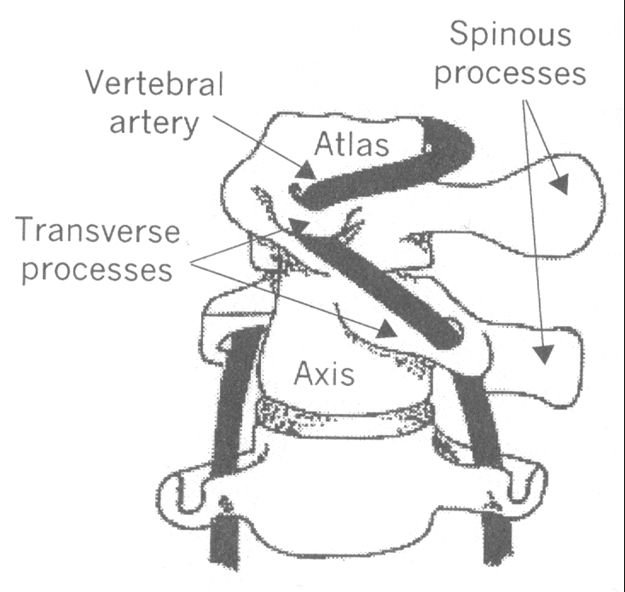
Because of this kinking, it is particularly susceptible to injury. Even a simple thing like extending the neck back over the basin for hair washing at the beauty salon has been known to cause a stroke. The artery is elastic, but with hardening of the arteries, with cholesterol plaques, with trauma (like automobile accidents) or simply with rapid stretching, the delicate lining of the artery can tear. It is easy to imagine how a rapid, forceful thrust by a chiropractor could cause damage.

Sometimes the damage is immediate and the patient collapses on the chiropractor’s table. Sometimes mild symptoms start immediately and progress after the patient leaves the chiropractor’s office. Sometimes the tear is a small one and it clots over; then days later the clot breaks loose, travels to the brain and causes a delayed stroke. By this time, the patient may not connect his sudden collapse to the previous visit to the chiropractor.

Chiropractors are well aware of the risk. They discuss it in their journals and online forums. They have tried to find ways to screen patients for high risk, but there is no reliable way to do so. Strokes are a major reason for chiropractic malpractice insurance payouts – 9% of claims paid by the major chiropractic insurer in 2002, the only year for which I was able to find statistics. Some chiropractors are now asking patients to sign an informed consent form before manipulations. If asked, most chiropractors downplay the risk, saying it occurs in less than one in a million manipulations. Many (perhaps most) chiropractors do not mention the risk at all.

Most alarming: some chiropractors perform these neck adjustments with no warning and without permission. I met a woman who still walks with a limp and has other residual impairments from a chiropractic stroke. She went to her chiropractor for a shoulder problem and thought he was going to massage her shoulder muscles. She did not want him to manipulate her neck, did not give him permission, and didn’t realize what he was doing until he suddenly twisted her neck. She collapsed on the table and nearly died.

How often can a stroke be attributed to neck manipulation? We really don’t know. Estimates have varied from one in ten million manipulations to one in 40,000. I should clarify that only one specific type of stroke, basilar stroke, has been linked to chiropractic. It has been estimated that about 20% of all basilar strokes are due to spinal manipulations. This would work out to about 1300 a year in the U.S. But we just don’t know, because it has not been properly studied. Carotid artery strokes have also been reported after chiropractic treatments. Chiropractors do not follow up on every patient. Patients who have delayed strokes may never see their chiropractor again, so chiropractors would naturally tend to underestimate the risk. Many of these diagnoses are missed because the vertebral arteries are not typically examined on autopsy.

One study of patients under the age of 45 who had this kind of stroke showed that they were 5 times more likely to have visited a chiropractor in the preceding week than control patients. In the past, neurologists treating stroke patients simply did not ask patients about chiropractic; and when they started asking, they started finding. There have been deaths. There have been court cases. In 2002, a group of Canadian neurologists issued a statement of concern to the public, recommending vigilance, education, informed consent, and other measures to protect the public. Awareness is rising, and injured patients have formed organizations in the US, Canada, and the UK both for support and for litigation.

Defensive chiropractors have tried to counteract the growing body of evidence with studies like this one, which concluded that “SMT [Spinal Manipulation Therapy] resulted in strains to the VA [Vertebral Artery] that were almost an order of magnitude lower than the strains required to mechanically disrupt it. We conclude that under normal circumstances, a single typical (high-velocity/low amplitude) SMT thrust is very unlikely to mechanically disrupt the VA.” That’s certainly true. It is unlikely. Under normal circumstances. But it does happen.

They tell us that the stroke would have happened anyway. Maybe. We don’t have any way of knowing. But when the patient collapses immediately after the neck is twisted, I think we can say the stroke wouldn’t have happened at that time without the manipulation. Given a choice of sooner or later, later is good.

They tell us that other treatments for neck pain, like NSAIDs, also carry dangers. Patients have developed bleeding ulcers and died from taking aspirin. That’s very true, but they are invoking the logical fallacy known as tu quoque: just because something else is dangerous too, that doesn’t make neck manipulation any less dangerous. And comparing the dangers of two treatments doesn’t mean there aren’t other options that are safer than either of them.

Until really good studies are done, we simply don’t know the magnitude of the risk; but we are reasonably confident there is a risk. Now, let’s measure that risk against the benefits. Some chiropractors are doing neck adjustments on 90% of their patients for everything from ear infections to low back pain. There are lots of testimonials, but no POEMS (patient-oriented evidence that matters) and no evidence of any long-term benefit or any advantage over other treatments. The only thing neck manipulations have been shown to help with is mechanical neck pain, and a recent Cochrane review did not find that manipulation was any better than simple mobilization treatments. If there is no benefit, isn’t any degree of risk too much?

There are plenty of other options for treating mechanical neck pain for those who prefer not to take pain pills. The cervical spine can be gently mobilized with physical therapy methods that have not been linked to stroke. Heat, massage, tincture of time, exercises and other measures may offer symptomatic relief with no associated risks.

“Don’t ever let a chiropractor touch your neck “is the safest advice; but we can’t expect everyone to accept it. Some patients have had good experiences with neck manipulations and will continue to ask for them. We can’t presume to dictate to others. If someone judges that there is a one in a million risk of a stroke and is willing to take that risk, he has every right to do so. I think people have the right to engage in risky behaviors like skydiving and smoking cigarettes. I just think they deserve to know there is a risk, and to have some idea how much of a risk it is. I suspect the general public doesn’t know the facts about neck manipulation.

I wonder if Laurie Jean Mathiason knew neck manipulations could cause strokes. This 20 year old girl had a tailbone injury and sought out a chiropractor who manipulated her neck. Yes, her neck – to fix her tailbone! She fell into a coma and died three days later. Her visit to the chiropractor might qualify her for a Darwin Award. In my opinion, it qualifies as a tragedy and a crime.

For more information and links see: http://www.quackwatch.org/01QuackeryRelatedTopics/chirostroke.html

Posted in: Chiropractic

Leave a Comment (324) ↓

310 Comments

  1. nwtk2007 September 16, 2008

    My statement is tu quoque only if it is offered as an argument for chiropractic. This is the point many just can’t grasp.

    It is only offered for perspective. Saying it is not a valid argument does not change the perspective.

    You say “Medical doctors do talk about the dangers of NSAIDs and medical errors all the time:”

    Well talk is cheap and the problem persists.

    It’s a universal concept really. Don’t bitch about my almost spotless house when yours is a pig barn.

    No tu quoque there. Just simple perspective.

  2. darwinfan September 16, 2008

    I appreciate your objective point of view on this topic. You are correct in suspecting I do not have a lot of experience with chiropractors; I have never actually even been to one. I am curious about this practice though, and I’ve been trying to come to some conclusion about it, as I have a friend in medical school who has been telling me that he believes it is a valid medical field, the “woo” parts excluded however.
    At any rate, once again, I appreciate your honest evaluation of chiropractic, since there seem to be a lot of skeptical sites out there that seem very biased against it, and I was not certain I was getting a fair evaluation. There are obviously quacks in this field, but I failed to see why the rest of the field should be deemed useless because of these quacks, and wanted to find out if there was more to the story. Your article is very informative.
    I certainly am curious as to why there is not more research out there on the long-term benefits of chiropractic, as well as why chiropractic is utilized instead of the other treatments you say are available (and are safer).

  3. Harriet Hall September 17, 2008

    darwinfan,

    If you want to learn more, the hands-down best book to read is Inside Chiropractic by Samuel Homola, a chiropractor who is also a critical thinker. He practiced evidence-based chiropractic throughout a long career (he’s retired now), so he can’t be accused of being anti-chiropractic, but he has shared his inside knowledge of what some of his colleagues are up to and what prospective patients should watch out for.

  4. ten2fore June 19, 2009

    I know strokes can happen after/during a chiropractic manipulation. I suffered a stroke during my only visit to a chiropractor in October of 1968. Would I have had the stroke later anyway ? I don’t know, but I have lived over forty years without going to another chiropractor, and without having another stroke.

  5. Mariners5144 July 25, 2009

    I am a chiropractic student attending New York Chiropractic College. I am aware of your concerns about how a patient coming into a chiropractic office and getting manipulative therapy and getting a stroke after the adjustments. You don’t seem to have evidence based literature claims. It is very possible that the patients were already at the likelihood of suffering a stroke regardless what the patient experiences in their daily living. We don’t know about the patient’s history and what conditions they might have been coming into the office for. We don’t know if the patient had a stroke before. According to Scott Haldeman’s article about chiropractic and stroke, patients who have a vertebral artery dissection following a cervical manipulation is 1 in 8.06 million office visits, 1 in 5.85 million cervical manipulations. Scott Haldeman is a credible researcher who is both chiropractor and a medical doctor leading chiropractic research. Vertebral Artery Dissections will happen with or without the manipulations. If the chiropractor had taken a good case history on the patient, then a stroke will most likely not occur. Chiropractic students are taught to take a thorough history of the patient before treatment. Chiropractic care has been proven to help patients who have serious injuries. For you to say “Don’t ever let a chiropractor touch your neck is the safest advice”, is not accurate. There are a lot of benefits from chiropractic care. We do more than just manipulating the spine. We treat muscles, address nutrition concerns, and guide them through exercises for faster recovery. As a medical doctor, you should be aware of what other health care professions do instead of claiming that chiropractors cause stroke. Have you seen what a chiropractor actually does? Have you been adjusted by a chiropractor? It has been proven that there is a low incidence of chiropractic manipulation causing stroke. Chiropractic malpractice insurance is the lowest of all in the health care profession because chiropractic doesn’t hurt people. We are at a critical time in addressing our health care system in our country. We are living at the age where integrative health care is emphasized for everyone. Patients can benefit from all different types of health care and we should all work together to improve the patients’ condition rather than judge other health care professions.

  6. Harriet Hall July 26, 2009

    Mariners5144,

    Even the chiropractic insurance companies recognize the risk of stroke and they pay claims for it. Your own professional journals recognize the risk and have tried to come up with screening tests to reduce the risk – without success. Yes, strokes can happen “anyway” but what about those smoking gun cases where an asymptomatic patient collapses on the table? We all agree that the risk of stroke is small, but what is the risk/benefit ratio? If you want to defend your chosen profession, you will need to provide hard evidence that chiropractic offers clinical results superior to other treatments.

    We shouldn’t judge other health care professions? Do you think homeopathy works? What about witch doctors? We have not only the right but the duty to judge treatments that don’t help and might harm.

  7. Fred Dagg July 27, 2009

    Harriet

    The Bone and Joint Decade summary has addressed all the issues you raise in regard to strokes. So get over it.

    The Bone and Joint Decade Task Force on Neck Pain Report – January 2008
    The latest release (Jan 2008) has been the report by the Task Force on Neck Pain. … the Neck Pain Task Force considered almost 32,000 research citations and …www.fcer.org/html/News/bonejointdecade.htm

    We have discussed it ad nauseum and you trot out the same stuff about “smoking guns” and patients that have unfortunate events on the chiropractors table.
    Tell me it never happens to medical practitioners?

    We have also discussed to risk/benefit ratio of care. You seem to excuse the Vioxx debacle as a slight aberration, however I am sure the relatives of the 30,000 people that died as a direct result of taking it do not feel that way. Nor would relatives of the 120,000 people in the U.S. that die each year from “medical accidents”. I do include Chiropractors, physical therapists and osteopaths in those figures as no one profession can claim to be immune.

    Your attitude of strong paternalism (Doctor knows best) is severly outdated. It is no longer relevant in todays culture.

    It has been replaced by a bioethical model based around,
    1) Benefance..What is done by the healthcare provider must do some good. So judge everybody from the same level playing field.
    2)Nonmalfeasance… Do no harm.
    3) Patient Advocacy. What does the patient want to do, and respect the patients rights to their choice of care. (Something you seem to have great problems with).
    4) Social Justice, what is good for the community as a whole.

    If you look at what you are claiming from a bioethical model, rather than one of strong paternalistic “Doctor knows best”. Then you will realise how much of an injustice you do to the people of the U.S. and even more so your colleagues as you do not judge everybody or profession from the same level.

  8. Fred Dagg July 27, 2009

    Harriet

    while we are on this topic, did you know that…

    The US spends about 16 per cent of GNP on healthcare, far more than France and Germany, which spend 11 to 12 per cent. Yet those countries provide universal care.

    Critics say the biggest issue is the profit motive that drives US healthcare.

    From a purely bioethical standpoint, you should be standing on your soapbox trying to help the President obtain a better system for the 47 plus million Americans who do not have good access to care, rather than writing poorly researched and emotive articles that do not fulfill the bioethical guidelines of Benefance, Nonmalfaefence, patient advocacy and Social justice.

  9. pmoran July 27, 2009

    Fred, that is nonsense. Never have the chiropractic contributors to this discussion entered into serious consideration of cost/risk/benefit in relation to any of the conditions that chiropractors treat with neck manipulation.

    You and the others have done everything to avoid such discussion, sheltering, as you do yet again here, behind the “but doctors kill people too” ploy, and the Neck Pain Task Force’s pretence that pre-existing stroke can explain all the cases. That is clearly not true, and I don’t know how you personally can ignore the many individual cases and case series that demonstarte that.

    And Mariners5144, you will find that chiropractors bear far less responsibility than medicos for the diagnosis and management of serious and disabling illnesses. You would be paying almost no malpractice insurance if it were not for the strokes caused by neck manipulation.

  10. Joe July 27, 2009

    @Mariners5144 on 25 Jul 2009 at 9:27 pm

    Chiros do cause strokes in otherwise-healthy people http://www.ptjournal.org/cgi/content/full/79/1/50

    http://stroke.ahajournals.org/cgi/content/full/32/5/1054

    We just don’t know how many. Due to the anatomy/physiology of the artery dissection, victims may succumb after leaving the chiro office and the connection could go unrecorded unless the neurologists has the opportunity to ask the question. In the unfortunate case of Sandra Nette, when her husband arrived at the emergency room the doctor saw him and said “Chiropractor, right?”