
Mar 29 2010

“Vaccines didn’t save us” (a.k.a. “vaccines don’t work”): Intellectual dishonesty at its most naked

If there’s one thing about the anti-vaccine movement I’ve learned over the last several years, it’s that it’s almost completely immune to evidence, science, and reason. No matter how much evidence is arrayed against it, its spokespeople always finds a way to spin, distort, or misrepresent the evidence to combat it and not have to give up the concept that vaccines cause autism. Not that this is any news to readers of this blog, but it bears repeating often. It also bears repeating and emphasizing examples of just the sort of disingenuous and even outright deceptive techniques used by promoters of anti-vaccine pseudoscience to sow fear and doubt about vaccines among parents. These arguments may seem persuasive to those who have little knowledge about science or epidemiology. Sometimes they even seemed somewhat persuasive to me; that is, at least until I actually took the time to look into them.

One example of such a myth is the claim that “vaccines didn’t save us,” also sometimes going under the claim that “vaccines don’t work.” The anti-vaccine website Vaccine Liberation has a large set of graphs purporting to show that the death rates of several vaccine-preventable diseases, including whooping cough, diptheria, measles, and polio were falling before the vaccines for each disease were introduced. The the article quotes Andrew Weil:

Scientific medicine has taken credit it does not deserve for some advances in health. Most people believe that victory over the infectious diseases of the last century came with the invention of immunisations. In fact, cholera, typhoid, tetanus, diphtheria and whooping cough, etc, were in decline before vaccines for them became available – the result of better methods of sanitation, sewage disposal, and distribution of food and water.

Bill Maher has said similar things about vaccines, and the “vaccines didn’t save us” gambit has become a staple of anti-vaccine websites. For example, one particularly ignorant blogger (URL Removed – Malware -webmaster) wrote:

The mythology surrounding vaccines is still pervasive, the majority of the population still believes, in faith like fashion, that vaccines are the first line of defense against disease. The true story is that nutrition and psychological/emotional health are the first line of defense against disease.

Vaccines are a concoction of chemical adjuvants and preservatives coupled with virus fragments and have clearly been implicated in the astounding rise in neurological disorders around the world, yet the ‘popular’ media has embedded itself as a spokesperson for the pharmaceutical cartel and simply does not report in any responsible way the real situation.

Ah, yes, the “toxins” gambit! Of course, it is true that better sanitation is a good thing and has decreased the rate of transmission of some diseases for which sanitation can do so, many infectious diseases are transmitted person-to-person through the air from aerosolized drops of saliva from coughs and sneezes or from being deposited on objects that people touch frequently, like doorknobs and other fomites.

The “vaccines didn’t save us” strategy is a distortion, as I will show. The best way to demonstrate this is to go on to the very first website that currently shows up on a Google search for “vaccines didn’t save us.” Although the post is from November, it’s the main post that’s been spreading this lie since then. Entitled Proof That Vaccines Didn’t Save Us, it’s one of the most breathtakingly spectacularly intellectually dishonest bits of anti-vaccine propaganda that I’ve ever seen. I say that not because it uses a common anti-vaccine distortion, but rather because it ups the ante by adding a new one clearly designed to address the criticism of the old one. That new distortion hides it in plain sight, too, which is why I have to give the blogger props for sheer chutzpah. Actually, I have to give some backhanded kudos to the person who devised the graphs used in this post, Raymond Obomsawin, PhD. They represent the classic anti-vaccine lie, combined with some very clever cherry picking. I won’t take them all on in this post. Maybe I’ll take some of them on in a future post. In the meantime, what I will do is to take on the first several, because they represent a common anti-vaccine theme that is very similar to the one sounded by the this disingenuous post.

In fact, let’s look at the Vaccination Library claims first. Notice that there are six graphs, four of which are for vaccine-preventable diseases for which widespread vaccination was undertaken, two for which it was not. All of them show decreasing death rates from various diseases. Wow! It seems like slam dunk evidence, doesn’t it? Vaccines didn’t save us! After all, death rates were declining years before the vaccine, and they were declining for the diseases that didn’t even need a vaccine!

Death rates.

Here’s the problem. It’s not surprising that death rates were declining before introduction of the vaccines. Medicine was improving. More importantly, supportive care was improving. For example, take the case of polio. Before the introduction of the iron lung and its widespread use, for example, if a polio patient developed paralysis of the respiratory muscles, he would almost certainly die. The iron lung allowed such patients to live. Some even survived in an iron lung for decades. No doubt improved nutrition also played a role as well. However, if you want to get an idea of the impact of vaccines on infectious disease, take a look at this graph from the CDC of measles incidence, not death rates:
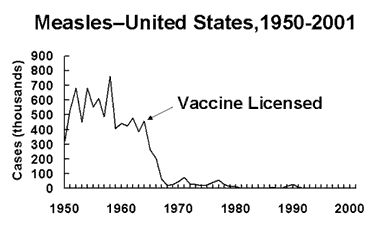
CDC Measles Incidence Graph

Similar results were seen most recently from several other vaccines, including the Haemophilus influenza type B vaccine, as the CDC points out:

Hib vaccine is another good example, because Hib disease was prevalent until just a few years ago, when conjugate vaccines that can be used for infants were finally developed. (The polysaccharide vaccine previously available could not be used for infants, in whom most cases of the disease were occurring.) Since sanitation is not better now than it was in 1990, it is hard to attribute the virtual disappearance of Haemophilus influenzae disease in children in recent years (from an estimated 20,000 cases a year to 1,419 cases in 1993, and dropping) to anything other than the vaccine.

In the post to which I referred, the most intellectually dishonest graph is this one:
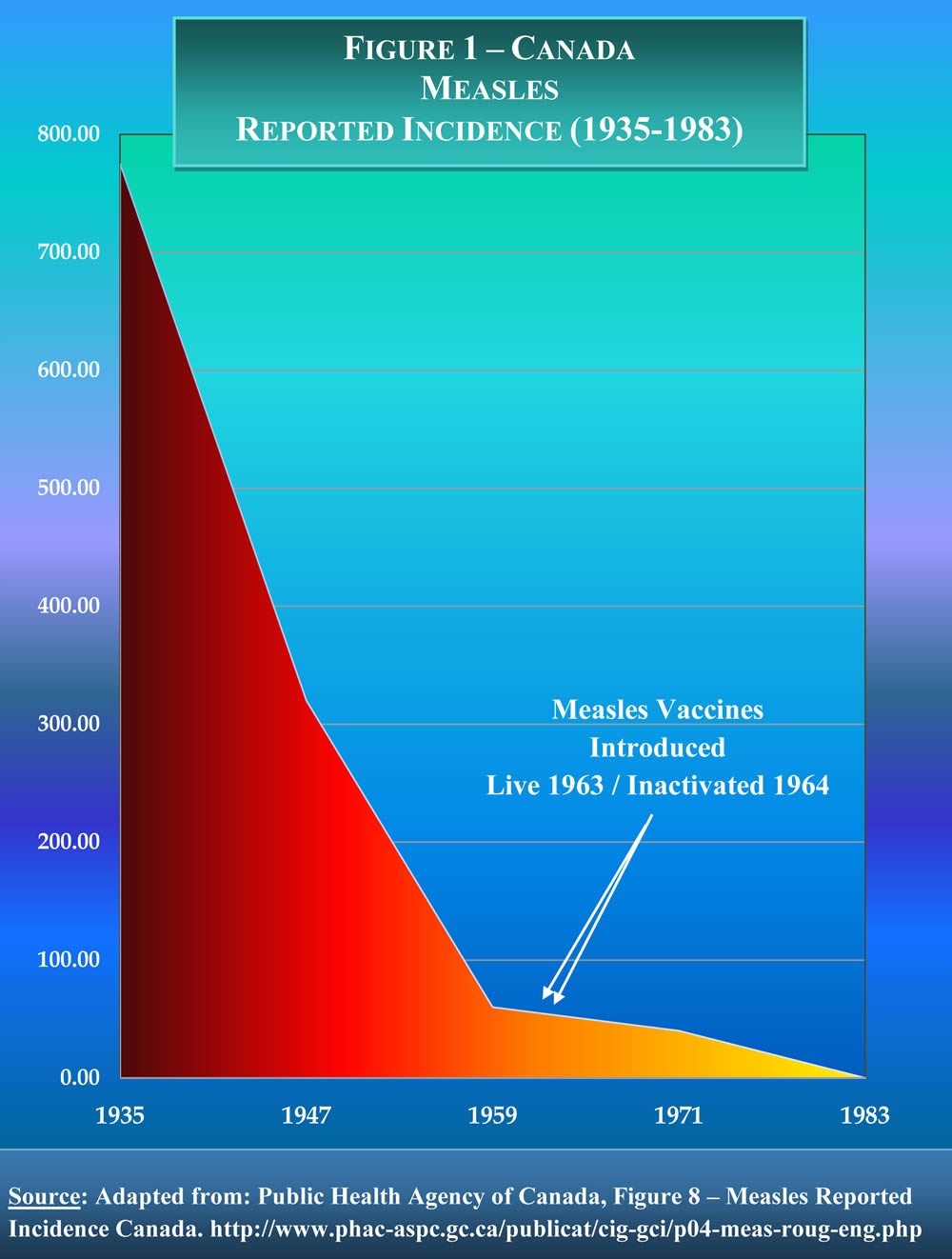
Fake Measles Graph
(Click to see full size figure.)

Note how this graph, unlike all the other graphs used to make the claim that “vaccines didn’t save us” actually uses incidence data, in this case from Canada from 1935 to 1983. I was immediately suspicious of this graph, though. The reason should be obvious; the decline in measles incidence is far too smooth. Measles incidence typically varies greatly from year to year. Fortunately, in his chutzpah, Obomsawin included a link to the actual source of the graph. Naturally, I couldn’t resist checking it out, and I found that the link leads to the Canadian Immunization Guide section on the measles vaccine. And this is the actual graph from which Obomsawin allegedly extracted his data:
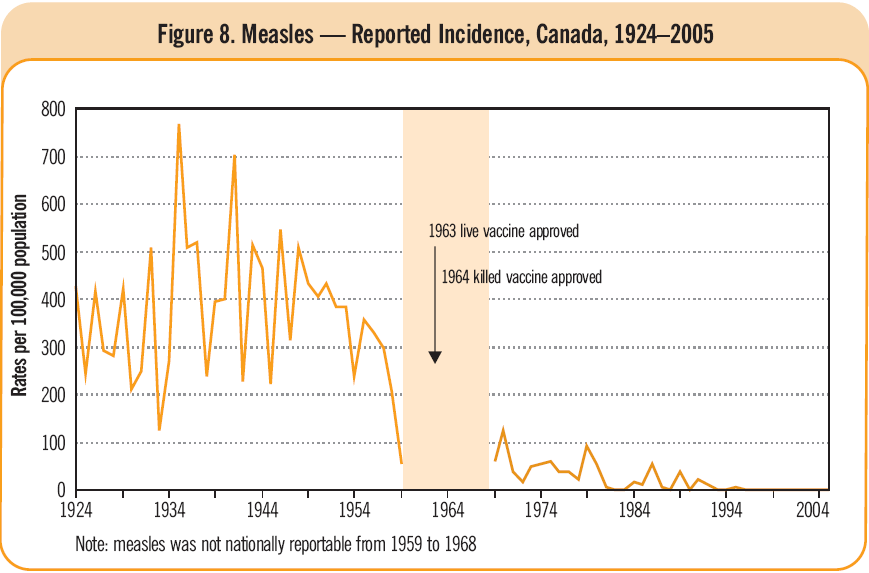
MeaslesCanada
(Click for full-sized version.)

Note how Obomsawin left out a section of ten years when measles was not nationally reportable. Also note how he has, to be charitable, cherry picked the years to produce the impression of a smoothly declining measles incidence from 1935 to 1959. As I said, it doesn’t get much more intellectually dishonest than that. But it’s even worse than that. The graph above still gives the impression that measles incidence was falling before the ten years for which there is no data. Steve Novella points out that there is a better version of the graph in this reference, and he was kind enough to send it to me, given that, for whatever reason, my university doesn’t have a subscription to the relevant journal:

measles canada
(Click for full-sized version.)

Note how this graph looks at raw case numbers and shows 40,000 cases of measles in Canada the year before the ten year interruption in the data. All in all, it’s a much clearer representation of the data than the first graph, showing a clear drop that occurred during the ten year period, in the middle of which the measles vaccine was introduced. It also shows another obvious drop in measles incidence later on in the 1990s, when the two-dose measles vaccine program was started. As for why it appears that there is a steep dip in the first graph before the ten year gap, that actually appears to be an artifact. There is no data for 1959, the first year that measles was not nationally reportable in Canada, but the line appears to go to a datapoint at 1959 or 1960. My guess is that whoever made the graph decided to set the value for the beginning of the ten year gap to equal the first datapoint at the end of the ten year gap. In other words, the graph a rather poor representation of the data, and the Canadian government would do well to replace it on its website with something more like the second graph, which makes the point much more clearly.

As intellectually dishonest as Obomsawin’s graph is, this description of Obomsawin matches it:

He has produced academically and/or professionally over eighty-five (85) articles, reports, policy documents, presentations, and publications.

A search of Pubmed reveals only one peer-reviewed publication from 1978, and it’s only a commentary. In any case, apparently served as Director National Office of Health Development of the National Indian Brotherhood (AFN); Founding Chairman of NIB’s National Commission Inquiry on Indian Health; Executive Director in the California Rural Indian Health Board; Supervisor of Native Curriculum, Government of the Yukon Territory; and Evaluation Manager – Department of Indian and Northern Affairs Canada. None of these are scientific positions. More tellingly, he is “currently engaged with government funding as Senior Researcher relative to establishing a Public Sector Policy on Traditional Medicine in Canada.” My translation? He’s somehow managed to get a government grant to try to promote “traditional medicine” in Canada. Apparently, the Canadian government has its own problems with government money going to promote unscientific and pseudoscientific nonsense of the type that NCCAM promotes. In any case, besides Obomsawin’s disingenuous and intellectually bankrupt distortions of incidence data used to serve his apparently anti-vaccine agenda, he has no qualifications to speak of with regard to science or epidemiology that I can find.

It also turns out that Dr. Obomsawin has some other–shall we say?–unconventional beliefs as well. For instance, he is approvingly featured on that aggregator of all things quackery and pseudoscience, Whale.to, where he expresses anti-vaccine views, HIV/AIDS denialism, and admiration for Royal Rife. So what we have here is a woo-meister using cherry picked points on a graph to give a false impression that the measles vaccine was not responsible for the dramatic decline in measles incidence in Canada in the 1960s. Shocking, I know.

Another rebuttal to the idea that vaccines didn’t reduce the incidence of the diseases against which they were designed comes from the simple observation that, as vaccine uptake falls, the disease vaccinated against returns. Always. This is described by the CDC quite well:

Finally, we can look at the experiences of several developed countries after they let their immunization levels drop. Three countries – Great Britain, Sweden, and Japan – cut back the use of pertussis vaccine because of fear about the vaccine. The effect was dramatic and immediate. In Great Britain, a drop in pertussis vaccination in 1974 was followed by an epidemic of more than 100,000 cases of pertussis and 36 deaths by 1978. In Japan, around the same time, a drop in vaccination rates from 70% to 20%-40% led to a jump in pertussis from 393 cases and no deaths in 1974 to 13,000 cases and 41 deaths in 1979. In Sweden, the annual incidence rate of pertussis per 100,000 children 0-6 years of age increased from 700 cases in 1981 to 3,200 in 1985. It seems clear from these experiences that not only would diseases not be disappearing without vaccines, but if we were to stop vaccinating, they would come back.

The United Kingdom is an excellent illustration of this trend. Back in the mid-1990s, it declared measles as under control, thanks to the MMR vaccine. Then came Andrew Wakefield in 1998 with his trial lawyer-funded, incompetent, and possibly even fraudulent study claiming to link the MMR vaccine to “autistic enterocolitis,’ and a credulous, sensationalistic British press to spread his message that the MMR vaccine causes autism. The result was that measles came roaring back in the U.K. to the point that two years ago measles was declared endemic again there.

The Vaccine Liberation graphs and the even more deceptive graphs produced by “Dr.” Obomsawin to claim that vaccine-preventable diseases were already plummeting before the introduction of the relevant vaccines are typical of anti-vaccine arguments. First, they contain enough of a grain of truth to them to sound plausible. After all, better nutrition and better sanitation have in general contributed to better health and contributed to a decreasing toll from various infectious diseases. But they were not enough. Indeed, part of the reason we vaccinated against some diseases is because sanitation wasn’t enough. Was sanitation so much worse in the late 1980s before the Hib vaccine was introduced than it is now? No. Was it probably even that much worse in the 1960s, when the measles vaccine was introduced? Probably not. Yet, such is the myth that the anti-vaccine movement would have parents believe. Such is the intellectually dishonest nonsense they promote.

Why do they do this? J.B. Handley himself has told us why: To bring the U.S. vaccine program to its knees. Or the U.K. program. Or whatever program where the anti-vaccine program has taken hold. The reason is that, no matter how much science says it isn’t, to the anti-vaccine activist, it’s first and foremost always all about the vaccines.

FacebookDiggLinkedInStumbleUponLiveJournalShare

516 responses so far

516 Responses to ““Vaccines didn’t save us” (a.k.a. “vaccines don’t work”): Intellectual dishonesty at its most naked”

  1. Harriet Hallon 29 Mar 2010 at 1:19 pm

    I’ve argued this with anti-vaccine activists. I have pointed out the many “natural experiments” where lowered vaccination rates led to increased incidence of disease and raising the vaccination rates then led to reduced incidence. I’ve never gotten any response. Have you? I’m thinking they can’t come up with any rationalization so they prefer to ignore the whole thing.

  2. sailwaveon 29 Mar 2010 at 1:32 pm

    This http://bit.ly/cpeugX JPANDS paper with similar graphs was used by somebody I know recently as their main argument against vaccination; ug.

  3. David Gorskion 29 Mar 2010 at 1:49 pm

    Actually, Steve Novella sent me a better graph using the original source article. Rather than posting an addendum, I decided to incorporate it into the post to show how Obomaswin’s graph is even more intellectually dishonest than I thought it was.

  4. windrivenon 29 Mar 2010 at 1:57 pm

    Two words: Poliomyelitis and smallpox.

    Improvements in public hygiene may well reduce rates of transmission of various diseases and that is to be applauded. But reduced transmission is not no transmission. There are two ways one can successfully deal with exposure to, say, smallpox. One can acquire immunity by surviving the infection or one can acquire immunity through vaccination.

    Now why isn’t someone working on a vaccine for stupidity?

  5. Watcheron 29 Mar 2010 at 2:08 pm

    That added graph is a great one, it illustrates the “cherry-picking” of data well.

    Awaiting Th1Th2 rebuttal …

  6. Shannonon 29 Mar 2010 at 2:28 pm

    I’ve noticed that most people enveloped in a fantastic ideology that suits their notions will ignore even the most blatant data when it’s shoved in their face. It creates the following effect on those who fall in the same camp.

    1. we believe X to be true.
    2. we *might* change our minds– if you can satisfactorily prove Y.
    3. you show us that Y is correct with adequate documentation.
    4. we ignore Y.
    5. Our act of ignoring of Y further causes our followers to believe in X even more.

    it’s like a test of faith. Jesus in the desert with the devil and all that.

    Glenn Sacks uses this tactic exactly the same way in his vitriolic, irrational and skewed views of domestic violence. He ignores all data and documentation in favor of his ideology. Glenn Sacks=domestic violence(protections) is same as anti-vaxers=disease(vaccines)

  7. waleson 29 Mar 2010 at 3:03 pm

    The Canadian public health agencies seem to be confused about their own measles reporting requirements. This link http://dsol-smed.hc-sc.gc.ca/dsol-smed/ndis/list-eng.php shows a list of notifiable diseases in Canada, with the first positive case year. Some notifiable diseases show an interruption in national notifiability, including chicken pox from 1959-1986 and mumps from 1959-1986. However this list does not indicate any interruption in the measles national notification requirements. It shows reporting starting in 1924 and continuing to present.

    Can anyone explain this discrepancy between the Public Health Agency of Canada’s data and the Canadian Disease Surveillance Online data? This is key to the point being made in this post.
    Also another question: why did these diseases become non-reportable? Due to low mortality rates?

  8. Th1Th2on 29 Mar 2010 at 3:09 pm

    windriven,

    “There are two ways one can successfully deal with exposure to, say, smallpox. One can acquire immunity by surviving the infection or one can acquire immunity through vaccination.”

    You know that vaccines carry disease antigens, don’t you? And immunity is a state of having sufficient biological defenses to avoid infection, disease, or other unwanted biological invasion http://en.wikipedia.org/wiki/Immunity_%28medical%29

    Who cares about acquired immunity, that’s not even the most important function of the immune system, hence the word “acquired”.

  9. Watcheron 29 Mar 2010 at 3:20 pm

    http://www.youtube.com/watch?v=35Lt4bIXyrY

  10. Watcheron 29 Mar 2010 at 3:26 pm

    Hit the submit button too fast. :)

    Th1Th2,

    Acquired immunity represents an advantage over a nonspecific method in that it can respond quickly in a more focused way to prevent disease reoccurrence. Also, the word “acquired” makes no towards importance in the definition.

    Also, I’m interested in what you make of David’s post …

  11. Watcheron 29 Mar 2010 at 3:28 pm

    Just for kicks …

    ac·quire (-kwr)
    tr.v. ac·quired, ac·quir·ing, ac·quires
    1. To gain possession of: acquire 100 shares of stock.
    2. To get by one’s own efforts: acquire proficiency in math.
    3. To gain through experience; come by: acquired a growing dislike of television sitcoms.
    4. To locate (a moving object) with a tracking system, such as radar.

  12. Steven Novellaon 29 Mar 2010 at 3:29 pm

    Th1Th2 – that was incoherent. You seem to be exploiting a subtle vagueness in the wikipedia definition you are using.

    The immune system both prevents infection but also fights off invading organisms – it fights infections.

    Acquired immunity refers to the immune system’s memory for antigens it has encountered before, in which case it mounts a more vigorous response. This leads to fighting off the infection before it become clinically apparent, or at least keeping it more mild than it otherwise would have been.

    Acquired immunity can also prevent the spread of infections, as the primed immune system fights off the infection before it can spread.

    Whether or not this is the “most important function” of the immune system is entirely irrelevant. And none of what you said has anything to do with the question of whether or not vaccines have benefit in excess of risk – they do.

  13. WilliamLawrenceUtridgeon 29 Mar 2010 at 3:30 pm

    Acquired ammunity isn’t an important function of the immune system? Without acquired immunity, we would be at mercy of nonacquired immunity every time we are exposed to an infection. For every exposure subsequent to the first our immune systems react more quickly, and strongly. If you survive the first exposure, your second reaction is thousands of times stronger, your third, even more so. Without acquired immunity, we would face the exact same level of risk to every flu strain, not to mention every time measles, chicken pox or any other infectious agent circulates through the population – in short, humans would quickly face extinction (particularly to novel pathogens). The reason we get vaccinated is so we can acquire immunity in a rather harmless way, so we do not have to go through the possibly deadly cycle of infection and recovery. The next time we are exposed to the same pathogen, it essentially can’t harm us (or others, as our immune systems nullify it before we become contagious).

    Acquired immunity isn’t important only if you don’t mind getting the chicken pox every single time your kid does.

  14. Archangl508on 29 Mar 2010 at 3:30 pm

    “Who cares about acquired immunity, that’s not even the most important function of the immune system, hence the word “acquired”.”

    Why don’t you ask that question of an AIDS patient?

    An AIDS patient only suffers from the loss of one specific component of the acquired immune system (aka CD4+ T cells). They still have other aspects of the acquired immune system (CD8+ T cells, B cells) as well as components of the innate immune system (NK cells, macrophages, neutrophils). Yet neither of those other components are able to prevent AIDS patients of dying from things like opportunistic infections with normal body flora (i.e. Candida albicans) or the malignant cancers that the remaining immune system is unable to manage.

    Yet the acquired immune system is not “the most important function of the immune system” according to you. Can you explain WHY the acquired immune system is not important? It would seem to be quite important to an AIDS patient.

  15. Th1Th2on 29 Mar 2010 at 3:37 pm

    Wathcer,

    The operational thought there is “disease reoccurence” since the first encounter with diseases is through exposure from natural infection or by way of vaccination.

  16. Watcheron 29 Mar 2010 at 3:48 pm

    Which in turn leads to, as alluded to previously, longer life and a greater chance to pass on ones genes. Without the acquired portion of the immune system our species would not last. The same goes for the innate aspect, it’s just as important. My point is that neither side is more important because one without the other creates a broken system. So I guess I’m not sure of your point.

    Also, what do you think of the original post?

  17. Th1Th2on 29 Mar 2010 at 3:59 pm

    William,

    “The reason we get vaccinated is so we can acquire immunity in a rather harmless way, so we do not have to go through the possibly deadly cycle of infection and recovery.”

    Immunity is all about defense, avoidance and resistance from disease antigens from entering the body. Vaccines, however, play the antagonistic role of “acquiring” a myriad of disease antigens, provoking and sensitizing the naive immune system. For example, in vaccination you have to destroy an innate physical barrier of the skin in order to introduce influenza viral antigens, which is an impossible let alone unnatural mode of transmission. And to say it is harmless is absolutely ridiculous.

  18. vexorianon 29 Mar 2010 at 4:09 pm

    Hello,

    What this time has scared me the most is not the main subject of the post but some of the comments in one of the links.

    Try the comments at : http://www.harvestdream.org/index.php?url=archives/431-GRAPHICAL-EVIDENCE-SHOWS-VACCINES-DIDNT-SAVE-US.html :

    I’m having a son born in January by a 20 year old who probably isn’t fit to be a mother, she fortunately is going to let me see the kid (for now) but she won’t even brook any discussion about vacinnes or even breaking up the triple shot. She has the power to prevent me from seeing my son so all I can do is hope that he doesn’t get fucked up by all these government mandated shots. Meanwhile I’ve dealt with progressive nuerological symptoms such as muscle twitching and recently loss of sensation in a few fingertips. Brutal stuff, and what can I do?

    Our best lessons lay precisely in the brutal stuff, if we’re serious we can learn to listen and avoid so much difficulty in the future.

    I strongly recommend for every man to learn to engender his core power, to withhold from the release of sexual energy. This lazy attitude towards sex is a practice that is purely the result of ignorance (by design) and a lack of discipline – an unfortunate situation which leads to many more children born to broken families than need be – for details on exactly what I mean please see Mantak Chai

    Have you considered leeching the heavy metals and chemical residues from your fat stores and sheaths?

    Here’s a short list of detox options that I have found very effective.

    -Drink only distilled water (at least 2 liters a day)
    -Have a sauna (preferably infrared) 3 – 4 times a week and re-mineralize generously with Himalayan mountain salt in your meals.
    -Eat green things (broccoli, spinach, kale, stinging nettle) with lemon juice dressings.
    -Drink lemon water every morning
    -Start taking MMS (See Jim Humble)
    -CoEnzyme Q-10
    -high quality filtered fish oil
    -meat only once a week
    -Start taking a teaspoon of Diatomaceous Earth in a fresh fruit drink
    -Stop consuming canned foods
    -Stop consuming pre-packaged foods which are high in additives
    -Start practicing with breathing techniques – see Systema

    I hope this all means something to you. :-D

    We really, really need some sort of science-based nutrition blog, or do we have it already?

  19. weingon 29 Mar 2010 at 4:15 pm

    Th1 illustrates that there is no vaccine against stupidity.

  20. Watcheron 29 Mar 2010 at 4:20 pm

    @Th1Th2

    Provocation and sensitization is the point.

    Also, many blood-borne and sexually transmitted diseases enter through breaks in the skin. So how is artificially creating an opening a poor way to introduce an antigen?

    @Vexorian

    I thought there was talk of a nutrition blog somewhere. Maybe it was something that was being brought up as a potential blogger spot here on SBM. Either way, diatomaceous earth? Infrared Sauna-ing? What is it that these are supposed to do? I would guess they’re inferring some type of filtering effect of the D-earth since it’s used this way in other applications. The infrared just boggles my mind …

  21. David Gorskion 29 Mar 2010 at 4:24 pm

    Unfortunately, finding a truly science-based nutritional blog has been difficult.

  22. Th1Th2on 29 Mar 2010 at 4:28 pm

    Archangl508,

    “Why don’t you ask that question of an AIDS patient?”

    Just so you know that AIDS stands for Acquired Immune Deficiency Syndrome. It is irrelevant to compare unvaccinated people from AIDS patients because the unvaccinated are NOT immuno-deficient.

  23. windrivenon 29 Mar 2010 at 4:45 pm

    @Th1Th2

    I have absolutely no idea what point you are trying to make. If it is that one shouldn’t avail one’s self of available vaccines, the point is inane. If it is that the risks of vaccination outweigh the benefits, the point is still inane.

    Smallpox has been effectively eradicated and polio is on its way. Are you suggesting that those are diseases we should tough out? Are you suggesting that improved public hygiene would have eradicated those diseases sans vaccines? Such suggestions are preposterous.

    Influenza viruses mutate rapidly so effectiveness is variable. So what? The potential benefit is high and the risk is negligible.

    I’ve got to go with weing on this one; there’s no vaccine for what you’ve got.

  24. Archangl508on 29 Mar 2010 at 4:49 pm

    Th1Th2,

    Do you even read what you write?

    You wrote:

    “Who cares about acquired immunity, that’s not even the most important function of the immune system, hence the word “acquired”.”

    My understanding of your point is that you are saying that acquired immunity is not an important function of the immune system. Therefore, if acquired immunity is not an important function of the immune system then one should be able to survive without acquired immunity. For a definition of acquire immunity see here:

    http://www.virtualmedicalcentre.com/anatomy.asp?sid=21

    I was not using AIDS patients to compare to unvaccinated people, but rather, as an illustration of how important the acquired immune system is. AIDS patients lack only one part of acquired immunity, CD4+ T cells, and yet they do not survive without the acquired immune system. Therefore, your original point that acquired immunity is not an important function of the immune system is wrong.

  25. Watcheron 29 Mar 2010 at 4:49 pm

    They were making a point that a potion of the acquired immune system takes the brunt of the HIV attack that leads to AIDS, questioning your hypothesis that “ … that’s not even the most important function of the immune system, hence the word ‘acquired’.

    Still interested in your thoughts on vaccination and the decline of disease …

  26. Th1Th2on 29 Mar 2010 at 4:53 pm

    Watcher,

    “Provocation and sensitization is the point.”

    Therefore, it is very wrong to say that vaccines has prevented disease occurrence and has protected the people from disease antigens.

    “Also, many blood-borne and sexually transmitted diseases enter through breaks in the skin. So how is artificially creating an opening a poor way to introduce an antigen?”

    It depends. The IM injection of Hepatitis B vaccine mimics a needle stick injury containing HbSag. And it would be ridiculous if the vaccine is taken orally, kwim? Meaning, specific vaccines enter the body based on the mode of transmission of natural infections. For example, you can get polio via fecal-oral route the same manner you can get VAPP from OPV. Make sense?

  27. Watcheron 29 Mar 2010 at 5:05 pm

    I understand your point, I’m just not sure that it’s relevant toward inducing immunity to a disease in all cases. The body has the capability to fight off an invader whether in the muscle or normal route of infection.

    Therefore, it is very wrong to say that vaccines has prevented disease occurrence and has protected the people from disease antigens.

    If it wasn’t the vaccine, then what is the cause of it?

    If I become sero-positive towards a disease antigen, it’s through one of two ways: I am introduced to it from my environment or I am vaccinated against it. Either way it shows that my body is ready to fight the next introduction of the disease.

  28. Th1Th2on 29 Mar 2010 at 5:06 pm

    Archangl508,

    You know that CD4 T cells are T helper cells, right? I know you know how they function and one thing that they are incapable of doing is to kill infected host cells, right?

    “Therefore, your original point that acquired immunity is not an important function of the immune system is wrong.”

    Healthy newborns do not possess (active) acquired immunity and yet they have inherent immunity from extraneous disease antigens. Care to explain as to why that is?

  29. Harriet Hallon 29 Mar 2010 at 5:22 pm

    Th1Th2,

    Are you suggesting that healthy newborns have inherent immunity to the antigens of smallpox, measles, polio, etc.? That’s clearly not true.

  30. Th1Th2on 29 Mar 2010 at 5:26 pm

    Watcher,

    “I understand your point, I’m just not sure that it’s relevant toward inducing immunity to a disease in all cases.”

    Because it is incorrect to say that one should be exposed to natural infection and/or vaccination in order to gain immunity, acquired immunity to be exact because either way you have to bypass the different protective barriers of the innate immune system to bring about secondary immunity. Hence, pox parties like vaccines are worthless and unnecessary.

  31. Watcheron 29 Mar 2010 at 5:32 pm

    Vaccines and preterm neonates: why, when, and with what.
    Esposito S, Serra D, Gualtieri L, Cesati L, Principi N.
    Early Human Development. Volume 85, Issue 10. 2009.

    http://www.ncbi.nlm.nih.gov/pubmed/19775838

    Says there are Ab titers seen in even preterm and low birth weight babies after most immunizations.

  32. Th1Th2on 29 Mar 2010 at 5:39 pm

    Harriet Hall,

    Are you suggesting that healthy newborns have inherent immunity to the antigens of smallpox, measles, polio, etc.? That’s clearly not true.

    Yes, they have genetic immunity like everyone else. They have intact skin integrity, mucosal membrane, enzymes, etc aside from a developing innate immune system. However, vaccination destroys and contaminates that inherent immunity with the above disease antigens.

  33. Watcheron 29 Mar 2010 at 5:39 pm

    Because it is incorrect to say that one should be exposed to natural infection and/or vaccination in order to gain immunity, acquired immunity to be exact, …

    The how should one gain acquired immunity?

    … because either way you have to bypass the different protective barriers of the innate immune system to bring about secondary immunity.

    But that’s what diseases do, they bypass our primary defenses and start reproducing forcing our secondary defenses to mount a response. Does the body produce a different quality titer of Ab or acquired cells when vaccinated or introduced into our body in a novel way?

  34. Th1Th2on 29 Mar 2010 at 5:43 pm

    watcher,

    “Says there are Ab titers seen in even preterm and low birth weight babies after most immunizations.”

    Newborns have self-derived immunoglobulins. It something inherent. Thus the reason why vaccines are worthless and unnecessary.

    Even though, Ab titers do not correlate to protective immunity.

  35. Wholly Fatheron 29 Mar 2010 at 6:05 pm

    Th1Th2,

    You seem to be stuck on some very pedantic points, which even if true (mostly they are not!) are irrelevant to the point of Dr Gorski’s post.

    Vaccines prevent illness and save lives.

  36. windrivenon 29 Mar 2010 at 6:06 pm

    @Th1Th2

    “They have intact skin integrity, mucosal membrane, enzymes, etc aside from a developing innate immune system. However, vaccination destroys and contaminates that inherent immunity with the above disease antigens.”

    Ah, a variant of the ‘precious bodily fluids’ theory first advanced by Gen. Bat Guano in Dr. Strangelove.

    So following what passes for Th1Th2 logic, we should abandon vaccination in favor of bubble wrap! How better to maintain that perfect skin integrity? How better to keep the precious bodily fluids (containing enzymes, one presumes) from leaking out? Ah but what to do about the mucosal membranes? A ball gag for the mouth to be sure. A diver’s mask should take care of the eyes. And maybe rubber pants for those unmentionable mucosal areas.

    Me? I’ll stick with the vaccinations.

  37. Harriet Hallon 29 Mar 2010 at 6:19 pm

    Th1Th2,

    I asked “Are you suggesting that healthy newborns have inherent immunity to the antigens of smallpox, measles, polio, etc.? That’s clearly not true.”

    You answered, “Yes, they have genetic immunity like everyone else. They have intact skin integrity, mucosal membrane, enzymes, etc aside from a developing innate immune system.”

    Are you under the delusion that unimmunized newborns can’t catch polio, pertussis, smallpox, etc.? That’s clearly not true.

  38. Th1Th2on 29 Mar 2010 at 6:33 pm

    Harriet,

    Being unvaccinated or unimmunized means the newborn was not exposed and sensitized with disease antigens? Isn’t that what the immune system protect us from the invasion of such antigens? So why the need for inoculation?

  39. Watcheron 29 Mar 2010 at 6:34 pm

    Newborns have self-derived immunoglobulins. It something inherent. Thus the reason why vaccines are worthless and unnecessary.

    True, but if you’d read the article, you’d see that these infants were immunized and later showed Ab titers against those diseases showing their immune system had been introduced to these Ag at some point in the past. Remember, IgG is highly specific for it’s Ag. You are right in stating that titers are not an indicator of protective immunity.Ab titers are, however, a decent way to judge efficacy of vaccine provocation of the immune system as well as previous introduction to a particular strain of disease. What this study suggests is that nothing intrinsic in their genetic makeup is that makes them unsusceptible, but something they came in contact with at a later date.

  40. Harriet Hallon 29 Mar 2010 at 6:41 pm

    Th1Th2,

    Please answer my question. Do you believe a newborn can catch polio, smallpox, measles, etc. or not?

  41. Watcheron 29 Mar 2010 at 6:41 pm

    So why the need for inoculation?

    Because controlled introduction of a dead disease agent provokes and sensitizes the bodies immune system, while showing little to no risk of catching the disease. When/if the organism comes into contact with it again, it can mount a secondary immune response that lowers the chance of a full blown sickness by clearing the disease-causing agent and thus the disease.

    Why isn’t there a need for inoculation? Because it can be taken care of when the body first sees it risking a full-blown debilitating sickness like small pox and polio?

  42. Th1Th2on 29 Mar 2010 at 6:51 pm

    Harriet,

    Give them the disease antigens into their naive system and vaccines are a very good vector. Guaranteed.

  43. Th1Th2on 29 Mar 2010 at 7:00 pm

    Watcher,

    Surely vaccines will give you the disease as specified by the label. But because of modification, attenuation or inactivation, vaccines are designed to limit the spread of infection thus minimizing certain symptoms of the disease.

  44. WilliamLawrenceUtridgeon 29 Mar 2010 at 7:05 pm

    Is Th1Th2 a new account for pec?

    “Immunity is all about defense, avoidance and resistance from disease antigens from entering the body.”

    Wow, that’s wrong. The barriers to the interior of the body are about preventing disease from entering the body. The inhospitable skin, thick layer of dead epidermis, mucus membrane, immune defences in the gut, stomach acid, etc. are one way of preventing antigens from entering the body. The immune system defends us once those barriers have been breached in some way. They’re totally different. With perfect barriers we wouldn’t need an immune system, but evolution of pathogens ensured that this will never be the case.

    ‘Vaccines, however, play the antagonistic role of “acquiring” a myriad of disease antigens, provoking and sensitizing the naive immune system.’

    Exactly, that way when the body is next exposed, its immune system will be primed to react quickly and strongly to prevent the infection from progressing to dangerous levels. That’s exactly the purpose of vaccination, and we’ve gotten pretty good at it, thank Dog, because otherwise we’d be at the mercy of “natural” immunity for polio, smallpox, measles, etc. i.e. paralysis, scarring, death. I would characterize this as “priming” rather than “antagonizing” the immune system.

    “For example, in vaccination you have to destroy an innate physical barrier of the skin in order to introduce influenza viral antigens, which is an impossible let alone unnatural mode of transmission. And to say it is harmless is absolutely ridiculous.”

    You don’t “destroy” the skin, you pierce it. And I’m pretty sure it has happened before, such as when someone sneezes on an open wound, when that wound is created in the first place by some filthy abrasion or sharp stick (I’m pretty sure prehistoric mixed woodlands were just as filthy and pathogenic back then as they are now), or when you have a cold and you brush your teeth, piercing the mucus membrane in your mouth (or eat something sharp for that matter). Hardly impossible, not even improbable, and very far from ridiculous. To say, as you seem to be implying, that the risks of vaccination outweigh the risks of the diseases they prevent seems rather ahistorical. As well as ignoring vaccines that are given orally and nasally. Vaccinations reduce the risk of the disease, and accordingly any serious complications that may accompany it. They prevent deaths, suffering, life-long disability, and let’s not forget smallpox scars. Acquired immunity is the best way to flexibly deal with virtually any pathogen that can evolve or be exposed to us, and vaccination is the safest way to administer it.

  45. Archangl508on 29 Mar 2010 at 7:09 pm

    Th1Th2,

    “I know you know how they function and one thing that they are incapable of doing is to kill infected host cells, right?”

    Helper T cells do not kill directly, those tasks are left to cytotoxic T cells (CD8+) or parts of the innate immune system. Instead they act as “generals” of the immune system helping to drive an immune response in a particular direction. But I do not understand why this is relevant to your point. AIDS patients still possess the same innate immune system and cytotoxic T cells (at least until the end stages where CD8+ T cells drop as well), but are still unable to respond to some of the most basic pathogens found in the environment. You still have not managed to answer this point.

    If, all is needed for immunity is to have, as you suggest, “intact skin integrity, mucosal membrane, enzymes, etc” and an “innate immune system”, then why do AIDS patients die when they have all that functionality, but only lack the acquired immune component of CD4+ T cells?

    “Healthy newborns do not possess (active) acquired immunity and yet they have inherent immunity from extraneous disease antigens. Care to explain as to why that is?”

    http://www.ncbi.nlm.nih.gov/pubmed/11339354

    “Typically, neonates exhibit decreased or aberrant cellular immune responses when compared to adults, resulting in increased susceptibility to infection. However, it is clear that newborns are able to generate adult-like protective T cell responses under certain conditions.”

    http://www.ncbi.nlm.nih.gov/pubmed/18804488
    http://www.ncbi.nlm.nih.gov/pubmed/19137537
    http://journals.lww.com/pedresearch/pages/articleviewer.aspx?year=2009&issue=05001&article=00015&type=abstract

    Newborns receive some protection in the form of passive antibody transfer from the mother. But they are still more susceptible to infection because they lack a full strength immune system capable of responding to pathogenic organisms.

    Healthy newborns certainly do possess an active acquired immune system. Newborns are able to respond with both B and T cell responses although not as strong as an adult. I still seem to have missed the papers that you linked to showing that neonates do not respond using the acquired immune system. Or perhaps some research showing that all you need is innate immunity to survive?

  46. windrivenon 29 Mar 2010 at 7:20 pm

    @ Harriet Hall

    Th1Th2 has achieved complete immunity against reason. Your efforts to breach his immunity are destined to fail!

  47. Harriet Hallon 29 Mar 2010 at 7:26 pm

    Th1Th2 said
    “Give them the disease antigens into their naive system and vaccines are a very good vector.”

    Perhaps you didn’t understand my question. Let me re-phrase more elaborately. Try this thought experiment: go back in time to before any vaccine was ever invented. Given a newborn child who has not yet encountered any disease antigens, if an epidemic of smallpox (or polio, or any other infectious disease) occurs in the community and the child is exposed to people sick with active disease, is the child protected by inherent genetic immunity so that he will not catch smallpox?

  48. Watcheron 29 Mar 2010 at 7:29 pm

    List of questions that need answered by Th1Th2:

    From Harriet ” Do you believe a newborn can catch polio, smallpox, measles, etc. or not?”

    From me “Why isn’t there a need for inoculation?”

    In addition …

    But because of modification, attenuation or inactivation, vaccines are designed to limit the spread of infection thus minimizing certain symptoms of the disease.

    I like the middle emboldened part, but you’ll have to explain the rest. The symptoms aren’t minimized in most cases as there isn’t enough pathogen to cause sickness. It’s more applicable to say that the disease or sickness is averted due to the sensitized affect of previous introduction so no symptoms can manifest.

  49. Th1Th2on 29 Mar 2010 at 8:00 pm

    Harriet,

    “is the child protected by inherent genetic immunity so that he will not catch smallpox?”

    I thought I answered that already. In the setting of a healthy and immunocompetent child, he is protected naturally. Now you have to wonder why even in a pox party, some children would not develop the disease even after exposure. Likewise, in the Philippines, the country experienced it’s worst smallpox epidemic as a result of the vaccination campaign. It affected the vaccinated more than the unvaccinated. http://www.whale.to/vaccine/Baratosy_Smallpox.pdf

  50. Th1Th2on 29 Mar 2010 at 8:09 pm

    Watcher,

    “The symptoms aren’t minimized in most cases as there isn’t enough pathogen to cause sickness. ”

    It’s called asymptomatic infection.

    “It’s more applicable to say that the disease or sickness is averted due to the sensitized affect of previous introduction so no symptoms can manifest.”

    You are not preventing any diseases from happening for as long as you keep on inoculating yourself with disease antigens. It just doesn’t make any sense, does it?

  51. Th1Th2on 29 Mar 2010 at 8:31 pm

    William,

    “because otherwise we’d be at the mercy of “natural” immunity for polio, smallpox, measles, etc. i.e. paralysis, scarring, death.”

    Complications from natural infections increase with poor health, malnutrition, depressed immune system, inappropriate management and treatment with drugs and even iatrogenesis.

    Also, vaccines are also capable of provoking the disease itself, paralysis, scarring and even death.

  52. David Gorskion 29 Mar 2010 at 8:37 pm

    In the setting of a healthy and immunocompetent child, he is protected naturally.

    Nonsense. You’re doing nothing more than repeating a variation the common “alt med” fantasy that if you’re healthy, eat the right foods, and do the right things, you won’t get sick.

    Apparently we haven’t sufficiently inoculated this blog against anti-vaccine talking points.

  53. Harriet Hallon 29 Mar 2010 at 8:38 pm

    Th1Th2,

    Throughout history, healthy children have caught infectious diseases. Do you deny this?

  54. Defender of Realityon 29 Mar 2010 at 8:38 pm

    The responses to this post got me wondering…

    Is the “science” in science-based medicine referring to the use of the “scientific method” to see where the preponderance of the evidence leads, or is it referring to the cooking up of some half-baked conclusion while using “science sounding” words to support it?

  55. WilliamLawrenceUtridgeon 29 Mar 2010 at 8:58 pm

    “Complications from natural infections increase with poor health, malnutrition, depressed immune system, inappropriate management and treatment with drugs and even iatrogenesis.”

    Of course, but those complications wouldn’t exist if you prevent the infection itself – it’s a double-win. Safety from any harm from the disease itself, and safety from any complications resulting from the disease, as well as treatment. Immunization can prevent all of this, reducing stress on bodies that are already in poor health, malnourished, have poor immunity (though if immunity is weak enough, then the individual can’t mount a competent defence thus rendering the vaccination useless – a very specialized circumstance recognized by doctors), preventing any potentially iatrogenic complications or side-effects of treatment. So, how could you, by your own logic, oppose vaccination? Particularly when research has demonstrated that vaccination is so low-risk?

    “Also, vaccines are also capable of provoking the disease itself, paralysis, scarring and even death.”

    Yes, all true. Take scarring for instance – my mother has a scar from a polio vaccine, but it’s on her shoulder, the size of a dime, and doesn’t cover her whole body – unlike severe smallpox scarring. She can also walk, because she didn’t get polio. The risk of causing the disease is present in live, weakened vaccines, but is far less than exposure to the actual main infectious agent from another human with the communicable, unweakened disease (i.e. the ideal vehicle for transmission of the disease from person to person in an unweakened form). Vaccination may (emphasis, may) cause these complications, but at a much lower rate than the disease itself. There’s a reason iron lung manufacturers went out of business after the polio vaccine was implemented on a broad scale.

    Your reference to paralysis may refer to the H1N1 vaccination from the 70s – which were of such a low rate, they’re still not sure whether it even ticked above the background rate. So again, the risks of vaccinations are so low, they’re having trouble proving them. Like the autism red herring. Vaccination saves lives, at virtually no risk. When it doesn’t outright prevent infection, it blunts its severity. For more excellent information on a whole host of vaccines, I strongly recommend Vaccinated: One Man’s Quest to Defeat the World’s Deadliest Diseases by Paul Offit – very good, very readable, very comprehensive, written by a noted expert who publishes extensively on the subject of vaccines. I might also recommend Mistakes Were Made which shows how self-justification can run wild to the point of irrationality.

  56. Th1Th2on 29 Mar 2010 at 8:59 pm

    Harriet,

    “Throughout history, healthy children have caught infectious diseases. Do you deny this?”

    No, I don’t. But what’s appalling to know is the fact that even a healthy child is utterly defenseless from invasion of disease antigens coming from every vaccines. A completely inoculated child would have been exposed intentionally to as much as 13 disease antigens by the age of 1 year which is absolutely outrageous and barbaric. Yes, unvaccinated children can be exposed too naturally but not to 13 diseases. They grew up normally along the way not knowing such diseases.

    Now you have to wonder again why Hep B vaccine given to newborns is worthless and an absolute crap.

  57. WilliamLawrenceUtridgeon 29 Mar 2010 at 9:03 pm

    http://www.whale.to/vaccine/Baratosy_Smallpox.pdf

    Oh snap! I hadn’t seen this. Whale.to has been invoked, this discussion is over.

  58. Archangl508on 29 Mar 2010 at 9:18 pm

    Th1Th2,

    You wrote this:

    “But what’s appalling to know is the fact that even a healthy child is utterly defenseless from invasion of disease antigens coming from every vaccines.”

    But you also wrote this:

    “I thought I answered that already. In the setting of a healthy and immunocompetent child, he is protected naturally.”

    Which is it? Utterly defenseless or protected naturally? Can you even manage to keep your ideas slightly consistent?

    If a child is protected naturally, then how can it also be utterly defenseless? Even if your argument is that vaccines enter into the body “non-naturally” that cannot hold for all vaccines, since some would be given in a similar route to the infection that would occur (for example, IPV and polio infection).

  59. Archangl508on 29 Mar 2010 at 9:20 pm

    Dr. Gorski,

    “Apparently we haven’t sufficiently inoculated this blog against anti-vaccine talking points.”

    As someone said above, “There is no vaccine against stupidity”.

    And as George Carlin said, “Think of how stupid the average person is….now realize that 50% of the people are dumber than that!”

  60. Th1Th2on 29 Mar 2010 at 9:21 pm

    William,

    “Of course, but those complications wouldn’t exist if you prevent the infection itself – it’s a double-win.”

    The same disease antigens you acquire from natural exposure that infect the body are also present in every vaccines, only modified. The immune system does not differentiate infection from natural exposure and infection from vaccination. Hence, in vaccination, there are neither prevention nor protection; there are induced-infection, sensitization and provocation.

  61. Harriet Hallon 29 Mar 2010 at 9:38 pm

    Th1Th2,

    Do you deny that when a disease enters a community, the unvaccinated are more likely to catch it than the vaccinated?

  62. Defender of Realityon 29 Mar 2010 at 9:43 pm

    Th1Th2,

    You wrote:

    “No, I don’t. But what’s appalling to know is the fact that even a healthy child is utterly defenseless from invasion of disease antigens coming from every vaccines. A completely inoculated child would have been exposed intentionally to as much as 13 disease antigens by the age of 1 year which is absolutely outrageous and barbaric. Yes, unvaccinated children can be exposed too naturally but not to 13 diseases. They grew up normally along the way not knowing such diseases.”

    Firstly, Dr. Hall is being very kind to continue to try to have a rational conversation with you even though you continually respond with non sequiturs and tangential replies. If you open your mind, you could really learn from her.

    Secondly, you are aware that exposure to disease antigens is not equivalent to exposure to the disease itself, right? I would hope that you understand this distinction, but it is not clear from your comments.

    Thirdly, using fear-mongering propaganda to talk people out of potentially life-saving medical treatment, particularly for the defenseless child, is what I consider “outrageous and barbaric.”

  63. Archangl508on 29 Mar 2010 at 10:02 pm

    Def of Reality,

    “Secondly, you are aware that exposure to disease antigens is not equivalent to exposure to the disease itself, right? I would hope that you understand this distinction, but it is not clear from your comments.”

    No, he/she is not aware of that distinction or, at the least, simply ignores that distinction as it doesn’t agree with the rhetoric he/she would like to use. No matter how many times it is explained, and it has been explained over and over again in the comment threads of multiple articles, it still has not sunk in.

    For example, Th1Th2 is appalled that a child is exposed “to as much as 13 disease antigens by the age of 1 year which is absolutely outrageous and barbaric.” Th1Th2 conveniently skips over the point that in a child’s first breath, the first bacteria that enters the lungs contains thousands of antigens and that is just one single bacteria and does not include the millions of bacteria, viruses, fungus, and other particles that the child will contact within its first hours outside the womb.

  64. weingon 29 Mar 2010 at 10:22 pm

    Th1 does not even know what an infection is. He thinks the antigen is the causative agent of the infection. He sees no need to satisfy Koch’s postulates. He is a troll, totally self-deluded, and probably certifiable. Maybe some psychiatric therapy might help him, but that is beyond my expertise.

  65. squirreleliteon 29 Mar 2010 at 10:25 pm

    WilliamLawrenceUtridge,

    I don’t think Tb1Th2 is a new or alternate account for pec/LizKat since they’ve been posting comments since before LizKat was kicked out. Perhaps Dr Novella or Dr Gorski could discern something from the ip address.

    In any case, trying to trying to have a coherent discussion with them is about as productive as Alice trying to talk to Humpty Dumpty:

    `When I use a word,’ Humpty Dumpty said, in rather a scornful tone, `it means just what I choose it to mean — neither more nor less.’

    `The question is,’ said Alice, `whether you can make words mean so many different things.’

    `The question is,’ said Humpty Dumpty, `which is to be master — that’s all.’

    Like most trolls, their real reason for commenting is not to communicate or learn but to find some excuse to disagree with whatever is said in response and see how long they can get people to keep responding. Then, when everyone else gives up trying to communicate or figure out what they are trying to say, they can consider themselves the master.

    So, mostly I don’t bother unless I think have something useful to point out to other readers who stumble into the confusion.

    I commend and thank you and Harriet and Archangl508 and all the others for making the valiant effort!

  66. squirreleliteon 29 Mar 2010 at 10:46 pm

    Defender of Reality,

    You asked the question:

    “Is the “science” in science-based medicine referring to the use of the “scientific method” to see where the preponderance of the evidence leads, or is it referring to the cooking up of some half-baked conclusion while using “science sounding” words to support it?”

    If you dig all the way back to the original posting in this blog, I think Dr Novella made an explanation to the effect that Science-Based Medicine is an effort to add the knowledge we at least think we have gained in biology, medicine, and other fields of science like chemistry and physics into the formal evaluation structure of Evidence-Based Medicine which emphasizes the randomized controlled double-blinded study.

    The goal is to improve our evaluation of current and prospective medicines, treatments, therapies, etc. and make better use of available time, money and other resources to more efficiently improve them. If we don’t include our general understanding of science into this decision matrix, we waste too much of these resources doing endless follow-ups on studies of methods that show no usefulness or at best ambiguous results and have no scientific reason to expect that they might work.

    Dr Novella has a good discussion of these ideas in his more recent post:

    http://www.sciencebasedmedicine.org/?p=4178

    Unfortunately, there are way too many people out there who much prefer to cook up half-baked conclusions and fish around for sciency sounding words to persuade the uninformed.

    So, we continue to fight the good fight.

  67. Prometheuson 29 Mar 2010 at 10:51 pm

    Windriven stated:

    “Ah, a variant of the ‘precious bodily fluids’ theory first advanced by Gen. Bat Guano in Dr. Strangelove.”

    That would be General Jack D. Ripper, commander of Burpelson Air Force Base, who was concerned about contamination of his “precious bodily fluids”.

    And las with Gen. Ripper, no amount of data or rational discussion will convince Th1Th2 that he/she/it is completely and utterly delusional in his/her/its understanding of biology in general and immunology in specific.

    Prometheus

  68. squirreleliteon 29 Mar 2010 at 11:04 pm

    WilliamLawrenceUtridge,

    Your whale.to link got me curious so I gave it a quick skim. It started semi-plausible and soon descended into major anti-vax ranting. But, I wondered what the facts were. This must be a hot topic on the anti-vax sites because I had to dig about four pages deep into google to find something that looked like it might have real data behind it.

    I found Heiser and Leach’s 1922 JAMA article:

    http://jama.ama-assn.org/cgi/content/summary/79/1/40-a

    which says:

    VACCINATION IN THE PHILIPPINES STILL EFFECTIVE

    VICTOR G. HEISER, M.D.; CHARLES N. LEACH, M.D.

    J Am Med Assoc. 1922;79(1):40-41.

    Since this article does not have an abstract, we have provided the first 150 words of the full text PDF and any section headings.

    Recently many publications and statements have been circulated throughout the United States alleging that vaccination in the Philippines had not given protection against smallpox. Quotations from annual reports of the Philippine Health Service have been cited by the antivaccinationists showing that more than 50,000 deaths from smallpox have occurred in the Philippines during the last few years. The inference is that these deaths have occurred among the vaccinated. The inference is entirely without foundation, as the direct opposite actually occurred. The deaths are recorded almost entirely among the unvaccinated.

    It may be recalled that during the Spanish régime and for some years after the American occupation more than 40,000 deaths from smallpox occurred annually in the Philippines. When systematic, properly controlled vaccination was instituted, the disease disappeared in the wake of the vaccinators.”

    Unfortunately, the full pdf is restricted unless you pay. Does anyone else have a good link on this subject?

  69. Galadrielon 29 Mar 2010 at 11:10 pm

    If I understand Th1Th2′s argument, s/he is trying to say that as long as the immune system never encounters any pathogens at all, it will be fine. Once it encounters the pathogens (eg via a “pox party,” or even antigens via a vaccine), then it’s no longer “naive”–apparently, naive is a good thing. Funny, it’s not a good thing in any other context. Perhaps it’s not *really* a good thing in this context either? Maybe?

    Th1Th2 seems to think that the ultimate, perfect job for the immune system is to not have to do anything. Once it can recognize (and defeat) a pathogen, it has failed. Somehow.

    I think Th1Th2 missed the part in elementary school science where it’s discussed just how small bacteria and virii are, and how many you encounter on a daily basis, much less in a year. Thirteen? Really? S/he thinks exposure to thirteen diseases is too many in one year? My immune system has easily defeated a thousand times that many pathogens as I sit here writing this post. I couldn’t have avoided them unless I lived in a bubble with a highly-filtered and treated air intake, and I wouldn’t be much good in this life if I did. But since I can’t avoid them, I at least have a built-in system specifically to take care of them, as much as it can.

    The immune system is CAPABLE. You don’t have to protect it from everything imaginable; you can’t. You can’t possibly keep pathogens out. But you can assist the immune system, give it extra tools to help it along. By giving the immune system weapons specifically aimed at some of the nastier diseases out there, we can help it to help us.

  70. Lenoxuson 29 Mar 2010 at 11:51 pm

    Galadriel: If I understand Th1Th2’s argument, s/he is trying to say that as long as the immune system never encounters any pathogens at all, it will be fine.

    Nailed it.

    This is part of why the more fervent antivaxers go so far as to reject germ theory. Otherwise, they’re forced to accept that diseases aren’t acquired solely because the victim suffered from poor sanitation/nutrition/chakra/whatever. And if it is that case that, for instance, “polio” refers to a contagion to which anyone is susceptible at any time (not just some genetic deformity), then properly introducing the body to a very-weakened form of polio beforehand would serve the greater good, since you simply can’t guarantee a person’s lifelong avoidance of the disease, no matter how well that person takes care of themselves.

    Recognizing this (as well as the oodles of evidence for vaccine effectiveness) most antivaxers put their rhetoric in the “pro-safe vaccine” category. (They still don’t make any actual suggestions as to which vaccines they find safer than others, but that’s little surprise — scratch any antivaxer enough, and you’ll ultimately find someone who’s opposed to, well, vaccination. Exceptions are few.)

  71. Sid Offiton 30 Mar 2010 at 12:30 am

    My immune system has easily defeated a thousand times that many pathogens as I sit here writing this post.

    —————————

    Our immune system isn’t at war with each and every microorganism on the face of the earth. And it’s not a pathogen if it can’t cause disease.

  72. BillyJoeon 30 Mar 2010 at 7:23 am

    Someone quoted this a few vaccine related articles ago:

    “It is a tale told by an idiot, full of sound and fury, signifying nothing.”

    That about sums it up.
    You can’t educate a closed-minded simpleton.

  73. Draalon 30 Mar 2010 at 7:53 am

    Th1Th2 has a point. In order to receive a vaccine shot, the skin barrier must be physically damaged by an intruding sharp foreign object. The horror! Why, oh, why did I not realize this before deciding to regularly donate blood at the local Red Cross? (sobs)

  74. WilliamLawrenceUtridgeon 30 Mar 2010 at 8:17 am

    “The same disease antigens you acquire from natural exposure that infect the body are also present in every vaccines, only modified.”

    Yes, this can be true. Vaccines use attenuated live, or killed viral/bacterial fragments so that they will cause an immune response. That’s the whole point of vaccination. This is the basic science of vaccination and the whole reason it is advantageous – all the benefits of surviving a potentially deadly or seriously harmful infection, with only a minute risk of actually getting sick – as opposed to actual exposure to the disease-causing agent which can cause both the disease and complications, as well as life-long injuries. We agree on this basic premise.

    “The immune system does not differentiate infection from natural exposure and infection from vaccination. Hence, in vaccination, there are neither prevention nor protection; there are induced-infection, sensitization and provocation.”

    Exactly, which again supports my point – you get all the benefits of immunity with a risk that is so low, it is incomparable. Vaccination is beneficial because both the amount of antigen presented is so small, and the infectivity so attenuated, that it can cause an immune response without the actual disease. That’s why they are so beneficial. Your immune response is not as strong as after an actual infection, but the whole point of immunization is to cue that initial reaction – becasue the next time the body exposed to the infectious agent, the immune reaction is many thousands of times stronger. Again, your understanding of vaccination is, from what I can tell, perfectly adequate. The only thing I really see is word games, as if induced-infection, sensitization and provocation rather than “prevention and protection” were a bad thing – as far as the immune system goes, they are essentially the same. Current knowledge affords us no beter way of preventing from deadly diseases aside from exposing us to the disease itself, with all of its potential deadliness. And again I invoke my dear mother – instead of crippling polio or death, she has a dime-shaped scar on her shoulder. Sure, you might get a mild fever from a vaccine, some muscle aches, and a tiny chance of something more serious, but you also get with that almost no chance of going sterile, deaf, paralysis, body-wide scarring, drowning in your own mucus, etc. that are the primary effects and complications from smallpox alone.

    Saying “vaccination doesn’t prevent illness, it just gives you a weakened form of it” is both scrupulously accurate and totally misleading – vaccination does “cause” infection but at such an absurdly low severity that the risks are essentially zero. You are presenting an accurate case in such a weaselly-way that it gives the impression of threat to the uninformed, while refusing to contextualize the actual threat in a meaningful way. Which points to having made a decision, and despite acquiring accurate information that contradicts that decision, an attempt to continue justifying it. Again I point to Mistakes Were Made. You can preview it at google books, see page 248 which discusses vaccination and autism. The principles also apply here: http://books.google.ca/books?id=Q-xxeolg09kC&pg=PA248#v=onepage&q=&f=false

  75. Alison Cumminson 30 Mar 2010 at 8:30 am

    micheleinmichigan,

    Would this pain scale have worked better?
    http://hyperboleandahalf.blogspot.com/2010/02/boyfriend-doesnt-have-ebola-probably.html

  76. WilliamLawrenceUtridgeon 30 Mar 2010 at 8:57 am

    squirreleliteon:

    I just want it noted that I was quoting a link by Th1Th2, not citing it as part of my own discussion. Please, please, please don’t think I would refer to whale.to unless I was having a larf.

    BTW, an aspect of vaccination I missed until this point – antigens are used (and here I’m not sure if it is in addition to, or instead of, actual viral/bacterial particles), to provide protection against the harmful aspects of infection; by having an immune competent response to those antigens, it would blunt the most serious consequences of infection. So strictly speaking, I believe antigen-based vaccination would not prevent infection or cause the thousand-fold immune reaction to infection, but would prevent that infection from causing significant harm. Essentially it means the first exposure to the infectious agent itself has a significantly reduced ability to cause harm, thus increasing the chances of a person surviving their first exposure to the true, wild-type infection. Survive the first time and you’re pretty much spared for life – so even if vaccination doesn’t prevent “infection” per se, it would prevent the serious consequences of that infection – which is really the whole point, isn’t it?

  77. squirreleliteon 30 Mar 2010 at 9:21 am

    WilliamLawrenceUtridge,

    It’s OK. I sort of thought that was what you were doing, I just didn’t say it.

    Actually, I have found your comments to be very useful and informative, not that Th1Th2 will let themselves learn anything from reading them.

  78. micheleinmichiganon 30 Mar 2010 at 9:33 am

    Alison – I posted my response over in the “Placebo Effects Revisited” comments…kinda like a binary an easter egg hunt. :)

  79. Dashon 30 Mar 2010 at 10:49 am

    Ignoring Th1Th2 for the moment, they are beginning to come up with a ‘reason’ why diseases come back with decreased vaccination and why there were drops in different diseases at different times (ie just after the vaccines were used).

    You see, we don’t really have good nutrition today, and now we’ve learnt that we didn’t really have good hygiene either because the chemicals in the cleaners cancelled it out.

    Back in the 50s when we got rid of polio we had a decent diet, but since then so many chemicals have been introduced that today we’re really all malnourished and extremely ill. We shouldn’t be eating gluten or lactose either, because we’re all intolerant. This is why the diseases are coming back.

    The same with cleaning products – we have far too many chemicals around us and should be using bicarb and vinegar only.

  80. Chrison 30 Mar 2010 at 11:36 am

    Dash:

    Back in the 50s when we got rid of polio we had a decent diet,

    Have they even seen a cookbook from the 1950s? Truly horrible vile stuff, especially with all the new packaged quick foods. I shudder to think about the old TV-dinners that made me want to gag.

    Also, cleaning supplies fifty years ago were very toxic. They had real lye, and some very dodgy chemicals. In the 1970s I was able to get an ant killer that was essentially sugar water with arsenic!

  81. gaiaincon 30 Mar 2010 at 1:01 pm

    My brother gave me a hilarious book several years ago called Regrettable Foods or something like that. It’s pictures of food from 1950′s and 60′s cookbooks and magazines with commentary. Seriously LOL stuff.

    Back to Dash… a 1950′s diet was decent? Really? Care to prove that instead of assert it?

    And we *all* are lactose and gluten intolerant? Based on what? That’s the basis of all disease? You mean I could have skipped my pathophys courses and residency and just recommended that all my patients stop eating anything containing dairy or gluten? Why didn’t I think of that before? That must mean people eating a mostly Asian diet must never get sick! Also people who don’t have access to cleaning supplies must also be healthy because they don’t have access to all those chemicals. I knew it.

    Oh… wait… Hep B is endemic in Southeast Asia and meningitis is endemic in Subsaharan Africa, a place that I doubt the regular population has access to Windex, Ajax, and the like. Try again, Dash.

    I do not understand people who will not vaccinate. I see no virtue or benefit in suffering (or making my child suffer) and going through disease naturally. It’s not like you end with extra brownie points or reward points or anything like that. A lot of the rhetoric reminds me of a lot of religious rhetoric… we have to suffer, it’s *good* for us, it’s *natural*. So is strychnine and I have no desire to take that in. Life is not a competitive sport, though I know a lot of people who think it is.

  82. micheleinmichiganon 30 Mar 2010 at 1:26 pm

    Dash – “shouldn’t be eating gluten or lactose either,”

    Actually, I’d like to tie this into the genetics testing article. I know there are some Irish populations that have a high incidence of gluten intolerance/celiac disease. Also apparently some Chinese/Chinese American’s have a very high rate of lactose intolerance, while other Asian populations with a longer herding history have much lower rates.

    I’d be interested if genetic testing could be useful in highlighting food intolerance or if the current methods are adequate.

  83. Alison Cumminson 30 Mar 2010 at 1:58 pm

    michele,

    Genes don’t determine, they suggest. Even for the kinds of things you would think are very straightforward, like eye colour. (I’m not sure how that works, but I read it on the internet so it must be true.) (I think for eye colour genes make very strong suggestions, but they aren’t the only factor.) (For comparison, skin colour varies with genes, age, sun exposure, injury and probably a bunch of other things. You can know that someone is likely to have lighter or darker skin from their genes, but you don’t actually know what their skin colour is until you look at them. And even then it will vary over their body.)

    In the case of lactose intolerance, many people who are genetically lactose intolerant have developed adaptations that allow them to drink a certain amount of milk anyway — up to 250 mL daily — without discomfort. Not sure how much of this adaptation is controlled by one’s own genes and how much is dependent on gut flora; I presume there’s an interaction.

    If someone from a genetic heritage that suggests the possiblity of lactose intolerance has abdominal cramping, you can suggest that they check to see if it goes away when they eliminate fresh milk and comes back when they reintroduce it. That’s really what you want to know. They can be genetically lactose intolerant and tolerate a certain amount of lactose anyway; maybe their abdominal pain is caused by something else not diet-related.

    If you are making nutrient-dense cookies to distribute in a famine emergency, please don’t put milk powder in them. That’s just cruel. Even people who are genetically lactose-tolerant may stop making various sugar-digesting enzymes under nutritional stress. That’s completely beside the fact that many people in famine-susceptible areas are genetically lactose-intolerant to begin with.

    I know people with celiac disease. They are quite aware that something’s not right. I suppose genetic testing for everything that could be a gene-related condition that causes abdominal pain could possibly substitute for invasive scopes and biopsies, but I’m dubious. Wouldn’t you want to have someone actually take a look at the sore place?

  84. Scotton 30 Mar 2010 at 2:03 pm

    I think some people may want to recalibrate their sarcasm detectors. The quotes around ‘reason’ in Dash’s post should have been a giveaway.

  85. WilliamLawrenceUtridgeon 30 Mar 2010 at 2:14 pm

    “Back in the 50s when we got rid of polio we had a decent diet…”

    This reminds me of Mad Men, when Roger Sterling wonders what he did wrong, since he followed the advice of his doctors – “Drank the cream, ate the butter” but still got a heart attack. People started dying of heart attacks because they stopped dying of infectious diseases. People started dying of cancer because they stopped dying of heart attacks. Cancer is a disease of old age – and you have to die from something eventually. Evolution coded for the reproduction of offspring, not immortality. The idea that you can do one thing and somehow you will never die is one of the more beguiling claims made by alternative medicine practitioners that simply ignores reality. There is no magic bullet – nature doesn’t care if you live or die, only people do.

    Evolution is catching up though – selecting for things like the ability to digest lactose well into adulthood, and greater reproductive fitness for older females.

    @gaiaincon

    Was there some sort of bundt cake, and the description involved the word “bukkake”? If so, you might be talking about The Amazing Mackerel Pudding Plan: Classic Diet Recipe Cards from the 1970s. Been there, read that.

  86. micheleinmichiganon 30 Mar 2010 at 2:29 pm

    Scott – actually the first paragraphs I thought “oh, sarcasm” particularly since it didn’t sound like the Dash that I recalled from other comments. Then again, my memory, so so. Then, last two paragraph just sounded so sincere that they broke my irony meter. :)

    Alison – You are probably right that conventional diagnostic measures are easier. Sometimes low tech is better. My husband has just begun to suspect that he is lactose intolerant after 2 weeks without milk and a happy stomach. Unfortunately, even with two years of repeat visits to the doctor for GI issues, no one thought to suggest stopping milk for a couple weeks. In the doctor’s defense, I think his symptoms are not spot on for LI.

    But I guess I was thinking ‘boy it would be nice if there were a test for those GI intolerance symptoms that would tell you what to try to eliminate first.’ I’ve heard of food allergy tests, but I think I heard they have a high rate of false positives. Maybe having a easy test is a wishes, horses deal.

  87. Scotton 30 Mar 2010 at 2:49 pm

    One of my friends has a gluten allergy/intolerance of some sort (not celiac, but she hasn’t mentioned the specifics otherwise and I don’t choose to pry). Apparently she’s had it all her life, but only realized there was a problem when she was about 25. Precisely because she’d always had it, she never considered that maybe people weren’t supposed to always feel sick to their stomachs after eating. Then she happened to mention it to her husband one day (who thought it was rather odd), and after a bit of trial and error they figured out what was up. She feels much better now, but for many years didn’t even consider that there might be a problem.

    Something of an anecdotal counterexample to Allison’s comment that “[t]hey are quite aware that something’s not right.” In many cases, certainly, but not all.

  88. Calli Arcaleon 30 Mar 2010 at 3:13 pm

    In theory, genetic testing could reveal celiac sprue, since it’s a straight-up genetic abnormality (unlike most intolerances and allergies). But it is instead diagnosed through biopsy of intestinal tissue. Why? Because if a person is having the sort of severe reactions associated with celiac sprue, you’re not going to want to wait for a genetic test to be done. You want to know *now*, while you still have a chance to start treatment for any of the *other* things that can cause the same symptoms.

    Genetic testing is often oversold. If you developed a good genetic test for celiac sprue, its main downside is that it would be unable to diagnose anything else. Biopsy doesn’t have that problem. Really, until you’ve done a biopsy, you don’t know you need to do the genetic testing, and by then you can easily point the finger at celiac sprue anyway, making the genetic testing pointless.

    BTW, celiac sprue can manifest with mild symptoms and go undiagnosed for a long time, as Scott suggested. But if one has the full-blown version, their immune system mistakes certain alcohols (produced in the digestion of gluten and some related chemicals) for signals that tell the immune system to go on the offensive. The immune system begins attacking the cells that seem to be producing the chemical: the villi of the intestines. The results can be quite nasty.

  89. gaiaincon 30 Mar 2010 at 3:44 pm

    My sarcasm meter could always do with a recalibration, especially since my little guy is working on yet another cold. However, since my patients some times tell me crap like what Dash wrote, it gets hard to figure it all out.

    @WilliamLawrenceUtridge: nope. It’s “The Gallery of Regrettable Foods: Highlights from Classic American Cookbooks” by James Lileks. Really a very funny book.

  90. MedsVsTherapyon 30 Mar 2010 at 4:40 pm

    ThisRThat1ThisRthat2 makes a great point! If only no one ever had a skin puncture, no one would ever die of small pox!

    I guess a bandaid would be too little, too late.

    Issue elbow pads to all infants!!! Give immunizations through inhalants!! Patch, anyone?

    But seriously…
    an old psychodynamic theory of schizophrenia is that the ego gets compromised by fear of penetration, or fear of violation of bodily integrity, if ya catch my drift. one psychaitrist i worked with would confirm this by having physical contact with a patient – hand on shoulder, or some such contact that most of us could handle without collapsing into psychosis; he would note how the patient would invariably get uncomfortable.

    Maybe ThisRThat1ThisRThat2 has an unconscious fear of violation of bodily integrity? Cuz this unsubstantiated theory seems to fall along those lines…

  91. Th1Th2on 30 Mar 2010 at 7:40 pm

    Archangl508,

    “Even if your argument is that vaccines enter into the body “non-naturally” that cannot hold for all vaccines, since some would be given in a similar route to the infection that would occur (for example, IPV and polio infection).”

    Wrong. The mode of transmission of polio viral antigens from an IPV requires a DEEP IM injection which is quite “unnatural” and sadistic as opposed to natural exposure which is transmitted via fecal-oral route and occasionally oral-oral route. You know what would happen if this vaccine takes the same point of entry to the body (OPV), don’t you? Right, VAPP and provocation poliomyelitis. And so do LMV can cause measles, LAIV can provoke influenza, mumps vaccine obviously can cause parotitis and so on. Which lead us to your next question.

    “If a child is protected naturally, then how can it also be utterly defenseless? ”

    It only requires a single needle stick using a 20-25 gauge 1-1 1/2 inch long needle filled with KNOWN disease antigens to break up their natural defense thus bypassing other protective barriers.

  92. Th1Th2on 30 Mar 2010 at 8:30 pm

    Wholly father,

    “Vaccines prevent illness and save lives.”

    Now that’s what I call ‘faith’, father.

  93. weingon 30 Mar 2010 at 8:45 pm

    “The mode of transmission of polio viral antigens from an IPV requires a DEEP IM injection which is quite “unnatural” and sadistic as opposed to natural exposure which is transmitted via fecal-oral route and occasionally oral-oral route.”

    OMG! How sadistic! I bet you find the fecal-oral route just delicious. And I’m sure you’ve never seen a kid scrape a knee.

  94. Th1Th2on 30 Mar 2010 at 9:10 pm

    Harriet,

    “Do you deny that when a disease enters a community, the unvaccinated are more likely to catch it than the vaccinated?”

    Catch what? Disease antigens. The vaccinated were the ones who have had the biological markers of the disease after their exposure to vaccines, meaning they are no longer naive to the disease. So your question really is, if vaccines will prevent re-occurrence of diseases among the vaccinated upon re-exposure to natural infection, which I highly doubt.

  95. weingon 30 Mar 2010 at 9:46 pm

    I’m pretty sure you don’t want your body to be naive to any disease. That way when you come in contact with the disease your defenses are in place and will not be overwhelmed by the onslaught. If your body is naive, good luck to you.

  96. squirreleliteon 30 Mar 2010 at 10:07 pm

    gaia and william,

    Lileks has an online version too:

    http://www.lileks.com/institute/gallery/spec.html

    Ah, the good old days!

  97. Chrison 30 Mar 2010 at 10:20 pm

    Thanks! I remember seeing that years ago, and tried to find the link!

  98. Chrison 30 Mar 2010 at 10:43 pm

    When I posted this morning I had a vague memory of a green olive jello salad. I thought that was too weird to comment on and maybe it was a false memory, so I let it pass. But it was real!

    See: http://www.lileks.com/institute/gallery/drpepper/2.html

    (though in reality I think it was something I read in a memoir of Betty McDonald, Onions in the Stew, where a neighbor brought that horror to a potluck)

  99. Dave Ruddellon 30 Mar 2010 at 11:12 pm

    “It only requires a single needle stick using a 20-25 gauge 1-1 1/2 inch long needle filled with KNOWN disease antigens to break up their natural defense thus bypassing other protective barriers.”

    Oh, now I get it. The immune system is like a balloon; one needle and POP!. No more immunity. Or something.

  100. Harriet Hallon 30 Mar 2010 at 11:53 pm

    Th1Th2 said

    “So your question really is, if vaccines will prevent re-occurrence of diseases among the vaccinated upon re-exposure to natural infection, which I highly doubt.”

    You are using your own idiosyncratic definition of disease, but even if you assume the vaccination amounted to having the disease, there is plenty of evidence that when a partially vaccinated population is exposed to natural infection, individuals who were vaccinated are less likely to develop symptoms of the disease than those who weren’t. Or do you deny that too?

  101. Chrison 30 Mar 2010 at 11:53 pm

    Funny, I remember the needle for the H1N1 vaccine I got was only about a half inch long, and very very tiny. Did not feel a thing.

  102. Dashon 31 Mar 2010 at 3:50 am

    Wow, glad I checked in again.

    That was most definitely, absolutely sarcasm. I was repeating the excuses I’ve been given by anti-vaxxers as to why diseases are coming back in populations where vaccination rates are dropping.

    As you know, it’s crap from both the vaccine point of view and any skerrick of historical accuracy. The only possible point is that there were less artificial chemicals in food in the 50s, doesn’t mean the natural chemicals were good for you!

  103. Th1Th2on 31 Mar 2010 at 5:23 am

    Defender of Reality,

    “Secondly, you are aware that exposure to disease antigens is not equivalent to exposure to the disease itself, right?

    So you are saying that there’s no need for terminal disinfection of rooms and equipments that have been occupied and used previously by contagious patients (measles, mumps, rubella and chicken pox)? I bet CDC wouldn’t agree.

    Anyway, that’s one hell of superstition you got there. I hope you find Lysol to be helpful. (Hint: fomites)

  104. Th1Th2on 31 Mar 2010 at 6:11 am

    Archangl508,

    “Typically, neonates exhibit decreased or aberrant cellular immune responses when compared to adults, resulting in increased susceptibility to infection. However, it is clear that newborns are able to generate adult-like protective T cell responses under certain conditions.”

    Well, that’s a pretty obvious explanation in the setting of a developing immune system which also shows a competent cellular immunity.

    “I still seem to have missed the papers that you linked to showing that neonates do not respond using the acquired immune system.”

    You know that active acquired immunity develops after exposure to natural infection and/or vaccination, right? But until then, babies are protected by both passive acquired immunity from the mother and and and their own active and developing innate immune system. Hence, vaccination at an early age are not only worthless and ineffective but also disease-provoking.

  105. Th1Th2on 31 Mar 2010 at 6:37 am

    Archangl508,

    “Th1Th2 conveniently skips over the point that in a child’s first breath, the first bacteria that enters the lungs contains thousands of antigens and that is just one single bacteria and does not include the millions of bacteria, viruses, fungus, and other particles that the child will contact within its first hours outside the womb”

    Isn’t that vaccines are the ones that “conveniently skip” let alone penetrate, contaminate and damage the protective barrier of mucosal immunity? Of course, antigenic stimulation is an inevitable process but then again they are protected naturally (passive and innate). Which means, you are not supposed to give babies any biological markers of a KNOWN disease, such as HbsAg from Hep B vaccine, otherwise that is insanity.

  106. Th1Th2on 31 Mar 2010 at 6:48 am

    Galadriel,

    “The immune system is CAPABLE. You don’t have to protect it from everything imaginable; you can’t. You can’t possibly keep pathogens out. But you can assist the immune system, give it extra tools to help it along. By giving the immune system weapons specifically aimed at some of the nastier diseases out there, we can help it to help us.”

    True, the immune system is capable only under certain circumstances. But if you stick a needle filled with disease antigens then it is rendered defenseless. You think vaccine antigens are ‘friends’ of the immune system? Now that’s funny.

  107. Th1Th2on 31 Mar 2010 at 7:09 am

    “And if it is that case that, for instance, “polio” refers to a contagion to which anyone is susceptible at any time (not just some genetic deformity), then properly introducing the body to a very-weakened form of polio beforehand would serve the greater good, since you simply can’t guarantee a person’s lifelong avoidance of the disease, no matter how well that person takes care of themselves.”

    Oh yeah polio virus are so virulent that 95% of the cases are asymptomatic. Well, that makes sense. I could also have some type of flu-like symptoms (abortive poliomyelitis) but I know it’s not polio unless I have received the biological marker of the disease thru polio vaccine. Which reminds me how inept pediatricians would label healthy nondiseased newborns to be susceptible to Hepatitis B if they are not vaccinated, meaning they need to have the vaccine HbsAg in their body to protect them from, guess what, HbsAg! That is just stupidity with no boundaries.

  108. Th1Th2on 31 Mar 2010 at 7:35 am

    Draal,

    “Th1Th2 has a point. In order to receive a vaccine shot, the skin barrier must be physically damaged by an intruding sharp foreign object. The horror! Why, oh, why did I not realize this before deciding to regularly donate blood at the local Red Cross? (sobs)”

    Why? Because the alcohol pad took away your fear and a nice gauze or cotton ball on top afterwards to hide the injury will make you feel comfortable and reassured. That’s how so simple it is.

  109. Th1Th2on 31 Mar 2010 at 8:13 am

    Harriet,

    “there is plenty of evidence that when a partially vaccinated population is exposed to natural infection, individuals who were vaccinated are less likely to develop symptoms of the disease than those who weren’t. ”

    In fact, the goal of vaccination is not about disease prevention; it’s about provoking subclinical symptoms of the disease and inducing asymptomatic infections. Thus, vaccines are worthless, ineffective and dangerous.

    There are also documented evidence of vaccine-induced epidemics in a population with a high rate of immunization. You are not going to blame the unvaccinated for this, are you? Whatever the answer is, vaccination is an epic failure.

  110. weingon 31 Mar 2010 at 8:37 am

    According to Th1 antigens in vaccines are the causative agents of infection whether on live agent, modified agent, or just simple pieces of the agent. Antibodies to the agent mean you have the disease, therefore vaccination causes disease. What a crock of feces! That’s right he prefers the fecal-oral route.

  111. Dawnon 31 Mar 2010 at 8:59 am

    Th1Th2 babbled: “It only requires a single needle stick using a 20-25 gauge 1-1 1/2 inch long needle filled with KNOWN disease antigens to break up their natural defense thus bypassing other protective barriers.”
    Um…you have a range of 3 needle sizes there, goof. And needle sizes get SMALLER as the needle size goes UP (a 25 gauge needle is very thin and fragile). Yeah, most needles for IM injections are 1 to 1 1/2 inches long. You need to get into the muscle, which is nicely hidden in fat for most adults. However, you are NOT using a 1 to 1 1/2 needle in most infants; they don’t have that much fat in their thighs or arms. Nor are you using a 20 gauge needle. Try again. And are you claiming a needle stick is more dangerous than a disease?

    As for the oral polio vaccine: it did cause polio in some (a lot fewer than those people who would have caught wild polio). But most people, including yourself, probably, as a child, got it without any problems to themselves OR their families.

    And Th1Th2 also babbled:”So you are saying that there’s no need for terminal disinfection of rooms and equipments that have been occupied and used previously by contagious patients (measles, mumps, rubella and chicken pox)? I bet CDC wouldn’t agree.”

    Strange, I never did terminal disinfection of the rooms my kids were in when they had chicken pox. Nor did my mother ever do it when my brother and I had measles, rubella, or chicken pox. Nor did my grandmother (a doctor’s wife) do it when the diseases ran through her children.

    A hospital room is NOT a home. A hospital (isolation) room will be cleaned between patients since you never know who will use the room next. But they rarely do “terminal disinfection” of any room. It is usually the thorough cleaning between ANY patient that a room gets. And the standards for hospitals are JCAHO based. They are based on specific populations, at risk because of whatever reason they are IN the hospital. I would hope your home is not as sterile as a hospital. (BTW…what on earth IS terminal disinfection? Sounds like he/she is confusing the very old idea that rooms required fumigation between infectious patients with way hospitals function now).

  112. Alison Cumminson 31 Mar 2010 at 9:04 am

    I’m not sure that Th1Th2 is worried about disease so much as ritual purity. S/he wants the body to remain unsullied, unpenetrated by anything. (Including needles for blood donation.)

    If you define your health goal as an uncontaminated, unpenetrated body, then of course vaccines do not promote this goal. But nothing else does either: this goal is neither attainable nor (fortunately) desirable.

  113. Archangl508on 31 Mar 2010 at 9:44 am

    “Wrong. The mode of transmission of polio viral antigens from an IPV requires a DEEP IM injection”

    I mistyped. I meant OPV, not IPV.

    ” You know what would happen if this vaccine takes the same point of entry to the body (OPV), don’t you? Right, VAPP and provocation poliomyelitis.”

    Every time? Every vaccination with OPV causes poliomyelitis? Does it occur at a higher rate than actual polio infections? If so, feel free to present the data showing that this is so.

    “It only requires a single needle stick using a 20-25 gauge 1-1 1/2 inch long needle filled with KNOWN disease antigens to break up their natural defense thus bypassing other protective barriers.”

    The skin is not an unpenetrable barrier, unless of course you are Superman. In fact you, or a child, have multiple scrapes and scratches that you would not even notice, yet would allow potential pathogens to enter. Pathogens bypass all of your barriers all the time, hence why you have an adaptive immune system, but I forgot, you don’t think the adaptive immune system is important, yet you still haven’t answered my question about how well an individual survives without an adaptive immune system.

    “You know that active acquired immunity develops after exposure to natural infection and/or vaccination, right?”

    Acquired immunity covers, not just immunologic memory, but also the ability to specifically respond to a large antigenic diversity. Even without memory, that ability to specifically respond to antigen exists and is part of acquired immunity. The innate immune system has the potential to respond, to some degree, to a variety of antigenic types, but not in the specific way that the acquired immune system can.

    http://www.virtualmedicalcentre.com/anatomy.asp?sid=21

    Again, ask an AIDS patient how they do without T cells.

    “Hence, vaccination at an early age are not only worthless and ineffective but also disease-provoking.”

    Again, your inability to read is shocking. From the paper I linked to earlier:

    http://www.ncbi.nlm.nih.gov/pubmed/11339354

    “However, it is clear that newborns are able to generate adult-like protective T cell responses under certain conditions. The focus of our research is to understand the deficiencies within the neonatal immune system that lead to improper cellular responses and how priming conditions can be altered to elicit the appropriate T cell response necessary to protect against development of pathogen-induced disease. With these goals in mind, we are exploring the attributes of neonatal T cells and their development, as well as the conditions during priming that influence the resulting response to immune challenge during the neonatal period.”

    So to summarize, they are examining the immune system in order to design appropriate vaccinations that can produce good cellular immunity.

    “So you are saying that there’s no need for terminal disinfection of rooms and equipments that have been occupied and used previously by contagious patients (measles, mumps, rubella and chicken pox)? ”

    You completely missed his point (as usual). A disease antigen is not a disease. Are you aware that a single protein from a bacteria or virus is a “disease antigen”, yet that singular disease antigen would not be capable of causing an infection. It may be capable of provoking an immune response, but not capable of causing a pathogenic infection. The entire bacterium or virion is required for that. But, as usual, you are probably using your own internal definition for words that you have generated within your own mind, rather than the actual medically accepted terminology.

    Here are some links to books you should read:

    http://www.amazon.com/Kuby-Immunology-Kindt/dp/1429202114/

    http://www.amazon.com/Janeways-Immunobiology-Seventh-Immune-Janeway/dp/0815341237/

    Not that you would actually read them as it is quite clear that your knowledge of immunology is woefully inadequate. Apparently “Google University” is not an acredited institution. I would suggest returning your degree and asking for your money back.

  114. Watcheron 31 Mar 2010 at 10:20 am

    Ahh good old Kuby. I have that book somewhere. :D

    It may be capable of provoking an immune response, but not capable of causing a pathogenic infection.

    And that’s the problem here as others have pointed out. Th1 views infection as beginning with the Ag presenting cells first taking up the antigen. As soon as it enters the cell, regardless of the fact that it’s by phagocytosis, that’s an infection. The Ag has entered the cell, thus the cell is now infected and experiencing an asymptomatic infection.

  115. WilliamLawrenceUtridgeon 31 Mar 2010 at 10:29 am

    @Th1Th2

    “The mode of transmission of polio viral antigens from an IPV requires a DEEP IM injection which is quite “unnatural” and sadistic as opposed to natural exposure which is transmitted via fecal-oral route and occasionally oral-oral route.”

    Actually, sadistic would be depriving children and adults of a known, effective preventive intervention for a deadly, and debilitating disease that can cause people to live out their whole lives with a crippling disability that could easily and painlessly been avoided. Like polio. Also, I believe the polio vaccine can be given orally, and if everybody in the world could be given it, polio could be erradicated (which would also neatly remove the need for the vaccine – something I believe you would be on board for Th1Th2). And even if 95% of cases were asymptomatic, you would think it important to prevent permanent crippling injury in the remaining 5%. All of vaccination is aimed at the small percentage of cases where death or permanent disability is the result. That doesn’t make it any less valuable, particularly given the absurdly low risks of the actual vaccination.

    “In fact, the goal of vaccination is not about disease prevention; it’s about provoking subclinical symptoms of the disease and inducing asymptomatic infections. Thus, vaccines are worthless, ineffective and dangerous. ”

    That’s somewhat true, but incomplete. The sentence completed with more intellectual honesty, precision and a complete context would be “the short-term goal of vaccination is about inducing asymptomatic infections with a long-term goal of preventing symptomatic infections.” That is incredibly valuable, because the symptoms can kill you directly, cause life-long disability (including scars, looks are important in this shallow world!) and complications that can cause…death, life-long disability and scars. Vaccines are precisely useful because they induce asymptomatic immune responses that result in life-long immunity. How is that anything but a laudable goal, unless you have concerns about some sort of ill-justified “purity” or “toxins”. Vaccines are accordingly, very worthwhile, extremely effective, and safe – with research to substantiate all these points. If you disagree, I would suggest exposing yourself and your family to smallpox, if you can find it (unlikely unless you have access to a WMD lab since it has been eliminated from the wild).

    @Archangl508on

    Obviously you didn’t watch any of the Superman movies, Superman could be vaccinated with a kryptonite needle. Tsk, with a geek-infested blog like this one, you’re never going to get away with so egregious error. Apologize!!

    (for clarification, I’m kidding – Dash has me gun-shy)

  116. Archangl508on 31 Mar 2010 at 10:45 am

    Watcher,

    “Th1 views infection as beginning with the Ag presenting cells first taking up the antigen.”

    And according to that definition we are all infected with ourselves given that our antigen presenting cells spend a good deal of time picking up self-antigens and presenting them to T and B cells. Th1Th2 doesn’t like the complex thinking required of understanding the immune system, he/she prefers a simplistic view without any complications.

    WilliamLawrenceUtridge,

    “Superman could be vaccinated with a kryptonite needle”

    As a reader of comic books, I should have clarified that I was speaking of Superman being impenetrable to normal needles, as of course his invulnerability would waver when exposed to kryptonite. It should also be noted that Superman possesses a super-human immune system as well and would not require vaccination, similar to Wolverine. But I doubt Th1Th2 is either Superman or Wolverine.

  117. Th1Th2on 31 Mar 2010 at 10:51 am

    Dawn,

    “I would hope your home is not as sterile as a hospital. BTW…what on earth IS terminal disinfection?”

    Shows how confused you are on the difference between disinfection and sterilization. Have you ever used Lysol by any chance? No wonder you have no idea about vaccination let alone the procedure/techniques unless you have actually administered one to a living creature.

    “And are you claiming a needle stick is more dangerous than a disease?”

    Vaccination is actually an intentional needle stick injury that harbors and transmits known disease antigens deep into the tissue bypassing other protective barriers unlike common childhood diseases which are limited by the body’s innate physical barriers (skin, mucous membrane, tears, saliva, enzymes etc.)

    So, I’ll ask you this. Would you rather prefer an intentional needle stick containing HbSag or a healthy baby naive (not exposed) to Hepatitis B?

  118. weingon 31 Mar 2010 at 11:20 am

    “So, I’ll ask you this. Would you rather prefer an intentional needle stick containing HbSag or a healthy baby naive (not exposed) to Hepatitis B?”

    How about a healthy naive baby bit by another that has real hepatitis B infection and not the imagined one you ascribe to vaccination?

  119. WilliamLawrenceUtridgeon 31 Mar 2010 at 11:27 am

    @Archangl508

    Of course, my apologies. Look who is eating crow now! It tastes like sad.

    @Th1Th2

    Vaccination can take many forms, one of which injection. Unless the vaccination damages the tissue it is injected into, the bloodstream will quickly carry it throughout the body (the muscular system is particularly well-invested with blood supply, which is one reason it generally does not have a lot of problems iwth infection).

    Naturally I’d rather have a baby that is never exposed to the dangerous pathogens and infectious agents that exist. However, the only way we can get to that point is by world-wide vaccination that eliminates all human infectious reservoirs (assuming the disease has no animal vectors – but then we could always vaccinate them too). Right now that’s not possible, but while we’re wishing for things, I wish that I never get sick, old, or poor. The false dilemma raised in no way invalidates the reality that vaccination is a low-risk way of preventing many serious diseases. We aren’t in a position to choose between perfect health and imperfect vaccination since perfect health is unobtainable, so while your point is an interesting intellectual exercise, it is rather meaningless for people who actually get sick in the real world (and that’s all of us).

    And by the by, those barriers exist to prevent infection from reaching the bloodstream and other tissues, but penetrating wounds are, and always have been a ubiquity – hence the evolution of an active immune system to deal with those pathogens that breach these physical barriers (or have evolved their own ways of penetrating them). It’s like a high-security house – just because you have a wall doesn’t mean a lock and alarm system is a bad idea. No one system is perfect, which is why evolution has provided us with several complementary ones.

  120. Th1Th2on 31 Mar 2010 at 11:46 am

    Archangl508,

    “Every time? Every vaccination with OPV causes poliomyelitis? Does it occur at a higher rate than actual polio infections? If so, feel free to present the data showing that this is so.”

    Every time a person gets infected with poliomyelitis virus whether it be from the vaccine or from wild-type source, 95% of the time that person will be asymptomatic. Who knows how much polio virus are there from the thousands of extraneous antigens we are exposed everyday, but I assure you that if that person develops any flu-like symptoms like fever, headache, malaise etc after vaccination with OPV/IPV then it MUST be polio (abortive poliomyelitis) guaranteed. No, polio is not just morbid paralysis What are you thinking?

    “The skin is not an unpenetrable barrier, unless of course you are Superman. ”

    The operational word is ‘intentional’ so do not be confused.

    “Pathogens bypass all of your barriers all the time, hence why you have an adaptive immune system,”

    Tell that to those malnourished hospital patients with different sorts of contraptions like peripheral IV lines, central lines, arterial lines, on endotracheal tubes, NG tubes, blood transfusions and on concomitant immunesuppressive drugs. In this case, you do not require ‘pathogens’ to bypass the barriers if you know what I mean.

    “So to summarize, they are examining the immune system in order to design appropriate vaccinations that can produce good cellular immunity.”

    Apparently, that is not gonna work without inducing infection. Vaccines have changed the balance between the cellular and humoral immunity and now they are shifting back to the former because they know that antibody production does not correlate to protective and long lasting immunity. In short, why not just give them a small dose of the disease.

    “You completely missed his point (as usual). A disease antigen is not a disease. Are you aware that a single protein from a bacteria or virus is a “disease antigen”, yet that singular disease antigen would not be capable of causing an infection. It may be capable of provoking an immune response, but not capable of causing a pathogenic infection. ”

    Hence the question, why do you have to use Lysol to disinfect fomites which are “capable of provoking an immune response, but not capable of causing a pathogenic infection” as you said? Clearly, you are not in line with the CDC with regard to disease prevention. The inoculum in the vaccine contains pathogen or pathogen parts which are antigens that cause the specific disease.

  121. Harriet Hallon 31 Mar 2010 at 12:12 pm

    Th1Th2 said

    “I assure you that if that person develops any flu-like symptoms like fever, headache, malaise etc after vaccination with OPV/IPV then it MUST be polio.”

    This is possibly the stupidest thing you have yet said. A person could develop flu-like symptoms at any time for a variety of reasons (such as flu!). The only way your statement could be true would be if the OPV/IPV had eliminated all possibilities of the patient getting sick from any infection other than polio! Surely you don’t think that!

    “the goal of vaccination is not about disease prevention; it’s about provoking subclinical symptoms of the disease and inducing asymptomatic infections.”

    Even if you believe this distorted idea about vaccines, don’t you recognize that having had an asymptomatic infection prevents you from having a symptomatic infection at a later date?

    “There are also documented evidence of vaccine-induced epidemics in a population with a high rate of immunization. You are not going to blame the unvaccinated for this, are you?”

    Yes, because it is the unvaccinated who lower the herd immunity and allow the epidemic to propagate. And you still haven’t answered my question – do you deny that in such an epidemic, the unvaccinated have a higher rate of illness than the vaccinated?

  122. Th1Th2on 31 Mar 2010 at 12:21 pm

    WilliamLawrenceUtridge,

    “And even if 95% of cases were asymptomatic, you would think it important to prevent permanent crippling injury in the remaining 5%. ”

    No, not true. Cases of paralytic poliomyelitis only accounts to 0.1-0.5% (not 5%) of the time of which 79% of this is the morbid spinal type. In fact, all cases (8 to 9 reported yearly) of paralytic poliomyelitis since 1979 in the US have been due to OPV administration. What a bummer, isn’t it?

    “the short-term goal of vaccination is about inducing asymptomatic infections with a long-term goal of preventing symptomatic infections.”

    Not every one in this board especially vaccine apologists will agree with you. They are intolerant about vaccine-induced infections at any level. To them, vaccines are infallible and cannot cause the disease. Anyway, with your premise, I am sure that the term ‘Vaccine-Preventable Diseases’ is nothing but a myth and a wild-ass scientific guess.

  123. weingon 31 Mar 2010 at 12:22 pm

    I think Bugs Bunny described Th1 to the T with the following:

    “What a maroon!”

  124. Harriet Hallon 31 Mar 2010 at 12:27 pm

    Th1Th2 said

    “all cases (8 to 9 reported yearly) of paralytic poliomyelitis since 1979 in the US have been due to OPV administration. What a bummer, isn’t it?”

    No, it’s not a bummer. It’s evidence of the incredible success of vaccination. It’s evidence that the vaccination campaign has entirely eliminated wild virus infections. The OPV is more effective in populations where polio occurs, but it has been replaced by IPV in the US because there is a small risk of vaccine-induced illness from OPV and there is no risk of wild polio virus exposure except from imported cases.

  125. Defender of Realityon 31 Mar 2010 at 12:27 pm

    Th1Th2 said: “Tell that to those malnourished hospital patients with different sorts of contraptions like peripheral IV lines, central lines, arterial lines, on endotracheal tubes, NG tubes, blood transfusions and on concomitant immunesuppressive drugs. In this case, you do not require ‘pathogens’ to bypass the barriers if you know what I mean.”

    I don’t know what you mean, nobody else on here knows what you mean, and I’m not even sure if you know what you mean… you know what I mean?

  126. David Gorskion 31 Mar 2010 at 12:58 pm

    Harriet, I admire your perseverance in the face of Th1Th2. I can only tolerate so much Gish gallop before I lose interest.

  127. Th1Th2on 31 Mar 2010 at 1:17 pm

    Harriet,

    “This is possibly the stupidest thing you have yet said. A person could develop flu-like symptoms at any time for a variety of reasons (such as flu!). ”

    Clearly shows you know nothing abortive poliomyelitis let alone its clinical symptoms.

    “The only way your statement could be true would be if the OPV/IPV had eliminated all possibilities of the patient getting sick from any infection other than polio! Surely you don’t think that!”

    Why do you have to resort to wild-ass scientific guessing when you know that the person has been exposed to polio virus and immediately became symptomatic? Either you don’t believe that OPV/IPV can cause flu-like symptoms or your blind ‘faith’ rules.

    “Even if you believe this distorted idea about vaccines, don’t you recognize that having had an asymptomatic infection prevents you from having a symptomatic infection at a later date?”

    It only stand to reason that vaccine never actually prevented diseases and infection regardless of symptom manifestation.

    “Yes, because it is the unvaccinated who lower the herd immunity and allow the epidemic to propagate.”

    The measles outbreak in Texas in 1985 occurred even when more than 99% have been vaccinated and more than 95% are immune. So you think that an acceptable herd immunity rate should be revised to 100%? You’re funny.

    “do you deny that in such an epidemic, the unvaccinated have a higher rate of illness than the vaccinated?”

    Not all the unvaccinated develop the disease or symptoms of infection even in an epidemic. There are factors which determines susceptibility risks and general health is one.

  128. Th1Th2on 31 Mar 2010 at 1:28 pm

    Harriet,

    “It’s evidence of the incredible success of vaccination. ”

    If you were one of those victims who were crippled by vaccine-induced poliomyelitis, I bet you will be suing the government for sure.

  129. Archangl508on 31 Mar 2010 at 2:08 pm

    @Defender of Reality:

    “I don’t know what you mean, nobody else on here knows what you mean, and I’m not even sure if you know what you mean… you know what I mean?”

    Thank you…now I don’t have to reply to that comment as I did not understand his/her point either….and it made me chuckle.

    “Hence the question, why do you have to use Lysol to disinfect fomites which are “capable of provoking an immune response, but not capable of causing a pathogenic infection” as you said?”

    Because the fomites would not just contain antigens, they would contain the entire pathogenic organism (bacteria or virus). It is that entire organism that would cause an infection, not a single antigen. I do not understand why this is such a difficult concept for you. Did you read those books yet?

    “The inoculum in the vaccine contains pathogen or pathogen parts which are antigens that cause the specific disease.”

    Will you ever learn the definition of antigen? An antigen is a molecule recognized by the immune system. Your body is filled with many antigens that are made by your own body every day and they manage to not cause any disease in most people. Antigens alone will not cause disease, although they can potentially drive an immune response. Antigens that can drive an immune response on their own are termed immunogens. All immunogens are antigens, but not all antigens are immunogens. Ovalbumin, a chicken egg protein, is an antigen. Does that antigen cause disease? No, it does not. Similarly pathotgenic organisms are made up of numerous antigens that would not be immunogenic on their own. I know the subtle workings of the immune system are a difficult concept for you, hence why I suggested you read those 2 books above.

    But I am sure you will just continue to use your own personal definitions of medical terms in order to accomodate your rhetoric. Did you read those books yet?

    “Not every one in this board especially vaccine apologists will agree with you.”

    Can’t say I have ever apologized for vaccines.

  130. Th1Th2on 31 Mar 2010 at 2:16 pm

    weing,

    “How about a healthy naive baby bit by another that has real hepatitis B infection and not the imagined one you ascribe to vaccination?”

    Who’s bitten by what? Isn’t that too early for them to develop their deciduous teeth to penetrate the skin thus transmitting HbsAg? You’re obviously daydreaming.

  131. weingon 31 Mar 2010 at 2:36 pm

    You mean an 8 month old baby can’t bite? What a maroon!

  132. Harriet Hallon 31 Mar 2010 at 2:43 pm

    From an article in the NEJM about the Texas epidemic: “Only 4.1 percent of these students (74 of 1806) lacked detectable antibody to measles according to enzyme-linked immunosorbent assay, and more than 99 percent had records of vaccination with live measles vaccine. Stratified analysis showed that the number of doses of vaccine received was the most important predictor of antibody response. Ninety-five percent confidence intervals of seronegative rates were 0 to 3.3 percent for students who had received two prior doses of vaccine, as compared with 3.6 to 6.8 percent for students who had received only a single dose. After the survey, none of the 1732 seropositive students contracted measles. Fourteen of 74 seronegative students, all of whom had been vaccinated, contracted measles. In addition, three seronegative students seroconverted without experiencing any symptoms.”

    The measles vaccine is not 100% effective at inducing an antibody response, but it protected 100% of the students who had an antibody response. Most of those who were seronegative had only received a single dose of the vaccine. Those with an inadequate vaccine response were susceptible; this study was in a population that was 99% vaccinated so it was unable to show that the attack rate in the unvaccinated would have been even greater. Other studies in areas with less vaccine coverage have shown that.

  133. Chrison 31 Mar 2010 at 2:51 pm

    weing:

    You mean an 8 month old baby can’t bite? What a maroon!

    Or an older toddler or playmate cannot bite a baby?

    I once watched a friend’s two year old son after her second child was born. He took out his frustration on my baby. He spent a long long time in timeout separated from both of my kids, the toys, books and television. He stopped assaulting the baby after that.

    I sincerely doubt that Th1Th2 has ever been around young children.

  134. micheleinmichiganon 31 Mar 2010 at 2:56 pm

    Well, would it actually have to be a baby? I mean a toddler can (and will) bite a baby. Not that it matters, really the whole idea of trying to keep a baby or child disease free by keeping them in a sterile, padded environment is a bit…

    Which brings me to my other point. A person who can complete a sign-up process, log onto a site, and write an email is intelligent enough to understand how vaccinations work. So it’s not a lack of intelligence at work (although, I can not rule out intense stubbornness.)

    Am I the only one who has ever known someone who is suffering from a paranoid delusion? I mean, I could be wrong, but that’s what it sounds like to me. Lots of jargon and technical stuff sort of jumbled into a sentence and that kind of intense focus. Have you noticed the lack of references to reality or social contacts. Usually the anti-vax folks that I’ve seen here talk about their friends or their child or parents…

    I know that’s neither here nor there on the vaccination issue. Just something I’ve been wondering.

  135. Harriet Hallon 31 Mar 2010 at 2:57 pm

    I said “A person could develop flu-like symptoms at any time for a variety of reasons (such as flu!). ”
    Th1Th2 said “Clearly shows you know nothing abortive poliomyelitis let alone its clinical symptoms…Why do you have to resort to wild-ass scientific guessing when you know that the person has been exposed to polio virus and immediately became symptomatic? Either you don’t believe that OPV/IPV can cause flu-like symptoms or your blind ‘faith’ rules.”

    I do know about the symptoms of polio. I know it can cause flu-like symptoms that can be similar to the symptoms of other diseases, like flu. I know that patients don’t “immediately become symptomatic”: the incubation period is from 3 to 35 days. I also know the difference between correlation and causation. And I know that when large numbers of people are given polio vaccine, some of them will coincidentally develop flu-like symptoms some time during the next 35 days. It is ridiculous to assume that anyone developing such symptoms developed them because of the vaccine. You could only suspect that if you could show that the number of people with those symptoms exceeded the expected background rate.

  136. Th1Th2on 31 Mar 2010 at 3:00 pm

    Archangl508,

    “Because the fomites would not just contain antigens, they would contain the entire pathogenic organism (bacteria or virus). It is that entire organism that would cause an infection, not a single antigen. I do not understand why this is such a difficult concept for you. Did you read those books yet?”

    Pathogens are infectious antigens and examples of antigens include bacteria, viruses, toxins, cancer cells and blood or tissues from another person or species. No wonder you are so confused as reflected by your statement below:

    “Ovalbumin, a chicken egg protein, is an antigen. Does that antigen cause disease? No, it does not. ”

    If you are just paying close attention, I said DISEASE antigens, not the chicken egg antigen, can cause the disease itself. You are really funny but again, confused.

  137. Harriet Hallon 31 Mar 2010 at 3:01 pm

    I asked “Even if you believe this distorted idea about vaccines, don’t you recognize that having had an asymptomatic infection prevents you from having a symptomatic infection at a later date?”

    Th1Th2 replied “It only stand to reason that vaccine never actually prevented diseases and infection regardless of symptom manifestation.”

    That is not an answer. Please try again. Do you recognize that having had an asymptomatic infection reduces the risk of subsequent disease, either symptomatic or not?

  138. Harriet Hallon 31 Mar 2010 at 3:03 pm

    A asked Th1Th2 “do you deny that in such an epidemic, the unvaccinated have a higher rate of illness than the vaccinated?”

    Th1Th2 replied, “Not all the unvaccinated develop the disease or symptoms of infection even in an epidemic. There are factors which determines susceptibility risks and general health is one.”

    We all know that. That is non-responsive to my question. Please answer: do you deny that in an epidemic the unvaccinated have a higher rate of illness than the vaccinated?

  139. Harriet Hallon 31 Mar 2010 at 3:10 pm

    Th1Th2 said,

    “If you were one of those victims who were crippled by vaccine-induced poliomyelitis, I bet you will be suing the government for sure.”

    That is really irrelevant to the argument, but if I were one of the vaccine-injured, I would apply for compensation under the vaccine injury act. I would recognize that my individual bad luck was an unavoidable consequence of trying to protect the entire community by vaccinating everyone. I would insure that my children got the vaccine.

  140. Harriet Hallon 31 Mar 2010 at 3:14 pm

    Th1Th2 said
    “Pathogens are infectious antigens and examples of antigens include bacteria, viruses, toxins, cancer cells and blood or tissues from another person or species.”

    No, those are not examples of antigens; they are examples of things that contain antigens, usually multiple antigens.

  141. Th1Th2on 31 Mar 2010 at 3:19 pm

    weing,

    “You mean an 8 month old baby can’t bite? What a maroon!”

    Haha. Now I see the reason why they vaccinate hours-old neonates with Hep B because they are not so good in biting people compared to 8-month olds. I guess they are not even notorious IV drug users compared to adults.

    Genius analysis. Keep up the insanity please.

  142. squirreleliteon 31 Mar 2010 at 3:21 pm

    Th1Th2,

    I don’t believe anything you say in your comments because they are so incoherent, but one thing you mentioned (probably a typo) has me curious.

    What is “abortive poliomyelitis”, how is it acquired or propagated and what are the symptoms?

    Is it a side effect of abortions?

    What do you recommend to reduce its incidence or prevent it?

  143. Harriet Hallon 31 Mar 2010 at 3:23 pm

    The reason they vaccinate neonates is that they can get Hep B from their mothers and the tests to show which mothers have it are not 100% reliable.

  144. weingon 31 Mar 2010 at 3:26 pm

    micheleinmichigan,

    I’m pretty sure he’s certifiable. Then again, google university can produce some weird results with copying and pasting being taken for understanding by a maroon. It’s interesting to note the certainty of his false beliefs. I could never find that certainty in anything I know, as knowledge just keeps evolving.

  145. Th1Th2on 31 Mar 2010 at 3:47 pm

    Harriet,

    “The reason they vaccinate neonates is that they can get Hep B from their mothers and the tests to show which mothers have it are not 100% reliable.”

    You know that’s not what’s really happening, don’t you? All infants are given the Hep B vaccine regardless whether or not the mother is HBsAg positive. They wanted them to protect the baby from HbsAg and yet they are comfortable injecting them with HbsAg at such an early age. Ridiculous indeed.

  146. Defender of Realityon 31 Mar 2010 at 3:54 pm

    Hey squirrelelite-

    I just saw your response to my “science based medicine” question from a couple days back. Thanks for the summary, but just wanted to make sure that you knew that I was making tongue-in-cheek commentary on some of the ridiculous claims by a certain poster on this blog, who will remain nameless.

    Oh hell, it was Th1Th2 :)

  147. Scotton 31 Mar 2010 at 3:55 pm

    Quoth Harriet:

    The reason they vaccinate neonates is that they can get Hep B from their mothers and the tests to show which mothers have it are not 100% reliable.

    Quoth Th1Th2:

    All infants are given the Hep B vaccine regardless whether or not the mother is HBsAg positive.

    Ah, the foolishness.

  148. Harriet Hallon 31 Mar 2010 at 4:33 pm

    Th1Th2 said,

    “You know that’s not what’s really happening, don’t you? All infants are given the Hep B vaccine regardless whether or not the mother is HBsAg positive. They wanted them to protect the baby from HbsAg and yet they are comfortable injecting them with HbsAg at such an early age. Ridiculous indeed.”

    Yes, that’s what I said: all babies are given the vaccine because there is no reliable way to ensure babies are not exposed to the virus. Yes, we are comfortable injecting babies with hepatitis antigens because we have seen the evidence that it is safe and effective. We know it is crucial to protect children at an early age because 90% of infants infected during the first year of life develop chronic infections and 25% of adults who became chronically infected during childhood die from HBV-related liver cancer or cirrhosis.

    Vaccination has reduced the rate of acute hepatitis B in children by over 95%. Over 100 million people have received hepB vaccines and we know severe problems are extremely rare. Severe allergic reactions are believed to occur about once in 1.1 million doses.

    Preventing 95% of infections and preventing deaths from liver cancer and cirrhosis is not ridiculous at all.

  149. Archangl508on 31 Mar 2010 at 4:37 pm

    “You are really funny but again, confused.”

    You will have to forgive me. Your consistent switching of accepted definitions of a word to the “Th1Th2′s reality” definition of a word can be quite confusing to those of us with brains that operate in a consistently logical manner.

    “Pathogens are infectious antigens and examples of antigens include bacteria, viruses, toxins, cancer cells and blood or tissues from another person or species.”

    Although Dr. Hall (I don’t think I know her well enough to call her Harriet) already quite adaquately responded to this I wanted to elaborate. Again, you are getting the definition an antigen wrong.

    The definition of pathogen from Wikipedia is an infectious agent, or more commonly germ, is a biological agent that causes disease to its host.

    http://en.wikipedia.org/wiki/Pathogen

    The definition of an antigen is a molecule recognized by the immune system

    http://en.wikipedia.org/wiki/Antigen

    The definition of an infection is the detrimental colonization of a host organism by a foreign species.

    http://en.wikipedia.org/wiki/Infection

    Those are the definitions that we are using to define infection, pathogen, and antigen. A pathogen is not an antigen. A pathogen is made up of antigens. An antigen is defined as a “molecule that the immune system responds to” A bacteria is not a molecule, nor is a virus. They are made up of multiple molecules and therefore, multiple antigens. Is this point sinking in yet?

    An antigen is not infectious as the key point in infection is “detrimental colonization”. An antigen is, by definition, only part of a pathogen and would lack the ability to replicate (i.e. colonize). Therefore, antigens alone are incapable of being a pathogen and causing an infection. Toxins are not infectious pathogens, but depending on their molecular structure, may be antigens. Cancer cells are also neither an infection nor a pathogen since they are self-derived and the definition of pathogen and infection requires an external biological agent. Cancer can be caused by an infectious pathogen, but the cancer cells themselves are not pathogens.

    These are the definitions that everyone here is using in regards to these words. If that is too complex for you, then perhaps you should take up a different hobby rather than commenting on science based discussion boards. I hear “Paint-by-number” is quite enjoyable.

    “You know that’s not what’s really happening, don’t you? All infants are given the Hep B vaccine regardless whether or not the mother is HBsAg positive. ”

    Do you even read what other people write? At all? Even just a little bit when you actually reproduce their quotations?

    If you actually did then it would be quite apparent that Dr. Hall addressed your point, in the quotation you used, by saying “the tests to show which mothers have it are not 100% reliable”, the point being that since the tests are not completely reliable it is possible that a negative testing mother could, in fact, be HepB+. Therefore, the public health decision is to vaccinate all children with HepB to prevent vertical transmission. Reading is fundamental.

  150. squirreleliteon 31 Mar 2010 at 4:42 pm

    Defender of Reality,

    I sort of thought when I wrote it that you might be doing that, but decided to set out a little explanation for our friendly readers.

    (unlike the ones who probably flunked Reading With Comprehension 101 :) )

  151. TheBlackCaton 31 Mar 2010 at 4:45 pm

    @ Th1Th2: Perhaps we should start with the basics. Please answer these questions:

    1) Do you know what the difference is between a protein (such as hemoglobin) and a nucleic acid (such as DNA or RNA)?

    2) Under which of those two categories does an antigen fall under?

    3) In a virus, molecules from which of those two categories is necessary for the virus to replicate and thus cause infection. In other words, if you inject a cell with the virus’s nucleic acids, can it cause infection (at least in some viruses)? If you inject a cell with the virus’s proteins, can it cause infection (at least in some viruses)?

  152. cellculturequeenon 31 Mar 2010 at 5:01 pm

    By Th’s “logic”, the only way to catch a disease is getting the vaccine against it. So polio actually didn’t exist before the polio vaccine was invented. Interesting thought.
    I guess I’ll have to tell my mother, who was crippled by polio before the vaccine became available in our country, that she did it wrong.

    It’s probably a good thing she doesn’t use the internet. Those anti-vax hordes would make her head explode.

  153. Th1Th2on 31 Mar 2010 at 5:01 pm

    Harriet,

    Y”es, that’s what I said: all babies are given the vaccine because there is no reliable way to ensure babies are not exposed to the virus.”

    Oh how so unscientific that was. Pretty much a shot in the dark. What’s next, AIDS vaccine for infants?

    “Preventing 95% of infections and preventing deaths from liver cancer and cirrhosis is not ridiculous at all.”

    Well, do you also account for the number of iatrogenic deaths related to chemotherapy treatment of liver CA not to mention the primary cause of liver cirrhosis?

  154. Th1Th2on 31 Mar 2010 at 5:11 pm

    Squirrelite,

    “What is “abortive poliomyelitis”, how is it acquired or propagated and what are the symptoms? Is it a side effect of abortions?”

    Duh. Just google it. I am not prohibiting you to learn. Although the last one, made me laugh.

  155. Th1Th2on 31 Mar 2010 at 5:15 pm

    Scott,

    “Ah, the foolishness.”

    More so, in the absence of any screening test done to mothers, they would still give Hep B vaccine to the naive infant, based on Wild Ass Scientific Guess. Now, do you any problem with that?

  156. Th1Th2on 31 Mar 2010 at 5:18 pm

    Scott,

    “Ah, the foolishness.”

    More so, in the absence of any screening test done to mothers, they would still give Hep B vaccine to naive infants, based on their famous Wild Ass Scientific Guess a.k.a hunch. Now, do you have any problem with that?

  157. Harriet Hallon 31 Mar 2010 at 5:58 pm

    Th1Th2,

    I explained the rationale for giving hepB to all infants. Were you not able to comprehend it? Do you understand that the vaccine has produced a 95% reduction in incidence of acute hepatitis B and is reducing the prevalence of chronic infection and preventing deaths? Current policy is not a “shot in the dark” or a “Wild Ass Scientific Guess” but a rational decision based on evidence and on harm/benefit ratios.

    You ask “do you also account for the number of iatrogenic deaths related to chemotherapy treatment of liver CA not to mention the primary cause of liver cirrhosis?”

    What does that have to do with the subject under discussion? What is your point? There are many causes of cirrhosis, but vaccinating infants for hepB will prevent the cases due to one cause: hepB. Liver cancer is a type of cancer that is not very responsive to chemotherapy – all the more reason to prevent it whenever possible, and hepB vaccination helps reduce the risk of developing it.

  158. Th1Th2on 31 Mar 2010 at 6:10 pm

    WilliamLawrenceUltridge,

    “Unless the vaccination damages the tissue it is injected into, the bloodstream will quickly carry it throughout the body (the muscular system is particularly well-invested with blood supply, which is one reason it generally does not have a lot of problems iwth infection).”

    Well, parenteral injections particularly IM injections are meant to damage the physiologic and structural integrity of the tissue. It’s no different to any deep puncture wound or needle stick injury. And whether you like it or not, vaccine ingredients including infections will be absorbed through the blood stream and then carried out to the circulation.

    “Right now that’s not possible, but while we’re wishing for things, I wish that I never get sick, old, or poor.”

    It is possible. Babies always have the chance to grow naive and uncontaminated with disease antigens however, with vaccination and unnecessary exposure to natural infection, that chance is lost and even with re-exposure to diseases, acquired immunity does not always work well.

  159. Alison Cumminson 31 Mar 2010 at 6:15 pm

    “Babies always have the chance to grow naive and uncontaminated with disease antigens.”

    No, they do not.

  160. Harriet Hallon 31 Mar 2010 at 6:25 pm

    Th1Th2 said

    “Babies always have the chance to grow naive and uncontaminated with disease antigens”

    I don’t think I really understand what you are trying to say here. Could you explain? I guess you mean that if a baby is not given any immunizations he is naive and uncontaminated with disease antigens. But what happens to this naive uncontaminated baby when an epidemic hits his community and he is confronted with those disease antigens?

  161. Th1Th2on 31 Mar 2010 at 6:28 pm

    cellculturequeen,

    “By Th’s “logic”, the only way to catch a disease is getting the vaccine against it. So polio actually didn’t exist before the polio vaccine was invented.”

    It is not the “only way” but just one way of how poliomyelitis can be be contracted.

  162. Th1Th2on 31 Mar 2010 at 6:39 pm

    Harriet,

    “But what happens to this naive uncontaminated baby when an epidemic hits his community and he is confronted with those disease antigens?”

    Unvaccinated babies are naturally protected with maternal antibodies (passive acquired immunity) along with their still developing but competent self-derived innate/humoral immune system. Also, and the most important thing to note is that transmission of common childhood disease antigens are mediated mucosally, and babies possess such innate immunity unless these disease antigens are being introduced intrusively like in vaccination, where they can become invasive.

  163. Harriet Hallon 31 Mar 2010 at 6:52 pm

    Th1Th2,

    Babies are protected only briefly by maternal antibodies and only by the particular antibodies the mother carries. Do you think babies do not catch diseases during an epidemic? Don’t you know there is plenty of evidence that they do?

  164. TheBlackCaton 31 Mar 2010 at 6:59 pm

    Th1Th2: It has been 2 hours, are you going to answer my questions or not?

  165. TheBlackCaton 31 Mar 2010 at 7:06 pm

    Sorry, that came across as fairly rude, which was not my intention.

  166. Th1Th2on 31 Mar 2010 at 7:17 pm

    Harriet,

    “Babies are protected only briefly by maternal antibodies and only by the particular antibodies the mother carries.”

    True. They are protected briefly by maternal antibodies particularly with maternal IgA but this does not mean babies are lacking their own antibodies. In fact, babies have self-derived immunoglobulins. Even in the absence of an epidemic, any malnourished babies, vaccinated or not, are vulnerable to diseases. Make sense now?

  167. TheBlackCaton 31 Mar 2010 at 8:02 pm

    “They are protected briefly by maternal antibodies particularly with maternal IgA but this does not mean babies are lacking their own antibodies.”

    It does, however, mean they are lacking the ability to quickly mass-produce antibodies necessary to fight an infection. So any baby is vulnerable to diseases it has not already been personally exposed to, malnourished or not.

  168. Dashon 31 Mar 2010 at 8:17 pm

    So only malnourished babies ever get sick? Have you ever actually met a baby?

    And why on earth are we talking about babies – your contention seems to be that (unless they are malnourished) they are perfectly protected, and if they don’t lose that through vaccination they would continue to be protected. Therefore none of us ever got sick before vaccinations.

  169. Harriet Hallon 31 Mar 2010 at 8:20 pm

    Th1Th2,

    Why are you bringing up malnourishment now? It’s irrelevant. We all know malnourished people are more vulnerable. What’s your point?

    What about a well-nourished, unvaccinated baby? Do you think he is less vulnerable to diseases than a baby vaccinated for those diseases? Do you think he will not get sick if an epidemic exposes him to the natural disease?

    I’m trying to get at what you think, and your indirect answers only distract from the subject. Please try to answer this siimple question directly and clearly: Do you deny that in an epidemic the unvaccinated have a higher rate of illness than the vaccinated?

  170. WilliamLawrenceUtridgeon 31 Mar 2010 at 9:12 pm

    “No, not true. Cases of paralytic poliomyelitis only accounts to 0.1-0.5% (not 5%) of the time of which 79% of this is the morbid spinal type. In fact, all cases (8 to 9 reported yearly) of paralytic poliomyelitis since 1979 in the US have been due to OPV administration. What a bummer, isn’t it?”

    And again, vaccination is only unimportant if you aren’t that 0.1 to 0.5%. If you are in that group, sweet Jesus do you wish you were vaccinated. And considering the polio vaccine was introduced in the 1950s, your comment just seems to underscore the idea that polio was virtually eliminated as a wild-type infection. The only reason we have to keep getting vaccinated is because of resistance to world-wide vaccination that would eliminate polio completely – so your point actually serves to emphasize the importance of universal vaccination. Just think – by everyone getting vaccinated, we could prevent 100% of all cases of polio-related paralysis within a generation! Seems kinda selfish to insist on 100% safety of a vaccine, when your choice benefits you, but harms future generations. By the logic of your comment, you should be advocating even harder for universal vaccination – for the children.

    “To them, vaccines are infallible and cannot cause the disease.”

    Wow, that suggests you haven’t read that many of the actual posts – the emphasis in this blog has never been that medicine is a universal panacea that is perfect in every way. All articles are phrased in terms of risk versus benefit, each treatment includes an accompanying awareness and discussion of side effects and whether the research base supports actually unleashing these things on real people. Suggesting editors see vaccination as risk-free really, really misses the mark. That kind of dogma and absolutist statement is usually reserved for antivaccination lunatics who insist on the reverse – vaccinations offer no benefit whatsoever, but place all children at significant risk of harm. No, I know there are risks to vaccines, and so do most of the contributors, but I also know the risks of the diseases are much greater. That’s a very short-sighted generalization that seems way off base.

    This is quickly getting absurd. Science-based medicine requires an understanding of risks, benefits, research, biology, methodology and a realistic appraisal of the evidence – not ideological adherence to doctrines of purity. Live is impure, vicious, bloody, and let’s face it – nature hates every single one of us. To pretend that there is somehow a perfect world that modern medicine has brought us out of with its damned disease-preventing and curing interventions shows a complete lack of appreciation for just how awful historical life was. Given the choice, any 15th century peasant would gladly take vaccination over smallpox any day – there’s a reason people injected themselves with the pus from cowpox blisters for more than a century. That our vaccines are now less risky and more effective, against a greater variety of conditions, is something to be grateful for. I know I am.

    So I’m done. You “win”, I see no point in continuing this discussion when our premises are so widely divergent. But please continue to discuss, it’s very entertaining to watch.

  171. Chrison 31 Mar 2010 at 11:13 pm

    WilliamLawrenceUtridge:

    This is quickly getting absurd.

    Getting? It became absurd the moment Th1Th2 first commented.

    I try to ignore him. Though if he thinks that “Babies always have the chance to grow naive and uncontaminated with disease antigens.” … I wonder how he can explain Dana McCaffery and Callie Van Tornhout.

  172. [...] Orac once again leaps into the fray with a magnificent exposure of some bold antivax lies. It’s amazing to me just how low some antivaxxers are wiling to go — cheating, [...]

  173. Dawnon 01 Apr 2010 at 7:13 am

    Wow. Well, guess I need to jump back in. I got busy and missed Th1Th2′s comments.

    Re: Lysol. No, I don’t use anything like that at home. I have no antibacterial soap in my house. We have soap. We have water. I clean with soap-based product. I’m not afraid of germs. My kids grew up exposed to all sorts of things and they are very healthy, happy children. (They were BIG eaters of grass and sand…talk about pathogen exposure! Not that I encouraged it, but as long as it wasn’t causing a problem, I just limited the intake).

    Th1Th2 still didn’t answer me about his/her immunization status. I bet Th1 had the OPV and so was protected against polio. Th1 has no fear of the disease. I can make my mother cry by asking her about the polio epidemics she lived through and had friends die/become paralized for life (in upper middle class urban areas with clean water and sewage).

    Th1TH2 obviously lives in a bubble of antiseptic cleanliness. Sorry, I’m not coming to visit. I’ll take the vaccines, with their low level of risk over the actual diseases risks and live a happy life.

  174. Th1Th2on 01 Apr 2010 at 8:52 am

    TheBlackCat,

    “It does, however, mean they are lacking the ability to quickly mass-produce antibodies necessary to fight an infection. So any baby is vulnerable to diseases it has not already been personally exposed to, malnourished or not.”

    You should understand that the level of antibody production does not correlate to protective immunity. In order to fight off infections, you need effector cells that are designed to kill and eliminate infectious antigens. And neither of these attributes pertain to antibodies. Also, with their still developing immune system, the antibody producing capability of the neonates requires a stepwise approach because of the dominant protective maternal IgG, T-cell regulated antibody synthesis and the obvious reason of the lack of antigenic stimulation during fetal life which is quite understandable. With regard to ‘mass-production of antibodies’, neonates, as a matter of fact, have a higher percentage of B-cells than the adults. Therefore, neonates, rather than being immunologically null, have fairly well developed and sophisticated immune system. And as I say again, malnourished babies are more prone to natural infections and diseases and vaccination will only exacerbate their frail condition. Guaranteed.

  175. Th1Th2on 01 Apr 2010 at 9:10 am

    Dash,

    “So only malnourished babies ever get sick? Have you ever actually met a baby?”

    Malnourished and vaccinated babies to be exact. Just by the look of it, nutrition and vaccination are quite incompatible at any level. But to be fair, there are also healthy babies who got sick and even deteriorated as a result of medical incompetency and iatrogenic events.

    “Therefore none of us ever got sick before vaccinations.”

    No, vaccination is just one of the main reasons why people get sick. Also, it is also one of those unnecessary medical intervention being administered early in life before a baby can even have a proper nutrition. How pathetic indeed.

  176. Archangl508on 01 Apr 2010 at 9:25 am

    “In order to fight off infections, you need effector cells that are designed to kill and eliminate infectious antigens. And neither of these attributes pertain to antibodies.”

    Are you ever going to use the term antigen correctly? Are you simply just going to continue to be wrong? That is your right, of course. Anyone has the right to continuously look like an idiot.

    Can you please define what you mean by effector cells? What kind of pathogens are you referring to? The responses to bacteria, viruses, or parasites are all very different, and dependent on the mechanisms employeed by the pathogenic organism itself.

    Antibodies can certainly contribute to destruction of pathogenic organsisms though opsonization or activation of complement cascades.

    “the antibody producing capability of the neonates requires a stepwise approach because of the dominant protective maternal IgG, T-cell regulated antibody synthesis and the obvious reason of the lack of antigenic stimulation during fetal life which is quite understandable”

    Can you explain how adult antibody production does not occur in a stepwise manner? How is antibody production in a neonate different from an adult in regards to the basic idea of B cell activation and antibody production? Can you also provide your source for wherever you derive your answer from?

  177. Th1Th2on 01 Apr 2010 at 9:44 am

    Harriet,

    “Why are you bringing up malnourishment now? It’s irrelevant. We all know malnourished people are more vulnerable. What’s your point?”

    Vaccination concomitant with malnutrition is a recipe for disaster. Since vaccine apologists rely on the Ig-hugging concept of immunity, they should realize that in a setting of a protein-deficient baby, Ig synthesis is compromised. Therefore, adding vaccines to their already malnourished body will only worsen their condition, weakens the immune system and promotes further toxicity. So, it is relevant.

    “What about a well-nourished, unvaccinated baby? Do you think he is less vulnerable to diseases than a baby vaccinated for those diseases? Do you think he will not get sick if an epidemic exposes him to the natural disease? ”

    Vulnerability only applies to the vaccinated because they are the ones who got breached. Which means the healthy unvaccinated are deemed disease-free unless proven otherwise. So simple and yet some people failed to understand the concept.

    “Do you deny that in an epidemic the unvaccinated have a higher rate of illness than the vaccinated?”

    Define illness.

  178. Weed Monkeyon 01 Apr 2010 at 10:04 am

    First, I have to say that reading this thread has been quite a mind blowing experience.

    Th1Th2, is the point you are trying to make that the way vaccines give immunity is by infecting the vaccinated person with the disease in question? As this is the only conclusion I can make from your rants.

    Of course, that is utterly wrong.

  179. weingon 01 Apr 2010 at 10:12 am

    “Define illness.”

    So you finally admit you don’t know what illness really is. Your concepts of disease only exist in your mind and not in reality. That is your illness.

  180. Watcheron 01 Apr 2010 at 10:15 am

    Vulnerability only applies to the vaccinated because they are the ones who got breached.

    Everyone is vulnerable since every physical barrier has its weaknesses. There are breaks in the skin, thinning of linings, etc.

    Which means the healthy unvaccinated are deemed disease-free unless proven otherwise.

    ROFL! Circular argument anyone.

  181. Th1Th2on 01 Apr 2010 at 10:31 am

    Archangl508,

    1. “Are you ever going to use the term antigen correctly? ”

    Remember when I said this: “If you are just paying close attention, I said DISEASE antigens, not the chicken egg antigen, can cause the disease itself. You are really funny but again, confused.”

    And you didn’t reply so now read this: http://jvi.asm.org/cgi/content/full/83/14/7235

    “In the respiratory tract, different dendritic cell (DC) populations guard a tight balance between tolerance and immunity to infectious or harmless materials to which the airways are continuously exposed. For infectious and noninfectious antigens administered via different routes, different subsets of DC might contribute during the induction of T-cell tolerance and immunity.”

    “In mice exposed to innocuous (ovalbumin) or infectious (influenza virus) antigen,”
    ———————-
    Haha. So there’s your infamous and noninfectious OA! So who’s an idiot now?

    2. “Can you please define what you mean by effector cells? What kind of pathogens are you referring to? The responses to bacteria, viruses, or parasites are all very different, and dependent on the mechanisms employeed by the pathogenic organism itself.”

    You ought to know them. It’s basic. Next.

    3. “Antibodies can certainly contribute to destruction of pathogenic organsisms though opsonization or activation of complement cascades. ”

    Yet, antibodies, in and of itself, do NOT kill. Make sense now?

    4. “Can you explain how adult antibody production does not occur in a stepwise manner?”

    Load them up with vaccine antigens!

    5. “How is antibody production in a neonate different from an adult in regards to the basic idea of B cell activation and antibody production? Can you also provide your source for wherever you derive your answer from?”

    I thought we’ve discussed this topic sometime ago. Anyway, neonates respond to antigens just like the adults. There’s nothing especial about B cell activation and Ig production except for the site and the transitional period it takes following exposure to antigen for obvious reasons.

  182. Th1Th2on 01 Apr 2010 at 10:44 am

    weing,

    “So you finally admit you don’t know what illness really is. Your concepts of disease only exist in your mind and not in reality. That is your illness.”

    You should know the reason first why I have to ask that.

  183. Th1Th2on 01 Apr 2010 at 10:59 am

    watcher,

    “Everyone is vulnerable since every physical barrier has its weaknesses. There are breaks in the skin, thinning of linings, etc. ”

    The practice of creating deep puncture wounds, repeated on a regular basis to inoculate hideous disease antigens is not a sign of physical weakness.

    Again, vulnerability applies only to the vaccinated.

  184. weingon 01 Apr 2010 at 10:59 am

    I know the reason. It’s your ignorance of reality. I already told you what your illness is. Go and look for treatment. There’s no vaccine for it.

  185. micheleinmichiganon 01 Apr 2010 at 11:11 am

    “There’s no vaccine for it.”

    But, wouldn’t it be cool if there was?!

  186. Archangl508on 01 Apr 2010 at 11:36 am

    Th1Th2,

    “For infectious and noninfectious antigens administered via different routes”

    The authors are not referring to the antigens themselves being infectious, but rather that the antigens are derived from an infectious organism. The authors write it in that form because the vast majority of people reading such a paper have the basic background to understand what is meant in the definition of “antigen”. The original definition of antigen still stands as a molecule recognized by the immune cells. I know your reading comprehension skills are severely lacking, but really, you think that posting one paper that uses the words “infectious antigen” somehow validates your inability to understand the basic definition of an antigen? You wrote:

    “you need effector cells that are designed to kill and eliminate infectious antigens”

    Please detail how one can “kill” an antigen given that it is a single molecule. How is a single molecule alive?

    “So who’s an idiot now?”

    I’m going to go out on a limb and say that the vast majority of people reading these comments still think you’re the idiot.

    “You ought to know them. It’s basic. Next.”

    Then you should be easily able to detail it. An inability to do so shows that you most likely do not understand the basics of the immune response you claim to have strong understanding of. Read those books yet?

    “Yet, antibodies, in and of itself, do NOT kill. Make sense now?”

    You have not yet made sense. In all your myraid postings that I have read, you have never once made any sort of sense, at least not to a rational, logical person.

    Antibodies + complement can destroy bacteria. You don’t need effector cells for that. You have yet to detail what you are defining as “effector cells”. Given your inability to use the accepted definitions for medical terms, it is difficult to ascertain what you are actually referring to, most likely due to your lack of knowledge in the subject.

    If you think antibodies are not important for getting rid of infections I would suggest talking to patients with x-linked agammaglobulinemia

    http://en.wikipedia.org/wiki/X-linked_agammaglobulinemia

    You seem to have an inability to understand the complexities of the immune system and the varied ways that it works. Many of its parts have important functions and a lack of any particular part can have severe detrimental effects of host ability to fight infections. I think I have reached by Th1Th2 limit.

  187. TheBlackCaton 01 Apr 2010 at 11:43 am

    Th1Th2, I am going to ask you again, please answer these simple questions:

    1) Do you know what the difference is between a protein (such as hemoglobin) and a nucleic acid (such as DNA or RNA)?

    2) Under which of those two categories does an antigen fall under?

    3) In a virus, molecules from which of those two categories is necessary for the virus to replicate and thus cause infection. In other words, if you inject a cell with the virus’s nucleic acids, can it cause infection (at least in some viruses)? If you inject a cell with the virus’s proteins, can it cause infection (at least in some viruses)?

  188. Harriet Hallon 01 Apr 2010 at 11:48 am

    Th1Th2,

    OK I’ll clarify what I mean by illness. The patient is “sick” by anyone’s definition. Take smallpox: the patient develops a high fever and breaks out with a characteristic rash, and the smallpox virus can be detected in his skin lesions. 30% die.

    In the past when smallpox was endemic, before vaccination, and when all infants got optimum nutrition in the form of breast milk, do you think these infants were protected and did not develop the fever and rash and did not die from the clinical disease smallpox?

    Do you deny that in a partially vaccinated population, it has been demonstrated over and over, for many different diseases, that the unvaccinated had a higher attack rate than the vaccinated? By attack rate I mean the number of people who were obviously sick by anyone’s definition, with characteristic signs and symptoms of the disease and laboratory confirmation.

  189. Th1Th2on 01 Apr 2010 at 11:53 am

    Weed Monkey,

    “Th1Th2, is the point you are trying to make that the way vaccines give immunity is by infecting the vaccinated person with the disease in question? ”

    First off, vaccines are antigenic preparations and antigens do NOT give immunity. Understood?

    Secondly, vaccination is the artificial equivalent and alternative for natural infection. Therefore, both varicella vaccination and a child being exposed to a pox party will not promote immunity to the child but rather lead to the development of an infectious process (breach on innate immunity) —and if this process is successful, the immune system will then develop secondary (acquired) immunity in the event of re-exposure to the same disease.

    “Of course, that is utterly wrong.”

    Try ignorance.

  190. Dawnon 01 Apr 2010 at 12:10 pm

    @Th1Th2…you never answered my question: did you get your polio vaccine?

    Additionally: Have YOU EVER been vaccinated? Are you chronically ill, if you have been?

    As for vaccines before a baby can even get nourishment: in every hospital I ever worked in, babies were encouraged to nurse as soon as possible after birth if a mother was breastfeeding. They would get colostrum…which is HIGHEST in maternal antibodies. Hep B was usually given in the nursery, long after the initial nursing (and often just before discharge home, not right after birth, since maternal consent was needed). We usually gave only Vitamen K upon nursery admission. But then, that’s also a break in the skin, and I’m sure Th1Th2 disapproves of that, too.

  191. Harriet Hallon 01 Apr 2010 at 12:25 pm

    Th1Th2,

    “First off, vaccines are antigenic preparations and antigens do NOT give immunity. Understood?”

    Of course we understand. What gives immunity is the body’s ability to produce antibodies to those antigens.

    “vaccination is the artificial equivalent and alternative for natural infection. Therefore, both varicella vaccination and a child being exposed to a pox party will not promote immunity to the child but rather lead to the development of an infectious process (breach on innate immunity) —and if this process is successful, the immune system will then develop secondary (acquired) immunity in the event of re-exposure to the same disease.”

    The only disagreement we have here is that you are using words like “infectious process” and “innate immunity” to mean something different from the meanings given those words by the scientific community. Accepting your definitions for the purpose of argument, the “infectious process” of the vaccine does not produce the same severe consequences as the natural disease. Once a person has been “infected” by the vaccine, he is protected from the consequences of natural infection in the future. Is this not a good thing?

  192. Th1Th2on 01 Apr 2010 at 1:11 pm

    Archangl508,

    “The authors are not referring to the antigens themselves being infectious, but rather that the antigens are derived from an infectious organism.”

    That is ridiculously false. Antigens derived from an infectious organism should definitely be infectious, otherwise, the vaccine made is nothing but snake oil. You obviously omitted this line to hide your unrelenting ignorance:

    “In mice exposed to innocuous (ovalbumin) or infectious (influenza virus) antigen,”

    In case you didn’t know, poliomyeltis virus consist of noninfectious C antigen and infectious D antigen. And voila! The IPV vaccine actually contains the infectious D antigen.

    “The original definition of antigen still stands as a molecule recognized by the immune cells.”

    Of course, if you ask the ignorant.

    “Antibodies + complement can destroy bacteria.”

    So which of these two have the license to kill?

  193. Archangl508on 01 Apr 2010 at 1:14 pm

    “The only disagreement we have here is that you are using words like “infectious process” and “innate immunity” to mean something different from the meanings given those words by the scientific community. ”

    And this is the main problem with Th1Th2. He/she uses their own definition of words and phrases to back up their rhetoric.

  194. Watcheron 01 Apr 2010 at 1:15 pm

    Is this not a good thing?

    In his words, no. Because:

    … vaccination destroys and contaminates that inherent immunity with the above disease antigens.

    Thus the reason why vaccines are worthless and unnecessary.

    It destroys the naive immune response.

    ad nauseum

  195. weingon 01 Apr 2010 at 1:24 pm

    ““Antibodies + complement can destroy bacteria.”
    So which of these two have the license to kill?”

    Guns don’t kill people, bullets do. Doubt if you will understand the analogy.

  196. Archangl508on 01 Apr 2010 at 1:38 pm

    Th1Th2,

    “That is ridiculously false.”

    Do you happen to know the authors? Or perhaps you are one of the authors of that paper? Maybe you’ve spoken with them via email. Otherwise, how would you know that it is ridiculously false?

    “Antigens derived from an infectious organism should definitely be infectious, otherwise, the vaccine made is nothing but snake oil.”

    So what you are saying is that you only require a small part of a virus or bacteria to actually colonize a host, correct? Infection requires detrimental colonization. Colonization denotes replication. You are suggesting that a bacterial coat protein will replicate in a host.

    “Of course, if you ask the ignorant.”

    Fair enough. I’ll ask you, does the definition still stand?

    It would be useful to all of us if you provided a list of words you are going to use and your interpretation of their definitions. That would probably save a lot of time and confusion and we could get more quickly to the points of deconstructing your illogical and irrational arguments.

  197. Harriet Hallon 01 Apr 2010 at 1:42 pm

    Th1Th2 said
    “Antigens derived from an infectious organism should definitely be infectious, otherwise, the vaccine made is nothing but snake oil.”

    Not true. Imagine that the infectious organisms are people who want to kick you. If you identify people by their faces and kill them, they won’t be able to kick you. Their faces never had the ability to kick.

  198. Big Von 01 Apr 2010 at 1:47 pm

    I think this would add little bit more fuel and flames (:

    “Of course we understand. What gives immunity is the body’s ability to produce antibodies to those antigens.” by Harriet Hall

    I would be interested in proving this quoted statement, that specifically made, manufactured antigens force immune system to provide antibodies, compared to non-vaccine presence of bacteria. Not that I don’t believe that such process exists. It does. However, mechanics would be greatly appreciated since we’re falling into believing that alive, dead or modified cells from vaccine influence production of anti-bodies.

    “Once a person has been “infected” by the vaccine, he is protected from the consequences of natural infection in the future.” by Harriet Hall

    I believe you’re comparing vaccine to natural infection. In my understanding these should be equal. From your opinion they are equal. That should give us one simple answer that vaccines are natural infection in the first place (: Yes, full fledged natural infection with its consequences you’re trying to be protected from. If it is not natural infection what can it be then?

    I find it rather curious that people mention natural infection as something they don’t live with. Something they avoid, as avoid being infected, or avoid being sick. Curiously that is what medicine is trying to prevent, still trying (: Trying to kill germs or bacteria, even attempting to kill a virus!!! Or training immune system to recognize and kill that virus under assumption it is invasion of your body.

    It rather surprising that people believe that they are free of any bacteria or virus. Most people don’t recognize that they have HIV. They have Cholera. They possibly have Candida virus living and even thriving in their body without visible “consequences”. People don’t realize that each bacteria and virus plays its role in the system called your body. I’m sure it is surprising to find that your hands have alot of virus on them. That you would digest whole bunch of virus/bacteria from even air! (: The scary part is that there are whole bunch of them inside body. Living with you.

    Take some urine samples and go do some analyzing. You’ll be surprised what you see.

    And as for antibodies, I believe immune system already knows what to do and how to kill bad cells, without much learning.

  199. squirreleliteon 01 Apr 2010 at 1:57 pm

    For the benefit of those patient readers who lack Th1Th2’s perspicacity and expertise and may prefer a simple answer, I offer a short review.

    Yesterday, I asked:
    “What is “abortive poliomyelitis”, how is it acquired or propagated and what are the symptoms? Is it a side effect of abortions?”

    Th1Th2 replied:
    “Duh. Just google it. I am not prohibiting you to learn. Although the last one, made me laugh.”

    Although I grew up when polio was still common, I had never heard of the “abortive” form of the disease. Maybe I was just too young. But, I was curious so I looked it up. The following site offers several definitions:

    http://medicaldictionary.thefreedictionary.com/abortive+poliomyelitis

    Dorland’s Medical Dictionary for Health Consumers. © 2007 by Saunders, an imprint of Elsevier, Inc. defines six different forms of polio:

    poliomyelitis /po•lio•my•eli•tis/ (-mi″ĕ-li´tis) an acute viral disease usually caused by a poliovirus and marked clinically by fever, sore throat, headache, vomiting, and often stiffness of the neck and back; these may be the only symptoms of the minor illness.

    abortive poliomyelitis the minor illness of poliomyelitis.

    acute anterior poliomyelitis the major illness of poliomyelitis.

    ascending poliomyelitis poliomyelitis with a cephalad progression.

    bulbar poliomyelitis a severe form affecting the medulla oblongata, which may result in dysfunction of the swallowing mechanism, respiratory embarrassment, and circulatory distress.

    cerebral poliomyelitis poliomyelitis that extends into the brain.

    spinal paralytic poliomyelitis the classic form of acute anterior poliomyelitis, with the appearance of flaccid paralysis of one or more limbs.

    However, I thought this comment from Mosby’s Dental Dictionary, 2nd edition. © 2008 Elsevier, Inc was especially illuminating:

    “It is now recognized that three types of viruses are responsible for the nonparalytic, paralytic, and bulbar varieties of poliomyelitis. The condition is rare in the United States due to vaccination by killed viruses (Salk) and attenuated mutant vaccines (Sabin).”

    Gee!
    Who’d uh thunk it?

  200. Th1Th2on 01 Apr 2010 at 2:01 pm

    Harriet,

    “Not true. Imagine that the infectious organisms are people who want to kick you. If you identify people by their faces and kill them, they won’t be able to kick you. Their faces never had the ability to kick.”

    Your analogy amuses me. But if the vaccinee is given only “faces” will they be able to recognize that true infectious organisms actually have legs to kick them? No, not at all unless they recognize the whole organism.

  201. TheBlackCaton 01 Apr 2010 at 2:09 pm

    “Your analogy amuses me. But if the vaccinee is given only “faces” will they be able to recognize that true infectious organisms actually have legs to kick them? No, not at all unless they recognize the whole organism.”

    Doesn’t matter. The immune system neither knows nor cares whether an agent is infectious or not, all it cares about is whether the agent is part of the person’s body or not. If it isn’t part of the person’s body, and is a type of molecule that antibodies can bind to, then it will be treated as a threat.

  202. Th1Th2on 01 Apr 2010 at 2:21 pm

    TheBlackCat,

    “If it isn’t part of the person’s body, and is a type of molecule that antibodies can bind to, then it will be treated as a threat.”

    Shows that vaccines are physiologic threat rather than need.

  203. weingon 01 Apr 2010 at 2:22 pm

    “Your analogy amuses me. But if the vaccinee is given only “faces” will they be able to recognize that true infectious organisms actually have legs to kick them? No, not at all unless they recognize the whole organism.”

    If I , the immune system, am given your “face”, then whenever I see it, I will pull the trigger and blow it out of existence, whether it’s attached to your legs or not.

  204. Th1Th2on 01 Apr 2010 at 2:28 pm

    weing,

    “If I , the immune system, am given your “face”, then whenever I see it, I will pull the trigger and blow it out of existence, whether it’s attached to your legs or not.”

    Which again proves that vaccines are worthless piece of crap, creates nothing but trouble, isn’t it?

  205. TheBlackCaton 01 Apr 2010 at 2:35 pm

    “Shows that vaccines are physiologic threat rather than need.”

    No, as I said it doesn’t care whether it is a threat or not. It doesn’t matter if it is the most innocuous substance in the world, the immune system will still treat it is a threat if it isn’t produced by the body and can bind to antibodies.

    And I am still waiting for you to answer my questions. I’ve asked the full set of question twice now. All it needs from you is three or four one-word answers (depending on how you answer), a maximum of about 20 characters (excluding spaces). Is that really so hard to do?

  206. Harriet Hallon 01 Apr 2010 at 3:09 pm

    And while you’re at it, answer my repeated questions. Last repeated in my 11:48 comment.

  207. EricGon 01 Apr 2010 at 6:59 pm

    found it

    Tsomething said:

    “In fact, the goal of vaccination is not about disease prevention; it’s about provoking subclinical symptoms of the disease and inducing asymptomatic infections. Thus, vaccines are worthless, ineffective and dangerous. ”

    pissed cause they do their job. however, the last sentence should probably read, “thus, a vacciniated individual enjoys the benefits of immunity without clinical, symptomatic manifestation of the disease.” interesting insertion of the non-sequitor, preceded by an obtuse definition of the “goal” of creating a vaccine.

    funny how T1000 continually leaves out those pesky references and simply relies on med text bloviation. sometimes i wonder if its just a cleverly devised bot with a google search funtion.

  208. Th1Th2on 01 Apr 2010 at 7:44 pm

    TheBlackCat,

    1. Yes
    2. Protein
    3. “In other words, if you inject a cell with the virus’s nucleic acids, can it cause infection (at least in some viruses)?” Yes it can, hence the term transfection
    4. “If you inject a cell with the virus’s proteins, can it cause infection (at least in some viruses)?” Yes it can

    “In a virus, molecules from which of those two categories is necessary for the virus to replicate and thus cause infection.”

    You know that viral infection of the host cell MUST occur first before replication, don’t you? Hence, non-replicating antigens, like inactivated vaccines, MUST infect the cell so that they can be presented to the cell surface. The use of inactivated vaccines only limits the spread of infection as in the case of live, attenuated vaccines, not only that they have to infect the cell but MUST also replicate.

  209. Annabelon 01 Apr 2010 at 8:06 pm

    I am no doctor and don’t pretend to be and a lot of this stuff is over my head, but what exactly are you getting at Th1Th2?

    From the bits a pieces I have read you seem to think injections can cause the disease or virus it is supposed to prevent or the symptoms of the disease or virus? I think?

    Millions of babies are vaccinated against Polio and other life threatening illnesses but millions of babies are not getting polio or any of the illnesses vaccines protect against. They are working as intended! They have eradicated those illnesses on a global scale! I don’t understand what your beef is with vaccines? At first I thought it might be the whole autism angle, but I haven’t seen you really mention that. So I really just don’t get it! You aren’t making any sense, to be honest.

  210. BillyJoeon 01 Apr 2010 at 8:50 pm

    Annabel,

    I would just give up if I were you.

    A simpleton who claims to know everything, but who is clearly having trouble grasping the basics, is not going to teach you anything.

    He clearly has no clue, and the only way he can maintain his self-delusion that he is an intellectual Goliath is to keep rambling and accusing you of being so intellectually inferior as to be incapable of understanding it.

    BJ

  211. weingon 01 Apr 2010 at 9:51 pm

    ““If I , the immune system, am given your “face”, then whenever I see it, I will pull the trigger and blow it out of existence, whether it’s attached to your legs or not.”
    Which again proves that vaccines are worthless piece of crap, creates nothing but trouble, isn’t it?”

    No it doesn’t mean that at all. The chances that your “face” is attached to your legs are pretty high. If I blow you out of existence, I’m not going to get kicked. You, the invader may not like it and it is definitely nothing but trouble for you. My organism will be happy as a clam to have gotten rid of you.

  212. Th1Th2on 02 Apr 2010 at 12:37 am

    EricG,

    “thus, a vacciniated individual enjoys the benefits of immunity without clinical, symptomatic manifestation of the disease.””

    No instead the vaccinated enjoys the benefit of not having clinical and symptomatic manifestation of the disease.

    Whereas, the unvaccinated enjoys the benefit of immunity by avoiding the disease.

  213. Th1Th2on 02 Apr 2010 at 1:26 am

    Annabel,

    “Millions of babies are vaccinated against Polio and other life threatening illnesses”

    No, millions of babies are vaccinated WITH polio and other life threatening illnesses.

    “but millions of babies are not getting polio or any of the illnesses vaccines protect against.”

    You mean they are not getting paralytic polio?

    “They are working as intended!”

    Vaccines work by reviving diseases back to life.

  214. Th1Th2on 02 Apr 2010 at 2:04 am

    weing,

    “No it doesn’t mean that at all. The chances that your “face” is attached to your legs are pretty high. If I blow you out of existence, I’m not going to get kicked. You, the invader may not like it and it is definitely nothing but trouble for you. My organism will be happy as a clam to have gotten rid of you.”

    That’s what I like about the immune system, it carries a shotgun. What if that thing came to you as a whole (with face and legs) for the first time? Are you going to flinch or you still gonna blow him out of existence because you are a tough ‘immune system’?

  215. Harriet Hallon 02 Apr 2010 at 2:22 am

    Th1Th2:

    Please answer:

    (1) do you deny that in an epidemic the unvaccinated have a higher rate of illness than the vaccinated?
    (2) do you think that during an epidemic a well-nourished non-vaccinated baby will not develop the illness?

    The last time I asked this you asked me to define illness, and I did, but you never answered the question.

  216. micheleinmichiganon 02 Apr 2010 at 7:58 am

    # Harriet Hall
    Th1Th2: Please answer: etc…

    Yes, everyone is waiting for Th1Th2 to make a comprehensible answer to why the huge majority of vaccinated people don’t (didn’t) get crippled by polio or receive disfiguring scars from small pox and why the “naive” unvaccinated children did.

    But I suspect this is a sort of infectious disease theme “Waiting for Godot”

    Estragon: [struggles to remove his boot and fails] Nothing to be done.
    Vladimir: I’m beginning to come round to that opinion. All my life I’ve tried to put it from me, saying Vladimir, be reasonable, you haven’t yet tried everything. And I resumed the struggle.

  217. weingon 02 Apr 2010 at 8:26 am

    “That’s what I like about the immune system, it carries a shotgun. What if that thing came to you as a whole (with face and legs) for the first time? Are you going to flinch or you still gonna blow him out of existence because you are a tough ‘immune system’?”

    Now you are describing the naive state. There’s only a few of me and you, the invader start reproducing rapidly. My organism starts making clones of me. Then it becomes a race. If you reproduce faster, I become overwhelmed. My organism gets kicked despite my valiant efforts at blowing your copies away. There’s just too many of them. My organism experiences disease, becomes damaged from your kicking, and could die.

  218. professional_lurkeron 02 Apr 2010 at 10:28 am

    Dr. Hall,

    In your repeated volleying with Th/1-2, you said:

    “Even if you believe this distorted idea about vaccines, don’t you recognize that having had an asymptomatic infection prevents you from having a symptomatic infection at a later date?”

    As a response to his/her assertion that vaccination leaves the vaccinated with a subclinical / asymptomatic infection of the disease for which they were vaccinated. In all of the posts made by Th/1-2, I actually understood this one perfectly, and I actually agree with that viewpoint.

    Can you tell me how being subclinical and / or asymptomatic benefits the immunocompromised or those too young to be vaccinated? This is a very common argument among the provaccine camp… eg. “Vaccinate your kid you parasite, you put others at risk.”

    Who’s putting who at risk? Those asymptomatic mingling in public, or people that are actually symptomatic at home being sick?

  219. AhtiFarmindon 02 Apr 2010 at 11:06 am

    It seems to me that Th1Th2 has some platonic ideal of “perfect health” and that disease can only occur in those deluded/unlucky individuals who do something to knock themselves off that lofty pedestal. Those of us who are vaccinated and/or are “malnourished” are now forever denied that subime state with our sullied bodies, if only we had remained pure and uncontaminated we could I presume stride upon the earth as gods unable to be assailed by any and all disease with our infallible “naive” immune system at our command.

  220. Watcheron 02 Apr 2010 at 11:51 am

    As a response to his/her assertion that vaccination leaves the vaccinated with a subclinical / asymptomatic infection of the disease for which they were vaccinated.

    Then you would also have to buy his alternate view on antigens causing causing infection, which flies in the face of the current medical definition of what an infection actually is. You can’t catch pertussis from someone vaccinated with only B. pertussis antigens since no replication is actually occurring in the vaccinated. It’s not an infection in the standard medical sense.

  221. weingon 02 Apr 2010 at 11:58 am

    “Can you tell me how being subclinical and / or asymptomatic benefits the immunocompromised or those too young to be vaccinated?”

    Who vaccinates those too young to be vaccinated?

    You are talking about live attenuated virus vaccines here. These are contraindicated in immunocompromised patients. So the answer to your question is obvious.

  222. Harriet Hallon 02 Apr 2010 at 12:00 pm

    professional_lurker said
    “Can you tell me how being subclinical and / or asymptomatic benefits the immunocompromised or those too young to be vaccinated?”

    I think you misunderstood. The only advantage of being subclinical/asymptomatic is that the patient suffers less. It makes no difference to the immune system whether the original exposure was a full-blown illness, a subclinical infection or a vaccination: in all cases, the immune system develops the ability to mount an antibody response in future exposures. If enough people in a community have this ability, it constitutes a “herd immunity” so the disease is less likely to spread through the community and expose those who are immunocompromised or too young to be vaccinated.

    Incidentally, the only way to know if someone has had a subclinical infection is to measure the antibody levels in his blood.

  223. squirreleliteon 02 Apr 2010 at 12:09 pm

    @professional_lurker,

    I’m sure Dr. Hall or Dr. Gorski could give a much better answer than I can, but since I’m reading and waiting I’ll give you my understanding.

    You said:

    “I actually agree with that viewpoint.”

    This was a bit vague. I’m not sure which viewpoint you agree with, but I’ll tackle your next questions.

    First you asked:

    ‘ Can you tell me how being subclinical and / or asymptomatic benefits the immunocompromised or those too young to be vaccinated? This is a very common argument among the provaccine camp… eg. “Vaccinate your kid you parasite, you put others at risk.” ‘

    This depends on the implied subject of your gerund, but I’ll try to cover the most likely possibilities.

    If I (or most relatively normal people) am vaccinated against a disease and get a satisfactory immune response while remaining “subclinical and / or asymptomatic”, then I am protected against the disease without suffering the potential harmful side effects of actually getting the disease up to and including death. Metaphorically speaking, my immune system now has the picture of that pathogenic organism posted on its bulletin board and is continually looking for a match. If I am exposed to that organism “in the wild”, then my immune system will recognize it immediately and start attacking and destroying it and protect me from getting a full blown infection, symptomatic or not. Thus, the organism does not have as much chance to reproduce in my body or potentially spread to other people, in particular those who are immunocompromised, too young to be vaccinated, chose for some reason not to be vaccinated, or just didn’t get a satisfactory protective response. Thus, it helps protect lots of other people from getting the disease as well.

    If someone is known to be immunocompromised, then they probably shouldn’t get vaccinated in the first place. It probably won’t help their nonfunctional immune system and it is better to avoid the small risk of secondary infection. If they are immunocompromised but don’t know it (perhaps they are only partially immunocompromised !?!?) and they get vaccinated and are fortunate enough to remain “subclinical and / or asymptomatic”, then the exposure may help give their immune system a critical head start. However, this depends heavily on how functional or nonfunctional their immune system is. That is why we try to identify people who are immunocompromised and make them aware of it!

    If someone is too young to be vaccinated, then obviously they won’t develop a subclinical response to the vaccine. If they are exposed “in the wild” and are lucky enough not to get the disease, then it depends on the individual disease. Unfortunately, there are many diseases which can get established in your body and make you infectious to other people without your actually showing symptoms or knowing you are infected. This is another reason why it is good to get vaccinated.

    You also asked:

    “Who’s putting who at risk? Those asymptomatic mingling in public, or people that are actually symptomatic at home being sick?”

    This is a false dichotomy.
    The goal of public vaccination programs is to get as many people as possible to be protected against getting the disease and less likely to spread it to others.

    Because some diseases are contagious before they are infectious, people in either of your alternatives could put others at risk.

  224. weingon 02 Apr 2010 at 12:23 pm

    My comment is still in moderation, so I will repeat it.

    “Can you tell me how being subclinical and / or asymptomatic benefits the immunocompromised or those too young to be vaccinated?”
    Who vaccinates those too young to be vaccinated?
    You are talking about live attenuated virus vaccines here. These are contraindicated in immunocompromised patients. So the answer to your question is obvious.

  225. professional_lurkeron 02 Apr 2010 at 12:50 pm

    I am html stupid, I hope these tags are correct.

    Watcher: Then you would also have to buy his alternate view on antigens causing causing infection,

    No I don’t, because that’s not what I meant. Let me try again, since several (Dr. Hall, weing… I’ll address squirrelite separately) you are making similar points. For example:

    A vaccinated person has antibodies to a disease causing agent for which they have been vaccinated. If they come into contact with said disease and have enough circulating antibody (which will obviously vary depending on the host) to destroy most, but not all of the pathogen then they are rendered asymptomatic (no symptoms, but still have the disease causing agent circulating… so they are still infectious). If they come into contact with the population that is compromised (children too young, or are contraindicated) how does this benefit them in any way?

    Nonvaccinators are vehemently admonished for putting this population at risk… obviously, vaccinated people do too. Just because you are not suffering from symptoms of a disease it does not mean you are not indeed spreading it.

    Squirrelite: If I (or most relatively normal people) am vaccinated against a disease and get a satisfactory immune response while remaining “subclinical and / or asymptomatic”, then I am protected against the disease without suffering the potential harmful side effects of actually getting the disease up to and including death.

    If your response destroys the disease causing agent enough to allow you to not suffer symptoms, how do you know you are not infectious? Just because you are not showing clinical symptoms doesn’t mean you aren’t spreading the disease you’re supposed to be immune to. How does an asymptomatic person that doesn’t know they are infectious, engaging in society, protect the vulnerable population that antivaxxers are supposed to be endangering (please revert back to my original point, which is the common claim that antivaxxers are endangering this population (too young, compromised) by NOT getting vaccinated.

    Weing: You are talking about live attenuated virus vaccines here.

    No, I’m not. Though cause for concern, statistically not that much based on available evidence.

    I’m talking about immune response, and subclinical infection, and how this affects the vulnerable population that antivaxxers are claiming to endanger.

  226. Scotton 02 Apr 2010 at 12:58 pm

    A vaccinated person has antibodies to a disease causing agent for which they have been vaccinated. If they come into contact with said disease and have enough circulating antibody (which will obviously vary depending on the host) to destroy most, but not all of the pathogen then they are rendered asymptomatic (no symptoms, but still have the disease causing agent circulating… so they are still infectious). If they come into contact with the population that is compromised (children too young, or are contraindicated) how does this benefit them in any way?

    Consider the situation in contrast with if said person had not been vaccinated, and the benefit to the unvaccinated is clear.

    Simply put, their choice is to come into contact with a person with a subclinical infection, or a person with a (much more contagious) full-blown infection. They’re a lot better off with the former.

    And that’s not even considering the fact that mass vaccination makes it much less likely that the first individual will come into contact with the pathogen in the first place!

  227. TheBlackCaton 02 Apr 2010 at 1:06 pm

    “Hence, non-replicating antigens, like inactivated vaccines, MUST infect the cell so that they can be presented to the cell surface. ”

    Viral proteins do not need to be bound to the cell surface at all to trigger an immune response. Free-floating viral particles can still trigger an immune response. Look up “Humoral Immune Response”.

  228. Harriet Hallon 02 Apr 2010 at 1:46 pm

    professional_lurker,

    You are saying that vaccinated people can harbor the microbe long enough to transmit it to others while their own immune system is working to eliminate it. What evidence do you have that such transmission actually occurs? I would think that if this ever occurs it is extremely rare. We know that herd immunity is effective at reducing spread in a community.

  229. weingon 02 Apr 2010 at 2:19 pm

    Because someone is immunized with an inactivated vaccine does not mean they will be asymptomatic carriers of the microbe when they do come in contact with it. That occurs in people who have not been immunized, like Typhoid Mary, hepatitis B carrier state, etc.

    With the live attenuated vaccine, transmission of the live is possible with live polio vaccine for a brief period of time after vaccination. It gets a little trickier with the chickenpox vaccine. It has rarely, I think about 3 cases out of 21 million doses, been shown to be transmitted to unvaccinated people. Since herpes is forever, the virus persists in the individual and can reactivate as shingles and be transmitted at that time to unvaccinated people. This will however be the modified virus and the transmission will result in either in immunity in the infected or at most a mild illness. Much less severe than the wild type infection. Normally this is not a problem, unless vaccination of the infected person is contraindicated, such as the immunocompromised.

  230. weingon 02 Apr 2010 at 2:21 pm

    My comment is again awaiting moderation, so I will repeat it again.

    Because someone is immunized with an inactivated vaccine does not mean they will be asymptomatic carriers of the microbe when they do come in contact with it. That occurs in people who have not been immunized, like Typhoid Mary, hepatitis B carrier state, etc.
    With the live attenuated vaccine, transmission of the live is possible with live polio vaccine for a brief period of time after vaccination. It gets a little trickier with the chickenpox vaccine. It has rarely, I think about 3 cases out of 21 million doses, been shown to be transmitted to unvaccinated people. Since herpes is forever, the virus persists in the individual and can reactivate as shingles and be transmitted at that time to unvaccinated people. This will however be the modified virus and the transmission will result in either in immunity in the infected or at most a mild illness. Much less severe than the wild type infection. Normally this is not a problem, unless vaccination of the infected person is contraindicated, such as the immunocompromised.

  231. Watcheron 02 Apr 2010 at 2:57 pm

    Agreed. And what’s the timeline on a secondary immune response? Doesn’t it reach max effectivity at something like 36 hours after initial infection? More often than not you end up never reaching a stage where you can effectively transmit the disease to others. But, I’m sure we can find a case study or two where someone spread a disease even in a secondary immune response state. Even so, they wouldn’t invalidate the idea that a secondary immune response is more capable of dealing with a disease than a primary immune response. Freeing up the person to get back to taking care of whomever is immune compromised in their lives.

  232. cloudskimmeron 02 Apr 2010 at 4:55 pm

    How nice that Th1 seems to be taking a holiday. I’d really like to know if the person is an alt-med practitioner or has any credentials at all in medicine or biology. And what is accomplished by spouting an unending stream of drivel; are they trying to make a point or just annoy everyone?
    Some of the questions and discussion makes me wonder about my own vaccination status. There are so many vaccines which were developed since I was a child. Now, as a middle-aged adult, I am wondering what additional vaccines I should have. I try to get the flu vaccine annually, and finally managed to obtain H1N1. When I get to 60, the pneumonia vaccine seems to be indicated. I plan to discuss this with my doctor, but is there some source for recommended vaccination/immunization over a lifetime?
    From what I’ve read of Th1′s assertions, it seems that I can only get diseases for which I have been vaccinated. So, can I only get pneumonia if I get the pneumonia vaccine? According to Th1′s twisted logic, only those vaccinated against pneumonia get the disease, right? And did pneumonia not exist until development of the vaccine?
    weing: Herpes causes shingles? I thought it was chicken pox? And isn’t there now a vaccine to reduce incidence of shingles?

  233. Th1Th2on 02 Apr 2010 at 4:55 pm

    TheBlackCat,

    “Viral proteins do not need to be bound to the cell surface at all to trigger an immune response. Free-floating viral particles can still trigger an immune response. Look up “Humoral Immune Response”.”

    What?? You’re guessing aren’t you? You do know that the primary immune cells in the humoral arm of immunity are the B cells, right? And B cells can function as antigen presenting cells, can’t they? And when they recognize a matching antigen especially a VIRAL protein, they will engulf the antigen, digest, process and eventually display the antigen fragments bound to its MHC molecules to its cell surface. They do NOT produce antibodies until they become fully activated.

    It wouldn’t concern me at all if we are bombarded with extraneous antigens naturally (like the Offit’s infamous 100000XX) for as long as they are not infectious antigens and become invasive like disease antigens in every vaccine.

  234. backeron 02 Apr 2010 at 5:04 pm

    I still would love for someone to explain to me how measles virtually disappeared on its own in scotland? Obviously if you look at the cases in scotland vaccines really did not save them.

  235. TheBlackCaton 02 Apr 2010 at 5:22 pm

    “What?? You’re guessing aren’t you? You do know that the primary immune cells in the humoral arm of immunity are the B cells, right? And B cells can function as antigen presenting cells, can’t they? And when they recognize a matching antigen especially a VIRAL protein, they will engulf the antigen, digest, process and eventually display the antigen fragments bound to its MHC molecules to its cell surface. They do NOT produce antibodies until they become fully activated.”

    Obviously, that’s my whole point. None of that requires the viral particle be infectious at all, not to mention require that it actually infect a cell as you claimed earlier. This whole paragraph disproves your earlier claim that vaccines have to be infectious in order for them to work. The humoral immune response works on any antigen, whether it is infectious or not. In fact, the humoral immune response has no way of even telling if an antigen is infectious or not.

  236. Th1Th2on 02 Apr 2010 at 5:32 pm

    weing,

    “If you reproduce faster, I become overwhelmed. My organism gets kicked despite my valiant efforts at blowing your copies away. There’s just too many of them. My organism experiences disease, becomes damaged from your kicking, and could die.”

    In short, you will cower, I thought you’re tough. In reality, your fortress is weak and your defense is easily penetrated despite you all that you’re equipped with archers and shotguns.

  237. Harriet Hallon 02 Apr 2010 at 5:34 pm

    Th1Th2:
    If you are going to continue commenting, please answer my repeated questions:

    (1) do you deny that in an epidemic the unvaccinated have a higher rate of illness than the vaccinated?
    (2) do you think that during an epidemic a well-nourished non-vaccinated baby will not develop the illness?

    You asked me to define illness, and I did.

  238. weingon 02 Apr 2010 at 5:45 pm

    “In short, you will cower, I thought you’re tough. In reality, your fortress is weak and your defense is easily penetrated despite you all that you’re equipped with archers and shotguns.”

    I would not cower. Just like the guys at the Alamo waiting for reinforcements. But that is the situation in the “naive”. That’s why you want to keep the babies “naive”. Now if my organism has been vaccinated, it is no longer “naive”, I have a picture of your “face” and my cousins have a picture of your “butt” and we have been cloned so there are many of us waiting for you to just show your “face” or “butt”. Come on, make our day.

  239. weingon 02 Apr 2010 at 5:50 pm

    “weing: Herpes causes shingles? I thought it was chicken pox? And isn’t there now a vaccine to reduce incidence of shingles?”

    Herpes zoster is the critter causing chickenpox and the reactivation of it is called shingles or zoster. It’s in the same family as the herpes you are referring to. Yes there is Zostavax for reducing incidence of shingles.

  240. Harriet Hallon 02 Apr 2010 at 5:52 pm

    backer asked about measles in Scotland. Here are the original data: http://www.documents.hps.scot.nhs.uk/immunisation/measles/historical-measles-data.xls

    It seems to me the data show just the opposite of what backer claims. Measles did not “virtually disappear on its own” but showed a marked decline after the introduction of measles vaccine and again after the introduction of MMR and the MR campaign, and finally dropped to the lowest levels ever after the second dose of MMR was introduced.

  241. Th1Th2on 02 Apr 2010 at 6:10 pm

    TheBlackCat,

    The humoral immune response works on any antigen, whether it is infectious or not. In fact, the humoral immune response has no way of even telling if an antigen is infectious or not.

    That’s what exactly I said. And a naive cell cannot be INFECTED unless it expresses the molecules of that antigen on its surface, that is, whether the antigen is infectious or not. Which is exactly the role of antigen-presenting cells. This process is essential in order for the antigen to be recognized by other immune cells (MHC Class I or Class II)

    “This whole paragraph disproves your earlier claim that vaccines have to be infectious in order for them to work.”

    No, it doesn’t. Vaccine antigens are derived from infectious disease antigens and not just from ubiquitous antigens from the environment and that’s a fact.

  242. Archangl508on 02 Apr 2010 at 6:27 pm

    Th1Th2,

    “And a naive cell cannot be INFECTED unless it expresses the molecules of that antigen on its surface, that is, whether the antigen is infectious or not.”

    What does that mean?

    Are you speaking of a naive B cell?

    And what sort of “infection” are you talking about. Internalization of an antigen, even an infectious one, via surface immunoglobulin is not the same as a cell becoming infected via purposeful injection of viral DNA into the cell. Some viruses possess the capability to escape from the MHC processing vesicles, but not all do, so you cannot make this generalization.

    Uptake of antigen is not equivalent to infection. Colonization and replication by a pathogenic organism is infection. And antigen uptake via surface immunoglobulin is not processed in the same manner as antigen present within a cell. If the virus inserts itself, takes over cellular machinery, and replicates inside the B cell then it has infected that B cell.

  243. Th1Th2on 02 Apr 2010 at 6:51 pm

    Archangl508,

    “What does that mean?”

    That infection requires internalization of the antigen thus displaying their molecules to the cell surface.

    “Internalization of an antigen, even an infectious one, via surface immunoglobulin is not the same as a cell becoming infected via purposeful injection of viral DNA into the cell.”

    “And antigen uptake via surface immunoglobulin is not processed in the same manner as antigen present within a cell.”

    Of course not, because immunoglobulins do NOT process antigens! So who is capable of internalizing, digesting, processing and displaying these antigens to its surface?

    “If the virus inserts itself, takes over cellular machinery, and replicates inside the B cell then it has infected that B cell.”

    Duh. Viral INFECTION involves two processess, viral attachment and penetration. Hence, a cell cannot be infected unless it expresses the molecule of the virus to its surface. So infection has to happen first before any replication can take place.

  244. Th1Th2on 02 Apr 2010 at 7:00 pm

    weing,

    “That’s why you want to keep the babies “naive”.

    Because they are immuned to disease antigens.

    “Now if my organism has been vaccinated, it is no longer “naive””

    That means you have EASILY acquired those pesky disease antigens hence you are no longer immuned.

  245. Th1Th2on 02 Apr 2010 at 7:10 pm

    cloudskimmer,

    “So, can I only get pneumonia if I get the pneumonia vaccine? According to Th1’s twisted logic, only those vaccinated against pneumonia get the disease, right? And did pneumonia not exist until development of the vaccine?”

    Exposure to natural infection and vaccination are pathogenetically the same, it just so happened you took the alternative method.

  246. backeron 02 Apr 2010 at 7:11 pm

    It seems to me the data show just the opposite of what backer claims. Measles did not “virtually disappear on its own” but showed a marked decline after the introduction of measles vaccine and again after the introduction of MMR and the MR campaign, and finally dropped to the lowest levels ever after the second dose of MMR was introduced.

    harriet
    click on the “data” tab and scroll up, there were 4 deaths in 1958! long before any vaccine, unfortunately no incidence rate are reported on this chart that far back, but surely you could extrapolate based on the deaths. However overall i see a slow gradual downward trend regardless of vaccine or not.

    Maybe we are looking at different data but to me there is pretty much a zero drop in incidence between 1968 (vaccine introduction) and 1982. if the vaccine were really the savior you claim it to be i would think we would see a greater drop in 14 years

  247. Harriet Hallon 02 Apr 2010 at 7:25 pm

    Still trying…

    Th1Th2
    1) do you deny that in an epidemic the unvaccinated have a higher rate of illness than the vaccinated?
    (2) do you think that during an epidemic a well-nourished non-vaccinated baby will not develop the illness?

  248. Th1Th2on 02 Apr 2010 at 7:29 pm

    Harriet,

    Come on, I have answered that ages ago.

  249. Harriet Hallon 02 Apr 2010 at 7:30 pm

    backer,

    “if the vaccine were really the savior you claim it to be i would think we would see a greater drop in 14 years”

    You can think all you want, but the drop was not greater because the vaccine is not 100% effective and the coverage was incomplete. Everywhere measles vaccine has been introduced, the rate of infection has dropped. More importantly, when the vaccination rate drops the disease has a resurgence, as recently occurred in the UK after the Wakefield hysteria. Vaccine critics have never even attempted to explain away that difficult fact.

  250. Harriet Hallon 02 Apr 2010 at 7:33 pm

    Th1Th2 says “Come on, I have answered that ages ago.”

    Either I missed it or I failed to understand your answer. You do tend to answer a bit indirectly. Please humor me and answer it again in simple terms that leave no room for misunderstanding.

  251. Archangl508on 02 Apr 2010 at 7:43 pm

    “That infection requires internalization of the antigen thus displaying their molecules to the cell surface. ”

    OK…just wanted to make sure you were again using your own definition of infection rather than the commonly understood definition. So according to your definition, any internalized antigen is infectious.

    “Of course not, because immunoglobulins do NOT process antigens! So who is capable of internalizing, digesting, processing and displaying these antigens to its surface?”

    Where did I say immunoglobulins process antigen? B cells do not uptake antigen in the same way as other APC’s. They uptake antigen by binding antigen to surface immunoglobulin, performing receptor-mediated endocytosis, then processing said antigen and presenting it complexed to MHC Class II. Intracellular viral antigens are processed in a different mechanism and presented on MHC Class I. Therefore, a cell that contacts antigen via BCR and one that in infected by a virus co-opting cellular machinery present antigen in different ways.

    You’ll have to forgive me if I seem confused. I left my idiot-to-english dictionary at home and the translation of your writings to english has been quite difficult.

    “Hence, a cell cannot be infected unless it expresses the molecule of the virus to its surface.”

    Again…huh? Where’s that dictionary?

  252. Th1Th2on 02 Apr 2010 at 8:31 pm

    Archangl508,

    “So according to your definition, any internalized antigen is infectious.”

    You seem to be having trouble understanding the difference between ‘infected’ and ‘infectious’, don’t you?

    “B cells do not uptake antigen in the same way as other APC’s.”

    So what’s your point? Are you saying antigens (infectious or not) do not penetrate and infect B cells? Without internal processing of these antigens, do you think antigen presentation and recognition as being class 1 or 2 could occur?

  253. backeron 02 Apr 2010 at 9:04 pm

    Harriet

    You can think all you want, but the drop was not greater because the vaccine is not 100% effective and the coverage was incomplete. Everywhere measles vaccine has been introduced, the rate of infection has dropped.

    You are completely missing the point. The article is about how vaccines supposedly did “save” us. Well it didnt save scotland in the way the article describes, and who cares if the incidence drops, again that isnt my point, my point is that it isnt the savior that you claim.

    Maybe you can make up a lame excuse as to what happened in 1994? vaccine uptake at 93.5% and incidence numbers close to pre-vaccination days? Another hole in your story is that supposed herd immunity kicks in at 83% with measles, so that means in 1988 the rate of infection (according to your belief) should have dropped dramatically. guess what? it didnt. It still gradually faded just like i would expect for all disease.

    More importantly, when the vaccination rate drops the disease has a resurgence, as recently occurred in the UK after the Wakefield hysteria. Vaccine critics have never even attempted to explain away that difficult fact.

    I have no doubt that vaccines are a contributing factor to controlling disease. I just doubt they are a major contributing factor. They had NOTHING to do with the drop in swine flu.

    If you scroll way up the list and notice that the disease seemed to start being controlled around 1943. The beveridge report came out in 1942, it outlined a NHS for scotland which was later instated. I think THAT was more of a factor in the demise of measles than any vaccine.

  254. weingon 02 Apr 2010 at 9:25 pm

    “weing,
    “That’s why you want to keep the babies “naive”.
    Because they are immuned to disease antigens.
    “Now if my organism has been vaccinated, it is no longer “naive””
    That means you have EASILY acquired those pesky disease antigens hence you are no longer immuned.”

    What crock of stool! Are you really that stupid or just insane? What it means, is my organism has easily acquired your picture and has me and my clones stationed all over and ready to blow you away at first notice, so that you never hurt the organism.

  255. Archangl508on 02 Apr 2010 at 9:27 pm

    “You seem to be having trouble understanding the difference between ‘infected’ and ‘infectious’, don’t you?”

    When someone consistently switches between meanings of words and the meaning in their head doesn’t match to the generally accepted medical terminology being used, then yes, it is confusing.

    You initially wrote:

    ““And a naive cell cannot be INFECTED unless it expresses the molecules of that antigen on its surface, that is, whether the antigen is infectious or not.””

    You are stating that internalization of the antigen qualifies as infection. The definition of infected is “To contaminate with a pathogenic microorganism or agent.”

    http://www.thefreedictionary.com/infected

    Therefore you are suggesting that any intake of antigen is then “infected” by antigen, when in fact, many antigens are not “a pathogenic microorganism or agent.” Most individuals who work in the field of immunology and who discuss antigen uptake by a B cell and subsequent presentation of said antigen would not consider that cell to be “infected” with antigen. All I am trying to do is to understand the terminology that you are using since you blatantly refuse to use the same terminology as the vast majority of immunologists.

    “Are you saying antigens (infectious or not) do not penetrate and infect B cells? Without internal processing of these antigens, do you think antigen presentation and recognition as being class 1 or 2 could occur?”

    My point is that the route of uptake and presentation of antigen determines the terminology used.

    1. Infected cell – Virus attaches to B cell. Virus inserts DNA into B cell. Virus DNA co-opts cellular machinery and produces viral proteins. Viral proteins are attached to MHC Class I via normal intracellular processing pathways that samples all cellular (self or non-self) proteins. Cell is recognized as infected by non-self virus usually leading to cell death.

    2. Antigen uptake (cell not-infected) – Antigen (such as a viral coat protein) binds to surface immunoglobulin. B cell activation signaling pathways activated. Antigen-antibody complex internalized by receptor mediated endocytosis. Antigen is processed through extracellular processing pathway leading to presentation on the surface complexed with MHC class II. T cell is activated leading to secondary signals for B cell leading to class switching, germinal center formation, etc.

    By saying “Antigens infect B cells” you are not using the normally understood medical definition of “infect”. Again, you use words with meanings that you think they have in order to support your own brand of rhetoric.

  256. backeron 02 Apr 2010 at 9:30 pm

    Measles Notifications and Laboratory reports
    Scotland 2000-2008

    Year
    Vaccine Uptake* (%)
    Notification (all ages)
    Laboratory
    Confirmation

    2000
    93.2
    395

    3

    2001
    88.5
    315
    0

    2002
    87.8
    399
    4

    2003
    86.8
    181
    15

    2004
    88.3
    257
    2

    2005

    89.9
    186
    1

    2006
    92.1

    259
    27

    2007
    92.1
    168

    4

    2008
    92.6
    219
    54

    * Uptake of one dose of MMR by age 24 months

    It seems to me that this table shows when the vaccine rate dropped the rate of infection also dropped. 2003 is second lowest incidence rate and lowest uptake rate.

  257. weingon 02 Apr 2010 at 9:34 pm

    “You seem to be having trouble understanding the difference between ‘infected’ and ‘infectious’, don’t you?”

    What a joke! Your Gish gallop is probably not even comprehensible to you, never mind any sane person.

  258. Th1Th2on 02 Apr 2010 at 9:39 pm

    weing,

    “What it means, is my organism has easily acquired your picture”

    I’d like to know how you have acquired my picture? OK, I will give you a hint: either they were introduced naturally or you invited them gladly by your own volition.

    Duh.

  259. weingon 02 Apr 2010 at 9:44 pm

    “weing,
    “What it means, is my organism has easily acquired your picture”
    I’d like to know how you have acquired my picture? OK, I will give you a hint: either they were introduced naturally or you invited them gladly by your own volition.
    Duh.”

    How many times do you have to be told? By vaccination of course.

  260. weingon 02 Apr 2010 at 9:50 pm

    The vaccination provided me your picture and told to me to prepare for you and to shoot to kill at sight. So you can’t hurt the organism because I am ready for you.

  261. weingon 02 Apr 2010 at 9:56 pm

    “Exposure to natural infection and vaccination are pathogenetically the same, it just so happened you took the alternative method.”

    Those are the ramblings of a deranged mind. Vaccination is preparing you to deal with an infection by mobilizing you and telling you what to destroy when it appears.

  262. Harriet Hallon 02 Apr 2010 at 10:41 pm

    backer said “who cares if the incidence drops, again that isnt my point, my point is that it isnt the savior that you claim.”

    I don’t remember ever describing vaccine as a savior but that’s beside the point. Most of us care if the incidence drops. That’s the whole point. Good hygiene, chance, and lots of other factors contribute to dropping the incidence, but so do vaccines. Given the best that hygiene and all those other factors can accomplish, vaccines still prevent disease and save lives. Do you deny that?

  263. Th1Th2on 02 Apr 2010 at 10:52 pm

    Archangl508,

    “You are stating that internalization of the antigen qualifies as infection.”

    Yes, regardless whether the antigen is infectious or not, as evidenced by this: http://pim.medicine.dal.ca/atg.htm

    “Often antigens are foreign proteins (or parts of them) that enter the body via an infection. ”

    It also proves that infection MUST occur first before replication such as in the case of replicating antigens.

    You said:
    “Therefore you are suggesting that any intake of antigen is then “infected” by antigen, when in fact, many antigens are not “a pathogenic microorganism or agent.”

    Yes, because infection is a process of binding, digesting, processing and presenting antigens to the cell surface to be recognized regardless on MHC class 1 or 2.

    You said:
    “Viral proteins are attached to MHC Class I via normal intracellular processing pathways that samples all cellular (self or non-self) proteins. Cell is recognized as infected by non-self virus usually leading to cell death.”

    Where do presentation and recognition on MHC class I takes place? It’s pretty obvious you didn’t mention the site.

  264. Th1Th2on 02 Apr 2010 at 11:25 pm

    weing,

    “The vaccination provided me your picture and told to me to prepare for you and to shoot to kill at sight. So you can’t hurt the organism because I am ready for you.”

    No, it’s not just a picture of me; it is the actual infectious me or parts of me. If it is just a picture of me that you need, then they could have given you immunoglobulins that just bears the picture of me.

    Your dishonesty (or ignorance) is pretty amazing.

  265. backeron 02 Apr 2010 at 11:51 pm

    I don’t remember ever describing vaccine as a savior but that’s beside the point.

    This article implies this.

    Most of us care if the incidence drops. That’s the whole point. Good hygiene, chance, and lots of other factors contribute to dropping the incidence, but so do vaccines. Given the best that hygiene and all those other factors can accomplish, vaccines still prevent disease and save lives. Do you deny that?

    No, I do not deny this. I just dont think vaccines have a significant impact. I would equate them to putting an ace bandage on a broken leg. It might secure it a little bit, but it is certainly not going to help much, so what is the point?

  266. backeron 03 Apr 2010 at 12:00 am

    No matter how much evidence is arrayed against it, its spokespeople always finds a way to spin

    This is the part that bothers me most. Quotes like this imply that there is overwhelming evidence supporting the position. Sorry, the evidence is flimsy at best.

  267. Harriet Hallon 03 Apr 2010 at 2:49 am

    backer said “I just dont think vaccines have a significant impact.”

    The data say otherwise.
    The CDC disagrees with you http://www.cdc.gov/mmwr/preview/mmwrhtml/00056803.htm

    Without vaccines, smallpox would not have been eradicated and polio would still be paralyzing American children.

    Apparently your definition of significant impact is different from mine. :-)

  268. JMBon 03 Apr 2010 at 2:53 am

    @Backer
    From the last statement in your post on data from HPS,

    It seems to me that this table shows when the vaccine rate dropped the rate of infection also dropped. 2003 is second lowest incidence rate and lowest uptake rate.
    “,
    you seem to imply that there may be a causal connection between vaccines and incidence of infection.

    However, I wouldn’t bother running a statistical analysis on the correlation between vaccine uptake and count of notifications because it doesn’t take any experience to see there is none in the years you have cited. If you expand the years in consideration to include years of vaccine uptake of less than 70%, then you will see a drop in notifications as uptake increases. If you want to take the time to perform a correlation or linear regression, please report your methodology and calculation results. Many spreadsheets make it simple to calculate, R is freely available. Just give us your methods and results.

  269. pmoranon 03 Apr 2010 at 3:13 am

    backer on 03 Apr 2010 at 12:00 am
    (on vaccines and their significant impact)
    “This is the part that bothers me most. Quotes like this imply that there is overwhelming evidence supporting the position. Sorry, the evidence is flimsy at best.”
    ++++++++++++++++++++++++++++++++
    PM Gee, I’m glad you spoke up, Backer. I personally have never had time to examine ALL the primary evidence gathered for ALL vaccines in ALL countries over the last seventy years or so, as you and (presumably) Th1 Th2 have.

    I lazily assumed that vaccines were the reason why we hardly ever see epidemics of certain vaccinated-against illnesses any more.

    It is weird, though, that supposedly improved sanitation has left us just as susceptible to epidemics of colds and flu, which are spread in much the same way as diphtheria, whooping cough or measles.

    Odd also, that despite being supposedly better nourished than our forebears we should have to also steer well clear of enteric and venereal infections. Even weirder, better nutrition gets this credit from antivaxers such as Mercola, even as they say elsewhere that our immune systems probably won’t make it to sunrise if we fail to buy their stuff.

    In fact, in my country I don’t think anything much has changed over this period other than the introduction of vaccines. But I am sure you will have a clear explanation as to how it all works.

  270. Paton 03 Apr 2010 at 3:39 am

    There are several rather glaring problems with the post.

    1) The graphs that offend so much, the death rate versus time, are summarily dismissed without adequate evidence. To shift your argument to apply incidence rates your really need to have analyzed the two data sets. You argue that various factors excluding vaccines lowered the mortality from the diseases but this increased the serious outcomes (example: polio). Have you data to show a strong, negative and statistically significant correlation between serious and fatal outcomes? You are setting up your straw man. Not so subtle.

    2) You cherry-pick an example of poorly presented graphical data – taken from Government statistics. Yes, this Obamsawin character did not present his data well – on the other hand had he really wanted to be intellectually dishonest he could have stated that incidence rate in c.1970, about 6-7 years after the vaccine was introduced, was the same as in 1933. An accurate statement, but obviously not a relevant comparison due to fluctuations. The ad hominem attack is completely superfluous.

    3) Cherry-picked examples provided by the CDC. A red herring appeal to authority? I thought you didn’t like cherry-picked stats?

    4) The other sidelines: Bill Maher, JB Handley. You should deal with the data that offends you, rather than discrediting by association. [X, who is an idiot, believes Y, therefore Y must be false.] Did they misrepresent the death rate statistics that offend you?

    The questions that you need to address are (at a minimum):

    a) Are there any serious misrepresentations of the death rates in the graphs or of the timing of vaccine introduction?

    b) Correlation regarding serious outcomes and deaths – if both decline with a reduction in incidence rate your straw man goes up in flames.

    c) Declines in incidence and death rates of diseases for which there are no widespread vaccine coverages – what is going on? It seems you’ve not really dealt with this at all.

  271. Chrison 03 Apr 2010 at 4:34 am

    backer, you have really never answered the question I asked months ago (http://www.sciencebasedmedicine.org/?p=3131#comment-37698)…
    From http://www.census.gov/prod/99pubs/99statab/sec31.pdf
    Year…. Rate per 100000 of measles
    1912 . . . 310.0
    1920 . . . 480.5
    1925 . . . 194.3
    1930 . . . 340.8
    1935 . . . 584.6
    1940 . . . 220.7
    1945 . . . 110.2
    1950 . . . 210.1
    1955 . . . 337.9
    1960 . . . 245.4
    1965 . . . 135.1
    1970 . . . . 23.2
    1975 . . . . 11.3
    1980 . . . . . 5.9
    1985 . . . . . 1.2
    1990 . . . . .11.2
    1991 . . . . . .3.8
    1992 . . . . . .0.9
    1993 . . . . . .0.1
    1994 . . . . . .0.4
    1995 . . . . . .0.1

    What happened between 1960 and 1970 in regards to the incidence of measles?

  272. Chrison 03 Apr 2010 at 4:43 am

    Pat, read the post I referenced on measles. There is a difference in factors between “death” and “incidence” in disease.

    When one wishes to establish a cause and effect criteria, you need to reduce the number of factors. Which has fewer factors in the manipulation of the data: death or incidence? These factors include age, health, hospital services, access to drugs, etc. Would the factor had been required for the disease if the incidence could have been prevented.

    By the way, there is not “missing data” in USA statistics. You too are invited to explain the difference in measles incidence between 1960 to 1970 in the USA. Do try to reinforce your argument with real data.

    In other words, do not compare apples to oranges.

  273. weingon 03 Apr 2010 at 4:53 am

    “No, it’s not just a picture of me; it is the actual infectious me or parts of me. If it is just a picture of me that you need, then they could have given you immunoglobulins that just bears the picture of me.
    Your dishonesty (or ignorance) is pretty amazing.”

    It’s your ignorance and concomitant dishonesty that are amazing. The immunoglobulins are honed for your picture, they do not carry it except for a negative image of you, an anti-picture. I can produce them myself through vaccination. The only time I would need them from someone else would be if didn’t have them because of some deficiency, or some ignoramuses denied me the vaccine.

  274. weingon 03 Apr 2010 at 5:01 am

    “Yes, because infection is a process of binding, digesting, processing and presenting antigens to the cell surface to be recognized regardless on MHC class 1 or 2.”

    Another crock of bull. That is not what an infection is. That is not what we mean in medicine by infection. That is not what we are treating when we treat infections. You are not speaking our language when you use this term. You sound like a six year old talking about the subtleties of orgasms.

  275. Archangl508on 03 Apr 2010 at 8:15 am

    TH1TH2,

    “It also proves that infection MUST occur first before replication such as in the case of replicating antigens.”

    From the site you quoted:

    “Often antigens are foreign proteins (or parts of them) that enter the body via an infection.”

    Where does it say that antigen uptake into a cell makes a cell infected? That quotation you gave says nothing about cellular infection, nor replication, but instead says “enter the body via infection”. “Enter the body” is not equivalent to “enter a cell”. “Enter the body” includes being in the airway or GI tract prior to actually entering any cellular machinery. If we then go back to the definition of infection:

    http://www.medterms.com/script/main/art.asp?articlekey=12923

    “The growth of a parasitic organism within the body. (A parasitic organism is one that lives on or in another organism and draws its nourishment therefrom.)”

    or

    http://en.wikipedia.org/wiki/Infection

    “An infection is the detrimental colonization of a host organism by a foreign species.”

    The authors are not referring to your definition of “infection” but obviously, the correct definition of infection. Colonization and growth both denote the key factors of replication or, at a minimum, coopting of cellular machinery. Taking up antigen by a Bcell through receptor mediated endocytosis would not qualify as an infection.

    Funny thing is they also say,

    “It is important to recognize that bacteria or viruses are not themselves antigens but they contain antigens both on their surface and inside them.”

    That statement would seem to be counter to your continued use of the term “antigen” to refer to bacteria or viruses in general, wouldn’t it?

    “Where do presentation and recognition on MHC class I takes place? It’s pretty obvious you didn’t mention the site.”

    I didn’t mention it as I assumed it was known. Its on the surface, but why does it matter?? As I detailed above, in that particular case, the antigens were being presented from a cell that WAS infected. Viral antigens being presented by class I from an INFECTED cell. You are claiming that any antigenic presentation of viral antigens, or any antigens for that matter, qualify a cell as being infected. As I have shown over and over, you are wrong. Not only are you wrong, but it is quite obvious that your reading skills are woefully inadequate.

    Perhaps if you actually used the correct terminology you could spend more time actually arguing your case and getting your point across, but I guess that would require you to have an actual point in the first place, wouldn’t it?

  276. professional_lurkeron 03 Apr 2010 at 11:36 am

    Dr. Hall said (way the heck up there, it took me a while to even find it) You are saying that vaccinated people can harbor the microbe long enough to transmit it to others while their own immune system is working to eliminate it. What evidence do you have that such transmission actually occurs? I would think that if this ever occurs it is extremely rare. We know that herd immunity is effective at reducing spread in a community.

    I am saying that the definition of asymptomatic and subclinical is just that. Do we disagree on what asymptomatic means? You are critising Th/1-2 for redefining well established terms, and it appears to me that you doing the same thing. Isn’t that what people with genital herpes are told when they are deciding whether or not to take Valtrex for the rest of their lives?

    I’m not talking about herd immunity, nor do I deny the phenomenon exists (by either natural or artificial exposure). I am talking about the asymptomatic transmission of infectious diseases due to measuring serological immunity by symptomalogy alone. By your admission (and others), vaccinated persons benefit from showing mild or no symptoms to the disease when they come into contact with it (which, by the way, is an individual benefit, not a herd benefit). If they are showing mild or no symptoms, then they are asymptomatic.

  277. Harriet Hallon 03 Apr 2010 at 12:00 pm

    professional_lurker,

    There is no question that non-immune people can have asymptomatic infection and pass it on to others. My argument was that even if you misclassify vaccination as asymptomatic infection, vaccinated individuals are immune and though they may encounter the disease organism and harbor it briefly, they are not likely to spread the disease to others.

  278. backeron 03 Apr 2010 at 12:05 pm

    Without vaccines, smallpox would not have been eradicated and polio would still be paralyzing American children.

    Apparently your definition of significant impact is different from mine. :-)

    then maybe you can answer this doctors questions for me

    Writing in the British Medical Journal (Jan. 21, 1928 p.116), Dr. L. Parry questioned the vaccination statistics, which revealed a higher death rate amongst the vaccinated than the unvaccinated, and asked the questions:

    “How is it that smallpox is five times as likely to be fatal in the vaccinated as in the unvaccinated? “How is it that in some of our most highly vaccinated towns — for example, Bombay and Calcutta — smallpox is rife, whilst in some of our most poorly vaccinated towns, such as Leicester, it is almost unknown? How is it that something like 80 percent of the cases admitted into the Metropolitan Asylums Board smallpox hospitals have been vaccinated, whilst only 20 percent have not been vaccinated?”

    “How is it that in Germany — the best-vaccinated country in the world — there are more deaths in proportion to the population than in England? For example, in 1919, there were 28 deaths in England, 707 In Germany; in 1920, 30 deaths in England, 354 In Germany. In Germany in 1919, there were 5,012 cases of smallpox with 707 deaths; in England in 1925, there were 5,363 cases of smallpox, with 6 deaths. What is the explanation?”

  279. Harriet Hallon 03 Apr 2010 at 12:31 pm

    backer,

    While it might have been rational for that doctor to ask those questions in 1928, it is not rational today in the light of 82 more years of data, knowledge, and experience. The simplest answer is that there are other possible explanations for those observations that do not involve discrediting vaccines. I won’t insult our readers by trying to list some of them: I’m sure they can think of several themselves.

  280. weingon 03 Apr 2010 at 1:36 pm

    backer,

    And, pray tell, how many cases have we had over the past 30 years or so? The vaccine won and ignorance lost. Now we no longer have the disease, and don’t need the vaccine any longer. Unfortunately, with measles it appears that ignorance has made some inroads. Make your choice.

  281. weingon 03 Apr 2010 at 1:38 pm

    “I am talking about the asymptomatic transmission of infectious diseases due to measuring serological immunity by symptomalogy alone.”
    WTF is that supposed to mean? Clarify please.

  282. squirreleliteon 03 Apr 2010 at 2:59 pm

    @professional_lurker on 02 Apr 2010 at 12:50 pm

    You replied to my comment as follows:

    “Squirrel Elite: If I (or most relatively normal people) am vaccinated against a disease and get a satisfactory immune response while remaining “subclinical and / or asymptomatic”, then I am protected against the disease without suffering the potential harmful side effects of actually getting the disease up to and including death.

    If your response destroys the disease causing agent enough to allow you to not suffer symptoms, how do you know you are not infectious? Just because you are not showing clinical symptoms doesn’t mean you aren’t spreading the disease you’re supposed to be immune to. How does an asymptomatic person that doesn’t know they are infectious, engaging in society, protect the vulnerable population that antivaxxers are supposed to be endangering (please revert back to my original point, which is the common claim that antivaxxers are endangering this population (too young, compromised) by NOT getting vaccinated.”

    First, I was trying to address three different possibilities for whom you were referring to as “being subclinical and / or asymptomatic”.

    The most common case, which I addressed first and you replied to, is for someone who has not previously been infected with the disease, has a normal, healthy immune system and receives the vaccine. Such a person would develop antibodies to the antigens in the vaccine which are distinctive to the disease. Those antibodies will then circulate and wait to respond to a real infection if one occurs in the future.

    However, since most current vaccines do not carry live agents but instead use killed viruses or just individual proteins, there are no live organisms in the virus to reproduce, circulate, and infect the body. Thus, such a person would not have a subclinical or asymptomatic case of the disease because they would not have the disease at all!

    I will acknowledge that it is possible that someone getting vaccinated could have been exposed to the disease and have an asymptomatic infection that has not yet been wiped out by their immune system. However, since prevaccination blood tests for asymptomatic individuals are rarely performed before vaccinating, I doubt if there are statistics available on a usefully large, representative population but perhaps someone knows of a study.

    But, my a priori best guess estimate is that the percentage of people getting vaccinated who are in that category is pretty low.

    So, when a normal healthy person gets vaccinated, it not only protects them from getting the disease. It also prevents them from growing a sufficient population of the organism in their body to spread the disease to others (vaccinated or not). i.e., it protects them from or reduces the time period during which they are being infectious.

    Besides, look at the U.S. measles incidence data in Dr. Gorski’s blog. All these discussions about the minutiae of the immune system don’t change those numbers. An effective vaccination program with high participation reduces the incidence of the disease. Better vaccines or multiple vaccinations reduce it further.

    Vaccination works!

    Q.E.D.

  283. Th1Th2on 03 Apr 2010 at 3:01 pm

    weing,

    “The immunoglobulins are honed for your picture, they do not carry it except for a negative image of you, an anti-picture. ”

    No, they do not carry my picture (immunological memory) unless I have been introduced to them at a previous time that is why you needed ME, the actual infectious ME just like what you had said with certainty: “I can produce them myself through vaccination.”, Yes that’s through ME. And if I wasn’t given to you, you will throw yourself in tantrums just like a tot who’s toy was taken away from him–”The only time I would need them from someone else would be if…some ignoramuses denied me the vaccine.”. So it’s ME again.

    Admit it. You needed the actual infectious ME/parts of ME. And you are ‘Sleeping With The Enemy’.

    Sadly, we have come along way and still you don’t know what’s in every vaccine.

  284. Harriet Hallon 03 Apr 2010 at 3:18 pm

    Th1Th2, Once more, please humor me and answer (again?)

    1) do you deny that in an epidemic the unvaccinated have a higher rate of illness than the vaccinated?
    (2) do you think that during an epidemic a well-nourished non-vaccinated baby will not develop the illness?

    Please, no indirect confusing answers this time. A simple yes or no would do.

  285. weingon 03 Apr 2010 at 3:49 pm

    Th1,

    What a steaming pile of horse manure!

    All I need is your picture with the inactivated vaccine. With the live/attenuated vaccine you are like a eunuch and can be allowed into the sultan’s harem and can’t do any harm. You suit the purposes of the sultan just fine without your cojones.

  286. Th1Th2on 03 Apr 2010 at 4:14 pm

    Archangl508,

    “Where does it say that antigen uptake into a cell makes a cell infected? That quotation you gave says nothing about cellular infection, nor replication, but instead says “enter the body via infection”. “Enter the body” is not equivalent to “enter a cell”. “Enter the body” includes being in the airway or GI tract prior to actually entering any cellular machinery. ”

    Don’t you understand what your elementary teacher has taught you about the body? That the body is composed of systems, organs, tissues and cells. A cell cannot be INFECTED unless it expresses the molecule of the antigen on MHC to its cell surface. So antigen uptake alone without the expression of its molecule to the surface is not considered an infection. Replication is NOT a requirement for an infection to occur. Infection takes precedence over replication. Without the former, there wouldn’t be any replication.

    You said:
    Funny thing is they also say,
    “It is important to recognize that bacteria or viruses are not themselves antigens but they contain antigens both on their surface and inside them.”
    That statement would seem to be counter to your continued use of the term “antigen” to refer to bacteria or viruses in general, wouldn’t it?

    No, not all. Because you’re just too adamant (or ignorant) to accept the fact that there exist both infectious and nonifectious antigens especially if the antigen in question was derived from an infectious bacteria or virus. For example, the IPV vaccine, although non-replicating, contains the infectious D-antigen!!! It can infect the cell without the need to replicate. And why wouldn’t they just use the non-infectious C-antigen? It’s because it will render the vaccine useless. If the vaccine is not infective, there will be no resultant immunogenic effect (humoral response aka antibody production). Duh duh duh

    “The growth of a parasitic organism within the body. (A parasitic organism is one that lives on or in another organism and draws its nourishment therefrom.)”“An infection is the detrimental colonization of a host organism by a foreign species.”

    You are really clueless, aren’t you? Infection does not only pertain to parasitic organisms or colonization. Aside from helminths, there are the usual bacteria, intracellular bacteria, virus, cancer, yeasts, allergens, and toxins.

    “I didn’t mention it as I assumed it was known. Its on the surface, but why does it matter?? ”

    Because it will suit the definition of infection, the same process you described on MHC Class II. You just evaded the comparison.

  287. weingon 03 Apr 2010 at 4:19 pm

    “Infection does not only pertain to parasitic organisms or colonization. Aside from helminths, there are the usual bacteria, intracellular bacteria, virus, cancer, yeasts, allergens, and toxins.”

    More horse manure.

  288. weingon 03 Apr 2010 at 4:22 pm

    Th1,

    Your talking about the subtleties of orgasm may impress other 6 year olds but not adults. We can tell it’s all crap.

  289. squirreleliteon 03 Apr 2010 at 4:37 pm

    Weing,

    Maybe Th1Th2 thinks they don’t need to use vaccines because they are boosting their immune system by following the Royal Society’s research into a 100% natural organic nutritional supplement with less fat and more protein and minerals than a Big Mac!

    ( :) )

    http://rspb.royalsocietypublishing.org/content/273/1585/439/T2.expansion.html

    Thanks, Nescio

  290. Th1Th2on 03 Apr 2010 at 5:03 pm

    Weing,

    “All I need is your picture with the inactivated vaccine.”

    A person who doesn’t know the difference between antigens and immunoglobulins let alone the use of vaccines and immune globulins shouldn’t be allowed to discuss even further. It’s dangerous!

  291. professional_lurkeron 03 Apr 2010 at 5:13 pm

    Hi Dr. Hall

    My argument was that even if you misclassify vaccination as asymptomatic infection

    I have not classified vaccination as asymptomatic infection.

    vaccinated individuals are immune

    If they are ‘serologically immune’, but still show symptoms to the disease they are not “immune”… or they wouldn’t have shown symptoms.

    and though they may encounter the disease organism and harbor it briefly, they are not likely to spread the disease to others.

    How do you know? If they are presenting with symptoms, regardless of severity, then enough of the organism remains to cause those symptoms. How are you determining they are ‘not likely’ to spread the disease to others?

    Hi Squirrelite:

    someone who has not previously been infected with the disease, has a normal, healthy immune system and receives the vaccine. Such a person would develop antibodies to the antigens in the vaccine which are distinctive to the disease. Those antibodies will then circulate and wait to respond to a real infection if one occurs in the future.

    Only if the disease causing agent breaches the mucosal barriers.

    since most current vaccines do not carry live agents but instead use killed viruses or just individual proteins, there are no live organisms in the virus to reproduce, circulate, and infect the body. Thus, such a person would not have a subclinical or asymptomatic case of the disease because they would not have the disease at all!

    I didn’t say they would. I said, if they came into contact with the disease causing agent in real life and showed mild symptoms, then they would be asymptomatic, or subclinical. Enough circulating antibody to destroy some, but not all, of the organism / virus causing the problem. Obviously not all, because they are still showing symptoms. If it is epidemiologically determined that the vaccinated individual did in fact come into contact with said organism / virus and showed no symptoms, how do you know they were not asymptomatic during the epidemic / outbreak?

    I will acknowledge that it is possible that someone getting vaccinated could have been exposed to the disease and have an asymptomatic infection that has not yet been wiped out by their immune system.

    This is my point. This person is less likely to receive a proper dx due to their vaccination status, and infect others. Not the person that has been correctly diagnosed and quarantined. Telling nonvaccinators that they endanger a vulnerable population is, at best, misleading.

    However, since prevaccination blood tests for asymptomatic individuals are rarely performed before vaccinating, I doubt if there are statistics available on a usefully large, representative population but perhaps someone knows of a study.

    This being the case, it is fallacious to consider that only UNvaccinated individuals are community risks. We all are. That’s what happens when you decide to live in a community, you risk being exposed to disease.

    best guess estimate is that the percentage of people getting vaccinated who are in that category is pretty low.

    This is your opinion.

    It also prevents them from growing a sufficient population of the organism in their body to spread the disease to others (vaccinated or not). i.e., it protects them from or reduces the time period during which they are being infectious.

    You cannot substantiate this statement. It is also opinion, and depends innumerable variables.

    Besides, look at the U.S. measles incidence data in Dr. Gorski’s blog.

    I think I see a goal post moving. I am not talking about measles incidence.

    All these discussions about the minutiae of the immune system don’t change those numbers.

    Those numbers are reliant upon accurate incidence reporting. If you don’t know who’s asymptomatic, or people aren’t reporting it, then the data are clearly subject to interpretation and further debate.

    An effective vaccination program with high participation reduces the incidence of the disease.

    How do vaccines work better than nonvax measures? eg. quarantine, etc… This may be true for some vaccines, but certainly not all.

    Better vaccines or multiple vaccinations reduce it further.

    Please elaborate.

  292. weingon 03 Apr 2010 at 5:15 pm

    “A person who doesn’t know the difference between antigens and immunoglobulins let alone the use of vaccines and immune globulins shouldn’t be allowed to discuss even further. It’s dangerous!”

    First correct thing you’ve said. You know neither and you continue to try to discuss in your pitiful way. Take your advice and stop it.

  293. weingon 03 Apr 2010 at 5:30 pm

    “This is my point. This person is less likely to receive a proper dx due to their vaccination status, and infect others. Not the person that has been correctly diagnosed and quarantined. Telling nonvaccinators that they endanger a vulnerable population is, at best, misleading.”

    While theoretically possible, what evidence do you have that this is endangering the vulnerable population? The reason quarantine in the unvaccinated doesn’t work too well is that once the disease is manifest to the degree that it is able to be diagnosed, it has already spread to the contacts. If you want to test this out for vaccinated people, you would have to check their titers, expose them to a known case of the illness during the infection, and then test them for viral shedding, whether they are asymtpomatic or develop some sniffles. Good luck getting that through an IRB.

  294. Harriet Hallon 03 Apr 2010 at 6:06 pm

    professional_lurker,

    “I have not classified vaccination as asymptomatic infection.”
    Th1Th2 was the one who appeared to be conflating vaccination with infection. My response to him was what started this discussion.

    Vaccines are not 100% effective. Vaccinated inviduals are either (1) entirely immune and do not display symptoms of disease when they encounter the disease organism, or
    (2) partially immune and can develop a mild symptomatic form of the disease, or
    (3) A small percentage of vaccinated people may not develop any immunity at all and are as susceptible to catching the disease as the unvaccinated.

    “If they are presenting with symptoms, regardless of severity, then enough of the organism remains to cause those symptoms. How are you determining they are ‘not likely’ to spread the disease to others?”

    I meant that vaccinated individuals who are immune and who do not display symptoms are not likely to spread the disease even if they harbor disease organisms temporarily. If a vaccinated person is not fully immune, catches a mild form of the disease, and is symptomatic, of course he would be able to spread the disease to others. But this is a small minority, and for all practical purposes a population of mostly immunized people constitutes herd immunity.

    “if they came into contact with the disease causing agent in real life and showed mild symptoms, then they would be asymptomatic, or subclinical.”

    No, they wouldn’t. Asymptomatic or subclinical means they do not show even mild symptoms.

    The bottom line is that when enough people are vaccinated, herd immunity comes into play and the disease does NOT spread through the community.

  295. BillyJoeon 03 Apr 2010 at 7:40 pm

    Th1Th2′s whole argument revolves around two things

    1) Th1Th2s defintion of infection:

    He has a dogmatic and idiosyncratic definition of infection.
    His definition is perhaps not clearly wrong, but it is certainly not shared by the majority in the field and it is not the way the general public normally thinks about infection. His definition possibly satisfies his small circumscribed area of work – though I’ve forgotten what that is – but does not apply as a general definition.

    However, this whole discussion about the defintion of infection is totally irrelevant to his actual claim:

    2) Th1Th2s claim:

    The effect of vaccination on the immune system is no different from that of the organism being vaccinated against. Both infect – his dogmatic and idiosyncratic definition – the immune system. Both are detrimental to the immune system. The preferred state of the immune system is to have never been exposed to any antigens at all. This is achieved by having an intact interface between the body and infective agents.

    Bullocks.
    This is the appropriate response. Period.
    But here we are nearly 300 posts later…

  296. BillyJoeon 03 Apr 2010 at 7:53 pm

    Harriet,

    My suspicions about PL are raised by the following exchange:

    Squirrelite said: “someone who has not previously been infected with the disease, has a normal, healthy immune system and receives the vaccine. Such a person would develop antibodies to the antigens in the vaccine which are distinctive to the disease. Those antibodies will then circulate and wait to respond to a real infection if one occurs in the future.”

    professional_lurker replied: “Only if the disease causing agent breaches the mucosal barriers”.

    The only justification for that response is that PL’s definition of infection is every bit as idiosyncratic as T1T2′s, but even broader in scope. For him, infection occurs as soon as the infective agent breaches the mucosal barriers!

    Immune system be damned!
    We are all being saved by the integrity our our mucosal surfaces.
    Now wait for the punchline…

  297. Th1Th2on 03 Apr 2010 at 8:04 pm

    BillyJoe,

    “The preferred state of the immune system is to have never been exposed to any antigens at all. This is achieved by having an intact interface between the body and infective agents.”

    No the preferred state of the immune system for a healthy newborn is by default they should be DISEASE-FREE, free of any disease antigens. That means you are not supposed to expose them to any pathogenic microorganisms whether it be naturally acquired or worse thru intentional inoculation.

  298. BillyJoeon 03 Apr 2010 at 8:43 pm

    Th1Th2:

    “the preferred state of the immune system for a healthy newborn is …[to be] free of any disease antigens”

    Two questions:
    - By “for a healthy newborn…” do you actually mean “for a new born to remain healthy…”, or do you mean to say that this doesn’t apply to “unhealthy newborns”?
    - When does the newborn period end? In other words, up to what age should humans remain free of disease antigens.

    “That means you are not supposed to expose them to any pathogenic microorganisms whether it be naturally acquired or … thru intentional inoculation.”

    Two question:
    - Why are we not supposed to do that if a benefit can be demonstrated?

  299. backeron 03 Apr 2010 at 8:44 pm

    Harriet-

    While it might have been rational for that doctor to ask those questions in 1928, it is not rational today in the light of 82 more years of data, knowledge, and experience. The simplest answer is that there are other possible explanations for those observations that do not involve discrediting vaccines. I won’t insult our readers by trying to list some of them: I’m sure they can think of several themselves.

    It is obvious to me that all you have is excuses. I guess dodging the question constitutes “evidence”?

    here is something more recent for you to dodge…

    In October 1971, Dr. Samuel Katz, Duke University Medical Centre, speaking at the annual meeting of the American Academy of Pediatrics, said that an average of six to nine individuals die each year from smallpox vaccinations. Authorities eventually abandoned the vaccine, as Dr. Archie Kalokerinos of Australia points out:

    “About 10 to 15 years ago, some of my colleagues in the United States gave me some very interesting information. They said that smallpox vaccination had been stopped, not because smallpox had been wiped out, but because they were having trouble with the vaccine. They would vaccinate an individual and that individual would give active smallpox to a contact. The whole thing was out of control and they weren’t game to use it.”

    This is probably why Professor Ari Zuckerman, a member of the World Health Organization’s advisory panel on viruses has stated, “Immunization against smallpox is more hazardous than the disease itself.”

    Even the British Medical Journal (1/5/1976) stated: “It is now accepted that the risks of routine smallpox vaccination outweigh those of natural infection in Britain.”

  300. BillyJoeon 03 Apr 2010 at 8:45 pm

    …slip of the pen on the second last line. I meant “One question:”

  301. Harriet Hallon 03 Apr 2010 at 8:48 pm

    Th1Th2,

    YES! I agree with you. It would be ideal if a newborn were not exposed to any pathogenic microorganisms.

    Problem: in the real world, infants will inevitably encounter pathogenic organisms.

    Our solution: Vaccination.
    Your solution?

  302. backeron 03 Apr 2010 at 8:57 pm

    weing

    And, pray tell, how many cases have we had over the past 30 years or so? The vaccine won and ignorance lost. Now we no longer have the disease, and don’t need the vaccine any longer. Unfortunately, with measles it appears that ignorance has made some inroads. Make your choice.

    again it doesnt seem that the vaccine had much effect on the disease in scotland. I am still waiting for someone to explain. so far all i have is a bunch of misdirection techniques.

    But while your at it maybe you can explain to me how a completely unrelated disease (cowpox) can confer immunity. so i guess i can just get a flu shot and i should be set for the measles…right?

  303. Harriet Hallon 03 Apr 2010 at 8:58 pm

    backer,

    All you offered were correlations that did not prove causation. They are meaningless unless confounding factors are considered and appropriate studies done. And they are cherry-picked anomalies that ignore the much larger body of data that conclusively shows the benefit of smallpox vaccine.

    Your argument completely misses the point. The smallpox vaccine became more dangerous than the disease only after widespread use of the vaccine had eliminated the disease.

  304. weingon 03 Apr 2010 at 9:03 pm

    lurker,

    You just described what happens when a disease becomes eradicated, the risks of the vaccine become greater than its benefits and vaccination is stopped. Where did you ever get the notion that vaccines are risk free?

  305. BillyJoeon 03 Apr 2010 at 9:04 pm

    Uh oh….

    Backer’s last post is word for word from an article written by the rabid anti-vaccination liar, Ian Sinclair, and can be found at the equally disreputable whale.to website here:

    http://www.whale.to/vaccines/sinclair.html

    —————–

    here it is word for word from that website:
    (Please compare with backer’s post)

    In October 1971, Dr Samuel Katz, Duke University Medical Centre, speaking at the annual meeting of the American Academy of Pediatrics said that an average of six to nine Individuals die each year from smallpox vaccinations. Authorities eventually abandoned the vaccine as Dr Archie Kalokerinos points out:

    “About 10 – 15 years ago some of my colleagues in the United States gave me some very interesting information. They said that smallpox vaccination had been stopped, not because smallpox had been wiped out, but because they were having trouble with the vaccine. They would vaccinate an individual and that individual would give active smallpox to a contact. The whole thing was out of control and they weren’t game to use it’.

    This is probably why Professor Ari Zuckerman, a member of the World Health organisation’s advisory panel on viruses has stated, “Immunization against smallpox is more hazardous that the disease itself’. Even the British Medical Journal (1/5/1976) states:

    “It is now accepted that the risks of routine smallpox vaccination outweigh those of natural infection In Britain”‘.

    —————

    How about some of your own research, backer (oh I get it “backer”!) instead of swallowing the antivaccination liars lies hook line and sinker.

  306. professional_lurkeron 03 Apr 2010 at 9:04 pm

    Hi Dr. Hall,

    We may be arguing semantics as it relates to asymptomatic (in which I do agree means the host isn’t showing symptoms) and subclinical (which actually means that signs and symptoms can be recognized). I apoligise in advance if I’m contributing to confusion for using them interchangeably (I should have been more careful), but either way they result in an incorrect diagnosis and usually among the vaccinated (I’ve read several accounts of vaccinated persons not even tested for certain diseases…. just because they were vaccinated and documents I’ve read as it relates to symptomalogy and diagnosing actually encourages it). How will you ever gain a true idea of disease incidence if we continue to inject prejudice into the data?

    [for all practical purposes a population of mostly immunized people constitutes herd immunity].

    A herd that insufficiently resists disease that it has been vaccinated to prevent, is not immune. When either fully or partially vaccinated populations contract the disease, they are obviously not immune. I think it’s probably worth it to be a little bit more careful when making these kinds of statements.

    [The bottom line is that when enough people are vaccinated, herd immunity comes into play and the disease does NOT spread through the community.]

    Maybe we should begin to be more specific when we are talking about herd immunity, because your statement obviously doesn’t apply universally (all vaccines are different). If the herd is exposed to a disease causing agent, and the vaccinated show symptoms to the disease, like what’s currently happening with mumps (http://www.ncbi.nlm.nih.gov/pubmed/7795768), they are not immune. There has been no herd immunity despite high vaccine uptake, yet this doesn’t stop people from continuing to make the very same kinds of sweeping statements that you are making.

    Bacterial vaccines also have a range of problems as it relates to herd immunity (replacement disease, they don’t prevent carriage, etc…) We cannot continue to make far reaching statements about “vaccines” creating herd immunity. And I haven’t even touched on adults, that the CDC readily admits is grossly undervaccinated.

    Hi Billy Joe,

    You said: [The only justification for that response is that PL’s definition of infection is every bit as idiosyncratic as T1T2’s, but even broader in scope. For him, infection occurs as soon as the infective agent breaches the mucosal barriers!]

    In response to my exchange with Squirrelelite where he/she said:

    [Such a person would develop antibodies to the antigens in the vaccine which are distinctive to the disease.]

    Where do antibodies circulate? It’s a lot easier to stop an intruder at the door than it is to bargain for your silver after they’ve broken in and started wrecking the place. The mucosal immune system is not a fabrication of Th/1-2′s imagination.

    For your last statement, you are constructing a strawman…because I didn’t say that, nor will I defend your interpretation. I have no interest in joining the circular discussion of infection, or antigens… or effector cells.

    My first comment addressed the discriminatory behavior exhibited to nonvaccinators for endangering the susceptible part of the population that is too young to be vaccinated, or are otherwise compromised. I’ve read, here and many, many other places, that those refusing vaccines endanger this part of the population for their choice to refuse. I disagree, for reasons discussed.

    In order to believe that, you must concede that when a person that’s been vaccinated and shows no symptoms to the disease they are supposed to be immune to… that they aren’t actually an asymptomatic carrier – and we have no way of knowing this. It most definitely IS a possibility, and cannot be discounted.

    If they have symptoms, but they are mild (I’d consider this subclinical) then they, too, pose the same threat as those refusing vaccines. More so, because it can end in misdiagnosis. Nonvax measures that the unvaccinated take (quarantine, etc.) have also historically shown to reduce the transmission of communicable disease.

  307. Harriet Hallon 03 Apr 2010 at 9:05 pm

    backer said, “maybe you can explain to me how a completely unrelated disease (cowpox) can confer immunity. so i guess i can just get a flu shot and i should be set for the measles…right?”

    In a word, cross-reactivity.

    It works for cowpox/smallpox. It doesn’t work for flu/measles. An antibody can react to the same or similar antigenic sites on different proteins.

  308. professional_lurkeron 03 Apr 2010 at 9:10 pm

    Hi Weing,

    You just described what happens when a disease becomes eradicated, the risks of the vaccine become greater than its benefits and vaccination is stopped.

    Can you please be more specific.

    Where did you ever get the notion that vaccines are risk free?

    I see a goal post moving.

  309. weingon 03 Apr 2010 at 9:10 pm

    The above should have said backer,

    “again it doesnt seem that the vaccine had much effect on the disease in scotland. I am still waiting for someone to explain. so far all i have is a bunch of misdirection techniques.”

    Keep waiting. Maybe some historian can dig that up for you. Maybe cows had something to do with it?

    “But while your at it maybe you can explain to me how a completely unrelated disease (cowpox) can confer immunity. so i guess i can just get a flu shot and i should be set for the measles…right?”

    What makes you think cowpox is unrelated and measles and flu are related? Wishful thinking? That might be a good search for you to do. How were cowpox and smallpox related? How related are flu and measles viruses? You might learn something instead of wasting your time and ours.

  310. Harriet Hallon 03 Apr 2010 at 9:14 pm

    professional_lurker said “subclinical (which actually means that signs and symptoms can be recognized).”

    No, it doesn’t. Look it up in any dictionary. Subclinical means there are no detectable symptoms.

    Herd immunity does not mean the herd is immune. It means that enough people are immune that the disease is unlikely to find its next non-immune victim and is unable to propagate through the community.

  311. weingon 03 Apr 2010 at 9:15 pm

    lurker, and this time I mean it,

    “I see a goal post moving.”
    Then stop drinking that crap and you won’t see movement where none exists. Don’t tell me you’ve never heard of risk benefit ratios. If true, then I suggest you read about it. Medicine won’t make sense to you without that concept. But remember, it’s real risk we are talking about and not the imagined risk spewing out of a deranged mind.

  312. weingon 03 Apr 2010 at 9:30 pm

    “In order to believe that, you must concede that when a person that’s been vaccinated and shows no symptoms to the disease they are supposed to be immune to… that they aren’t actually an asymptomatic carrier – and we have no way of knowing this. It most definitely IS a possibility, and cannot be discounted.”

    Bullcrap, that can only be conceded with proof and not conjecture.
    Where is your proof? This is testable. No one is stopping you. You might even learn something, if you really want to.

  313. Th1Th2on 03 Apr 2010 at 9:33 pm

    BillyJoe,

    “do you mean to say that this doesn’t apply to “unhealthy newborns”?”

    More so for the unhealthy newborns with compromised immune system.

    ‘When does the newborn period end? In other words, up to what age should humans remain free of disease antigens.”

    Until they are exposed thru natural infection or thru vaccines.

    “Why are we not supposed to do that if a benefit can be demonstrated?”

    If you want to prevent diseases or acquiring disease antigens, logically, you should avoid exposing yourself intentionally otherwise that is insanity. What kind of benefit are you talking? There is none but INFECTION!

  314. Th1Th2on 03 Apr 2010 at 9:46 pm

    Harriet,

    “Problem: in the real world, infants will inevitably encounter pathogenic organisms.
    Our solution: Vaccination.
    Your solution?”

    Again, for logic’s sake, vaccination will never be a solution. On the contrary, it is a shortcut of becoming diseased.

    If all you want is protection, you need ‘soldiers’ not ‘invaders’. Hence, you must inject yourselves with specific immune globulins (Igs) and not with disease antigens.

  315. BillyJoeon 03 Apr 2010 at 9:52 pm

    Th1Th2: “the preferred state of the immune system for a healthy newborn is …[to be] free of any disease antigens”
    BillyJoe: “By “for a healthy newborn…” do you actually mean “for a new born to remain healthy…”, or do you mean to say that this doesn’t apply to “unhealthy newborns”?
    Th1Th2: “More so for the unhealthy newborns with compromised immune system.

    So, why did you specify “healthy newborns” instead of just “newborns” in your first post.

    BillyJoe: “When does the newborn period end? In other words, up to what age should humans remain free of disease antigens.”
    TYh1Th2: “Until they are exposed thru natural infection or thru vaccines.”

    So, newborns should remain free of disease antigens until they are exposed through natural infection or vaccines?
    Does that reply even make sense?

    Th1Th2: “If you want to prevent diseases or acquiring disease antigens, logically, you should avoid exposing yourself intentionally otherwise that is insanity. “

    I’m not talking about exposing yourself deliberately to natural infection. You implied that natural infection and vaccination have the same disease producing effect.

  316. BillyJoeon 03 Apr 2010 at 9:57 pm

    Th1Th2:

    “Again, for logic’s sake, vaccination will never be a solution. On the contrary, it is a shortcut of becoming diseased.”

    Again, you are implying vaccination has the same disease producing effect as natural infection.
    Which is obviously false.

    “If all you want is protection, you need ’soldiers’ not ‘invaders’. Hence, you must inject yourselves with specific immune globulins (Igs) and not with disease antigens.”

    That covers only a limited number of infective diseases and a very limited number of situations. What about the rest?

  317. weingon 03 Apr 2010 at 10:01 pm

    “If all you want is protection, you need ’soldiers’ not ‘invaders’. Hence, you must inject yourselves with specific immune globulins (Igs) and not with disease antigens.”

    So passive immunity is your solution. It’s used in certain cases. I don’t think we could afford widespread use and to use it in epidemics we would have shortages. It’s just not that efficient. It’s also not risk free. You might find yourself dealing with serum sickness more than you like. Do you, perchance, have stock in companies producing IgGs? That might explain your crusade.

  318. Th1Th2on 03 Apr 2010 at 10:12 pm

    BillyJoe,

    “So, why did you specify “healthy newborns” instead of just “newborns” in your first post.”

    Because a ‘healthy newborn’ is NOT a medical diagnosis; if it is, the medical people would have never contaminated them with disease antigens intentionally.

    “So, newborns should remain free of disease antigens until they are exposed through natural infection or vaccines?”

    I thought that was self-explanatory. It’s either you have it or not at all.

    “I’m not talking about exposing yourself deliberately to natural infection. You implied that natural infection and vaccination have the same disease producing effect.”

    Of course, because the immune system does NOT differentiate between infection from natural exposure and infection from exposure to vaccine antigens. It just so happened you took the easier way to get infected.

  319. Th1Th2on 03 Apr 2010 at 10:40 pm

    weing,

    “So passive immunity is your solution.”

    No. You don’t get me, do you? Neither of the two is a solution. I am just saying that in reference to the common superstitious belief that vaccines “protect” people or “prevent” diseases and such ‘faith’ is utterly incomprehensible. The only passive naturally acquired immunity that works is thru maternal transfer of antibodies.

  320. professional_lurkeron 03 Apr 2010 at 11:13 pm

    Dr. Hall,

    I don’t want to continue arguing over the definition of asymptomatic and subclinical. I’ll agree that both remain below clinical ‘detection’ (is that satisfactory?), but this is obviously open to interpretation. The clinical presentation of a disease is not classically shown in a person that has enough circulating antibodies to destroy the pathogen. Commonly described as, “showing mild or no symptoms” – in either case, it results in an incorrect diagnosis. Do you agree, or not?

    Herd immunity does not mean the herd is immune.

    Surely you see the oxymoron in this statement?

    It means that enough people are immune that the disease is unlikely to find its next non-immune victim and is unable to propagate through the community.

    If people are considered “immune” via vaccination status or by seriopositivity, and they still become infected with said disease, then obviously, “immune” is probably the wrong word to be using here.

    Weing,

    Then stop drinking that crap and you won’t see movement where none exists.

    If I have made no assertion regarding risk / benefits, and you interjecting this argument as an attempt to change the subject of MY point means that you are moving the goal posts. Period.

    But remember, it’s real risk we are talking about and not the imagined risk spewing out of a deranged mind.

    Ad hominem. Real risk can only be identified when the adverse events that occur in the real populations that vaccines are administered are required to be reported and the actually analyzed.

    Bullcrap, that can only be conceded with proof and not conjecture.
    Where is your proof? This is testable. No one is stopping you. You might even learn something, if you really want to.

    I’m not making extraordinary claims about the benefits of vaccines while denying the patently obvious. Every circular, every monograph and every vaccine recipe contained in the PDR state that vaccinees may experience mild or no symptoms during epidemics or outbreaks. This absolutely DOES NOT exempt the Holy Vaccinated from spreading disease. You want to claim it does, then you prove it.

  321. BillyJoeon 03 Apr 2010 at 11:19 pm

    “Because a ‘healthy newborn’ is NOT a medical diagnosis;”

    Depends what you mean by “diagnosis”.
    Surely a doctor can “diagnose” a newborn as “healthy”.

    “…if it is, the medical people would have never contaminated them with disease antigens intentionally.”

    No? What about the very small harm of vaccination to prevent a comparatively much larger harm of natural infection?

    BillyJoe: “So, newborns should remain free of disease antigens until they are exposed through natural infection or vaccines?”
    “Th1Th2: “I thought that was self-explanatory. It’s either you have it or not at all.”

    Unless you see the word “should”. ;)
    Remove the word “should” and your answer is correct. Now, how about answering the question with “should” in place.

    BillyJoe: “You implied that natural infection and vaccination have the same disease producing effect.”
    Th1Th2: “Of course, because the immune system does NOT differentiate between infection from natural exposure and infection from exposure to vaccine antigens.”

    There’s the word “infection” again with your idiosyncratic definition no doubt. In any case, it doesn’t matter, even if the immune system doesn’t differentiate between natural infection and vaccination, the biological effects of natural infection are demonstrably far greater than that of vaccination. The rate of SSPE after natural infection with measles is about 100,000 times greater than that of vaccinations for example.

    “The only passive naturally acquired immunity that works is thru maternal transfer of antibodies.”

    Good luck with that till about 9 months of age.

  322. Th1Th2on 03 Apr 2010 at 11:51 pm

    BillyJoe,

    “Depends what you mean by “diagnosis”.
    Surely a doctor can “diagnose” a newborn as “healthy”. ”

    Then you should stop there. There is no need to infect.

    “No? What about the very small harm of vaccination to prevent a comparatively much larger harm of natural infection?”

    Nonsense. It’s not about harm. It’s all about the actual disease antigens that they are transmitting to the baby deliberately.

    “Remove the word “should” and your answer is correct. Now, how about answering the question with “should” in place.”

    Because neither of the two is an option.

    “The rate of SSPE after natural infection with measles is about 100,000 times greater than that of vaccinations for example.”

    The rate of getting measles from a measles vaccine is 100% guaranteed!

    “Good luck with that till about 9 months of age.”

    It is just passive. You forgot to mention that newborns have active innate immunity and self-derived immunoglobulins upon birth.

  323. Harriet Hallon 04 Apr 2010 at 12:05 am

    Th1Th2 said

    “If all you want is protection, you need ’soldiers’ not ‘invaders’. Hence, you must inject yourselves with specific immune globulins (Igs) and not with disease antigens.”

    Have you thought through all the implications of that advice? You previously said some rather unfavorable things about penetrating the skin with needles. Do you realize that protection with immune globulin would require repeated injections for each disease? Do you realize that people sometimes have adverse reactions to immune globulin?

    If we had used smallpox immune globulin instead of smallpox vaccine, how could we afford to provide those regular globulin injections to the entire population of the world? Smallpox would still be with us, and we would all be condemned to lifelong injections. And what about all the local and systemic reactions to the injections? Doesn’t sound like a good plan to me.

    Anyway, we don’t just want individual protection, we want to eliminate diseases entirely. We eliminated smallpox and are well on the way to eliminating polio. Measles will be next. When the diseases are eradicated, no injection of either antigens or immune globulins will ever be needed again.

  324. Harriet Hallon 04 Apr 2010 at 12:16 am

    professional_lurker said

    “If people are considered “immune” via vaccination status or by seriopositivity, and they still become infected with said disease, then obviously, “immune” is probably the wrong word to be using here.”

    In herd immunity, not everyone in the herd is immune. I already explained that vaccination is not 100% effective and vaccinated people can be immune, partially protected or unprotected. The point is that when enough people have been vaccinated, the disease will not be able to propagate through the community. This is a fact that has been demonstrated many times. And when the immunization rate drops, the rate of infection rises. Measles is now endemic again in the UK after it had been almost entirely eliminated, thanks to the reduced immunization rates following the Wakefield scare. This kind of experience has been repeated for various diseases in various countries around the world. That’s proof enough for most of us! If you think it is not proof of the herd immunity concept, how else would you explain the data?

  325. weingon 04 Apr 2010 at 1:12 am

    “Every circular, every monograph and every vaccine recipe contained in the PDR state that vaccinees may experience mild or no symptoms during epidemics or outbreaks. This absolutely DOES NOT exempt the Holy Vaccinated from spreading disease. You want to claim it does, then you prove it.”

    What is the Holy Vaccinated? Ad Hominem, of course. What is your goal post? You are claiming the immune vaccinated spread the disease during outbreaks, plain and simple. This hasn’t been shown to be happening. You are asking me to prove that it is not happening. Then vaccinated everyone eligible, check their titers and if negative revaccinate until titers are positive, and we’ll see if outbreaks continue. Wait a minute, that’s what we are trying to do already.

  326. Th1Th2on 04 Apr 2010 at 1:35 am

    Harriet,

    “Doesn’t sound like a good plan to me.”

    Neither vaccines nor immune globulins is the answer. I only mentioned the latter to juxtapose it from vaccine antigens.

    “Anyway, we don’t just want individual protection, we want to eliminate diseases entirely.”

    The continued practice of injecting disease antigens to naive individuals certainly will not eliminate diseases, both legacy and novel.

    “We eliminated smallpox and are well on the way to eliminating polio. Measles will be next. When the diseases are eradicated, no injection of either antigens or immune globulins will ever be needed again.”

    No, you have not eradicated any diseases. They never disappeared. In fact, they just made the vaccinated experience asymptomatic infection or subclinical signs and symptoms of the disease.

  327. Th1Th2on 04 Apr 2010 at 1:37 am

    Harriet,

    “We eliminated smallpox and are well on the way to eliminating polio. Measles will be next. When the diseases are eradicated, no injection of either antigens or immune globulins will ever be needed again.”

    No, you have not eradicated any diseases. They never disappeared. In fact, you just made the vaccinated experience asymptomatic infection or subclinical signs and symptoms of the disease.

  328. weingon 04 Apr 2010 at 1:49 am

    Th1,

    The younger generation is not vaccinated against smallpox. It has disappeared. You should be happy that we succeeded. Are you saying it’s hiding somewhere waiting for a mucosal break? If ignorance doesn’t stop us, coming generations won’t have to be vaccinated against polio and measles.

  329. Harriet Hallon 04 Apr 2010 at 1:59 am

    Th1Th2 said,

    “No, you have not eradicated any diseases.”

    Then you should be able to show that smallpox is still occurring. I thought the last case occurred 3 decades ago. Do you know of any cases since that time?

  330. Harriet Hallon 04 Apr 2010 at 2:22 am

    Th1Th2 said,

    “you just made the vaccinated experience asymptomatic infection or subclinical signs and symptoms of the disease.”

    There is no such thing as a subclinical symptom. Subclinical means there are no symptoms or signs of disease. It can only be diagnosed with lab tests.

  331. Th1Th2on 04 Apr 2010 at 3:53 am

    Harriet,

    “There is no such thing as a subclinical symptom. Subclinical means there are no symptoms or signs of disease. It can only be diagnosed with lab tests.”

    Oh dear, actually there is.

    ————-
    Symptoms and complications
    The spectrum of clinical manifestations of polio ranges from subclinical (unapparent polio) to paralytic polio. In 90 to 95 percent of cases the infection with polioviruses results in subclinical or unapparent polio with minimal symptoms or no symptoms.

    Diseases and Disorders
    By Victoria J. Fraser, M.d.
    —————————————

    Therefore, all individuals inoculated with either OPV or IPV vaccines were indeed infected with the poliovirus regardless if they became symptomatic or not.

  332. Chrison 04 Apr 2010 at 4:14 am

    backer, why have you not answered my question? Did I miss it?

    Is the answer not available at whale.to ?

  333. Th1Th2on 04 Apr 2010 at 4:30 am

    weing,

    “The younger generation is not vaccinated against smallpox.”

    No, the younger generation is not inoculated with smallpox.

    “It has disappeared”

    No, it has not disappeared. They are stockpiling it.

    “You should be happy that we succeeded.”

    I am happy because they stopped what they were doing –infecting people.

    “Are you saying it’s hiding somewhere waiting for a mucosal break? ”

    It is just a needle away.

    “If ignorance doesn’t stop us, coming generations won’t have to be vaccinated against polio and measles.”

    That is an obvious wishful thinking.

  334. Th1Th2on 04 Apr 2010 at 4:33 am

    Harriet,

    “Then you should be able to show that smallpox is still occurring. I thought the last case occurred 3 decades ago. Do you know of any cases since that time?”

    They are all in the stockpile cabinet and just a needle away to naive individuals.

  335. BillyJoeon 04 Apr 2010 at 7:14 am

    Th1Th2,

    You’ve become incomprehensible once again.

    This seems to be the pattern, hey? When you can’t think of an answer, when you’ve been backed into a corner with nowhere to go, just say something incomprehensible. Your test of that is, let me guess, that you don’t even understand it yourself.

    If you disagree, please translate your last six posts.
    Betcha can’t do it.

    :D

    (BTW, subclinical means below the level of clinical detection. This means no symptoms. Your source is incorrect. I wonder how many links you went through to find one that fitted?

  336. BillyJoeon 04 Apr 2010 at 7:23 am

    Subclinical infection.

    Let’s play the quotes game:

    “An illness that stays below the surface of clinical detection. A subclinical disease has no recognizable clinical findings. It is distinct from a clinical disease, which has signs and symptoms that can be recognized”

    “describes an early stage or mild form of a medical condition, no symptoms of which are detectable”

    “A subclinical infection is the asymptomatic carrying of an infection by an individual ”

    “In medicine, a disease is asymptomatic if a patient carries a disease or infection but experiences no symptoms. A condition might be asymptomatic if it fails to show the noticeable symptoms with which it is usually associated. Asymptomatic infections are also called subclinical infections. The term clinically silent is also used.”

    “subclinical: Of a disease or injury, without signs and symptoms that are detectable by physical examination or laboratory test; not clinically manifest.”

  337. weingon 04 Apr 2010 at 8:24 am

    “They are all in the stockpile cabinet and just a needle away to naive individuals.”

    I agree that they should destroy the stockpiles to complete the process. Do you really think a needle is the most efficient way of infecting a population with it? Wouldn’t an aerosol of it released in a subway, airport, stadium, or mall be much easier?

  338. backeron 04 Apr 2010 at 11:06 am

    Billy joe-

    I didnt get it from whale.to, i am sure public quotes are available in 100 different places on the web, thanks for playing. But like i have said before if it is true it doesnt matter where it comes from now does it.

    Maybe you could respond to the quotes and stop trying to dodge the point

  339. backeron 04 Apr 2010 at 11:07 am

    Chris-

    can you tell me the vaccine uptake in 1970?

  340. Archangl508on 04 Apr 2010 at 11:15 am

    Th1Th2,

    “You are really clueless, aren’t you?”

    Here’s a challenge. You and I will both take the same final exam from an immunology class in any undergraduate or graduate school in the US. Then we can compare scores and see who is truly clueless.

    Just let me know where and when to show up.

    “A cell cannot be INFECTED unless it expresses the molecule of the antigen on MHC to its cell surface.”

    Again, I never said a cell couldn’t be infected and in fact detailed what is commonly understood as the process of infection and antigen presentation. However, you continue to use your own idiosyncratic definition of infection to imply that all antigens infect. The link you had previously provided did not in any way provide evidence for such a definition.

    “For example, the IPV vaccine, although non-replicating, contains the infectious D-antigen!!!”

    The creator of the polio vaccine would seem to disagree with your calling it “infectious”.

    http://www.ncbi.nlm.nih.gov/pubmed/6740092

    “Infection does not only pertain to parasitic organisms or colonization. Aside from helminths, there are the usual bacteria, intracellular bacteria, virus, cancer, yeasts, allergens, and toxins.”

    Where did I say helminth? Helminths are not the only parasite. A parasite is any organism that infects a host to the detriment of the host. Under that definition bacteria, yeast, and viruses can all be potentially parasitic.

    No intelligent individual refers to infections of cancer, allergens, or toxin. I don’t seem many anti-vaccine folks complaining that their child’s autism was caused by mercury infection, do you? Toxicity, yes, but not infection. Do you deny that you are using your own personal definition of these words?

    And you have yet to provide evidence

  341. Harriet Hallon 04 Apr 2010 at 12:24 pm

    Th1Th2

    “They are all in the stockpile cabinet and just a needle away to naive individuals.”

    Is that the only response you could come up with? That only demonstrates how indefensible your position is. I didn’t mean the virus had been eradicated, I meant the illness had been eradicated. I think you knew perfectly well what I meant. People are no longer getting sick from smallpox. Even if I accepted your definition of infection, that would mean that in the past some people got “infected” by vaccine and some by natural means, and now no one is getting infected at all. Isn’t that a good thing? Is there any other way to reach that goal without vaccines?

    If you persist in creating your own definitions of infection, subclinical, eradication, etc. there is no way you can hope to carry on a rational discussion with people who accept the conventional dictionary/scientific definitions. We couldn’t discuss the vitamin C content of oranges if I defined oranges as the species Citrus sinensis and you defined oranges as apples and watermelons.

    I have tried to take you seriously and tried to understand what you are thinking, but you are not responding reasonably. The message I’m getting is that your mind is made up that vaccines are bad and you refuse to let anyone confuse you with the facts. And you are lashing out with the only weapons you have, and those weapons are laughable. You have lost everyone’s respect. I suppose I look even more ridiculous for spending all this time trying to answer you. :-)

  342. keletonon 04 Apr 2010 at 12:58 pm

    Dr. Hall,

    I appreciate your efforts to set Th1Th2 straight, if only for the people who may read this blog without an understanding of the process of infection and immune response. I myself only have a basic understanding of these concepts from 200 level physiology/microbiology classes.

    If someone comes to read this post and they are of the opinion that vaccines really didn’t cause the decline in diseases they are credited for, they might be able to understand the truth by reading Dr. Gorski’s post (my personal hero, swoon) and your comments.

    As a young mother I know many, many other young mothers who are fully entrenched in alt-med, anti-vax, unattended birth, etc. I hope someday they will see the light but it’s like a religion, as so many others have pointed out.

    Kepp up the good work here on SBM. I love you guys!

  343. backeron 04 Apr 2010 at 1:18 pm

    harriet-

    In a word, cross-reactivity.

    OK … so here is my question then, if we are so confident in vaccine technology, and we have it down to a science. then why can we not create a cross-reactive influenza vaccine?

    Maybe we don’t know as much about this stuff as you proclaim

  344. Harriet Hallon 04 Apr 2010 at 1:48 pm

    backer,

    “why can we not create a cross-reactive influenza vaccine”

    It’s not that simple. Cross-reactivity depends on the properties of the disease organism. An analogy: some keys will open more than one lock, but I don’t think you would expect us to be able to create a key that will open all locks.

    We have been unable to develop an AIDS vaccine because of the characteristics of the HIV virus. We have to produce new flu vaccines every year because the virus mutates and presents new antigens. We have no vaccines against the common cold because there are so many different strains.

    No one has claimed vaccines are perfect or that they can prevent all diseases.

    Our current technology has its limitations. It can’t do everything, but it works very well for the things it can do.

  345. cloudskimmeron 04 Apr 2010 at 2:10 pm

    Th1Th2: If you wanted to learn something, (which I doubt) you could read about Smallpox. http://en.wikipedia.org/wiki/Smallpox

    You could learn about the history of the disease, and the fact that inoculationswere not performed with the smallpox virus, but with a related virus which induces the immune reaction without the risk of causing the disease.

    Do you really think that there is no difference between a disease organism and the disease itself? Or that the only cause of disease is vaccination? How can you ignore the long history of disease, a history which predates vaccination by thousands of years? Do you really think that there were no diseases prior to the development of inoculation?

    It’s nice of Dr. Hall to continue to try to educate a person so determined to remain ignorant. I thank her because there are other people reading this website who are learning from the article and the posts, not just about medicine and disease, but about people who cannot argue logically and employ irrelevant fallacies in order to hold on to their own ignorance. One of the most transparent of your ploys is your refusal to respond to the internal contradictions in your statements, and the simple questions posed to you. Instead of evasion, you ought to plainly respond, if you really have something to say.

  346. Watcheron 04 Apr 2010 at 3:46 pm

    List of Th1Th2′s varied definitions:

    Eradication
    Infection
    Immunity
    Effector cells

  347. BillyJoeon 04 Apr 2010 at 5:16 pm

    backer,

    “I didnt get it from whale.to, i am sure public quotes are available in 100 different places on the web, thanks for playing. But like i have said before if it is true it doesnt matter where it comes from now does it.”

    You are a liar.

    Provide the link to where that is quoted in it’s entirety other than on whale.to, and I’ll retract my accusation. Not that it matters where you plagiarised it from. It’s really bad form pass someone else’s words off as your own.

    “Maybe you could respond to the quotes and stop trying to dodge the point”

    No, you back it up “backer”, seeing as you’ve yet to do any work on it. Show me how credible these individuals are (apart from those who Ian Sinclair, has quoted completely out of context).

  348. Th1Th2on 04 Apr 2010 at 5:18 pm

    BillyJoe,

    ‘You’ve become incomprehensible once again.”

    I don’t mind you resorting to ad hom for as long you can refute everything I presented objectively.

    “BTW, subclinical means below the level of clinical detection. This means no symptoms. Your source is incorrect. I wonder how many links you went through to find one that fitted”

    I do not know if you are dyslexic or just plainly ignorant. If subclinical means no symptoms, I wonder what asymptomatic means to you or what it means by “below the level of clinical detection”? OK, I will give you facts what subclinical symptoms are for poliomyelitis:

    http://www.nlm.nih.gov/medlineplus/ency/article/001402.htm

    Symptoms

    There are three basic patterns of polio infection: subclinical infections, nonparalytic, and paralytic. Approximately 95% of infections are subclinical infections, which may not have symptoms.

    SUBCLINICAL INFECTION

    * General discomfort or uneasiness (malaise)
    * Headache
    * Red throat
    * Slight fever
    * Sore throat
    * Vomiting

    People with subclinical polio infection might not have symptoms, or their symptoms may last 72 hours or less.
    ————————————————————————–

    It is considered subclinical not because of the absence of symptoms (otherwise the individual is asymptomatic in subclinical poliomyelitis) but because of the presence of non-specific symptoms and the absence of clinical signs and symptoms of nonparalytic and/or paralytic form of polio.

    You want some more?

  349. BillyJoeon 04 Apr 2010 at 5:22 pm

    backer,

    “OK … so here is my question then, if we are so confident in vaccine technology, and we have it down to a science. then why can we not create a cross-reactive influenza vaccine?”

    And here’s my question:
    How come you’re so ignorant that you can ask such an inane question without feeling totally embarassed for having asked it?

    “Maybe we don’t know as much about this stuff as you proclaim”

    I have another question: Do you know what irony means?

  350. Harriet Hallon 04 Apr 2010 at 5:29 pm

    BillyJoe,

    backer’s quotation is an excerpt from an article by Ian Sinclair at http://www.naturodoc.com/library/public_health/truth_re_smallpox_vaccine.htm

    Apparently whale.to copied it from there.

    It is just as stupid no matter where backer found it. I already explained why. The fact that the vaccine had become more dangerous than the disease is only evidence of how well it had worked to eliminate the disease. It illustrates exactly the opposite of what backer and other copiers seem to think it means.

  351. pmoranon 04 Apr 2010 at 5:33 pm

    Backer: “But while your at it maybe you can explain to me how a completely unrelated disease (cowpox) can confer immunity. so i guess i can just get a flu shot and i should be set for the measles…right?”

    Are you saying that cowpox is “completely unrelated” to the smallpox virus? You are wrong.

    Vaccinia (cowpox) is a very similar large, cytoplasmic, DNA virus to the smallpox virus. They clearly have antigens in common and probably share common evolutionary ancestry.

    A very lethal mouse virus, Ectromelia, belongs to the same family.

    Having worked intimately with Ectromelia virus in a University of Sydney lab, I found myself immune to vaccinia — so my smallpox vaccination (live vaccinia virus) would never “take”. This was usual experience in that laboratory. Ectromelia was not overtly infective for humans, and could probably have been exploited as another way of immunising against smallpox.

  352. Harriet Hallon 04 Apr 2010 at 5:41 pm

    Th1Th2,

    The website you cited does not use the word subclinical in the generally accepted sense. If you will google for “subclinical” and “definition” you will see that most dictionaries define it as having no detectable signs or symptoms.

  353. BillyJoeon 04 Apr 2010 at 6:02 pm

    Th1Th2,

    Don’t be an idiot.

    How can I refute responses whose only purpose is to obfuscate. It’s just a trick to avoid having to admit you’ve been backed into a corner.
    Just look at your opaque responses to my simple question about “healthy newborns”. After three resonses no one is any the wiser what on Earth it is that you are talking about. I can only conclude that you don’t have a clue and are trying desperately not to make that completely obvious.
    Let me tell you that you have failed.

    ————–

    As for “subclinical” and “asymptomatic”
    All I’m trying to point out is that Harriet was not wrong. Subclinical can mean asymptomatic or it can mean having symptoms that are below the level of clinical detection.
    Even your source has it both ways:

    “Approximately 95% of infections are subclinical infections, which may not have symptoms.”
    “People with subclinical polio infection might not have symptoms.

    Here are some opinions (in addition to the five I gave above) that unequivocally say that subclinical means having no symptoms:

    http://wordnetweb.princeton.edu/perl/webwn?s=subclinical
    subclinical: relating to the stage in the development of a disease before the symptoms are observed.

    http://en.wikipedia.org/wiki/Sub-clinical
    Sub-clinical is a medical term referring to a disease process that has initiated but has not yet manifested symptoms.

    http://www.epa.gov/oecaagct/ag101/dairyglossary.html
    Subclinical – A disease condition without symptoms

    As I said, we can play the quote game forever.
    The point is that, apart from having your very own quaint definitions, you are just hung up on definitions.

  354. BillyJoeon 04 Apr 2010 at 6:07 pm

    My comment awaits moderation :(

    I will try to post the non-inflammatory bit:

    ———–

    As for “subclinical” and “asymptomatic”
    All I’m trying to point out is that Harriet was not wrong. Subclinical can mean asymptomatic or it can mean having symptoms that are below the level of clinical detection.
    Even your source has it both ways:

    “Approximately 95% of infections are subclinical infections, which may not have symptoms.”
    “People with subclinical polio infection might not have symptoms.

    Here are some opinions (in addition to the five I gave above) that unequivocally say that subclinical means having no symptoms:

    http://wordnetweb.princeton.edu/perl/webwn?s=subclinical
    subclinical: relating to the stage in the development of a disease before the symptoms are observed.

    http://en.wikipedia.org/wiki/Sub-clinical
    Sub-clinical is a medical term referring to a disease process that has initiated but has not yet manifested symptoms.

    http://www.epa.gov/oecaagct/ag101/dairyglossary.html
    Subclinical – A disease condition without symptoms

    As I said, we can play the quote game forever.
    The point is that, apart from having your very own quaint definitions, you are just hung up on definitions.

  355. BillyJoeon 04 Apr 2010 at 6:08 pm

    No, didn’t work.
    It was adressed to TH1Th2 and included some more links to the generally accepted definitions for subclinical.

  356. Harriet Hallon 04 Apr 2010 at 6:41 pm

    Anyway, the definition of subclinical is irrelevant. I have already acknowledged that when a partially vaccinated population is exposed to a disease, most of the vaccinated will be fully protected and will develop no signs or symptoms of the disease, but some are only partially protected and are susceptible to developing a mild symptomatic form of the disease, and a few are unprotected because they failed to develop an antibody response to the vaccine and these can develop the full-blown disease. Nevertheless, if enough people have been vaccinated, the disease will not spread through the community. And when a disease occurs in a partially vaccinated community, if you compare the attack rate in the unvaccinated to that in the vaccinated, there is always a clearly higher percentage of sick people among the unvaccinated than among the vaccinated. And over and over we have seen that when the vaccination rate has dropped, there have been resurgences of disease; and when the vaccination rate has risen again, the rate of disease has dropped again. Those who say reductions in disease are not due to vaccines have not even tried to suggest any other explanation for these data. They can’t, so they just ignore the data.

  357. BillyJoeon 04 Apr 2010 at 7:22 pm

    Harriet.

    Good summary to end this discusion (not that it will!)

    My last post was meant to indicate that my previous post is awaiting moderation. It contained some unflattering remarks about TH1Th2 and some references to the generally accepted meaning of subclinical (ie equals aymptomatic).

    It is difficult to know how to respond to posters like Th1Th2 and backer.
    I don’t think it helps to ignore them. That’s what caused the problem in the first place. The antivax movement got a real foothold because experts in the field (though there were notable exceptions) thought that if they ignored them they’d go away and that, if they engaged them, they would give them legitimacy they didn’t deserve. We’re only now seeing a concerted effort by them to confront these ignorant, and sometimes dishonest, individuals and rectify the damage. It is clearly the better tactic.
    Same with the homoeopathy, chiropractic, acupuncture nonsense, not to mention anthropogenic global warning.

    Thanks for your contribution.

  358. squirreleliteon 04 Apr 2010 at 7:40 pm

    Thank to BillyJoe, Harriet, Weing, pmoran and all the others for fighting the good fight.

    I was going to make a further response to backer, but as you have shown better than I can, it is pointless.

  359. Th1Th2on 04 Apr 2010 at 9:11 pm

    Harriet,

    “The website you cited does not use the word subclinical in the generally accepted sense. If you will google for “subclinical” and “definition” you will see that most dictionaries define it as having no detectable signs or symptoms.”

    No, you do not need a dictionary, you need a medical book.

    “Anyway, the definition of subclinical is irrelevant. I have already acknowledged that when a partially vaccinated population is exposed to a disease, most of the vaccinated will be fully protected and will develop no signs or symptoms of the disease,”

    No, that is not the point. The fact is, when the naive population is exposed to the disease antigens from the vaccines, they will develop asymptomatic infection and subclinical symptoms of the acquired disease. It has nothing to do with their re-exposure to natural infection whether they become symptomatic or not.

    “but some are only partially protected and are susceptible to developing a mild symptomatic form of the disease, and a few are unprotected because they failed to develop an antibody response to the vaccine and these can develop the full-blown disease.”

    If you think that high antibody titer correlates to protective immunity then that is a misplaced instinct.

    “Those who say reductions in disease are not due to vaccines have not even tried to suggest any other explanation for these data. They can’t, so they just ignore the data.”

    Nonsense. Vaccines neither have prevented nor reduced diseases; they merely reduced the symptoms of the disease.

  360. Th1Th2on 04 Apr 2010 at 9:30 pm

    BillyJoe,

    “As for “subclinical” and “asymptomatic”
    All I’m trying to point out is that Harriet was not wrong. Subclinical can mean asymptomatic or it can mean having symptoms that are below the level of clinical detection.”

    That means you are wrong. Failed.

    “Even your source has it both ways:”

    Really? Read this again:

    “People with subclinical polio infection might not have symptoms, or their symptoms may last 72 hours or less.”

    “As I said, we can play the quote game forever.
    The point is that, apart from having your very own quaint definitions, you are just hung up on definitions.”

    Admit it, you are just clueless.

  361. [...] readers might also be interested in this post at ScienceBased Medicine, which examines some of the ‘vaccines don’t work’ [...]

  362. professional_lurkeron 04 Apr 2010 at 9:52 pm

    Hi Dr. Hall,

    The point is that when enough people have been vaccinated, the disease will not be able to propagate through the community.

    You seem to believe that vaccination is the only way to resist disease.

    his is a fact that has been demonstrated many times. And when the immunization rate drops, the rate of infection rises.

    This is certainly a possibility, especially when you’re looking for it. And when this happens, the vaccinated are usually excused from spreading disease to the vulnerable population ‘cos they were vaccinated and only showing mild symptoms. Which brings me full circle to my original point.

    Measles is now endemic again in the UK after it had been almost entirely eliminated, thanks to the reduced immunization rates following the Wakefield scare.

    I’m not talking about Wakefield, nor the status of measles virus in the UK.

    This kind of experience has been repeated for various diseases in various countries around the world. That’s proof enough for most of us! If you think it is not proof of the herd immunity concept, how else would you explain the data?

    Did you totally ignore the mumps data I posted? How does herd immunity apply to bacterial vaccines, since they don’t appear to prevent carriage or transmission of the organism… and for the sake of specificity, let’s just chose a single vaccine / disease at at time… since they are all totally different.

    Hello there Weing,

    What is the Holy Vaccinated? Ad Hominem, of course.

    Just returning the favor. Those enamored with vaccines bear the burden of proof.

    What is your goal post? You are claiming the immune vaccinated spread the disease during outbreaks, plain and simple. This hasn’t been shown to be happening.

    You have to look in order to observe. The fact that my claim is is biologically plausible certainly does not put the burden on me… since I’m not the one making assertions regarding the efficacy of vaccines and that nonvaccinators spread disease more frequently than their vaccinated counterparts.

  363. Harriet Hallon 04 Apr 2010 at 10:10 pm

    Th1Th2 said,

    “No, you do not need a dictionary, you need a medical book.”

    I consulted both. My sources all agreed with what we were taught in medical school: that subclinical means without symptoms. The fact that you found a website that misuses the word doesn’t change its generally accepted definition. But as I said, the definition of subclinical is really irrelevant to our discussion.

    I said “when a partially vaccinated population is exposed to a disease, most of the vaccinated will be fully protected and will develop no signs or symptoms of the disease,” and you responded with an irrelevant comment about what happens when a naive person is exposed to the vaccine. That amounts to changing the subject. You completely ignored my point.

    “when the naive population is exposed to the disease antigens from the vaccines, they will develop asymptomatic infection and subclinical symptoms of the acquired disease.”

    This is demonstrably untrue. Even if we were to accept your idiosyncratic definitions of infection and subclinical, most vaccinated individuals do not develop any symptoms of the disease.

    “If you think that high antibody titer correlates to protective immunity then that is a misplaced instinct.”

    No that isn’t an instinct, it’s a fact. You yourself acknowledged that fact when you mentioned that immune globulin could be used for protective immunity instead of vaccines.

    “Vaccines neither have prevented nor reduced diseases; they merely reduced the symptoms of the disease.”

    Demonstrably not true. They reduce the rate of disease and prevent most patients from developing any symptoms of the disease. When herd immunity kicks in, they even prevent the unvaccinated from developing the disease.

    You have offered no alternative explanation for the fact that as vaccination rates drop, disease incidence rises, and as vaccination rates rise again, disease incidence drops again.

    You can keep repeating unsupported opinions and untrue statements, but that won’t make them true.

  364. Harriet Hallon 04 Apr 2010 at 10:39 pm

    professional_lurker said

    “You seem to believe that vaccination is the only way to resist disease.”

    Nothing I have said supports that interpretation.

    “the vaccinated are usually excused from spreading disease to the vulnerable population ‘cos they were vaccinated”

    The vaccinated usually do not spread disease. There are documented exceptions with live vaccines. I suppose it is possible that a person who was given a non-live vaccine could encounter and then harbor the disease organism long enough to transmit it to another person. Do you have any evidence that this actually occurs?

    “I’m not talking about Wakefield, nor the status of measles virus in the UK.” I’m not either. I just mentioned that as one of many examples that validate the herd immunity concept.

    I didn’t ignore the mumps data. I tried to explain it. See above.

    “How does herd immunity apply to bacterial vaccines, since they don’t appear to prevent carriage or transmission of the organism”

    Where did you get the idea that bacterial vaccines don’t prevent carriage or transmission? Reference, please! Herd immunity is effective for bacterial vaccines and herd immunity rates have been estimated at 85% for diphtheria, 92-94% for pertussis. See http://www.bt.cdc.gov/agent/smallpox/training/overview/pdf/eradicationhistory.pdf Also note the footnote: “even if desired herd immunity levels can be reached, outbreaks of the disease can and still do occur, though not to the extent they occurred before larger-scale immunity was achieved”

  365. weingon 04 Apr 2010 at 10:40 pm

    “Nonsense. Vaccines neither have prevented nor reduced diseases; they merely reduced the symptoms of the disease.”

    Smallpox symptoms have only been reduced? You still don’t make sense.

    Lurker,

    “The fact that my claim is is biologically plausible certainly does not put the burden on me… since I’m not the one making assertions regarding the efficacy of vaccines and that nonvaccinators spread disease more frequently than their vaccinated counterparts.”

    My mistake. I thought you were making that assertion.

  366. weingon 04 Apr 2010 at 10:50 pm

    I’m still not sure I understand you, so let me get this straight.
    We all know that non-vaccinated spread disease. We have no evidence that the vaccinated spread disease. Do you have evidence saying otherwise?

    This can be tested by vaccinating everyone eligible, checking their titers and if negative revaccinating until titers are positive, and then we can see if the vaccinated are spreading disease. We know it didn’t happen with smallpox.

  367. Watcheron 04 Apr 2010 at 11:01 pm

    I thought he was too …

  368. Th1Th2on 04 Apr 2010 at 11:07 pm

    weing,

    “Smallpox symptoms have only been reduced? You still don’t make sense. ”

    This is how smallpox vaccines reduce the symptoms of ordinary smallpox.
    —————–
    “The needle is used to prick the skin (usually the upper arm) a number of times in a few seconds. If successful, a red and itchy bump develops at the vaccine site in three or four days. In the first week, the bump becomes a large blister (called a “Jennerian vesicle”) which fills with pus, and begins to drain. During the second week, the blister begins to dry up and a scab forms. The scab falls off in the third week, leaving a small scar.” http://en.wikipedia.org/wiki/Smallpox
    ——————————–

    Of course, instead of getting 16-10 small ‘bumps’ from ordinary smallpox, you only get one big ‘bump’ from the vaccine.

    Is this what vaccine apologists call the Holy Immunity?

  369. Th1Th2on 04 Apr 2010 at 11:23 pm

    weing,

    “We all know that non-vaccinated spread disease”

    What disease/s? Diseases they don’t have?

    Is not ‘faith’ called a nonthinking process?

  370. weingon 04 Apr 2010 at 11:34 pm

    Ok. Let’s go before we had vaccines. Ever hear of the bubonic plague? None of the people were vaccinated. Therefore, using your logic, they could not possibly have gotten the plague and spread it to others. Look at smallpox and the American Indians, none were vaccinated, therefore they did not get smallpox and spread it to others. They simply died of non-disease.

  371. weingon 04 Apr 2010 at 11:36 pm

    BTW, I’ve had the smallpox vaccine twice.

  372. rtcontractingon 05 Apr 2010 at 12:29 am

    Dr. Gorski:

    I have been following Dr. Raymond Obomsawin for a while. I just wanted to add a bit of information:

    Obomsawin got his PhD from Columbia Pacific University, which was described by the Deputy Attorney General of California as a “dipolma mill” and a “complete scam.” California went to court and shut the school down in 1999.

    Also, Stats Canada has a spreadsheet with the historical rates for notifiable diseases (including measles) at:

    http://www.statcan.gc.ca/pub/11-516-x/sectionb/B517_525-eng.csv

    It says that measles was not notifiable from 1958 to 1968. Obomsawin’s cherry-picked data point for 1959 is complete fiction.

    On a side note, we just had a small outbreak of measles in Canada:

    http://www.cbc.ca/health/story/2010/03/30/bc-measles-outbreak.html

    According to the CBC, there were 14 people diagnosed with measles and “none of the cases identified to date had received two doses of the measles vaccine, which is needed for full protection, officials said in statement.”

  373. Harriet Hallon 05 Apr 2010 at 1:25 am

    Th1Th2 said,

    “instead of getting 16-10 small ‘bumps’ from ordinary smallpox, you only get one big ‘bump’ from the vaccine.”

    No one is getting any bumps any more, because no one is being vaccinated and no one is developing any symptoms of smallpox.
    And if you think anyone with ordinary smallpox only had 16-10 lesions, you must never have seen pictures of smallpox patients.

    And when people were getting smallpox vaccine, wasn’t it better to develop one bump than to catch smallpox and be seriously ill with fever and other incapacitating symptoms, have a 30% chance of dying, and end up with permanent disfiguring scars over much of the body? Wasn’t it better to eliminate the disease smallpox from the world so that no one would ever have to be vaccinated or catch the disease again?
    ———
    ““We all know that non-vaccinated spread disease”-What disease/s? Diseases they don’t have?”

    I think you know perfectly well he meant that the non-vaccinated spread diseases when they catch them.
    ——-
    “Is not ‘faith’ called a nonthinking process?” Yes, but what does that have to do with this discussion?
    ——–
    Do you deny that when a disease enters a community, the unvaccinated are more likely than the vaccinated to get sick with that disease? Do you deny that rate of disease rises as the immunization rate drops and that it falls again when the immunization rate rises again? How do those facts fit with your hypotheses?

  374. Chrison 05 Apr 2010 at 3:02 am

    backer, answer the question. What caused the change in measles incidence between 1960 and 1970?

  375. arclighton 05 Apr 2010 at 3:09 am

    “The fact is, when the naive population is exposed to the disease antigens from the vaccines, they will develop asymptomatic infection and subclinical symptoms of the acquired disease.”

    Let me get this straight: you claim antigens can cause infection even though antigens are simply molecules broken off an actual infectious agent, rather than fully-functional agents themselves. Funny definition of ‘infection’ you have there.

    Then you claim this ‘infection’ has no observable symptoms and a ‘disease’ is acquired. Without symptoms, how do you know a ‘disease’ is acquired? Symptoms are evidence of an effect, so if there are no symptoms, there’s no effect. Surely there’s some evidence of this ‘disease’, some deleterious effect on the victim, some tangible harm.

    Dr. Hall, etc., please let me know if my understanding is correct here. Back in the world of standard medical parlance and rationality, vaccines are composed of either antigens (pieces and parts of infectious agents), or, more rarely, weakened (attenuated) live vaccines

    By analogy, if a live turkey is an infectious agent, a vaccine might contain a turkey leg, neck, or feathers, or in rare cases a sterile, sickly live turkey. Vaccination is analogously a visit to the Ren Faire for a turkey leg or a visit to the Petting Zoo for quality time with a moulting old bird past his Thanksgiving prime. In neither case does one end up with a pen full of breeding turkeys (i.e. becoming infected, as that term is commonly accepted), except for rare cases when Old Tom is more spry than expected (i.e. giving attenuated live viruses to the immunocompromised.)

    By exposure to turkey parts or a weak, sickly turkey, the hunting dog of our immune system learns the sight and smell of a turkey so when a real live one shows up, he grabs it by the neck, gives it a good shake and dumps its carcass on the doorstep, licks your face, and proceeds to drink out of the toilet and emit smells.

    One might have a particularly stupid hunting dog or be clumsy enough to drop the turkey leg (no doubt distracted by the leather mug maker at the Ren Faire), meaning vaccines are not 100% effective. The dog may emit some particularly noxious smells during training (side-effects.) But overall, enough people with a number of trained hunting dogs keep the overall turkey population at bay, possibly driving them from the area completely, the same way smallpox has been chased out of the wild into the lab.

    Does that about cover it?

  376. Th1Th2on 05 Apr 2010 at 4:46 am

    arclight,

    “Let me get this straight: you claim antigens can cause infection even though antigens are simply molecules broken off an actual infectious agent, rather than fully-functional agents themselves. Funny definition of ‘infection’ you have there.”

    The operational thought you gave there is “antigens are simply molecules broken off an actual infectious agent”

    That is correct. That’s why the IPV vaccine uses the infectious D-antigen of the infectious poliomyelitis virus and so are the strains of infectious influenza virus in the vaccines are all infectious antigens or like you said ‘simply molecules’. So what is your problem?

    “Then you claim this ‘infection’ has no observable symptoms and a ‘disease’ is acquired. Without symptoms, how do you know a ‘disease’ is acquired? ”

    Simple. By acquiring the disease antigen, the body becomes infected regardless if symptoms are present or not. And you know where to find them right?

    “Does that about cover it?”

    You see story telling is not the same as reading vaccine package inserts or medical literature. No wonder children are the most vaccinated.

  377. Paton 05 Apr 2010 at 5:36 am

    Chris-

    Sorry for the delayed reply – busy weekend.

    I actually don’t have to explain anything. The introduction of mass vaccination is not a randomized double blinded trial. It is not sufficient to show merely statistical significance – even a very strong one. Other factors that could affect the statistics must be eliminated.

    You appear to agree that death rates can be dismissed. It is true that death rates were declining without vaccination. Refer to: Engelhardt SJ, Halsey NA, Eddins DL, Hinman AR. Am J Public Health. 1980 Nov;70(11):1166-9.PMID: 7425188 [PubMed - indexed for MEDLINE]. The decline in death rate is about 7 to 8% per year from 1912 – 1960. But there is also a clear, apparently independent correlation with incidence (just eye-balling the graph). So the dismissal of death rates needs more consideration. The blog states that serious outcomes increase (the iron lung “gambit”) as mortality decreases. Any stats on these for measles?

    The graph in the article looks very good for the impact of the vaccine. More details regarding vaccination coverage are required as well as review of overall incidence and mortality from other infectious diseases to see if the decrease for measles is consistent with all the data and that this is not simply reporting bias. These issues need to be dealt with.

    I do not claim to have evidence that vaccines saved us or not. The presentation of the incidence rate (or death rate) graph by itself requires much more analysis to conclude causation. Likewise, the graphs presented by Vaccine Liberation are equally problematic since the scales are not appropriate to show the impact of vaccines at the time of introduction.

    This post did nothing to increase the height of the scientific high ground that the pro-vaccine lobby claims. This post works if you are only preaching to the choir. Personally, I think vaccines do have an impact, but the cost is underestimated and the impact is overestimated.

  378. weingon 05 Apr 2010 at 5:51 am

    “Personally, I think vaccines do have an impact, but the cost is underestimated and the impact is overestimated.”

    That is your personal and uninformed opinion. So what? Following your thought the impact of smallpox vaccination is overestimated and its costs underestimated. Despite us no longer vaccinating. So you want more analysis to conclude causation. Go ahead and analyze. No one is stopping you. You will get the requisite background to learn how to go about doing that? Or do you already carry this knowledge?

  379. Archangl508on 05 Apr 2010 at 10:17 am

    Arclight,

    That turkey analogy was one of the best I have ever seen in reference to an immune response and vaccination. Def made me chuckle a bit!

    Th1Th2,

    ” That’s why the IPV vaccine uses the infectious D-antigen of the infectious poliomyelitis virus and so are the strains of infectious influenza virus in the vaccines are all infectious antigens or like you said ’simply molecules’. ”

    Just because the vaccine contains an antigen that is infectious in a normal viral infection does not mean that the antigen retains its ability to infect cells in the vaccine. As detailed in the vaccine package insert, the purified virus is inactivated using formalin.

    http://www.fda.gov/downloads/biologicsbloodvaccines/vaccines/approvedproducts/ucm133479.pdf

    “After re-equilibration of the purified viral suspension, with Medium M-199 and adjustment of the antigen titer, the monovalent viral suspensions are inactivated at +37°C for at least 12 days with 1:4000 formalin.”

    Such steps render the vaccine non-infectious. The formalin treatment would render the proteins, including the infectious D antigen, unable to perform their normal functions as the formalin would destroy the protein’s structure. The initial creator of the inactivated polio vaccine even agrees that it is a non-infectious vaccine.

    http://www.ncbi.nlm.nih.gov/pubmed/6740092

    But I’m sure you’ll just change the definition you are using for “antigen” or “infectious” or maybe even “is” (were you Bill Clinton’s counsel during Monicagate?) in order to continue your nonsensical semantic game.

  380. professional_lurkeron 05 Apr 2010 at 11:05 am

    Hi Dr. Hall,

    My apologies for the html fail above, thank you for being able to decipher what I wrote. I’ll do a better proof before submitting my future comments. I’ll also apologise in advance for the length of this post, it’s an attempt to answer what I feel will sure to be questions to come.

    You said: Where did you get the idea that bacterial vaccines don’t prevent carriage or transmission?

    Well, they are all different, and Hib has definitely reduced carriage of Hib (same with prevnar), but it certainly has increased carriage and infection of nontypeable strains, such as what was reported here:

    http://www.ncbi.nlm.nih.gov/sites/entrez?cmd=Retrieve&db=PubMed&list_uids=10982068&dopt=AbstractPlus

    That’s what happens when a vaccine is created effectively enough to pluck a microbe out of the environment.

    There’s quite a bit of literature on pertussis, and it’s becoming increasingly clearer that the only difference between vaccinated and unvaccinated populations that contract the disease (that is currently endemic… since it’s cyclical, this shouldn’t be surprising) is severity of illness…

    http://pediatrics.aappublications.org/cgi/content/full/115/5/1422

    B. pertussis and the infection it causes are at prevaccination rates, despite high uptake. Both infanrix and daptacel package inserts, as well as the PDR, show 85% efficacy for the pertussis component, not 92-94%? This leaves a lot of the population ‘unprotected’. Those vaccinated walking around thinking they have a chest cold certainly do nothing to prevent transmission of the disease. Conflicting presentation aside, it certainly hasn’t stopped advertising to the older population… like here:

    http://www.vaccineplace.com/index.cfm?FA=protect/adacel/content&S=HOME&P=HowS_pread

    Please note the disclaimer.

    It is unknown whether immunizing adolescents and adults against pertussis will reduce the risk of transmission to infants

    o_o

    I have had healthy discussions on tetanus with my friend that’s a nurse in Michigan. She sent me this link to explain to me how important it was that I vaccinate for tetanus because of my hobbies. I have been vaccinated for in the past, but haven’t in a very, very long time. This coat-tailed into pertussis… and diphtheria.

    http://www.vna.org/myh_tetanus_gardening.aspx

    She didn’t realize that it said: The vaccine – Tetanus and Diphtheria can be prevented with a safe, effective and generally well-tolerated vaccine. The vaccine contains detoxified bacteria. An individual will not contract Tetanus or Diphtheria from the vaccine. The Center for Disease Control reports protection should last for at least 10 years. The vaccine does not eliminate carriage of Corynebacterium diphtheriae. The Advisory Committee on Immunization Practices recommends the use of the combined toxoids vaccine rather than single component vaccines for both primary and booster injections.

    Asymptomatic or symptomatic carriage, it matters not to me really since humans have had harmonious relationships with all kinds of bacteria. I don’t deny that a susceptible part of the population has a problem encountering these pathogens either. What I have a problem with, is discriminating against others for realizing that vaccinating may, or may not, reduce their odds for contracting an illness and deciding to forgo vaccines and somehow blaming them when a vulnerable member of society becomes ill. They don’t pose any more of a threat to the community than vaccinated people do… do they get sick when a vaccine available disease surfaces in a community? Sometimes… especially when you’re looking for it. And if you’re looking for it and find an unvaccinated person, they most certainly become diagnosed….(and then subsequently vilified in the media and elsewhere shortly thereafter thanks to global technology… another confounding factor in the transmission of communicable disease since becoming acutely aware of it will send every Tom, Dick and Harry running to the ER for a dx) whereas the vaccinated peer that is only showing mild symptoms gets a pass and exonerated for their contribution in the spread of the disease. At least the UNvaccinated person that is presenting correctly gets quarantined…one would hope at least, since this is responsible behavior for ANYONE that thinks they are sick.

    In an attempt to alleviate my need to address moving goal posts, I’ll add that there are two standard responses to my point of view here, since I’ve had it happen repeatedly to me during the course of debate. First, is to bring up measles. I actually think measles vaccine works quite well, so there’s no need. However, I do have a problem with people that classify vaccine refusers for this particular vaccine (MMR in particular) as [insert ad hom of choice].

    I had previously noted a case study http://www.ncbi.nlm.nih.gov/entrez/q…_uids=11858860 that isolated measles virus in the throat of a boy after vaccination that was dismissed as irrelevant because it was simply a case study and needed to be replicated in order to be even considered as a possibility for the transmission of measles in the community. I’m sure there are folks looking for THAT. The fact will always remain, that in order to observe something within the realm of the scientific process, you HAVE to look. If side effects from MMR include high fever, malaise, and all the other maladies associated with measles, and it is experienced in the vaccine recipient, what does it mean when they experience that? I was told it was a normal side effect… when the truth, is that it is a case of vaccine induced measles. If we are not taking care to even look and see if what is demonstrated in the case study happens on a larger population level, then obviously it will never be replicated. The fact remains, that it is absolutely biologically plausible.

    It’s also worth noting that vaccination has shifted the demographic of this disease somewhat (inevitable really… once you start tinkering around with the environment) since newborns used to be protected during the times of vulnerability (the first year, provided they breastfed) that acquired measles naturally in childhood and were still ‘immune’. Breastfeeding is another highly polarised topic that is near impossible to discuss without hurting someone’s feelings, and I have to agree with many that I consider breastfeeding to be vital for newborns and host defense.

    http://www.ncbi.nlm.nih.gov/pmc/articles/PMC2812877/?itool=EntrezSystem2.PEntrez.Pubmed.Pubmed_ResultsPanel.Pubmed_SingleItemSupl.Pubmed_DiscoveryDbLinks&ordinalpos=1&tool=pubmed

    And it’s free.

    There’s probably a better way to reach those who refuse MMR vaccine, instead of blaming them for any tragedy that occurs in a child too young to be vaccinated (and this happens a LOT… you know who you are). Any person that gets sick certainly isn’t ‘at fault’ for becoming so, but looking for someone to blame for it hasn’t really helped the current situation. They (antivaxxers) find it hypocritical that we so quickly blame others for another becoming sick, and that when people are trying to tell their doctors that their child suffered a vaccine reaction – “they’re just looking for someone or something to blame and it’s a coincidence”. As if being around a person potentially transmitting disease is sure-fire causation for a child falling ill, whereas when a child receives a vaccine and suffers seizures and encephalopathy, it’s coincidence. They are met with, “reactions are rare”… and you cannot extrapolate data that shows reactions to be ‘rare’ while excluding non-healthy people. In the real world, there are way too many variables, and a lot of sick people.

    The second, is ‘why risk complications from the disease when you can prevent it with vaccination’? To which the answer is, just because you are serologically immune it certainly doesn’t mean you’ll resist disease and ‘prevent’ anything. Vaccines are NOT black and white, and continuing to talk about them as if they are, is not a good strategy if this is about public health.

    The bottom line? Treat everyone as if they are not vaccinated and capable of spreading disease (since they are), or the vaccine did not confer immunity… You have no way of knowing anyway.

  381. Chrison 05 Apr 2010 at 11:21 am

    Pat:

    It is not sufficient to show merely statistical significance – even a very strong one. Other factors that could affect the statistics must be eliminated.

    Personally, I think vaccines do have an impact, but the cost is underestimated and the impact is overestimated.

    Here is some reading for you then, it is a bit more recent than 1980:

    Economic Evaluation of the 7-Vaccine Routine Childhood Immunization Schedule in the United States, 2001
    Zhou F, Santoli J, Messonnier ML, Yusuf HR, Shefer A, Chu SY, Rodewald L, Harpaz R.
    Arch Pediatr Adolesc Med. 2005;159:1136-1144.

    An economic analysis of the current universal 2-dose measles-mumps-rubella vaccination program in the United States.
    Zhou F, Reef S, Massoudi M, Papania MJ, Yusuf HR, Bardenheier B, Zimmerman L, McCauley MM.
    J Infect Dis. 2004 May 1;189 Suppl 1:S131-45.

    Impact of universal Haemophilus influenzae type b vaccination starting at 2 months of age in the United States: an economic analysis.
    Zhou F, Bisgard KM, Yusuf HR, Deuson RR, Bath SK, Murphy TV.
    Pediatrics. 2002 Oct;110(4):653-61.

    Impact of specific medical interventions on reducing the prevalence of mental retardation.
    Brosco JP, Mattingly M, Sanders LM.
    Arch Pediatr Adolesc Med. 2006;160:302-309.

    You will find that if you put “economic impact vaccines” into PubMed you will come up with lots of studies like (trying to stick with studies in the USA):

    Estimated burden of rotavirus-associated diarrhea in ambulatory settings in the United States.
    Flores AR, Szilagyi PG, Auinger P, Fisher SG.
    Pediatrics. 2010 Feb;125(2):e191-8. Epub 2010 Jan 25.

    Reduction in hospitalizations for diarrhea and rotavirus infections in New York state following introduction of rotavirus vaccine.
    Chang HG, Smith PF, Tserenpuntsag B, Markey K, Parashar U, Morse DL.
    Vaccine. 2010 Jan 8;28(3):754-8. Epub 2009 Nov 5.

  382. Th1Th2on 05 Apr 2010 at 11:38 am

    Archangl508,

    “Such steps render the vaccine non-infectious. The formalin treatment would render the proteins, including the infectious D antigen, unable to perform their normal functions as the formalin would destroy the protein’s structure. The initial creator of the inactivated polio vaccine even agrees that it is a non-infectious vaccine.”

    Of course, the IPV vaccine is NOT infectious enough to cause the paralytic form of poliomyelitis like his infamous Big Brother, OPV. This is because the IPV is inactivated in such a way not to replicate, thus limiting the spread of infection to subclinical, abortive or even non-paralyzing form. Do you really understand what you are reading?

    Do you think vaccine antigens (live/killed) when injected to the body will immediately cause the immune system to produce antibodies without infecting the APCs first? Where did you hear this kind of superstitious belief? You’ve been discussing MHC classes but you failed to apply that in vaccination. Like what I stated previously, if vaccines are NOT infective, then they are useless for there will be no resultant immune response (antibody production). And as a general rule, the CDC even states that: “The more similar a vaccine is to the disease-causing form of the organism, the better the immune response to the vaccine.”

    From there you have to wonder why IPV is not as infectious as OPV to cause paralytic poliomyelitis.

  383. Alison Cumminson 05 Apr 2010 at 11:48 am

    PL on the pointlessness of vaccination:
    “The bottom line? Treat everyone as if they are not vaccinated and capable of spreading disease (since they are), or the vaccine did not confer immunity… You have no way of knowing anyway.”

    I see. So you will treat me as though I might give you smallpox? Even though I have been vaccinated against it, and even though vaccination was able to reduce transmission to the point that it became extinct?

    Quarantine did not drive smallpox to extinction. Vaccination did. Yet your argument is that the false sense of security of vaccination leads to abandonment of the more important, more effective quarantine. How do you explain the discrepancy?

  384. Harriet Hallon 05 Apr 2010 at 12:32 pm

    Professional_lurker,

    It is disingenuous to say that bacterial vaccines don’t prevent carriage or transmission when you meant something entirely different: that elimination of one organism leaves a niche that can be filled by other organisms. That is true, but in most cases the entire burden of disease is still lower than it would have been without vaccines.
    ——————
    With regards to the pertussis article you cited: you quoted selectively. That article goes on to say:

    1. “Data presently exist that suggest that vaccine-induced immunity is actually better than that induced by B pertussis infection.”

    2. “The modest increase in reported pertussis in the United States since 1984 is mainly a result of an increased awareness of B pertussis illness and also the use of many vaccines that were less efficacious than DTP vaccines of the past.” (It explains that past reporting mainly identified cases in children and now, with more awareness, we are testing adults and finding it where we had not previously been looking.)

    3.“A program with adolescent and adult boosters will decrease the circulation of B pertussis in these age groups and could lead to the elimination of the organism from the population.”
    —————————
    “85% efficacy for the pertussis component, not 92-94%? This leaves a lot of the population ‘unprotected’.”

    Yes it does. And the immunity wanes and adults are not protected. That’s why the article you cited said “A program with adolescent and adult boosters will decrease the circulation of B pertussis in these age groups and could lead to the elimination of the organism from the population.” If enough people are vaccinated, we might well be able to send pertussis the way of smallpox and then the entire population would be protected forever. It’s a worthwhile goal.
    ———–
    “The vaccine does not eliminate carriage of Corynebacterium diphtheriae.”

    OK. So what? Tetanus is not spread from person to person, and the vaccine is very effective at preventing tetanus disease and saving lives. You are very foolish if you are not getting tetanus boosters. But you will only hurt yourself. It won’t hurt the rest of us like forgoing some other vaccines will.
    ———————-
    “They don’t pose any more of a threat to the community than vaccinated people do.”

    Yes, they do. The unvaccinated are more likely than the vaccinated to catch the disease and transmit it to others. That constitutes a threat. The more unvaccinated people in a community, the more likely the disease will spread and become endemic in that community. That constitutes a threat. We have seen over and over that when the vaccination rate drops, the disease rate rises, and when the vaccination rate rises again, the disease rate drops. I keep pointing out this inconvenient fact, and as yet no vaccine critic has even acknowledged it, much less tried to explain it in light of their beliefs.

    An analogy about blaming: Lots of people speed without causing an accident, and you could argue that they are not to blame for other accidents caused by speeding; but if everyone avoided speeding, accidents due to speeding would not occur.

  385. Harriet Hallon 05 Apr 2010 at 12:38 pm

    Th1Th2 said,

    “you have to wonder why IPV is not as infectious as OPV to cause paralytic poliomyelitis.”

    No, we don’t have to wonder. We understand why. IPV does not contain live virus; OPV does. IPV is not as effective as OPV in eradicating polio from a community where it is endemic, but when polio is no longer an immediate threat, the IPV is safer precisely because it cannot cause the disease.

  386. Archangl508on 05 Apr 2010 at 12:57 pm

    “the IPV vaccine is NOT infectious enough to cause the paralytic form of poliomyelitis like his infamous Big Brother, OPV.”

    It was not termed, semi-infectious, but rather non-infectious, implying that it is NOT infectious AT ALL. Not slightly infectious, not even a little bit infectious, at least not according to the generally used definition of infectious. But of course, why should you suddenly start using any definitions of words other that the ones that live inside your head.

    “Do you think vaccine antigens (live/killed) when injected to the body will immediately cause the immune system to produce antibodies without infecting the APCs first?”

    And, as I predicted, you again use your own version of the definition of infection implying that antigen uptake is equivalent to infection. Can you provide some evidence showing that the formalin inactivated vaccine D antigen infects cells in the same manner as it enters an APC through antigen uptake or in the same manner as the active polio virus does? For reference here’s a paper on polio virus cell entry:

    http://www.ncbi.nlm.nih.gov/pmc/articles/PMC1500891/

    There’s a big difference between a virus infecting a cell via its receptor mediated infection process and APC antigen uptake. I know you don’t acknowledge such a difference in the reality in which you inhabit, but that doesn’t mean that one does not exist.

  387. weingon 05 Apr 2010 at 12:57 pm

    “The vaccine does not eliminate carriage of Corynebacterium diphtheriae.”

    No shit! Really? The point of the vaccine is not to eliminate the bacteria. The vaccine is against its toxin. Which not all strains carry. Just like the tetanus vaccine is against the toxin produced by the bacteria.

  388. weingon 05 Apr 2010 at 1:00 pm

    Th1,

    Here’s the difference between you and me. To you, having a picture of Megan Fox in your bed is the same as having her there in person. To me, it’s not the same at all. I know you can’t see the difference. I, and most people, can.

  389. Alison Cumminson 05 Apr 2010 at 1:29 pm

    weing,

    No. It’s even worse. Having a picture of Megan Fox in your bed means you no longer enjoy the desired state of naïveté and are therefore NOT A VIRGIN. Which further means that you are both INFECTED and PREGNANT.

  390. micheleinmichiganon 05 Apr 2010 at 2:01 pm

    # Alison
    “weing,
    No. It’s even worse. Having a picture of Megan Fox in your bed means you no longer enjoy the desired state of naïveté and are therefore NOT A VIRGIN. Which further means that you are both INFECTED and PREGNANT”

    Yeah, sure I quite trying to understand TH1 a zillion posts ago…so it makes perfect sense that now weing is pregnant.

    congrats weing!

    On a different comment, Weing, If it’s not too intrusive to ask. Why the second small pox vaccine? Meaning why did you feel the need to maintain immunity to small pox?

  391. Harriet Hallon 05 Apr 2010 at 2:36 pm

    I had more than one smallpox vaccination too. Smallpox immunity starts to wane after 3-5 years; the vaccination has to be repeated to maintain immunity, sort of like tetanus boosters. We all felt the need to maintain immunity to smallpox until the disease was eradicated. Until 1977, the disease was still out there and could have been imported to our community by airplane.

  392. Watcheron 05 Apr 2010 at 2:45 pm

    Alison takes weing’s “Th1Th2 & Megan Fox in a bed” analogy and squares it! Awesome :D

  393. weingon 05 Apr 2010 at 2:48 pm

    There was an outbreak of smallpox in one city in the country I lived in and they vaccinated everyone.

  394. zedon 05 Apr 2010 at 3:22 pm

    th!th@th#th$ or whatever,

    way up in comments you talk about a baby being “Immuned” I can’t find a definition of that term anywhere, and have to answer “You keep using that word. I do not think it means what you think it means.” which seems to be the only answer I can come up with to most of your posts.

    You seem to think that having your immune system respond to a vaccine is equivalent to being “infected”, this is so wrong as to be absurd.

  395. professional_lurkeron 05 Apr 2010 at 3:25 pm

    Alison Cummings,

    So you will treat me as though I might give you smallpox? Even though I have been vaccinated against it, and even though vaccination was able to reduce transmission to the point that it became extinct?

    You are attempting to move my goal posts. Smallpox is not on the schedule, and this is what I am discussing. There are several circular viewpoints on this disease as well, and I have no desire to discuss any of them.

    Quarantine did not drive smallpox to extinction. Vaccination did.

    There are numerous examples of regions that ceased using the vaccine, yet smallpox continued to decline. You might find this interesting reading:

    http://www.ncbi.nlm.nih.gov/pmc/articles/PMC1082657/?page=1

    Dr. Hall,

    It is disingenuous to say that bacterial vaccines don’t prevent carriage or transmission when you meant something entirely different: that elimination of one organism leaves a niche that can be filled by other organisms.

    You are continuing to act as if all vaccines (bacterial or otherwise) are equal. I simply demonstrated why they were different, because I think it is important to make a distinction. I also directed you to source for health care professionals that freely admitted that the vaccine it was addressing would not prevent carriage or transmission. You simply chose to focus on the first part of my post, which is another concern regarding bacterial vaccines. I clearly said that I was posting information that related to replacement disease (which is obviously a different issue with bacterial vaccines that I have in no way stated were the same across the board… I keep saying they are different), and this is not disingenuine. On the other hand, continuing to represent the lot of vaccines that are administered per CDC schedule as if they are all the same, IS.

    I said: “85% efficacy for the pertussis component, not 92-94%? This leaves a lot of the population ‘unprotected’.”

    Then you said: Yes it does. And the immunity wanes and adults are not protected. That’s why the article you cited said: And the immunity wanes and adults are not protected. That’s why the article you cited said “A program with adolescent and adult boosters will decrease the circulation of B pertussis in these age groups and could lead to the elimination of the organism from the population.”

    It also says this:

    In the prevaccine era pertussis epidemics followed a cyclic pattern, with peaks every 2 to 5 years. With the marked reduction of pertussis by vaccination, the same cyclic pattern still occurs. Studies relating to reported pertussis and Bordetella pertussis infection have been reviewed and analyzed. The increase in reported pertussis over the last 2 decades is mainly due to a greater awareness of pertussis and perhaps to the use of several less efficacious vaccines.

    and this:

    These 2 different patterns suggest that with measles both the disease incidence and the circulation of the virus have been reduced. With pertussis, however, the incidence of reported disease has been reduced, but the circulation of Bordetella pertussis has continued in the overall population in a manner similar to that which occurred in the prevaccine era.

    There are some other different, concerning issues about this vaccine as well.

    Then I said regarding the unvaccinated: They don’t pose any more of a threat to the community than vaccinated people do

    and you repliedYes, they do. The unvaccinated are more likely than the vaccinated to catch the disease and transmit it to others.

    This is your opinion, too many variables. It is certainly possible, but why are they more of a threat than those are spreading disease atypically? Such as those with enough circulating antibodies to destroy a pathogen, but not all. If there are still disease causing agents circulating (viral load, etc) within the host, and the host has minor symptoms, then can, and do, spread disease. If the host shows no symptoms, you do not know if they are asymptomatic UNLESS YOU LOOK. Bringing me once again, to my original point.

    We have seen over and over that when the vaccination rate drops, the disease rate rises, and when the vaccination rate rises again, the disease rate drops.

    Based wholly upon incidence reporting, and epidemiological data. In order to correctly diagnosis a person that is transmitting a communicable disease, you have to realize that they may not be presenting correctly due to their vaccination status and that just because they aren’t showing symptoms, it certainly doesn’t mean they are not contagious / infectious.

    I keep pointing out this inconvenient fact, and as yet no vaccine critic has even acknowledged it, much less tried to explain it in light of their beliefs.

    I just did. For the third time. You just don’t like what I’m saying.

    OK. So what? Tetanus is not spread from person to person, and the vaccine is very effective at preventing tetanus disease and saving lives.

    I wasn’t talking about tetanus, and didn’t address it because obviously my vaccination status will not protect the herd (the entire reason I keep telling you to be specific when you are talking about vaccines, because they and their diseases are all very, very different). Diphtheria on the other hand…. is what the article addressed.

    Lots of people speed without causing an accident, and you could argue that they are not to blame for other accidents caused by speeding; but if everyone avoided speeding, accidents due to speeding would not occur.

    Getting in your car and driving is a voluntary action that allows the person driving to control whether or not they speed. Getting vaccinated does not allow the vaccinee to control whether or not they are injured from the vaccine, it is not comparable.

  396. zedon 05 Apr 2010 at 3:28 pm

    On an unrelated note, according to the CDC website “Routine smallpox vaccination among the American public stopped in 1972 after the disease was eradicated in the United States.” But I was born in 1973 and have a smallpox vaccine scar, could this be because I was born premature and very low weight (~4lbs3oz)? Just wondering.

    I had all vaccines required while growing up, plus lots of other ones while serving in the Navy, 6 at a time at one point, and I get my flu vaccine every year, although not being in a high risk group I didn’t get the H1N1 vaccine so that I was not preventing someone else who needed it from getting it. My 12 year old Daughter has had all her vaccines and will get the HPV vaccine next year.

  397. Th1Th2on 05 Apr 2010 at 3:29 pm

    Archangl508,

    “It was not termed, semi-infectious, but rather non-infectious, implying that it is NOT infectious AT ALL.”

    Kindly read the title again from your link: “One-dose immunization against paralytic poliomyelitis using a noninfectious vaccine.”

    It was referring to paralytic poliomyelitis, VAPP or provocation polio induced by OPV. Vaccine apologists are almost always inclined to exaggerate the actual poliovirus to be so infectious, that 99% of the time, the disease will NOT lead to paralysis let alone some would even deny subclinical poliomyelitis in 95% of the cases. Now, does that make any sense?

    “Can you provide some evidence showing that the formalin inactivated vaccine D antigen infects cells in the same manner as it enters an APC through antigen uptake or in the same manner as the active polio virus does?”
    “There’s a big difference between a virus infecting a cell via its receptor mediated infection process and APC antigen uptake.”

    There are no difference, it involves the same process, whether natural or artificial. Antigens in a particular vaccine or from the pathogen, are recognized by any APCs. They eat, ingest and process antigens to small molecules. And these processed small molecules are displayed to its surface. And a cell cannot be infected unless the molecules are presented to the surface.

    Now, I see what your problem is all about; you are confused with antigenicity versus immunogenicity. Haha

    Read.

    “These studies indicate that inactivated virus in
    vaccine differs antigenically from native virus so that
    measuring the potency of vaccine in assays in vitro may
    require careful selection of an appropriate antibody. In
    addition it is possible that some of the antibodies
    produced by recipients of formalin-inactivated polioviruses
    may not contribute to the protective immune response.”

    Not only that the vaccinated got infected but also this:

    “As the inactivated virus appears to be antigenically
    different from native virus, the spectrum of antibodies
    induced will be altered by inactivation and it is likely that
    some antibodies induced by the modified sites wilt react
    poorly with the native virus.”

    Hence, the CDC is correct when it states:

    AS A GENERAL RULE

    “The more similar a vaccine is to the disease-causing form of the organism, the better the immune response to the vaccine.”

  398. Th1Th2on 05 Apr 2010 at 3:35 pm

    weing,

    “Here’s the difference between you and me. To you, having a picture of Megan Fox in your bed is the same as having her there in person. To me, it’s not the same at all. I know you can’t see the difference. I, and most people, can.”

    Nice analogy but pathetic!

    A picture of Megan Fox is NOT the same as having a piece of the actual arms or legs of Megan Fox. The picture will NOT rot in your bed but the actual arms and legs will!

    That’s why you need FORMALIN.

    You failed.

  399. micheleinmichiganon 05 Apr 2010 at 3:36 pm

    Dr. H. “We all felt the need to maintain immunity to smallpox until the disease was eradicated. Until 1977, the disease was still out there and could have been imported to our community by airplane.”

    Thanks Dr. H. I did not realize that the immunity ran out so quickly. I was vaccinated when I was a kid, but not again.

    My daughter (adopted in Kazakhstan 2004) has a smallpox vaccine scar that she would have received in Kaz 2003. I wondered if there was any reasonable explanation for a non-military person to have a recent smallpox vaccine.

    At this point the only explanation I’ve come up with is that there was a concern over Soviet lab contained virus. But that just sounds too Michael Crichton for me. Guess I probably won’t ever know.

  400. edgaron 05 Apr 2010 at 3:41 pm

    Based wholly upon incidence reporting.

    Pish. There is no such thing as ‘incidence reporting.’

  401. edgaron 05 Apr 2010 at 3:46 pm

    Michele,
    It has been a while and my infection disease epi is rusty, but I believe there are some counties that still choose to vax for smallpox. Basically it is a tossup between universal vax, and having the infrastructure in place to deal with a sporadic case.

  402. edgaron 05 Apr 2010 at 3:47 pm

    Also, is there a way to email the author privately? Or is that inappropriate?

  403. edgaron 05 Apr 2010 at 3:48 pm

    infectious
    countries

    probably other typos, too.

    oops

  404. Th1Th2on 05 Apr 2010 at 4:11 pm

    zed,

    “way up in comments you talk about a baby being “Immuned” I can’t find a definition of that term anywhere, and have to answer “You keep using that word. I do not think it means what you think it means.” which seems to be the only answer I can come up with to most of your posts.”

    Anybody with a brain stem knows that babies have natural immunity a.k.a. innate immunity and with the bonus natural passive acquired immunity from the mother.

    Why? You didn’t have those when you were born?

    “You seem to think that having your immune system respond to a vaccine is equivalent to being “infected”, ”

    Yes, it is. Vaccination is an artificial infection derived from natural infection. Take smallpox vaccine for example. Instead of going to endemic areas to be exposed to ordinary smallpox, all you need is to sit tight, relax and this:

    “The current formulation of smallpox vaccine is a live virus preparation of infectious vaccinia virus. The vaccine is given using a bifurcated (two-pronged) needle that is dipped into the vaccine solution. The needle is used to prick the skin (usually the upper arm) a number of times in a few seconds. If successful, a red and itchy bump develops at the vaccine site in three or four days. In the first week, the bump becomes a large blister (called a “Jennerian vesicle”) which fills with pus, and begins to drain. During the second week, the blister begins to dry up and a scab forms. The scab falls off in the third week, leaving a small scar.” http://en.wikipedia.org/wiki/Smallpox
    ——————-

  405. edgaron 05 Apr 2010 at 4:23 pm

    “Anybody with a brain stem knows that babies have natural immunity a.k.a. innate immunity and with the bonus natural passive acquired immunity from the mother”

    This comment makes me laugh and laugh

  406. Archangl508on 05 Apr 2010 at 4:27 pm

    “Kindly read the title again from your link: “One-dose immunization against paralytic poliomyelitis using a noninfectious vaccine.””

    I actually wasn’t posting the link to the paper for any actual reference to the information contained therin other than to make the point that the IPV vaccine, contrary to your claims that it “infects” APC’s, is non-infectious. You are trying to make the point that the IPV is “infecting” people with the “infectious D antigen”. We have not actually moved into discussing actual poliovirus infection. I am simply pointing out that your use of terminology is incorrect. Try to stay on point. That paper isn’t useful for our particular discussion for anything beyond the fact that the IPV is labeled noninfectious. I used that paper as an example of how the definition you are using for “infectious” is incorrect.

    You have made the claim that the IPV vaccine contains the “infectious D antigen” and therefore is infecting APCs when you vaccinate. I have pointed out that the antigen is rendered inactive by formalin treatment and therefore does not infect cells in the same manner as an normal active virus.

    “There are no difference, it involves the same process, whether natural or artificial. Antigens in a particular vaccine or from the pathogen, are recognized by any APCs. They eat, ingest and process antigens to small molecules. And these processed small molecules are displayed to its surface. And a cell cannot be infected unless the molecules are presented to the surface.”

    No, it doesn’t involve the same process. If you read the link I gave above you would see how the active virus actually infects cells:

    http://www.ncbi.nlm.nih.gov/pmc/articles/PMC1500891/

    Please show data showing how the inactive viral proteins can still act through the above mechanisms in order to “infect” a cell.

    I don’t understand your rant about antigenicity versus immunogenicity, so why don’t you stay on the topic of determining whether an antigen from IPV can infect a cell. (That’s not an entirely true statement as I know the reason you have the rant….to distract from the actual issue….you are quite adept at subject changing).

    But again, you are using your own definitions of words….so it is nearly impossible to have intelligent discussion with you….although I doubt that word usage is the only reason you are unable to engage in intelligent discussion.

    I feel like I’ve fallen down the rabbit hole or walked through the looking glass when I attempt to talk to you.

    “If I had a world of my own, everything would be nonsense. Nothing would be what it is, because everything would be what it isn’t. And contrary wise, what is, it wouldn’t be. And what it wouldn’t be, it would. You see?”” – Lewis Carroll

  407. edgaron 05 Apr 2010 at 4:38 pm

    “There are numerous examples of regions that ceased using the vaccine, yet smallpox continued to decline. You might find this interesting reading:

    http://www.ncbi.nlm.nih.gov/pmc/articles/PMC1082657/?page=1

    I have no doubt that a very regimented control policy could (and in fact did) halt the spread of smallpox.
    However, it is doubtful that this was a feasible approach for all communities.
    1880′s and 90′s? How do you think that would have gone down in the westward expansion for example?

  408. Alison Cumminson 05 Apr 2010 at 5:29 pm

    PL,

    RE Leicester: well, yes, one would expect that if people in surrounding communities got vaccinations and stopped contracting and transmitting smallpox, that an individual non-vaccinating community would be able to partially contain smallpox within it. According to your article, London (moderately well vaccinated) had a much lower incidence of smallpox than Leicester (very low vaccine uptake) did at the same time. Also according to your article, a 20.5 per 10,000 incidence of smallpox is “eradication.” (This is the rate achieved by aggressive quarantining in non-vaccinating Leicester when surrounding communities were vaccinating.) The rest of the world considers eradication to be 0 per 10,000 incidence. (This is the world-wide rate ultimately achieved by aggressive vaccination.)

    This does not support your contention that quarantine is more effective than vaccination.

    RE the current vaccine schedule (which you prefer to discuss) and smallpox (which I am discussing): yes, I am the one bringing up smallpox. Ok, you want to talk about rubella? Fine. It is infectious for seven days before a rash appears. It’s highly contagious. Vaccination is associated with dropping rates and vaccine refusal is associated with outbreaks.
    http://www.phac-aspc.gc.ca/im/vpd-mev/rubella-eng.php

    Vaccinated carriers were not blamed for the 2005 Southern Ontario rubella outbreak that affected 309 people in an unvaccinated religious community because it was not caused by them. It was caused by unvaccinated religious people from the Netherlands, who had been unsuccessful in using quarantine to contain their rubella outbreak since 2004; 387 Dutch people contracted the illness.

    Polio: in an unvaccinated population (US in the 1950s), the carrier:case ratio was about 100:1. Great effort was expended on isolation measures which were unsuccessful in containing it. Vaccination was. Unvaccinated carriers were the problem.

    Measles: in the US, comes from unvaccinated people outside the US and is transmitted within the US by unvaccinated people to other unvaccinated people. The period of greatest contagiousness is the 2-3 day period before a rash appears. There is no ongoing carrier state.

    Ok. Three diseases where unvaccinated people, not vaccinated people, are identified as those primarily responsible for transmitting a particular disease… because they are primarily responsible.

    Now name me three deadly diseases where unvaccinated people are being unfairly blamed for transmitting the disease even though vaccinated people have been documented to be the primary vectors: that is, 100,000 vaccinated people transmit more disease than 100,000 unvaccinated people do.

    (As Harriet Hall has pointed out, tetanus is irrelevant because it is a soil baterium and contracted from contact with the soil, not with other people.)

  409. Watcheron 05 Apr 2010 at 5:42 pm

    Also, is there a way to email the author privately? Or is that inappropriate?

    I’m know we could use a new infusion of life into this dead-horse-beating; maybe get onto something other than alternate definitions of infection that have been twisted to suit one’s argument.

  410. Watcheron 05 Apr 2010 at 5:43 pm

    That’s interesting, I’m not sure what I did there. The first part was @Edgar, the second part was my response.

  411. Chrison 05 Apr 2010 at 6:48 pm

    edgar:

    Also, is there a way to email the author privately? Or is that inappropriate?

    See the “Contact us” link below the list of contributors on the left side of the page.

  412. Harriet Hallon 05 Apr 2010 at 7:24 pm

    I said “We have seen over and over that when the vaccination rate drops, the disease rate rises, and when the vaccination rate rises again, the disease rate drops.”

    Professional_lurker said: “Based wholly upon incidence reporting, and epidemiological data. In order to correctly diagnosis a person that is transmitting a communicable disease, you have to realize that they may not be presenting correctly due to their vaccination status and that just because they aren’t showing symptoms, it certainly doesn’t mean they are not contagious / infectious.”

    This would not explain the data, and you have presented no evidence to support the idea that immunized people are actually spreading disease. If more than a tiny minority of the immunized were able to spread infection, that wouldn’t fit the observed facts. It wouldn’t explain why the rate of spread in a community decreased when immunization rates rose, and vice versa. I’m afraid you are grasping at illogical straws.

    Re the speeding analogy: “Getting vaccinated does not allow the vaccinee to control whether or not they are injured from the vaccine, it is not comparable.”

    Whaaat? Getting vaccinated allows the vacinated to control (not perfectly, but to a high degree) whether they are protected from the disease, just as controlling whether they speed determines whether they are protected from speeding accidents. I don’t understand why you brought up injuries from vaccines: the analogy would be with injury from the disease, not injuries from the vaccine. Someone might be injured by a vaccine just as someone might be injured by not speeding (for instance, not getting out of the way of a dangerous situation in time), but that would be a rare occurrence.

    My point was that if all drivers chose not to speed, there would be no accidents due to speeding. If all people chose to accept vaccination, every disease that is only spread person-to-person could be eradicated like smallpox. If all drivers chose not to speed, they would not only protect themselves but others from injuries due to speeding accidents.

  413. Chrison 05 Apr 2010 at 7:40 pm

    See the “Contact us” link below the list of contributors on the left side of the page.

    Not knowing my right from my left… it is on the right hand side of the page!

  414. Harriet Hallon 05 Apr 2010 at 8:24 pm

    Th1Th2 said

    “babies have natural immunity a.k.a. innate immunity and with the bonus natural passive acquired immunity from the mother.”

    You keep saying this and I’m still not clear on exactly what you mean. Do you think a baby is naturally immune to diseases like pertussis or measles or smallpox and will not catch them if exposed? And you do realize, don’t you? that passive immunity from the mother can only provide antibodies to diseases she herself has developed active immunity to, and she can only provide them for a short period. Healthy, breastfed babies do catch vaccine-preventable diseases despite whatever “natural immunity” they have.

  415. Chrison 05 Apr 2010 at 9:51 pm

    backer, the information you wanted is available, but it should not help you in answering my question. Something you have still not done months after it was first asked.

    What happened between 1960 and 1970 to affect measles incidence? Pat provided a paper from 1980 that shows a nice graph where the incidence remains pretty level (even though the death rate decreases), but both plunge during that decade.

    I am annoyed at that comment from Th1Th2 on the natural immunity from diseases should exist for babies. My daughter was only on breastmilk when she got chickenpox as a baby. And he has not responded to why the two newborns I mentioned died from pertussis. If one checks the data, more and more infants under three months are dying from pertussis.

    It is disgusting that Th1Th2 is ignoring that data.

    Though not as disgusting as a commenter (Food Magick) on the Bad Astronomer blog that blames the parents for not eating the proper diet.

  416. weingon 05 Apr 2010 at 10:42 pm

    Th1,

    You are one sick puppy. If you had pictures of Megan Fox’s thighs and arms in bed with you, what makes you think they wouldn’t rot?

  417. weingon 05 Apr 2010 at 10:53 pm

    “It is unknown whether immunizing adolescents and adults against pertussis will reduce the risk of transmission to infants? ”
    True, let’s test this and see. Seems plausible, but needs verifying. Then we will know. Well, those who really want to know, will; those who don’t, will never know.

  418. Watcheron 06 Apr 2010 at 2:44 am

    Since Th1Th2 seems to be absent at this hour, I will deign to answer for them. *Ahem*

    Do you think a baby is naturally immune to diseases like pertussis or measles or smallpox and will not catch them if exposed?

    Yes, but only until such a time that they are infected from an environmental source or forced penetration into the body by way of an unnatural vaccination.

    I don’t know if it’s sad that i know that or not. He’s just going to use his alternate, illogical, definition of “immunity” by weakly referencing everyone’s innate immunity through barriers like the skin and mucosa. “Acquired immunity isn’t immunity though, it’s the bastard brother of the innate immune network,” and whatnot. And then go on to apply the term “infection” towards non-replicating proteins, totally disregarding germ theory.

  419. Archangl508on 06 Apr 2010 at 7:48 am

    Watcher,

    “He’s just going to use his alternate, illogical, definition of “immunity” by weakly referencing everyone’s innate immunity through barriers like the skin and mucosa.”

    He does like his own definitions. Still hasn’t answered my question about how well an AIDS patient survives with a fully intact innate immune system, only lacking one component of acquired immunity (CD4 T cells). But acquired immunity isn’t important, right?

  420. backeron 06 Apr 2010 at 12:17 pm

    Chris-

    What happened between 1960 and 1970 to affect measles incidence? Pat provided a paper from 1980 that shows a nice graph where the incidence remains pretty level (even though the death rate decreases), but both plunge during that decade.

    thanks for the data, i looked but couldnt find it anywhere. My simple answer to your question is i dont know what happened. I am assuming you think vaccines are the cause for the drop. which might seem to be the case on the surface, however when we look at the data from scotland you do not see the same drop in cases. This tells me something else is going on, and the vaccine isnt the only reason for the drop. If it were we should see the same results no matter where it is implemented. The drop in cases in scotland between the 60′s and 80′s was effectively zero, yet the vaccine coverage in both countries was virtually equal. When i asked harriet about this she responded with…

    “You can think all you want, but the drop was not greater because the vaccine is not 100% effective and the coverage was incomplete.”

    She seems to be distorting the data to fit her case. the vaccine coverage was virtually the same in both countries yet we see a dramatic drop in one country and not the other? To me this is a clear example of bait and switch.

  421. weingon 06 Apr 2010 at 12:34 pm

    Why the concern about Scotland? Do you live there? If so, you should be able to find where that information is stored, or what happened.

  422. edgaron 06 Apr 2010 at 12:47 pm

    There is such thing called innate immunity, and it is what you are born with. It is indeed important.
    But immunity in this context refers to ‘that of the immune system’ and not being actually immune like in the sentence ” TH is immune to learnin’”

  423. edgaron 06 Apr 2010 at 12:57 pm

    You can think all you want, but the drop was not greater because the vaccine is not 100% effective and the coverage was incomplete.”

    She seems to be distorting the data to fit her case. the vaccine coverage was virtually the same in both countries yet we see a dramatic drop in one country and not the other? To me this is a clear example of bait and switch.

    This is where epi comes into play. Not knowing anything about the case in Scotland I can think of lots reasons why Scotland had different outcomes.
    A longer cold/wet season in which there is more close (indoor) contact, perhaps Scots are sicker, or their immunity is affected by alcohol consumption (broad stereotype here) just to name a few. I don’t know. But they are plausible reasons.

    So your assumption that vax rates being equal, all societies should respond the same is just false. T

    Vaccines are vitally important. And they do reduce disease/death. However other factors can and do come into play, as evidenced above. And I don’t see anyone on her suggesting otherwise.

  424. backeron 06 Apr 2010 at 12:57 pm

    weing-

    here is the information…

    http://www.documents.hps.scot.nhs.uk/immunisation/measles/historical-measles-data.xls

    click on the data tab and scroll up to see the full list.

    the concern about scotland is that the vaccine seems to have had little effect in the decline there. It was a slow gradual decline. not the sharp decline we see in the US. The only logical explanation is that the vaccine isnt the only reason for decline in the US. If it was we would see similar results in scotland.

  425. backeron 06 Apr 2010 at 1:00 pm

    edgar

    So your assumption that vax rates being equal, all societies should respond the same is just false.

    then your claim that vaccines work adequately to stop infection is false as well.

    Your statement is humorous in light of your position.

  426. edgaron 06 Apr 2010 at 1:03 pm

    Really? I think of it as a nuanced public health position.

    That is indeed, correct.

  427. backeron 06 Apr 2010 at 1:04 pm

    edgar

    Vaccines are vitally important. And they do reduce disease/death. However other factors can and do come into play, as evidenced above. And I don’t see anyone on her suggesting otherwise.

    are you kidding,? the initial article blatantly suggests this.

    My whole point is that vaccines are not reliable enough to hang your hat on, so why are you all doing it?

    I have never said that they don’t have a role in help stopping infection. We just rely on them too much, i personally think they should stop using them all together except in the case of dire emergency.

  428. Harriet Hallon 06 Apr 2010 at 1:14 pm

    backer,

    “the vaccine coverage was virtually the same in both countries yet we see a dramatic drop in one country and not the other”

    This fact does not prove that vaccines were ineffective. It is compatible with the possibility that vaccines are effective and that some other factor caused a discrepancy in disease rates between the two countries. I can think of many confounding factors that might have caused this situation. Can’t you? Use your imagination.

    If the rate of vaccination had been 100% and the vaccine had been 100% protective, the disease would have vanished in both countries. It did not vanish in either country because susceptible people were able to pass it on to others. Chance alone could mean that a chain of disease got established in one country but not in another. Reporting could have been different in the two countries. A more virulent strain could have been circulating in one country. There are any number of factors that could have led to a discrepancy in disease rates. Before you can cite these figures as evidence that vaccines don’t work, you would have to rule out confounding factors.

    When you weigh data like these against the mountain of other data showing a correlation between higher vaccination rates and lower disease rates, the anomalous data become insignificant.

    And if you wanted to prove that vaccines didn’t cause the “dramatic drop” in one country, you would have to come up with some other explanation for the drop, and that explanation would have to be tested.

    What if an antibiotic were used for strep throat in two populations and in one population 99% of the followup cultures were strep-negative and in the other population only 70% were negative. Would you conclude from that data that the antibiotic didn’t work? I don’t think so!

    backer said “This tells me something else is going on, and the vaccine isnt the only reason for the drop”

    I say “This tells me something else is going on, and a lack of efficacy of the vaccine isn’t the only reason for the lack of drop.”

  429. edgaron 06 Apr 2010 at 1:15 pm

    Huh.
    And I’d rather prevent a dire emergency. But that’s just me.

  430. weingon 06 Apr 2010 at 1:16 pm

    “We just rely on them too much, i personally think they should stop using them all together except in the case of dire emergency.”

    So, you are a physician with vast experience and knowledge dealing with these types of infections, handling epidemics, reviewing literature, etc and we should take your opinion seriously.

  431. Harriet Hallon 06 Apr 2010 at 1:16 pm

    backer said

    “I have never said that they don’t have a role in help stopping infection.”

    and yet he said “i personally think they should stop using them all together”

    If they have a role, why should we stop using them?

  432. Th1Th2on 06 Apr 2010 at 1:23 pm

    Archangl508,

    “You have made the claim that the IPV vaccine contains the “infectious D antigen” and therefore is infecting APCs when you vaccinate. I have pointed out that the antigen is rendered inactive by formalin treatment and therefore does not infect cells in the same manner as an normal active virus. ”

    The infectivity of poliovirus is determined by D antigen because it contains complete viral particles. Therefore, to be able to neutralize the infectiousness of a live virus, the D antigen is required in the vaccine. The more infective vaccines are, the better immunogenicity. I will quote this again from the CDC so you’ll know that they do not agree with you:

    “The more similar a vaccine is to the disease-causing form of the organism, the better the immune response to the vaccine.”

    Formalin is used to inactivate the live virus in order not to replicate in the cells, but it does not alter the viral structure nor prevent it to infect the cell (i.e. attachment and penetration to APCs.)

    Can live viruses replicate OUTSIDE of the cell?
    Can they replicate INSIDE without infecting the cell (i.e. attachment and penetration)?

    Figure 2 from your link, it states, “Infection is initiated by attachment to receptor”

    So for you to claim that IPV does NOT infect people with poliomyelitis virus is like you making an assertion that paralysis is the only symptom of poliomyelitis.

  433. backeron 06 Apr 2010 at 1:28 pm

    harriet-

    This fact does not prove that vaccines were ineffective. It is compatible with the possibility that vaccines are effective and that some other factor caused a discrepancy in disease rates between the two countries. I can think of many confounding factors that might have caused this situation. Can’t you? Use your imagination.

    I can think of some confounding factors too, again you miss my point. My point is that this article implies that vaccines did indeed “save” us. A true savior works regardless of confounding factors, it works every time with equal efficacy.

    Dogmatic assertions about vaccines is what bothers me, not that they exist.

  434. backeron 06 Apr 2010 at 1:33 pm

    harriet-

    This fact does not prove that vaccines were ineffective. It is compatible with the possibility that vaccines are effective and that some other factor caused a discrepancy in disease rates between the two countries. I can think of many confounding factors that might have caused this situation. Can’t you?

    I can think of some confounding factors too, again you miss my point. My point is that this article implies that vaccines did indeed “save” us. A true savior works regardless of confounding factors, it works every time with equal efficacy.

    Dogmatic assertions about vaccines is what bothers me, not that they exist.

  435. Harriet Hallon 06 Apr 2010 at 1:34 pm

    Th1Th2 said “to claim that IPV does NOT infect people with poliomyelitis virus…”

    There is no such thing as “poliomyelitis virus.” Poliomyelitis is a disease. The disease is caused by infection with the polio virus. IPV doesn’t contain polio virus so it couldn’t possibly infect anyone with polio virus and it couldn’t possibly cause the disease poliomyelitis. It contains antigens derived from the polio virus. The body produces antibodies against those antigens and is then able to respond to either the antigens alone or the entire virus.

  436. micheleinmichiganon 06 Apr 2010 at 1:41 pm

    yeah, call me crazy, but I’m going with the folks who don’t want to wait for a dire emergency…In fact, in my mind, that’s kinda the whole point to medicine. (Although it’s pretty cool what doctor’s can do in a dire emergency sometimes, but that is besides the point.)

  437. Harriet Hallon 06 Apr 2010 at 1:57 pm

    backer said “A true savior works regardless of confounding factors, it works every time with equal efficacy.” Then he said “Dogmatic assertions about vaccines is what bothers me, not that they exist.” His comment about “a true savior” is a dogmatic assertion, but for some reason that particular dogmatic assertion doesn’t bother him.

    No one has claimed that vaccines work every time with equal efficacy. Some people have an exaggerated idea of what vaccines can accomplish, but that only means they are misinformed. Backer could have simply said that and we would have agreed with him. Instead, he tries to battle a straw man. I don’t know who may have called vaccines “a true savior” but that amounts to an opinion, not a scientific statement. It seems a bit silly to argue about how a “true savior” would work. Angels, pinheads.

    Even if you don’t want to call it a true savior, the smallpox vaccine indisputably did truly save humankind from ever having to experience smallpox again. And every vaccine for a disease that lacks a non-human reservoir has the potential to send that disease the way of smallpox.

  438. weingon 06 Apr 2010 at 2:04 pm

    “A true savior works regardless of confounding factors, it works every time with equal efficacy.”

    That does sound like a dogmatic assertion to me. It’s also a crock of stool.

  439. Th1Th2on 06 Apr 2010 at 2:18 pm

    Harriet,

    “IPV doesn’t contain polio virus so it couldn’t possibly infect anyone with polio virus and it couldn’t possibly cause the disease poliomyelitis. It contains antigens derived from the polio virus. ”

    Yes, it does. They are not just live virus.

    IPOL®, Poliovirus Vaccine Inactivated, produced by Sanofi Pasteur SA, is a sterile suspension of three types of poliovirus:
    Type 1 (Mahoney), Type 2 (MEF-1), and Type 3 (Saukett).
    https://www.vaccineshoppe.com/image.cfm?doc_id=5984&image_type=product_pdf

    “There is no such thing as “poliomyelitis virus.” Poliomyelitis is a disease. The disease is caused by infection with the polio virus.”
    ——————–
    Poliomyelitis
    The words polio (grey) and myelon (marrow, indicating the spinal cord) are derived from the Greek. It is the effect of poliomyelitis virus on the spinal cord that leads to the classic manifestation of paralysis.

    http://www.cdc.gov/vaccines/pubs/pinkbook/downloads/polio.pdf
    —————–
    I hope the CDC knows what they are talking about when they say influenza is caused by influenza virus.

  440. Harriet Hallon 06 Apr 2010 at 2:44 pm

    Th1Th2,

    I stand corrected. I mis-spoke. IPV does not just contain antigens, it contains the whole virus but it has been killed and is incapable of replicating or causing disease. Although for all practical purposes, you could say it contains polio antigens in the form of a killed virus rather than an infective organism. OPV has caused cases of paralytic poliomyelitis, but
    there has never been a case of poliomyelitis attributed to IPV.

    As for the “poliomyelitis virus” the site you linked to does indeed incorrectly use that term once, but the rest of that article correctly refers to the “polio virus.” The fact that you can find an incorrect usage of a term does not make it correct. In the scientific classification of viruses, “poliomyelitis virus” is not listed. Polio virus is.

  441. backeron 06 Apr 2010 at 4:26 pm

    harriet-

    His comment about “a true savior” is a dogmatic assertion, but for some reason that particular dogmatic assertion doesn’t bother him.

    one distinction need to be made. a dogmatic assertion that always equals reality is called a fact. I made a factual statement there is a difference.

    I don’t know who may have called vaccines “a true savior” but that amounts to an opinion, not a scientific statement.

    you keep gliding over the fact that the OP implies this as a given.

    Even if you don’t want to call it a true savior, the smallpox vaccine indisputably did truly save humankind from ever having to experience smallpox again.

    I agree, we should use it for circumstances just like smallpox. NOT for rotavirus, varicella and Hib B

  442. edgaron 06 Apr 2010 at 4:31 pm

    Silly African Children…if only they’d drink CLEAN water.

  443. Archangl508on 06 Apr 2010 at 4:32 pm

    Th1Th2,

    “The words polio (grey) and myelon (marrow, indicating the spinal cord) are derived from the Greek. It is the effect of poliomyelitis virus on the spinal cord that leads to the classic manifestation of paralysis.”

    That is the incorrect terminology whether the CDC has it in a brocheure or not. Poliomyelitis is the disease, not the virus. The taxonomy of the virus is

    Family : Picornaviridae
    Genus : Enterovirus
    Species : Poliovirus

    Check out Table 4 in the following:

    http://www.ncbi.nlm.nih.gov/ICTVdb/MCM8.pdf

    “The infectivity of poliovirus is determined by D antigen because it contains complete viral particles.”

    As I said before, the IPV does not contain intact and active viral particles as the virus produced is inactivated using formalin which then renders it non-infectious. If you have some evdience that the IPV vaccine is still infectious, then please present it. For example, you could link to a report showing that the use of the IPV vaccine in a plaque assay results in plaque production (indicating virus infection). I don’t believe such a report exists, but if you link to such a report then I will concede the point.

    “Formalin is used to inactivate the live virus in order not to replicate in the cells, but it does not alter the viral structure nor prevent it to infect the cell (i.e. attachment and penetration to APCs.”

    Formalin alters protein structure. Virus coat proteins are not immune to the chemical effects of formaldehyde.

    http://en.wikipedia.org/wiki/Formaldehyde
    http://pubs.acs.org/doi/abs/10.1021/jf020492u
    http://www.jhc.org/cgi/reprint/39/2/225.pdf
    http://www.ncbi.nlm.nih.gov/pubmed/8578849
    http://www.ncbi.nlm.nih.gov/pubmed/7682250

    “As with foot-and-mouth disease virus (FMDV), poliovirus which had been inactivated with formaldehyde did not release its RNA on extraction with phenol-SDS and the capsid proteins were also cross-linked.”

    Cross linking of virus capsid proteins = protein structure changes.

    The fact that protein structure of the virus capsid changes is part of the reason why an inactivated vaccine is not always as good as an attenuated vaccine. The epitopes that your immune system would use to generate neutralizing antibodies can be dependent on native protein structure. Destroy that structure and you remove that epitope from existence in the vaccine, potentially leading to reduced capacity to generate neutralizing antibodies. This is why the CDC makes the statement that you quote above:

    “The more similar a vaccine is to the disease-causing form of the organism, the better the immune response to the vaccine.”

    Attachment to PVR on APCs is not infection, but it is also likely that the viral capsid structure is sufficiently altered so as to not bind to its normal receptor. Virus penetration is infection, but again virus penetration requires native virus and does not occur with inactivated virus. The process by which the virus enters the cell is either phagocytosis (if virus capsid no longer binds the virus receptor) or receptor-mediated endocytosis (if virus still binds receptor, but is no longer capable of normal virus penetration mechanism).

    “Figure 2 from your link, it states, “Infection is initiated by attachment to receptor””

    Of the wild-type virus. The formalin inactivated virus would not act by the same mechanism due to the effects of formalin on protein structure. Furthermore, by saying “infection is initiated” they are not implying that the initiation of the infection process means that cells are infected. A cell would be infected at the end of the infection process. If the virus binds the receptor and then releases the receptor (as some would be expected to since all ligand/receptor interactions have certain kinetic on/off rates) then the cell that the virus attached to, but let go of would not be an infected cell.

    By way of analogy, if I start the breakfast process (get out cereal and milk from cabinet/refrigerator), but stop and leave my house prior to pouring the cereal/milk into the bowl and eating it, I would not still say, “I ate breakfast this morning”. I started the process and did not finish it, therefore the end result did not occur.

    “Can live viruses replicate OUTSIDE of the cell?
    Can they replicate INSIDE without infecting the cell (i.e. attachment and penetration)?”

    As far as I know, viruses can accomplish neither of those tasks. Viruses require a cell’s machinery to replicate. It is possible to bypass true viral infection and cause viral replication by injecting viral DNA/RNA into a cell and allowing for gene transcription/translation and production of virions.

  444. Harriet Hallon 06 Apr 2010 at 4:36 pm

    backer,

    I was referring to this dogmatic statement: “A true savior works regardless of confounding factors, it works every time with equal efficacy.” That is not “a factual statement” but an interpretation of what “a true savior” means to you.

    “the OP implies this as a given”
    It does? Sez who? Again, this is just your interpretation.

    Why should we not use vaccines to eliminate every disease that has no non-human reservoirs?

  445. Th1Th2on 06 Apr 2010 at 5:06 pm

    Harriet,

    “In the scientific classification of viruses, “poliomyelitis virus” is not listed. Polio virus is.”

    Agreed. Polio is just short for poliomyelitis so I think they can be used interchangeably to denote disease, virus, infection, symptoms, death, vaccines, cases etc. In fact, there are publications and studies that still uses the term ‘poliomyelitis virus’ and I do not think it was erroneously done. Likewise, I do not think it’s wrong to say that influenza is caused by influenza virus (colloq. ‘flu virus’)

  446. Th1Th2on 06 Apr 2010 at 5:25 pm

    Harriet,

    “OPV has caused cases of paralytic poliomyelitis, but
    there has never been a case of poliomyelitis attributed to IPV.”

    This is the intended effect when the viruses are not replicating; they are less infectious and the inoculee has fewer serious symptoms compared to that of live vaccines. Of course there are non-specific symptoms caused by IPV and these symptoms reflect the symptoms of the disease (subclinical and/or abortive poliomyelitis). Therefore, the vaccinated have had the disease without the paralysis.

  447. backeron 06 Apr 2010 at 5:36 pm

    edgar-

    no kidding, we should be more concerned with their water than vaccines

  448. backeron 06 Apr 2010 at 5:58 pm

    harriet-

    That is not “a factual statement” but an interpretation of what “a true savior” means to you.

    uhhh, no. the technical definition of a savior is…

    savior- one who saves, rescues, or delivers

    I don’t see anything here about….”unless there are confounding circumstances”

    But maybe i am being nit picky

    “the OP implies this as a given”
    It does? Sez who? Again, this is just your interpretation.

    harriet, seriously? It is obvious just by the title that Dr Gorski is taking the stance the vaccines DID indeed save us. This is not my interpretation, there is only one logical answer that follows from such a statement/tone.

    Why should we not use vaccines to eliminate every disease that has no non-human reservoirs?

    because we know so little about the long term effects of these vaccines. They could actually be doing more harm than good. No one knows

  449. micheleinmichiganon 06 Apr 2010 at 6:55 pm

    backer

    “no kidding, we should be more concerned with their water than vaccines”

    Which is like saying we should be more concerned with their food than their water. Or we should be more concerned with political stability than the food or water supply. Which do you do first? Well, one thing we know, even after aid organizations have been kicked out of the country by the current regime, the vaccines are still going to keep working for their allotted time.

    And are you sure you know more about the long term effects of the chemicals used in water treatment v.s. the effects of vaccination? Me, I’m for both. But I’m not sure why one would except chemicals in their water, but not vaccination.

  450. weingon 06 Apr 2010 at 7:01 pm

    backer,

    A kid was drowning. The only one nearby was the town drunk, who jumped in and saved him. If a town drunk can be a savior, so can vaccines.

    “because we know so little about the long term effects of these vaccines. They could actually be doing more harm than good. No one knows”

    Again, you are the expert on this? What you are saying is that because you know so little that no one else could possibly know more than you. And your ignorance tells you that it’s possible they could actually be doing more harm than good, then they must be doing harm so we should stop vaccinating. That’s pretty arrogant of you, pec. I mean, backer.

  451. micheleinmichiganon 06 Apr 2010 at 7:03 pm

    “Scots are sicker, or their immunity is affected by alcohol consumption (broad stereotype here)”

    No, you’ve got the stereotype wrong. It’s the Irish who drink. The Scots are cheap.

    Sincerely, an American mutt (cheap, drinker)

  452. backeron 06 Apr 2010 at 7:12 pm

    And are you sure you know more about the long term effects of the chemicals used in water treatment v.s. the effects of vaccination? Me, I’m for both. But I’m not sure why one would except chemicals in their water, but not vaccination.

    this is why we filter our own rainwater.

    but when was the last time water potentially caused diabetes?

    http://www.ncbi.nlm.nih.gov/pubmed/12482192

  453. Harriet Hallon 06 Apr 2010 at 7:44 pm

    Th1Th2 said,

    “Of course there are non-specific symptoms caused by IPV and these symptoms reflect the symptoms of the disease (subclinical and/or abortive poliomyelitis). Therefore, the vaccinated have had the disease without the paralysis.”

    No, the vaccinated only have non-specific reactions. Your statement doesn’t even make sense because non-specific means the reactions are not specific to the particular vaccine but to general effects of any injection, from mechanical disruption due to needle insertion and introduction of liquid into the tissues. In other words, they get sore arms. Rarely someone will have an allergic reaction. They don’t get symptoms of the disease polio.

  454. Harriet Hallon 06 Apr 2010 at 8:07 pm

    backer,

    It is correct to point out that some people have an exaggerated belief in the efficacy of vaccines. It is ridiculous to quibble about the meaning of savior.

    I think Dr. Gorski’s point (he can correct me if I’m wrong) was that when anti-vaccine activists argue that vaccines didn’t save us, they are attacking a straw man, because we didn’t say “they saved us.” What they really mean is that they think the statistics don’t support our argument that vaccines lower the risk of disease and death. And they are wrong.

    Science does not claim that vaccines “save” us, it only provides the evidence that vaccines markedly reduce the burden of illness and death from specific diseases. Smallpox vaccine is the one exception where a vaccine might be said to have “saved” all humanity from a disease. Some vaccines like polio would be able to save us all from ever getting the disease again if only people accepted polio vaccination as they accepted smallpox vaccination.

  455. micheleinmichiganon 06 Apr 2010 at 8:25 pm

    this is why we filter our own rainwater.

    So, you think that filtered rain water is the answer in the Sudan? Afganistan?

    but when was the last time water potentially caused diabetes?

    http://www.ncbi.nlm.nih.gov/pubmed/12482192

    I’m asking about a cost, risk, benefit comparison of chemically treated water, purified water and vaccination in preventing disease. Do you have it? or are you just guessing?

  456. micheleinmichiganon 06 Apr 2010 at 8:27 pm

    quote marks error.

    backer “this is why we filter our own rainwater.”

    Me- So, you think that filtered rain water is the answer in the Sudan? Afganistan?

    backer “but when was the last time water potentially caused diabetes?

    http://www.ncbi.nlm.nih.gov/pubmed/12482192 –”

    Me -I’m asking about a cost, risk, benefit comparison of chemically treated water, purified water and vaccination in preventing disease. Do you have it? or are you just guessing?

  457. micheleinmichiganon 06 Apr 2010 at 8:47 pm

    “Some vaccines like polio would be able to save us all from ever getting the disease again if only people accepted polio vaccination as they accepted smallpox vaccination.”

    Sorry, Dr H. Maybe I’m in a quibbling mood. But WHO states these as the challenges to adequate polio vaccination.

    “Challenges
    Access: The persistently un-reached children, particularly in countries with wild poliovirus (WPV) transmission.

    Optimizing surveillance: Maintaining high quality and effective surveillance for polio.

    Inadequate infrastructure: Difficulty in reaching remote areas for immunization.

    Ineffective communication: Lack of accurate relay of information and community mobilization.

    Motivated/skilled staff: Inadequate numbers of motivated and/or adequately trained staff.

    Funding: Securing adequate funding to implement planned and outbreak activities.
    http://www.afro.who.int/en/divisions-a-programmes/ddc/immunization-and-vaccines-development/programme-components/polio-eradication.html

    Who says “only four countries remain polio endemic, namely Afghanistan, India, Nigeria and Pakistan.”

    So while “accepting polio vaccination” maybe one barrier to polio eradication, it may not be fair to say that the acceptance of vaccination would eliminate all barriers. War and lack of political, communication and transportation infrastructure would be other significant barriers.

    An the other hand conspiracy theorists, folks with paranoid delusions and those who want you to prove a negative don’t HELP a heck of a lot either.

  458. Harriet Hallon 06 Apr 2010 at 9:15 pm

    I certainly didn’t mean to imply that vaccine refusers were the only barrier to eradicating polio. There are many barriers, including the paranoid lies that were spread in Nigeria that allowed polio to break out again to other countries.

    Let me rephrase: if we could get enough people vaccinated, we could eradicate polio.

    I am hopeful. There were many of the same barriers to smallpox vaccination, and it took a long, expensive, cooperative worldwide campaign to reach the goal, but it eventually succeeded.

  459. weingon 06 Apr 2010 at 9:17 pm

    backer,

    Does anyone deny vaccines have side effects? You cite one flawed study about IDDM and HIB and expect us to abandon a vaccine? Puhleeze! Here’s something useful you could do. Try and find the flaws in that study. Here is another to check out.

    http://content.nejm.org/cgi/content/full/350/14/1398

  460. Alison Cumminson 06 Apr 2010 at 9:23 pm

    backer,

    Do you believe that risk/benefit ratios are only contemplated by people who are scared of vaccines? Or do you think that perhaps scientists, doctors and epidemiologists also consider risk/benefit ratios?

  461. backeron 06 Apr 2010 at 9:36 pm

    You cite one flawed study about IDDM and HIB and expect us to abandon a vaccine?

    No i expect you to abandon it because there are only about 1000 cases per year, even before the vaccine. If you are REALLY that concerned with your child getting HIB then you should not drive around with them in your car. They have a better chance of dieing in your car than HIB 10 times over

  462. backeron 06 Apr 2010 at 9:39 pm

    allison-

    I am not scared of vaccines, i just believe they have are being abused

    Or do you think that perhaps scientists, doctors and epidemiologists also consider risk/benefit ratios?

    No I do not especially considering that the hippocratic oath specifically states…

    “I will not give a lethal drug to anyone if I am asked, nor will I advise such a plan”

    surely doctors know that when they give a vaccine it could potentially kill the child.

  463. weingon 06 Apr 2010 at 9:50 pm

    “No i expect you to abandon it because there are only about 1000 cases per year, even before the vaccine. If you are REALLY that concerned with your child getting HIB then you should not drive around with them in your car. They have a better chance of dieing in your car than HIB 10 times over”

    You really are exemplifying epistemic arrogance here. Try my advice in my previous post.

    “I will not give a lethal drug to anyone if I am asked, nor will I advise such a plan”

    So it’s OK to kill someone by not giving them a vaccine that would have saved them. Well, I will not advise such a plan. I know. I know. Risk/benefit ratios are tough to wrap your head around.

  464. Alison Cumminson 06 Apr 2010 at 9:56 pm

    backer on whether they think scientists, doctors and epidemiologists think about risk/benefit ratios:

    “No I do not”

    Ok. So let’s see if I understand your logic.

    1) Doctors do not attempt to balance risks and benefits before recommending a course of action.
    2) Doctors are bound by the hippocratic oath not to kill people or to advise them on methods of suicide.
    3) Doctors are fully aware that vaccines have the ability to kill a child.

    We have just logically proven that no doctor has ever vaccinated a child, even if the potential benefits clearly outweighed the risk!

    Doctors know that any vaccine has a tiny possiblity of harm, so they are bound not to administer them. Since they never balance harms and benefits, the benefits are irrelevant.

    Since risks are the only thing that count, I guess no doctor has ever prescribed any kind of drug either, because no matter how beneficial it might be, somebody might suffer a side-effect. Surgery has never been performed.

    Wow. The entire field of medical science… an illusion! There is no such thing as a doctor!

  465. weingon 06 Apr 2010 at 10:09 pm

    “If you are REALLY that concerned with your child getting HIB then you should not drive around with them in your car. They have a better chance of dieing in your car than HIB 10 times over”

    I must admit I find this difficult to understand. Are you saying the child has a 10 times over risk of dying from HIB because they are driven in a car? That doesn’t make sense. They get HIB because they are driven in a car? Do you have studies showing that? I’m not aware of any. Do you mean a child that has HIB, if driven in a car, is 10 times as likely to die than if not driven in a car? I don’t know. Is this when you drive them to the hospital? Then an ambulance might be more appropriate. Someone really did a study about this?

  466. Harriet Hallon 06 Apr 2010 at 10:27 pm

    backer says there are only 1000 cases of Hib a year.

    (1) backer’s numbers are wrong. The CDC estimates 4,700 cases of invasive disease and 675 deaths a year.
    (2) The numbers are low – way lower than they used to be – precisely because vaccination works! backer’s claim of low current risk proves exactly the opposite of what he is trying to prove. That’s actually pretty funny! :-)

    According to the CDC website “Due to routine use of the Hib conjugate vaccine since 1990, the incidence of Hib disease in infants and young children has decreased by 99% to fewer than 1 case per 100,000 children under 5 years of age. In the United States, Hib disease occurs primarily in underimmunized children and among infants too young to have completed the primary immunization series. In developing countries, where routine vaccination with Hib vaccine is not widely available, Hib remains a major cause of lower respiratory tract infections in infants and children.
    Sequelae 3%-6% of cases are fatal; up to 20% of surviving patients have permanent hearing loss or other long-term sequelae.”

    We protect our children in cars with car seats; we protect them in the community with Hib vaccine.

    “surely doctors know that when they give a vaccine it could potentially kill the child.”

    Yes, and surely they know that omitting vaccines could potentially kill the child. And surely they know that children are less likely to die with the vaccines than without.

  467. professional_lurkeron 06 Apr 2010 at 11:32 pm

    Alison Cummins,

    I see you’ve tried to construct your strawman accordingly by continuing to address smallpox as if it bears some significance on the current schedule. It doesn’t. I said Leicester would be interesting reading… I hope it was. I see you’ve not taken this away from the article though:

    Dr. Millard wrote and spoke extensively on smallpox and vaccination. He emphasized the protection given by recent vaccination, and argued that the Leicester Method was of value in protecting a community from an epidemic. He stressed the hazard to society of a person vaccinated in infancy subsequently developing “modified smallpox”. This person’s illness was (and still would be) difficult to identify and
    capable of spreading true smallpox before diagnosis. Following his conversion to Leicester and its ways, he advocated the Leicester Method combined with his use of selective vaccination. He also campaigned for repeal of the Infant Vaccination Acts from 1912-1914 onwards.

    Irrelevant to your interpretation I suspect. Round and round we go? Sorry, I get off…. right here.

    RE the current vaccine schedule (which you prefer to discuss) and smallpox (which I am discussing): yes, I am the one bringing up smallpox. Ok, you want to talk about rubella? Fine.

    Using an argument out of context (like you did with smallpox) is not going to further discussion. If I make a statement as it refers to the vaccine schedule as it is currently administered, obviously, smallpox is not on the list. There are at least 100 points of view on this vaccine, the disease and the disease eradication. I’ll repeat again, that I have no desire to discuss the circular arguments contained therein, no matter how hard you try :) Bringing it up, is a distraction from what is actually a valid concern regarding the schedule. It is a diversionary tactic, no more.

    Polio: in an unvaccinated population (US in the 1950s), the carrier:case ratio was about 100:1. Great effort was expended on isolation measures which were unsuccessful in containing it. Vaccination was. Unvaccinated carriers were the problem.

    Oh dear me, as if polio is so simple. The shift that occurred (and still does occur) in diagnostic criteria for this disease and its clinical symptoms are almost a joke. Erasing disease incidence with the stroke of a pen (or broadening it) seems to be an acceptable measure of ‘scientific adjustment’ to evolving data. If you care to be more specific, I’m happy to further the discussion. At present, you are regurgitating a talking point with no evidence.

    Measles: in the US, comes from unvaccinated people outside the US and is transmitted within the US by unvaccinated people to other unvaccinated people. The period of greatest contagiousness is the 2-3 day period before a rash appears. There is no ongoing carrier state.

    How curious that you would choose a disease for which I have conceded value in the vaccine designed to prevent it? I’ve read that a carrier state “has not been observed”. It was certainly observed in the case study I posted previously in this thread. In order to observe with significance, you must look. I’ve given you reason to look.

    Three diseases where unvaccinated people, not vaccinated people, are identified as those primarily responsible for transmitting a particular disease… because they are primarily responsible.

    No. If you are only looking at unvaccinated people, exactly WHAT are you trying to tell me? That the unvaccinated people transmitted disease because they showed symptoms and we didn’t look at the vaccinated… because they were vaccinated? I’m not accepting this position. I’m sorry.

    Dr. Hall,

    This would not explain the data, and you have presented no evidence to support the idea that immunized people are actually spreading disease.

    Really? You are asking me to present you with data (in your acceptable form) that no one will quantify because no one is looking, though the notion is totally and completely possible? Bout right, yes? Seems it’s you that needs to tailor your response to include the “what if”, not me that need provide you with ‘data’. It’s biologically plausible, and you know it. You cannot, with no equivocations, continue to say that “vaccines prevent disease and you must vaccinate to ensure herd immunity”. You will need to be specific, and far more convincing, if you are intending to convince the professional lurkers.

    If more than a tiny minority of the immunized were able to spread infection, that wouldn’t fit the observed facts.

    But it does. From the same Corpus Christi outbreak you and Th/1-2 quibbled about above:

    Only 4.1 percent of these students (74 of 1806) lacked detectable antibody to measles according to enzyme-linked immunosorbent assay, and more than 99 percent had records of vaccination with live measles vaccine. Stratified analysis showed that the number of doses of vaccine received was the most important predictor of antibody response. Ninety-five percent confidence intervals of seronegative rates were 0 to 3.3 percent for students who had received two prior doses of vaccine, as compared with 3.6 to 6.8 percent for students who had received only a single dose. After the survey, none of the 1732 seropositive students contracted measles. Fourteen of 74 seronegative students, all of whom had been vaccinated, contracted measles. In addition, three seronegative students seroconverted without experiencing any symptoms

    ff

    I’m totally convinced that there were no carrier states, since we’re measuring the rate of infectiousness with seriopositivity and symptomalogy.

    It wouldn’t explain why the rate of spread in a community decreased when immunization rates rose, and vice versa. I’m afraid you are grasping at illogical straws.

    If the local health department spreads bulletins throughout the community, what kind of impact might this have? I’m afraid it’s you, that are tying on vaccination to every possible, positive variable and riding their coat-tails into the night until we are all blinded by the light.

    I said: Re the speeding analogy: “Getting vaccinated does not allow the vaccinee to control whether or not they are injured from the vaccine, it is not comparable.”

    You responded with: Whaaat? Getting vaccinated allows the vacinated to control (not perfectly, but to a high degree) whether they are protected from the disease, just as controlling whether they speed determines whether they are protected from speeding accidents.

    I disagree, and you have totally ignored adverse reactions which do not result from stepping on an accelerator. In order for you to properly assess risk and benefits, we must first agree on what that risk is. They are not comparable.

  468. professional_lurkeron 06 Apr 2010 at 11:38 pm

    Dr. Hall,

    According to the CDC website “Due to routine use of the Hib conjugate vaccine since 1990, the incidence of Hib disease in infants and young children has decreased by 99% to fewer than 1 case per 100,000 children under 5 years of age. In the United States, Hib disease occurs primarily in underimmunized children and among infants too young to have completed the primary immunization series. In developing countries, where routine vaccination with Hib vaccine is not widely available, Hib remains a major cause of lower respiratory tract infections in infants and children.
    Sequelae 3%-6% of cases are fatal; up to 20% of surviving patients have permanent hearing loss or other long-term sequelae.”

    Correct. We have shifted this demographic of disease to the older populations (like we have with other diseases) and increased the frequency of nontypeable strains since we’ve plucked Hib out of the environment.

    http://www.ncbi.nlm.nih.gov/sites/entrez?db=pubmed&uid=17304452&cmd=showdetailview&indexed=google

    Nontypeable H. influenzae disease accounted for the greatest proportion of cases (35.8%-61.5%) in all but 1 age group. The number of cases of invasive nontypeable H. influenzae disease increased by 657%, from a low of 7 cases in 1996 to a high of 53 cases in 2004; as a proportion of annual cases, nontypeable H. influenzae disease increased from 17.5% in 1996 to 70.7% in 2004.

    o_o

  469. professional_lurkeron 06 Apr 2010 at 11:45 pm

    Dr. Hall,

    Yes, and surely they know that omitting vaccines could potentially kill the child. And surely they know that children are less likely to die with the vaccines than without

    I’m asking you politely, for the sixth time, please do NOT classify all vaccines as one and the same. They are all different. The diseases are all different. You know this. You are either being intellectually dishonest, or you you think no one is paying attention.

    Don’t pull the mea culpa here either. Just stop it.

  470. weingon 07 Apr 2010 at 12:31 am

    “I’m asking you politely, for the sixth time, please do NOT classify all vaccines as one and the same. They are all different. The diseases are all different. You know this. You are either being intellectually dishonest, or you you think no one is paying attention.”

    I must have missed where Dr. Hall classified all vaccines as one and the same.

    ” We have shifted this demographic of disease to the older populations (like we have with other diseases) and increased the frequency of nontypeable strains since we’ve plucked Hib out of the environment.”

    This is another example of epistemic arrogance. Your misunderstanding of the article is laughable to people who know what they are talking about. You could actually learn something if you try to figure out what the article really means. But that would mean acknowledging that others may know more than you. Some egos can’t take that. You are like the kid telling another that you can multiply. When asked to prove it you say “2×2=7″. Your fellow kid will be amazed with your proven knowledge. No one who knows math, will.

  471. BillyJoeon 07 Apr 2010 at 12:46 am

    PL

    “I’m asking you politely, for the sixth time, please do NOT classify all vaccines as one and the same. They are all different. The diseases are all different. You know this. You are either being intellectually dishonest, or you you think no one is paying attention.
    Don’t pull the mea culpa here either. Just stop it.”

    Oh, no, mommy has spoken really harshly this time, and she has even stomped her feet, so she must be REALLY serious….

    :D

    So, all you little children, beware now.

    But, as for the adults….
    …well, doesn’t she look just a little silly all upset and red and stomping for no good reason.

  472. Th1Th2on 07 Apr 2010 at 4:26 am

    Archangl508,

    “As I said before, the IPV does not contain intact and active viral particles as the virus produced is inactivated using formalin which then renders it non-infectious. If you have some evdience that the IPV vaccine is still infectious, then please present it. For example, you could link to a report showing that the use of the IPV vaccine in a plaque assay results in plaque production (indicating virus infection). I don’t believe such a report exists, but if you link to such a report then I will concede the point.”

    “Formalin alters protein structure. Virus coat proteins are not immune to the chemical effects of formaldehyde.”

    Two words. Cutter Incident.

    “Furthermore, by saying “infection is initiated” they are not implying that the initiation of the infection process means that cells are infected. A cell would be infected at the end of the infection process. ”

    That’s what I’ve been saying. A cell cannot be infected unless it expresses the viral molecule to its surface. If the cell is not infected with vaccine antigens and not able to display the molecule to the surface would you be expecting antibody production? (Hint: vaccine failure)

  473. Dawnon 07 Apr 2010 at 6:58 am

    @Backer: OK. So the Denmark study showed in mice BRED to be diabetes prone, the HIB vaccine caused clusters of them to develop diabetes. Are you saying that humans are also bred to be diabetes prone? That all humans are diabetes prone? I don’t follow you here.

    @Th1TH2: OH NOES!!!! Back in 1955 polio vaccine was contaminated with live polio virus. As a review finds, “Cutter was and was not responsible: tests for detecting live virus at the time were simply not sensitive enough, but Cutter departed from Salk’s safe production protocols”. Somehow, I think we have improved things in 50 years.

    BTW..you STILL haven’t answered my question. I am going to guess that the answer is yes, since you have ignored me several times. However, just in case you missed it, I’ll type it in capslock so it stands out: WERE YOU FULLY VACCINATED AS A CHILD SO YOUR PARENTS DIDN’T HAVE TO WORRY ABOUT VACCINE-PREVENTABLE DISEASES?

  474. micheleinmichiganon 07 Apr 2010 at 8:04 am

    Backer
    “No I do not especially considering that the hippocratic oath specifically states…

    “I will not give a lethal drug to anyone if I am asked, nor will I advise such a plan”

    surely doctors know that when they give a vaccine it could potentially kill the child.”

    So, you’re against anesthesia also?

  475. micheleinmichiganon 07 Apr 2010 at 8:21 am

    PL – I’m not sure why you are railling at Dr. H. for presenting all vaccines as the same when she was only responding to Backer’s reference to vaccines as a “lethal dose”. In the context of the original comment it makes sense to generalize vaccines…I mean we have a word “vaccines” because they have a common attribute.

    Perhaps if you follow the whole discussion it will make more sense to you.

  476. micheleinmichiganon 07 Apr 2010 at 8:31 am

    sorry that was “lethal drug” not “lethal dose”.

  477. micheleinmichiganon 07 Apr 2010 at 9:19 am

    # Harriet Hallon 06 Apr 2010 at 9:15 pm

    “I certainly didn’t mean to imply that vaccine refusers were the only barrier to eradicating polio.” etc

    Sorry, Dr. H. In retrospect I should have clarified that I did not assume you believed that. I was more concerned with how some might read the statement. I my area, I have encountered folks who seem to believe that most misfortunes in other countries or even in urban areas are caused by the residents/citizens rejecting help. These people then throw up their hands and say “There’s nothing to be done!”.

    I sincerely don’t believe you are one of these people. But, when I read that statement I could hear them saying “see!” And I felt the need to response to those (phantom/real) people.

    My apologies for any offense to you.

  478. edgaron 07 Apr 2010 at 9:26 am

    There were many of the same barriers to smallpox vaccination, and it took a long, expensive, cooperative worldwide campaign to reach the goal, but it eventually succeeded.

    This was not necessarily the case. There were instances of forced smallpox vax, with no consent and no patient education. Wonder if this had an impact on the resistance to polio vax.

  479. Archangl508on 07 Apr 2010 at 9:48 am

    Th1Th2,

    “Two words. Cutter Incident.”

    Two more words : Not Relevant.

    I asked for an example of an inactivated virus that can infect cells. You gave me an example of an incident where live viruses were not completely inactivated, leading to residual live virus particles capable of infecting. You do see that those are not the same, correct?

    Obviously live viruses can infect cells, but that is not your claim. Your claim is that, in general, the inactivated polio vaccine is capable of infecting cells. The Cutter Incident does not prove your point, it argues against your point. The other vaccine manufacturers that followed the correct procedures and completely inactivated the virus did not have the same outbreaks of polio since there was no live virus present (i.e. the virus did not “infect” anyone). If the virus is not inactivated, then it is capable of infection. If it is inactivated, then it is not capable of infection.

    “A cell cannot be infected unless it expresses the viral molecule to its surface.”

    And what I am saying is that it is more complicated and subtle than that. Expression of viral antigen to the cell surface is not equivalent to infection. As you said above, infection consists of attachment and penetration with penetration being the critical point under discussion. Virus penetration is infection, but again virus penetration requires native virus and does not occur with inactivated virus.

    An inactivated virus will not be incapable of bypassing cellular processes and inserting its genetic material into the cell. Therefore, since penetration cannot be completed, the cell is not infected. Such a still could still potentially display viral antigens on the cell surface as external antigens are taken up and attached to MHC Class II leading to activation of an immune response.

    However, the immune system would not consider such a cell to be “infected” as viral antigens would not be presented on the cell surface by MHC Class I leading to activation of CD8 “killer” T cells. Expression of proteins on MHC Class I requires cytoplasmic proteins which, in the case of viral infection, requires that the virus has taken over the cellular machinery and is transcribing and translating its own viral proteins. This does not occur with an inactivated virus.

    http://bioportal.kobic.re.kr/PDbase/BioCarta/h_mhcPathway/h_mhcPathway.gif

    As I have said before, by your definition, any antigen that is taken up is “infecting” a cell. Since that occurs with everything according to you, then term “infection” no longer carries with it any connotation of pathogenicity since anything taken up by the cell is “infecting” the cell from the most harmless protein to the most virulent virus.

  480. edgaron 07 Apr 2010 at 9:56 am

    Cutter incident. So that is your evidence?
    Contaminated product causes harm?

  481. backeron 07 Apr 2010 at 10:55 am

    allison-

    Since risks are the only thing that count, I guess no doctor has ever prescribed any kind of drug either, because no matter how beneficial it might be, somebody might suffer a side-effect. Surgery has never been performed.

    one distinction needs to be made here. Treatment is different than prevention. My opinion is that doctors should TREAT not advise/administer drug induced prevention. Vaccines arent their field, they are taught to treat illness. Therefore treating illness falls under a different category, the “harm” is already done you are trying to heal, if this means a doctor has to do some drastic things…fine.

    Vaccines on the other hand arent treatment. A perfectly healthy child may never come in contact with any of these diseases. So let say a child who dies as the result of a vaccine reaction would have never come in contact with the disease that they were being vaccinated against. would it have been better to not do it?

  482. edgaron 07 Apr 2010 at 10:59 am

    There where does post-exposure vax fit into your scenario?

  483. weingon 07 Apr 2010 at 11:04 am

    “My opinion is that doctors should TREAT not advise/administer drug induced prevention. Vaccines arent their field, they are taught to treat illness. Therefore treating illness falls under a different category, the “harm” is already done you are trying to heal, if this means a doctor has to do some drastic things…fine. ”

    What arrogance. Now you are the world expert and what doctors are taught and on preventing diseases too. Amazing.

  484. backeron 07 Apr 2010 at 11:12 am

    weing-

    I must admit I find this difficult to understand. Are you saying the child has a 10 times over risk of dying from HIB because they are driven in a car? That doesn’t make sense. They get HIB because they are driven in a car? Do you have studies showing that? I’m not aware of any. Do you mean a child that has HIB, if driven in a car, is 10 times as likely to die than if not driven in a car? I don’t know. Is this when you drive them to the hospital? Then an ambulance might be more appropriate. Someone really did a study about this?

    No i am saying that Hib is so rare (4700 cases according to harriet, i will admit i just threw the 1000 cases number out there, i was too tired to actually look it up last night, but i knew it was a relatively low number, so 4700 it is) that your child is MUCH more likely to die in a car accident over their life span than actually get Hib. But you put your kids in the car everyday and don’t even give a thought that it will die in a wreck.

    let me give you another scenario…

    When i buckle my child seat belt i am under no illusion that it will actually save their life should we be in an accident. Sure in some cases it will help and in others it won’t help at all. So lets say you have a 50/50 chance of the seat belt not working at all. Now lets take that same example and apply it to vaccines. If i went to the doctor and they said you have a 50/50 chance of this vaccine not working at all, i would think a vast majority of people would just skip them all together. I even have friends that are doctors who have told me they don’t get the seasonal flu shot for that exact reason.

    One important point though, inherently a seat belt does no harm to use it while it is in use, prior to an accident. the jury is still out whether or not the same can be said for vaccines.

  485. backeron 07 Apr 2010 at 11:14 am

    weing-

    What arrogance. Now you are the world expert and what doctors are taught and on preventing diseases too. Amazing.

    havent you figured it out by now i am a world expert on everything, but i never knew stating your opinion=proclaiming that you were an expert. I will have to take a note of that.

  486. edgaron 07 Apr 2010 at 11:16 am

    One important point though, inherently a seat belt does no harm to use it while it is in use, prior to an accident. the jury is still out whether or not the same can be said for vaccines.

    Not true, they can indeed cause harm. It is just that the harm they cause is less than (or less probable than) not using them

  487. backeron 07 Apr 2010 at 11:17 am

    There where does post-exposure vax fit into your scenario?

    i don’t quite follow?

  488. backeron 07 Apr 2010 at 11:20 am

    Not true, they can indeed cause harm. It is just that the harm they cause is less than (or less probable than) not using them

    how many cases can you show me that a child simply riding around in a car with a seat belt on was harmed?

  489. edgaron 07 Apr 2010 at 11:20 am

    A post exposure vax is one where someone gets the vaccination after exposure to prevent the manifestation of disease.

  490. backeron 07 Apr 2010 at 11:22 am

    edgar-

    if the seat belt is used properly

  491. backeron 07 Apr 2010 at 11:23 am

    A post exposure vax is one where someone gets the vaccination after exposure to prevent the manifestation of disease.

    ah! well that is treatment, i am all for it.

  492. weingon 07 Apr 2010 at 11:26 am

    “havent you figured it out by now i am a world expert on everything, but i never knew stating your opinion=proclaiming that you were an expert. ”

    Oh. So what you are saying is that your opinion about what doctors should be doing is uninformed.

  493. edgaron 07 Apr 2010 at 11:29 am

    A post exposure vax is one where someone gets the vaccination after exposure to prevent the manifestation of disease.

    ah! well that is treatment, i am all for it

    It is not treatment, as they may or may not develop illness. It is a secondary prevention measure.

    Have you ever seen the bruising that comes with a seatbelt accident? That is harm. What about entrapment in a burning/sinking car? That is harm too.

    There risk is there. It is just much less than the alternative.

  494. Alison Cumminson 07 Apr 2010 at 11:35 am

    backer on the domain of medical science:
    “Vaccines arent their field, they are taught to treat illness.”

    Horse poopy. Vaccines are exactly their field. Doctors are trained to treat and prevent illness: primary, secondary and tertiary prevention.

    “Therefore treating illness falls under a different category, the “harm” is already done you are trying to heal, if this means a doctor has to do some drastic things…fine.”

    No, it is not different. You never know for sure that a sick person will die of their illness or not die of the treatment. For instance, there is a small chance that a frail person with severe pneumonia might live even if you don’t treat them. And if you give them antibiotics, there is a tiny chance they will die of anaphylactic shock. You are balancing risks and benefits. The person will probably die of pneumonia if left untreated; they will almost certainly not die of the treatment; therefore we usually estimate that the risk is worth the benefit even though we never know for sure what the outcome would have been of the other course of action.

    However, if we interpret the hippocratic oath the way you do, and reject balancing risks and benefits because we are never 100% sure of anything and only the risks count, then we never prescribe antibiotics (or any other medication) for any indication. Ever. Because there might be a harm and we don’t know for absolutely certain what the benefit will be in any individual case.

    In fact, you have shown that you do accept the concept of balancing risks and benefits, just the way any doctor does. You distinguish between the way risks and benefits of an intervention for a healthy individual are weighed and the way risks and benefits of an intervention for an ill person are weighed. Just the way any doctor does.

    Medical science does indeed accept that the benefits of an intervention directed towards a healthy child must far outweigh any risks. Doctors, scientists, makers of health policy all demand an extraordinarily high ratio of benefit:risk for vaccines precisely because they are given to currently healthy individuals. And vaccines do meet that standard. They prevent far more harm than they cause, by many orders of magnitude.

  495. backeron 07 Apr 2010 at 11:57 am

    allison-

    Horse poopy. Vaccines are exactly their field. Doctors are trained to treat and prevent illness: primary, secondary and tertiary prevention.

    from what i remember of the curriculum there was not a class called “vaccines”. Would you go to get a knee surgery from a general practitioner, after all they did have to go through gross anatomy.

    For a doctor to be qualified to “know” about vaccines i would say we should have vaccine doctors that study only vaccines for a minimum of 2 years, and then they might be qualified as experts.

    No, it is not different. You never know for sure that a sick person will die of their illness or not die of the treatment. For instance, there is a small chance that a frail person with severe pneumonia might live even if you don’t treat them. And if you give them antibiotics, there is a tiny chance they will die of anaphylactic shock. You are balancing risks and benefits. The person will probably die of pneumonia if left untreated; they will almost certainly not die of the treatment; therefore we usually estimate that the risk is worth the benefit even though we never know for sure what the outcome would have been of the other course of action.

    you made my point quite nicely here. the “harm” IS the pneumonia. From this point on i think a doctor is well within their rights to do whatever they see fit, even if it does end up killing the person.

  496. micheleinmichiganon 07 Apr 2010 at 12:07 pm

    #
    #

    Not true, they can indeed cause harm. It is just that the harm they cause is less than (or less probable than) not using them

    backer – “how many cases can you show me that a child simply riding around in a car with a seat belt on was harmed?”

    Well the reason you wear a seat belt is because you can not control when you are “just riding around” vs being involved in a car accident. Just as you can not control when you are exposed to a communicable disease.

    You believe that seat belts never do more harm than good in an accident? That is not the case. It is only that a seat belt is more likely to do good than harm. It’s all playing the odds, just like vaccination… In vaccination your odds for no harm are extremely good.

  497. backeron 07 Apr 2010 at 12:10 pm

    michelle

    You believe that seat belts never do more harm than good in an accident?

    read what i said here…

    http://www.sciencebasedmedicine.org/?p=4431&cpage=5#comment-47482

  498. micheleinmichiganon 07 Apr 2010 at 1:03 pm

    I don’t see anything in your comment that clarifies whether you believe that a seat belt can do more harm than good in an accident.

    You say it may do no good. That is not what I’m saying. The fact is, it can do harm, but it is more likely to do good. That is why the are recommended (or mandated in some states.)

    And your hypothetical of vaccines working 50 percent of the time is not factual. You can’t make a real decision based on a made up efficiency ratio. You look at stats for HIB infections, but do not consider that the 4700 is in a population WITH HIB vaccinations.

    Your logic, it does not hold together. It looks like you are starting with a conclusion and looking for rationales to support your conclusion. It is like building a house from the second floor down.

  499. Harriet Hallon 07 Apr 2010 at 1:03 pm

    backer said

    “4700 cases according to harriet, i will admit i just threw the 1000 cases number out there, i was too tired to actually look it up last night, but i knew it was a relatively low number”

    He admitted that he is just making things up and presenting them as fact. That destroys any credibility he might have had.

    “My opinion is that doctors should TREAT not advise/administer drug induced prevention. Vaccines arent their field, they are taught to treat illness.”

    I was taught to prevent illness whenever possible, and that prevention is more effective and more important than treating illness once it has occurred. It’s really ironic that we are now being criticized for prevention, when the usual (undeserved) criticism is that doctors only treat symptoms and don’t pay any attention to prevention. If vaccines aren’t the field of doctors, whose field are they?

  500. Alison Cumminson 07 Apr 2010 at 1:12 pm

    backer,

    “For a doctor to be qualified to “know” about vaccines i would say we should have vaccine doctors that study only vaccines for a minimum of 2 years, and then they might be qualified as experts.”

    I see, you mean like an MD doing a postdoctoral fellowship in Microbiology and Immunology? Would you consider that such a person might know as much as you do about vaccines? What if they thought that the status of current research fully supports the idea that currently approved vaccines do more good than harm? Would you still think they were knowledgeable, or would you require even higher qualifications?

    “the “harm” IS the pneumonia. From this point on i think a doctor is well within their rights to do whatever they see fit, even if it does end up killing the person.”

    No, because it is only potential harm. We don’t actually know if the person is going to die from the pneumonia; we just think it’s fairly likely. And we don’t actually know that antibiotics won’t kill them; we just think that it’s very unlikely. What if the person who was killed by antibiotics would have lived if they hadn’t been treated? It happens.

    When healthy people are vaccinated, it’s because we judge that if they aren’t vaccinated they are fairly likely to come to harm from wild viruses (and to cause harm to others by transmitting the wild viruses) and extremely unlikely to come to harm from vaccines.

    Similarly, when people wear seatbelts (even if they are still currently uninjured right now) it’s because we think that the potential benefits of seatbelts are greater than the harms. If you really believed that it is always better to treat afterwards than to incur the risks of a preventive measure, then you would not wear seatbelts. They do carry a level of risk of harm and you aren’t in an accident yet. You would wait until you were in the middle of an accident and then put on your seatbelt, or you would choose the uncertainty of a trauma team trying to revive you after you had been skinned by being thrown through your windshield and then slammed onto the road.

    But if you are not currently having an accident right now, then the a seat belt offers no benefit at all and it does cause harms. It gets in the way, it may chafe your neck, press your bladder; it might even get stuck and you wouldn’t be able to get out of your car until someone cut you out. What if you were having a heart attack and your seatbelt was stuck so couldn’t get out to get help? You would die! Plus, it raises the price of the car. Completely unnecessary.

  501. Harriet Hallon 07 Apr 2010 at 1:19 pm

    professional_lurker,

    I have not classified vaccines as all the same, and it is intellectually dishonest of you to pretend I did, and it is arrogant of you to chastise me for something I never did.

    The Corpus Christi outbreak does not show what you seem to think it shows.

    It seems to me that you have some kind of misunderstanding about how diseases are diagnosed and reported.

    The mechanisms you hypothesize would not explain the large body of evidence that has repeatedly shown the relationship between vaccination rates and disease incidence.

  502. weingon 07 Apr 2010 at 1:39 pm

    When I took microbiology, it was a 2 semester course, Immunology was a 1 semester course. This was just in the basic sciences, not the clinical sciences and way back in the 70s in Europe. I don’t know how it is now.

  503. edgaron 07 Apr 2010 at 1:42 pm

    Good lord, with all that doctors need to be ‘experts’ in ,i’d think they’d object to the 42 years of medical school…Not to mention student loans.

  504. Th1Th2on 24 Apr 2010 at 1:47 pm

    Archangl508,

    “However, the immune system would not consider such a cell to be “infected” as viral antigens would not be presented on the cell surface by MHC Class I leading to activation of CD8 “killer” T cells. Expression of proteins on MHC Class I requires cytoplasmic proteins which, in the case of viral infection, requires that the virus has taken over the cellular machinery and is transcribing and translating its own viral proteins. This does not occur with an inactivated virus.”

    An antigen-infected cell does not always lead to activation of CD8 T cells such as in the case of non-replicating/ inactivated vaccine antigens. There are other pathways that promote cytotoxicity of antigen-infected cells presented on MHC Class II like antibody dependent cell mediated cytotoxicity (ADCC) and the complement-dependent cytotoxicity mediated by the complement system.

    “As I have said before, by your definition, any antigen that is taken up is “infecting” a cell. Since that occurs with everything according to you, then term “infection” no longer carries with it any connotation of pathogenicity since anything taken up by the cell is “infecting” the cell from the most harmless protein to the most virulent virus.”

    And I say it one more time, a cell cannot be infected unless it displays the molecule of the antigen on it’s surface. So cellular uptake of antigens alone does not mean infection without antigen presentation. Pathogenicity applies only to infectious antigens and that includes disease antigens from vaccines.

  505. Marshaon 24 Jun 2010 at 2:15 pm

    For truth on the writings of Gorski, Orac, Harriet Hall & others commisioned to oppose what’s really going on, please see Matt Lauer’s wall at Facebook in the discussion section @ http://www.facebook.com/NBCMattLauer

    Scroll his infamous wall, too, & see the storm that’s brewing. See the facts & evidence being covered up as many, many angry parents & citizens of the world are there setting the record straight & they are not going away. This is war & our children’s well being & very lives are at stake so beware those complicit in these crimes against humanity.

    “You can fool some of the people all of the time, and all of the people some of the time, but you can not fool all of the people all of the time.”
    Abraham Lincoln

  506. Harriet Hallon 24 Jun 2010 at 4:50 pm

    Marsha said “Gorski, Orac, Harriet Hall & others commisioned to oppose what’s really going on”

    I don’t have any memory of being commissioned and I have no record of any payments. I am getting on in years, and it’s possible that my memory might be failing. Apparently you know more about this than I do. Please refresh my memory and tell me who commissioned me so I can get my money. :-)

    PS – Are BOTH Gorski and Orac commissioned?

  507. Alison Cumminson 24 Jun 2010 at 5:24 pm

    Marsha,
    You want me to see the facts and evidence being covered up, but if they are covered up how can I see them?

  508. Chrison 24 Jun 2010 at 5:42 pm

    Marsha, I tried looking at that facebook page, but the discussion wall is full of lots of posts. Could you be more specific on which comment? And what their evidence is? And why it would be revealed in the mass of crazy of a television personality’s very busy facebook wall?

  509. David Gorskion 24 Jun 2010 at 5:49 pm

    I glanced at the Facebook page. There’s a whole lot of antivax crazy going on there.

    As for my being “commissioned,” is that anything like being inducted into the Illuminati? :-)

    In any case, I want to know what’s going on. Where’s my share of all that filthy pharma lucre? Dammit, I’m tired of being a pharma shill without actually making any money at it. At the very least, I’d like a ride on the infamous Pharma Black Helicopter! Jake Crosby says I deserve one, after all!

    P.S. Note that this is an old post. Also note that, as a general policy, this blog is set to shut down comments automatically 90 days after each post. This cuts down on comment spam. By my estimation we’re only three days from this thread shutting down automatically. Just a warning. As editor, I certainly don’t plan on extending that time.

  510. Chrison 24 Jun 2010 at 5:55 pm

    Found it. Marsha is the one doing the accusing, with very little in the way of evidence except some very dodgy websites (and a link to a guest editorial written by Dr. Hall to a local newspaper, apparently Marsha is upset that Dr. Hall did not participate in the comment section to her satisfaction).

    She does reference Tim O’Ranter Bolen, which is amusing.

    Marsha, if you wish to have a “debate”, then put in writing actual evidence you have. Not conspiracy websites. Keep it to the scientific evidence, not anything else.

  511. Danioon 24 Jun 2010 at 6:18 pm

    An astonishing number of antivax loons are smearing feces all over Matt Lauer’s facebook ‘wall’. Quite a disturbing read, really.

  512. pmoranon 24 Jun 2010 at 6:39 pm

    Marsha, any comment on babies dying in under-vaccinated California?

    http://cbs2.com/local/Whooping.Cough.Epidemic.2.1768290.html

  513. Harriet Hallon 24 Jun 2010 at 6:39 pm

    Marsha got upset with me because she can’t read. I said something in a private e-mail about not criticizing your opponent’s point of view unless you understand it to the point that you could argue for the opposing side in a debate. As I remember, I was hinting that she didn’t understand the pro-vax arguments well enough to do that. She misinterpreted that as my agreeing to participate in a public debate, which I most emphatically never agreed to do – and I explained to her why. I gave her several reasons, and none of them were about not wanting to alarm parents – I have no idea where she got that idea.

    I thought it was hilarious that she criticized my “Defending Isagenix” article as “a fraudulent piece of deception” when it consists almost entirely of quoting comments that were made on another blog and it links to that blog so readers can verify that those comments were actually made.

    It’s also amusing that she calls me a criminal and almost threatens me, saying I will be called to account for my crimes.

    She provides a great example of just the sort of thing I described in the “Defending Isagenix” article.

  514. weingon 24 Jun 2010 at 9:49 pm

    Marsha,

    I see you thought Sandra called you a moron and you got all bent out of shape about it. Must have struck an nerve. Deep down inside you do realize that you are in fact a moron. Based on the evidence presented by your posts, I also conclude that you are a moron. Once you accept this tiny fact, you might begin to learn and stop being a moron. Have a nice day.

  515. squirreleliteon 24 Jun 2010 at 10:45 pm

    Actually, Dr Hall, I think you and I were both “commissioned” a few decades ago when we were both commissioned officers. But, that was to defend and protect the constitution of the United States. It had nothing whatsoever to do with opposing the truth of “what’s going on”, whatever that means.

    In fact, I think you and Dr Gorski (and others) have done a very good job explaining the truth of what’s going on, which is what irritates these people so.

    Keep up the good work.

  516. micheleinmichiganon 25 Jun 2010 at 7:17 am

    Danio

    “An astonishing number of antivax loons are smearing feces all over Matt Lauer’s facebook ‘wall’. Quite a disturbing read, really.”

    Is it an astonishing number of people? When I checked I saw around six anti-vaxers making a lot of the comments, but I don’t have the time to back-page through the whole history.

    What astonishes me is the huge amount of time that some people have to spend on FB. I wonder if there is a support group, “FBA”.