

Like many of you I’m interested in the science of good nutrition. In general, I’ve come to be pretty skeptical of the nutritional literature, as so many studies seem to follow the same trajectory that we see with drug studies: Trivial changes in non-relevant outcomes, a failure to consider the results in the context of the accumulated scientific evidence and often, significant conflicts of interest. What’s worse, “real world” nutritional studies aren’t blinded and they’re rarely prospective. So we’re left to dig through observational studies and try to sort out correlation from causation. It’s little wonder that so many consumers are confused about the basics of healthy eating. Many believe that vitamins supplements are both beneficial and routinely necessary (they are not) and that the latest “superfood” is all that’s standing between themselves and immortality. But nutritional science is important, and I’m always pleased when patients initiate discussions about weight loss, or just improving their dietary habits. After all, obesity is a significant risk factor for an array of chronic illnesses. Improving our dietary patterns should pay off with improved health. A regular challenge I face is that my patient that has already decided to use a highly restrictive weight loss plan in order to achieve a specific weight loss goal. I always caution them to take a long-term view. Weight loss is easy. Maintaining that loss is the challenge. Most “diets” fail. So I’m critical of useless interventions (like food intolerance blood tests) or faddy diets (like going gluten-free) with the hope of easy weight loss. At its core, weight loss and weight maintenance comes down to caloric balance. Permanent weight loss requires permanent dietary changes, and how we “spend” our calories matters.
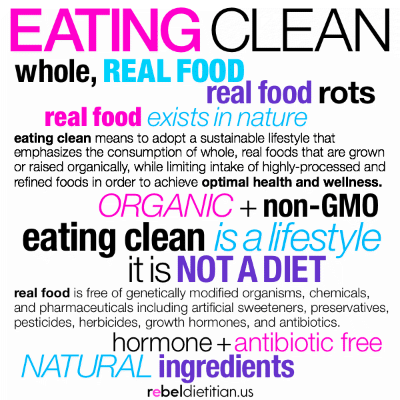
Over the past few months I’ve seen a few friends and colleagues announce that they’ve decided to transform their diet, lose weight, and “eat clean”. When I asked what “clean” food was, no-one seems to have a consistent answer. The most common response was that “eating clean” meant cutting out processed foods. But to others, eating clean meant avoiding meat, anything with GMOs, wheat, and sometimes milk. It seemed to mean something different to everyone. It reminds me a bit of Humpty Dumpty in Through the Looking Glass:
When I use a word,’ Humpty Dumpty said, in rather a scornful tone, ‘it means just what I choose it to mean — neither more nor less.’
Is “eating clean” just a faddish buzzword? There are a number of personalities competing in the “eating clean” dietary space. The pioneer seems to be Tosca Reno, who has the Eat-Clean Diet and about a dozen related books based on the same idea. But she’s not alone, as there are several other books with related names, including Terry Walters with her “Clean Food” books. Success breeds competition, it seems. Given Reno’s book appears to be the most popular, I’ll take her plan as the template. She outlines the principles of how she defines eating clean in her 2007 book. I’ve added my comments after each principle.
Eat 5 or 6 small meals every day. There’s nothing inherently wrong with this approach, but there’s no good evidence to say that it’s necessary. Obesity specialist Yoni Freedhoff notes that while smaller, spaced meals may reduce cravings and hunger, meal spacing is often individualized and shouldn’t be forced into any specific schedule. The best schedule is what works for you.
Eat every 2 to 3 hours. This is somewhat redundant with the above. Eating regularly may reduce the risk of snacking.
Combine lean protein and complex carbs at every meal. Protein promotes satiety, and the requirement to combine it with complex carbohydrates is presumably based on the idea that it will result in more stable blood sugar levels. There’s nothing unorthodox about this advice, but neither has it been shown to be always necessary.
Consume adequate healthy fats each day. This is a reasonable recommendation, and one that’s supported by good evidence. Substituting refined carbohydrates for saturated or trans fats with has either no effect, or a negative effect, on your health. Substituting monounsaturated and polyunsaturated fats for saturated and trans fats helps lower the risk of heart disease, a positive effect. So the advice to consume adequate healthy fats would be better phrased as guidance to substitute healthy fats (mono- and poly-unsaturated) for unhealthy fats (saturated and trans).
Drink at least 2 liters, or 8 cups, of water each day. This is unfounded advice. There’s no persuasive evidence to demonstrate that we need to consume that much water each day. It’s such a pervasive urban myth that there’s even a Snopes page on the statement. Water may be supplied in beverages but also in food. Thirst is an acceptable guide – there’s no reason to force fluid consumption.
Never miss a meal, especially breakfast. Again, this is somewhat redundant with the advice above. While there is some evidence to suggest that regular eating, including breakfast, can help manage hunger, it’s not an absolute rule. Some people don’t like to eat breakfast, and it’s often an individual decision.
Carry a cooler loaded with Eat-Clean foods to get through the day. This is reasonable advice if accessing foods is difficult or expensive. But not always necessary.
Avoid all over-processed, refined foods, especially white flour and sugar. Here’s where we finally get into some specific dietary advice. This is largely reasonable, as heavily processed foods tend to be higher in salt and calories, and may also be less nutritious. There is very little scientific debate that whole grain products are superior to those that contain mainly white flour, which is missing the most nutritious parts of the grain. There’s also good evidence to suggest many people obtain an excessive number of calories from sugar, and from refined carbohydrates in general. However, advising that all white flour and sugar be avoided is very difficult, and there’s no reason they cannot be consumed in moderation. What matters is the overall caloric balance.
Avoid chemicals, preservatives, and artificial sugar. This simply the fallacy of appeal to nature. It’s not possible to avoid “chemicals” in your diet; chemicals ARE your diet. The same can be said for preservatives. Salt is a preservative. Added ingredients need to be evaluated on their own merits, not avoided wholesale. The same can be said for artificial sweeteners. Reno demonizes sugar substitutes claiming they “work against you just as much as white sugar does.” Yet there is no persuasive evidence to demonstrate that artificial sweeteners are harmful, or will compromise dietary goals. The same cannot be said for sugar.
Avoid saturated and trans fats. There is no good evidence to suggest that a high fat intake is inherently harmful so long as overall calorie intake is reasonable, or that total amount of fat in one’s diet must be limited. However, as noted above, the types of fats matter. Avoiding saturated fats completely is difficult and probably inadvisable as many sources of healthy fats will usually contain some saturated fat (e.g., fish, nuts). Trans fats from prepared foods, however, should be avoided, as there’s good evidence to suggest that their consumption is associated with negative health outcomes.
Avoid sugar-loaded colas and juices. Reno’s advice here is consistent with most dietary advice that identified colas and juices as low-nutritive, high-calorie beverages. Beverages can be a significant source of calories. In these circumstances, minimizing their consumption is probably warranted. While most liquid calories are treated the same as colas and juices, these two categories are commonly consumed and represent easily modifiable changes in one’s diet. However, Reno also says products like honey and maple syrup are acceptable substitutes for sugar when used in moderation, ignoring the fact that calories are calories, and these substitutes differ little from sucrose from a nutritional perspective.
Consume adequate healthy fats (EFAs) each day. This advice is largely sound. Essential fatty acids (EFAs) are “essential” because they cannot be synthesized by the body. Polyunsaturated fatty acids like eicosapentaenoic acid (EPA) and docosahexaenoic acid (DHA) are healthy fats are associated in prospective and observational studies with a number of cardiovascular (and other) benefits. Fatty fish consumption (e.g., salmon) at least twice per week is the usual recommendation for those without known disease, with supplements only when justified in those that don’t eat fish. Daily consumption, however, hasn’t been established as necessary.
Avoid alcohol-another form of sugar. While alcohol can be a source of calories, and contains no nutritional benefits, the health effects of alcohol are mixed. Alcohol may reduce the risk of cardiovascular disease, while raising cancer risks slightly. For many, alcohol can be consumed in moderation without any expected significant health effects.
Avoid all calorie-dense foods that contain little or no nutritional value. This is a general statement that speaks to caloric and nutrient density. On balance we want to maximize the nutrition within a given amount of food consumed. But while intuitively appealing, studies don’t show a strong relationship between caloric density and weight. It may be that we increase overall consumption in response to deliberately cutting calorie density. Whether these types of foods need to be avoided completely hasn’t been established – it’s a restrictive rule, and it’s probably better to consider the consumption of these products in the context of the overall diet. Forbidding “treat” foods entirely may be more difficult to manage than accommodating them within daily or weekly eating plans.
Depend on fresh fruits and vegetables for fiber, vitamins, and enzymes. Fruits and vegetables are good sources of nutrients, fiber and vitamins, but so are other foods, such as grains. Insisting on “fresh” produce is unnecessarily restrictive, as frozen or canned versions can offer the same nutritional benefits. Enzymes are large proteins that act as catalysts for biochemical reactions throughout the body – but our body produces what we need, and digests the ones we consume.
Stick to proper portion sizes-give up the super sizing! This is also reasonable advice. Portions sizes, particularly in restaurants, have grown over time. While Reno doesn’t mention calories, they’re the fundamental energy unit of diet.
The good
Reno’s plan emphasizes whole grains, lean cuts of meat, healthy fats and lots of fruits and vegetables. No classes of foods are completely banned, and the plan promotes an overall balanced diet of grains, fruits, vegetables, fats, and protein. Consequently, I can see the program being easier to maintain for some people than diets that advocate dramatic shifts in habits (e.g., Atkins and paleo). The recipes she promotes look nutritious and some look quite tasty. Depending on your current diet, following the principles may significantly improve your dietary habits, and help you break established bad habits. Like most diet plans, exercise is encouraged, particularly weights, which is a good recommendation.
The bad
Reno is a certified Nutritional Therapy Practitioner (NTP), an accreditation offered by the Nutritional Therapy Association. The NTP certificate program’s required reading include books on detoxing and adrenal fatigue (a non-existent condition). This non-science-based background is evident in Reno’s recommendations. Much of her advice is based on anecdotes, not science:
She says that calories don’t matter. She’s wrong.
We now realize that different foods react in different ways in our body. Whereas we may lose weight on 2000 calories per day of Clean food we may gain weight on 1600 calories per day of junk. Many, many people have messed up their metabolisms by worrying too much about calories and not enough about just getting good nutrition regularly throughout the day.
Tell that to Mark Haub, who lost 27 pounds eating only Twinkies. Calories matter, no matter how you spin it. If you eat excessive amounts of the foods she recommends, you will gain weight, just as sure as a consistent calorie deficit will cause weight loss. While some of the recommended approaches (small, spaced meals, each with protein) may help with satiety, they are no guarantee that you’ll lose weight by eating clean (if that is your goal).
Even more questionable is the advice to take supplements and even drug treatments, with recommendations (depending on the book) ranging from human growth hormone, to bee pollen, wheat germ, L-carnitine, vitamin K, turmeric, green tea extract, and raw apple cider vinegar. No references are provided to substantiate claims of benefit that range from burning fat to improving abdominal definition. She recommends “natural” hormones such as pregnenolone for “memory”, and states that bioidentical hormones are a safe natural alternative for hormone replacement. They’re not.
Reno advocates “detoxing” and believes it has an effect on your body’s pH, reducing acidity which she attributes to be a cause of disease.
Eliminating all processed foods is something that Reno emphasizes repeatedly. This may be very difficult to do, and the incremental benefits are unclear. Eliminating frozen meals is one matter, making your own condiments and crackers is something entirely different. It’s not necessary to eliminate all processed foods to benefit from the best elements of the eating plan.
Other “eat clean” advice
Several other authors and personalities that advocate some form of “eat clean” use the same formula as Reno: Combine some reasonable dietary advice and recipes using unprocessed foods with bizarre statements and suggestions that reflect a strong appeal to nature fallacy and a lack of basic science knowledge. Terry Walters has some nice recipes in her Clean Food cookbook, but also suggests you chew your food well “to avoid putting stress on your digestive organs.” She calls aluminum “a known carcinogen” and says to avoid it, as well as plastic and Teflon. She believes that some foods make the body acidic and recommends cooking them with minerals (e.g., sea salt) to “neutralize this effect”. She also attributes specific effects to specific foods (“Dark leafy greens lift our mood, heal our organs, and counteract the damage resulting from out stressful lives.” Root vegetables “help us feel longer and ‘rooted'”. Squash is “blood -alkalinizing”. And so on.) She argues organic food is “cleaner” and believes that organic foods are grown without the use of pesticides or herbicides (wrong).
Conclusion: Clean eating is marketing, not science
Categorizing foods as or diets as “clean” is clearly a successful marketing strategy, but is less useful when it comes to daily decision-making about good nutrition. Some of the concepts that underlie “eating clean” are supported by good scientific evidence. But the “eating clean” philosophy is imbued with a considerable amount of pseudoscience and a large amount of the naturalistic fallacy. Calories matter, and supplements probably don’t. For that reason, I would not recommend any of the “Eat Clean” and related books. There are too many inaccuracies to compensate for the good advice buried within. Dietary design needs to be based on good evidence, not anecdotes and logical fallacies.